
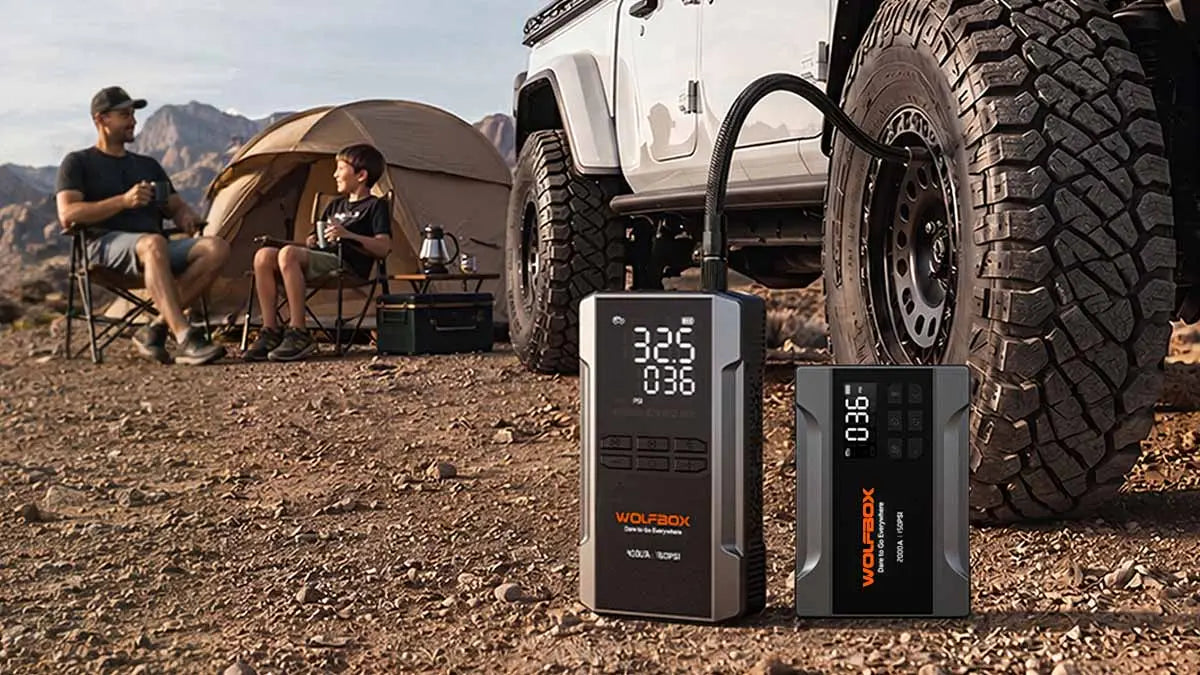
Search for this question, and you will find confident answers ranging from "two" to "dozens", which tells you something already. Nobody can give you one number that holds for everyone, because the count depends on the unit, the tires and how low they were to begin with. What you can get is a clear picture of what drives the number, what manufacturers claim, and a five-minute test that tells you the real figure for your own setup.
That last part matters more than any claim on a box. If you have a jump starter with air compressor, knowing how many tires it will fill, and how much it needs to keep back for starting an engine, is the difference between a handy gadget and a plan you can rely on.
How Many Tires Can the MegaVolt 10Air and 24Air Inflate?
The WOLFBOX 4-in-1 jump starters combine jump-starting power with a built-in air compressor, making them practical for roadside emergencies and everyday tire maintenance. The MegaVolt 10Air and MegaVolt 24Air offer different battery capacities and inflation capabilities to suit different needs.
|
Model |
Battery |
Jump Starts per Full Charge |
Inflation Performance |
|---|---|---|---|
|
MegaVolt 10Air |
37 Wh |
Up to 30 |
Up to 27 sedan tires, 139 motorcycle tires or 6 off-road tires |
|
MegaVolt 24Air |
88.8 Wh |
Up to 40 |
Inflation times vary by tire size and pressure (see below) |
The WOLFBOX MegaVolt 10Air is designed for convenient tire inflation and emergency jump-starting. On a full charge, it can inflate up to 27 sedan tires, 139 motorcycle tires or 6 off-road tires. Actual results may vary depending on tire size, starting pressure, battery charge and inflation conditions.
For drivers who need greater battery capacity, the WOLFBOX MegaVolt 24Air features an 88.8 Wh battery and delivers efficient inflation across different vehicle types. It can inflate a 195/65R15 car tire from 30 to 36 PSI in approximately 39 seconds, a 275/75R17 SUV tire in around 1 minute 40 seconds, and a 37x12.5R17 pickup tire from 35 to 40 PSI in approximately 1 minute 50 seconds.
With more than twice the battery capacity of the 10Air, the MegaVolt 24Air is a practical choice for drivers who need longer operation and more demanding inflation tasks. Actual inflation performance will depend on tire specifications and operating conditions.
What Actually Decides the Number
Think of the battery as a fuel tank and each inflation as a trip. Several things change how far one tank goes.
How many PSI you add. Topping a tire up by 3 PSI takes a few seconds. Filling one from 15 to 35 takes much longer and uses far more energy. A set of four tires each 2 PSI low costs a fraction of one tire pumped up from near flat.
Tire size. A bigger tire holds more air at the same pressure, so it takes more pumping per PSI. The 24Air's own times show it: the SUV tire and the pickup tire each take several times as long as the compact car tire.
Target pressure. Light trucks and some SUVs run higher pressures than small cars, and every extra PSI is extra work for the compressor.
Battery condition. A pack that is fully charged and fairly new delivers more than one that is half empty or several years old. Lithium capacity fades with age, so a unit that managed six tires when new may manage fewer later.
Temperature. Cold reduces what a lithium battery can deliver, so winter morning inflation drains the unit faster than the same job on a mild afternoon.
Stops and starts. Each time you reconnect the hose, you lose a little air from the line and the tire. Neat, continuous inflating wastes less than constant fiddling.
Find Your Own Number With a One-Tire Test
The most reliable answer comes from your unit and your tires. It takes about as long as one inflation.
- Charge the unit fully and note the percentage on its display.
- Check each tire with a separate gauge and write down the starting pressures. Do this when the tires are cold. The National Highway Traffic Safety Administration defines cold as the car not having been driven for at least three hours.
- Inflate one tire to the placard pressure on the driver's door jamb, then look at the battery percentage again.
- Divide the percentage you used by the PSI you added. That gives you a rough cost per PSI for that tire size.
Here is an invented example to show the arithmetic, not a real measurement. Say the display drops from 100 to 94% after you add 8 PSI to one tire. That is about 0.75% per PSI. Four tires that each need 4 PSI would use about 12% in total. If another tire is much lower, scale it up. You will quickly build a feel for it.
Repeat the test on a different tire size if your household has more than one vehicle, or on a spare. Different tires cost different amounts, so one test will not describe all of them.
Leave Charge for the Job You Bought It For
Here is where many people get caught. The same battery that inflates your tires also has to crank an engine. If you spend most of it on a roadside top-up and then discover the car battery is dead, you have nothing left.
Our troubleshooting guide for a jump starter that fails to crank an engine suggests checking for at least about 50% charge first. That is a sensible floor to keep in mind. Treat anything above 50% as spendable on tires, and anything below as reserved for starting. So the practical tire count is the number you can inflate before the display falls to about half, not before it falls to empty.
Larger engines and cold mornings call for more reserve. Our guide on how many amps to jump start a car explains how engine size and temperature change the current needed. If your car is a diesel or you live somewhere that gets properly cold, keep your floor higher than half.
Top-Ups Are Cheap, Flat Tires Are Not
In daily use, most of what a jump starter inflator does is small. Tires lose pressure slowly over time. Our tire maintenance article puts the loss at roughly 1 PSI a month, with about 1 PSI more for each 10°F the temperature falls, which matches the usual rule of thumb. A monthly check, as NHTSA recommends, usually means adding a few PSI to each tire. That kind of work takes seconds per tire and costs the unit very little.
Seen that way, a unit that can inflate a handful of tires on one charge covers a lot of ordinary use. By that logic, a family with two cars could top up all eight tires in a single session without much trouble. The heavy draw comes with the unusual jobs: a tire that has dropped to 10 or 15 PSI, a large truck tire, or inflating pool toys and sports gear afterward.
For more on tire care between those jobs, see our tire maintenance tips.
Recharge After Inflating, Not Just After Jumping
People tend to recharge a jump starter after it starts a car and forget about it after inflating. Pumping uses real energy, and a unit left at 60% after a tire session has less in reserve than you think. Our guide on how to charge a jump starter properly recommends recharging right after any use, and it is a good rule to follow for inflation as well. The step-by-step process for how to use a jump starter with air compressor also fits neatly into a monthly routine.
Picking a Unit Based on the Tires You Own
Match the unit to the work you expect it to do.
For small cars, motorcycles and bikes, a compact 2000A unit with a modest battery is usually enough. Its tire-count claims are the best fit for light, frequent top-ups. For SUVs, pickups and anyone who carries a trailer or travels far from help, a larger battery gives you more margin for both inflation and starting.
If you are still deciding whether you need the compressor at all, the comparison of a jump starter vs a jump starter with an air compressor covers weight, cost and roadside scenarios. For a closer look at one of the units discussed here, there is also a detailed Wolfbox jump starter review of the 10Air. Full specifications for both the 24Air and the 10Air are on the product pages linked earlier in this article.


Frequently Asked Questions
Can I inflate tires and still jump start a car on the same charge?
Yes, as long as you keep enough in reserve. Aim to keep the battery above roughly 50 percent after inflating, and recharge before the unit goes back into storage.
Does a bigger battery always inflate more tires?
Generally, a larger battery stores more energy, so it can do more work. The compressor matters too, since a more efficient pump uses less energy for the same job. That is why the published times on a product page are worth reading alongside the battery size.
How many motorcycle or bicycle tires can I fill?
Small tires need very little air. The WOLFBOX MegaVolt 10Air can inflate up to 139 motorcycle tires per full charge. Actual results may vary depending on tire size, starting pressure, and inflation conditions.
Does cold weather change how many tires I can inflate?
Yes. Cold reduces what a lithium battery can deliver and also lowers tire pressure, so you need more air in less favorable conditions. Keep the unit warm before use when you can.
How do I know when to recharge?
Recharge after every session that used a noticeable amount of charge, and check the level every month or two even if you did not use it. If the display is near or below about half, charge it before you need it.


Leave a comment
All comments are moderated before being published.
This site is protected by hCaptcha and the hCaptcha Privacy Policy and Terms of Service apply.