
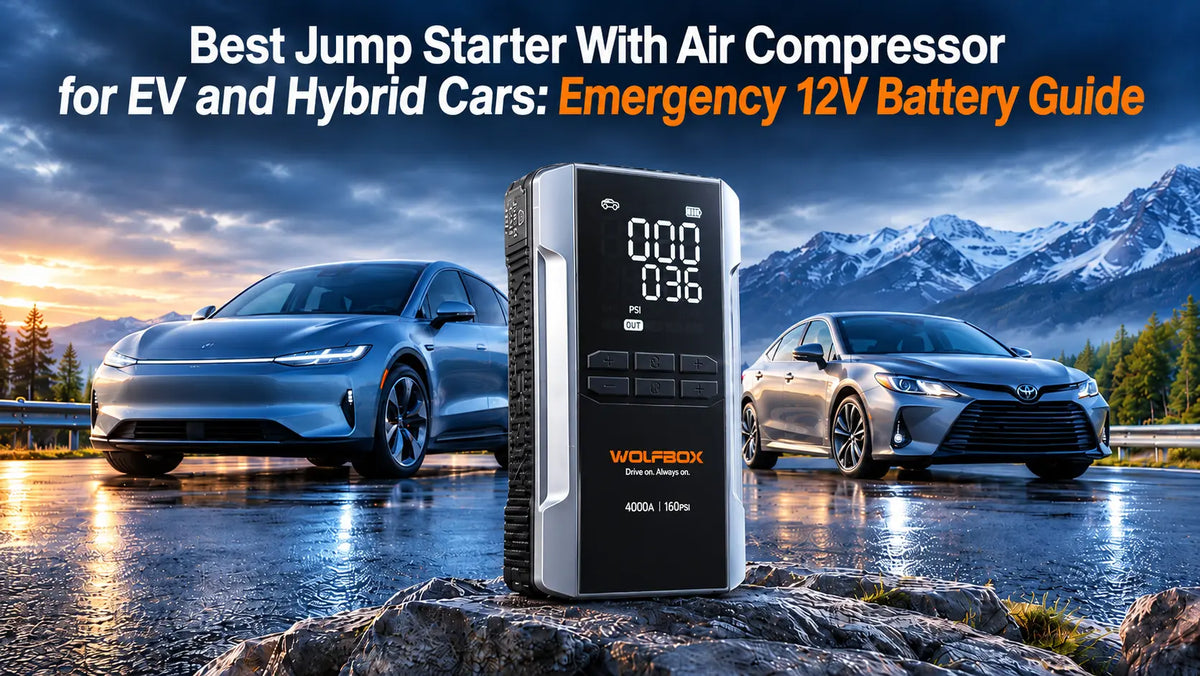
Your electric car has a second battery that most owners forget about: the 12V auxiliary. When it dies — and it dies more often than most EV owners expect — the car may not close its high-voltage contactors at all, so the vehicle stays dead even with a fully charged traction battery. A portable lithium jump starter is the fastest self-rescue option for this situation, and models with a built-in tire inflator also cover flat tires at the same time. Roadside assistance or a jump from another car works too, but both require someone else to turn up. This guide explains why EV and hybrid 12V batteries fail, how to bring one back safely, and which WOLFBOX jump starter with air compressor best fits your vehicle and driving habits.[4][6]
The Short Answer
The WOLFBOX MegaVolt 24Air is the best jump starter for EV and hybrid owners in 2026 — 4,000A peak current covers 12V vehicles with up to 10L gasoline or 6L diesel engines, the 160 PSI automatic tire inflator handles a flat without waiting for roadside assistance, and the IP64 rating means it is dust-tight and protected against splashing water at the roadside.[4] Two more models cover lower price points: the MegaVolt16 Air at $179.40 (3,000A, up to 8L gasoline or 6L diesel, 160 PSI) and the compact MegaVolt 10Air at $133.32 (2,000A, up to 5L gasoline or 3L diesel, 150 PSI).[5][6] All three include LED emergency lights and weigh between 1.8 and 3.43 lb. USB-C power-bank duty is not the same across the range: the 24Air and 16Air have PD 65W USB-C in/out plus 18W USB-A, while the 10Air's USB-C port is input-only at 15W and its only output is USB-A 12W — it cannot charge a laptop over USB-C.[4][5][6]
Why EVs and Hybrids Have a 12V Battery Problem
It seems counterintuitive. An EV carries a 60 kWh or larger traction battery that can propel the car 300 miles — so why would it ever need a jump start? The answer lies in how EVs and hybrids manage their low-voltage electrical systems.[1]
Every electric and hybrid vehicle has two separate electrical systems. The high-voltage system — 400V or 800V on mainstream battery-electric models, while 48V mild-hybrid systems run a much lower-voltage architecture — powers the drive motor, climate compressor, and onboard charger. The 12V system powers everything else: door locks, infotainment, interior lights, window motors, and — critically — the contactors that physically connect the high-voltage battery to the rest of the car. If the 12V battery is too weak to close those contactors, the traction battery cannot deliver power, regardless of its state of charge.[1]
Unlike a gasoline car with an alternator that recharges the 12V battery whenever the engine runs, an EV tops up its auxiliary battery through a DC-DC converter that steps high-voltage power down to 12V. The converter only runs when the vehicle is on or actively charging, so anything that stays awake while the car is parked draws its current straight out of the 12V battery.[1]
A 2026 analysis of Tesla 12V battery issues documented batteries draining to 10V after parking, with parasitic loads and DC-DC charging logic gaps cited as primary causes.[2] The problem is not limited to Tesla — it affects every EV and hybrid on the market. Common triggers include:
- Sentry mode or dash-cam recording keeping cameras and computers awake for hours — AutoPlug notes that Sentry Mode "can significantly increase drain" while the car sits parked[2]
- Short trips where the DC-DC converter never runs long enough to fully recharge the 12V
- Cold weather reducing battery capacity and increasing internal resistance
- OTA software updates keeping modules awake and increasing parasitic draw
- Aged 12V batteries losing capacity past their service life — roughly 3–5 years for a conventional lead-acid battery and 5–7 years for AGM, according to RACV[3]
When this happens, the vehicle may not start: no lights, no screens, no response to the key fob. A portable lithium jump starter kept in the car brings the 12V circuit back in a couple of minutes.[4][5][6]
Top Jump Starters for EV and Hybrid Cars
WOLFBOX currently sells three jump starters with integrated air compressors: the MegaVolt 24Air, the MegaVolt16 Air, and the MegaVolt 10Air. All three suit EV and hybrid 12V auxiliary batteries, and they differ by peak current, battery capacity, inflator pressure and price.[4][5][6]
1. WOLFBOX MegaVolt 24Air — Best Overall for EV and Hybrid Owners
The MegaVolt 24Air is the most complete roadside emergency tool in WOLFBOX's lineup. Its 4,000A peak current covers 12V vehicles with up to 10L gasoline or 6L diesel engines — from a compact hybrid sedan through mid-size gasoline pickups and SUVs, though not the 6.7L-class heavy-duty diesel pickups that sit above WOLFBOX's 6L diesel rating.[4]
The 24,000mAh (88.8Wh) lithium battery delivers up to 40 jump starts of a 12V 3.0L gasoline engine per charge. A PD 65W bidirectional USB-C port recharges the unit in 1.5–2 hours and also charges laptops, tablets, and phones. The 160 PSI air compressor inflates a standard car tire from 30 to 36 PSI in 39 seconds with auto-stop at the preset pressure, and a 400-lumen LED light with strobe and SOS modes provides roadside visibility at night.[4]
For EV owners specifically, the IP64 rating matters at the roadside: it means the unit is dust-tight and protected against splashing water, which covers wet weather and dirty verges, though it is not a guarantee of operation in sustained heavy rain or snow. Cold weather is one of the most common triggers of 12V failure, because it cuts battery capacity and raises internal resistance.[3] The included EVA carrying case keeps the unit protected in the trunk or frunk alongside charging cables. WOLFBOX backs the MegaVolt 24Air with a 24-month warranty; orders placed on wolfbox.com automatically add 6 months for a 30-month total. An optional extra 12 months is a paid extension sold separately.[4][8]
2. WOLFBOX MegaVolt16 Air — Best Mid-Range Choice
The MegaVolt16 Air sits between the other two on both power and price. Its 3,000A peak current covers 12V vehicles with up to 8L gasoline or 6L diesel engines, and its 160 PSI inflator matches the 24Air's 45 L/min airflow. The 16,000mAh (59.2Wh) battery is rated for up to 30 jump starts of a 12V 3.0L gasoline engine, and it recharges in 1–1.5 hours over PD 65W USB-C, which also charges laptops and tablets; USB-A output is 18W. A 400-lumen LED covers SOS, strobe and high-beam modes, the unit is rated IP64 and weighs 3.12 lb in its EVA carrying case.[5]
It costs less than the 24Air. The trade-off is 1,000A of peak current, about 8,000mAh of battery reserve, and support for smaller engines — fine for a two-car household with an EV plus a mid-size gasoline SUV, less so if you also tow with a diesel truck.[5]
3. WOLFBOX MegaVolt 10Air — Best Value for Hybrid and Compact EV Owners
The MegaVolt 10Air packs jump-starting and tire inflation into a smaller, lighter package at $133.32. Its 2,000A peak current covers 12V vehicles with up to 5L gasoline or 3L diesel engines — enough for the compact 12V auxiliary batteries in a Toyota Prius, Honda Insight, Hyundai Ioniq or similar hybrid and compact EV. What matters here is not cranking current but whether the 12V circuit can wake the ECUs and pull in the high-voltage contactors, which draws far less than turning over a gasoline engine.[6]
The 150 PSI air compressor inflates a 195/65 R15 tire from 29 to 36 PSI in approximately 60 seconds across five preset modes (car, motorcycle, bicycle, ball, custom), with at least 25 L/min airflow. A 200-lumen LED light covers three modes.[6]
The WOLFBOX 10Air features UL, FCC, CE, and CA65 compliance, side vents for heat dissipation, and 10 built-in safety protections for reliable operation.[6]
For a single-car household with one hybrid or compact EV, the MegaVolt 10Air provides complete roadside coverage at roughly the cost of a single tow truck call.[6]
MegaVolt 24Air vs MegaVolt16 Air vs MegaVolt 10Air: Specs at a Glance
|
Specification |
MegaVolt 24Air[4] |
MegaVolt16 Air[5] |
MegaVolt 10Air[6] |
|---|---|---|---|
|
Peak current |
4,000A |
3,000A |
2,000A |
|
Engine support |
Up to 10L gas / 6L diesel |
Up to 8L gas / 6L diesel |
Up to 5L gas / 3L diesel |
|
Battery |
24,000mAh / 88.8Wh |
16,000mAh / 59.2Wh |
10,000mAh / 37Wh |
|
Jump starts per charge (12V 3.0L gas) |
Up to 40 |
Up to 30 |
20–30 |
|
Air compressor |
160 PSI, 45 L/min |
160 PSI, 45 L/min |
150 PSI, ≥25 L/min |
|
Tire inflation |
195/65R15 30→36 PSI in 39s |
- |
195/65R15 29→36 PSI in ~60s |
|
USB charging |
PD 65W USB-C in/out, 18W USB-A |
PD 65W USB-C in/out, 18W USB-A |
15W USB-C in only, 12W USB-A out |
|
Charging time |
1.5–2 h |
1–1.5 h |
≤3.5 h |
|
LED light |
400 lumens, 3-mode |
400 lumens, 3-mode |
200 lumens, 3-mode |
|
IP rating |
IP64 |
IP64 |
IP64 |
|
Weight |
3.43 lb |
3.12 lb |
1.8 lb |
|
Warranty |
30 months |
30 months |
30 months |
How to Jump Start an EV or Hybrid Safely
Jump-starting an EV or hybrid usually involves restoring power to its low-voltage auxiliary battery, not charging its high-voltage traction battery. If the 12V battery is depleted, a compatible external power source may help wake the vehicle's control systems and allow the hybrid or electric drive system to become operational. However, the correct procedure varies by vehicle model and low-voltage battery type.[1][3]
The procedure:
- Locate the 12V battery. In many hybrids it sits in the luggage compartment — on a Toyota RAV4 Hybrid, for example, in a side tray under a panel. In many EVs it is under the front hood or behind a trim panel, and some models provide remote positive and negative jump terminals even when the battery is elsewhere. Check your owner's manual for your own car.[3]
- Connect the jump starter clamps. Red to positive (+), black to negative (−) or an unpainted metal ground point on the chassis. WOLFBOX describes the 24Air as spark-proof; reverse-polarity protection is not documented for either model, so check the clamp orientation before you connect anything.[4][6]
- Power on the jump starter and give the vehicle time to wake up. Do not cut this short: Tesla's own owners manual warns that it "may take several minutes for the touchscreen to wake up" after a jump start. Tesla's Model 3 manual also warns that it "may take several minutes for the touchscreen to wake up" after a jump start, and its lithium-ion low-voltage procedure differs from the lead-acid one: you connect the positive cable to a dedicated jump post under a red cover, and the negative cable to a ground bolt next to the brake fluid reservoir. Follow your own car's manual rather than a generic procedure.[3][10]
- Press the vehicle's start button. On a pure EV or a hybrid in electric mode there is no starter motor to crank: what you are doing is letting the ECUs boot and the high-voltage contactors close. In a hybrid the gasoline engine may then start on its own, which is normal. The "READY" indicator on the dashboard confirms the hybrid or EV drive system is active.[3]
- Disconnect the jump starter once the vehicle is up: black clamp first, then red. Close the battery access panel and the hood.
- Keep the vehicle on for a while. The DC-DC converter needs run time to recharge the 12V battery, so do not switch the car off again immediately after the jump. RACV advises driving 10–20 minutes after a jump start on a conventional car; on an EV, leaving it in the READY/on state lets the DC-DC converter do the same job.[3]
Important: Never use an EV or hybrid to jump-start another vehicle. The 12V auxiliary battery is not designed to deliver the cranking current a gasoline engine requires, and both Tesla and Toyota warn against it in their owner's manuals — attempting it can damage the DC-DC converter or blow a 12V system fuse. Always confirm the procedure in your own vehicle's manual.[3][10]
How to Choose a Jump Starter for Your EV or Hybrid
Match Power to Your Household Fleet
If you only drive one hybrid or EV, 2,000A peak (MegaVolt 10Air) is more than sufficient — the vehicle's electronics draw far less current than a starter motor. If your household also includes a gasoline truck or SUV, 3,000A (MegaVolt16 Air) covers up to 8L gasoline or 6L diesel. If a diesel pickup at the 6L limit is in the driveway, the 4,000A MegaVolt 24Air has the most headroom.[4][5][6]
Air Compressor: Worth It for EV Owners
Many EVs ship without a spare tire, relying instead on a can of sealant and a portable inflator. A jump starter with a built-in compressor consolidates two emergency tools into one device that you are more likely to keep charged and accessible. The MegaVolt 24Air's 160 PSI compressor handles everything from a low car tire to a high-pressure road bike tire.[4]
Battery Capacity and Power Bank Use
The MegaVolt 24Air's 88.8Wh battery provides up to 40 jump starts. As a power bank, assume roughly 85% conversion efficiency, which leaves about 75Wh usable — enough for about one to one and a half full charges of a 50–70Wh laptop, or five to six charges of a 12–15Wh phone.[4][5][6]
Summer heat accelerates 12V battery degradation in every car type. For a broader look at how seasonal temperature swings cause unexpected failures across all vehicles — not just EVs — see WOLFBOX's guide to summer heat and dead car batteries.[9]
Frequently Asked Questions
Can I jump start an EV with a regular jump starter?
Yes, provided the car uses a conventional lead-acid 12V auxiliary battery. Connect to the 12V battery or the jump terminals, power on the jump starter, then press the vehicle's start button. On an EV that wakes the ECUs and lets the high-voltage contactors close — there is no starter motor to crank, and the drive motor is never powered from the jump starter. On a hybrid the gasoline engine may start once the system is up.[1][3]
Will a jump starter damage my EV's electronics?
A compatible 12V jump starter should not damage your EV's electronics when used according to the vehicle manufacturer's instructions. Always use the designated jump-start terminals and follow the correct connection sequence. Never connect a jump starter to the high-voltage traction battery, and check your owner's manual to confirm that external 12V jump-starting is supported.
How often should I check my EV's 12V battery?
Check the 12V battery voltage every 3–4 months, especially before winter. A healthy battery reads around 12.6V at rest. RACV's table puts 12.4V at roughly 75% state of charge, 12.2V at 50% and discharged, 12V at 25%, and 11.9V as effectively dead — anything under 12.4V is considered discharged.[3] Many EVs display 12V battery status in the vehicle settings menu or companion app.
Why does my hybrid's 12V battery keep dying?
Hybrids typically use smaller 12V batteries than conventional cars because they do not need to crank an engine. Combined with continuous parasitic draw from keyless entry and telematics, these smaller batteries drain faster — especially if you drive infrequently or only take short trips. A portable jump starter solves the symptom; replacing a battery that has passed its service life (roughly 3–5 years for lead-acid, 5–7 years for AGM) solves the root cause.[2][3]
Do I need a different jump starter for a hybrid vs a full EV?
Not necessarily. Both hybrids and full EVs may use a low-voltage auxiliary battery, but the battery type and jump-start requirements vary by vehicle. Some use conventional 12V lead-acid batteries, while others use lithium-ion or different low-voltage systems. For example, certain Tesla Model 3 and Model Y vehicles use lithium-ion low-voltage batteries and require a specific jump-start procedure. Always check your owner's manual to confirm the battery type, compatible external power source, and correct connection points before using a jump starter.[3][10]
Is the air compressor feature useful for EV owners?
Yes — especially since many EVs ship without a spare tire. A built-in inflator lets you address a slow leak or low tire pressure immediately without unpacking a separate device. The auto-stop feature prevents over-inflation on all three WOLFBOX models in this guide.[4][5][6]
References
[1] DC/DC Converter for EV/HEV, STMicroelectronics Application Page. https://www.st.com/en/applications/electro-mobility/dc-dc-converter-for-ev-hev.html
[2] Tesla 12V Battery Draining to 10V After Parking: Causes and Fixes, AutoPlug, February 2026. https://autodataplug.com/repairs-fixes/tesla-12v-battery-draining-to-10v-after-parking-causes-and-fixes/
[3] Car Battery Guide: How They Work, When to Replace Them, and How to Jump-Start, RACV RoyalAuto, 2026. https://www.racv.com.au/royalauto/transport/cars/car-battery-guide-how-to-know-if-it-needs-replacing.html
[4] WOLFBOX MegaVolt 24Air Jump Starter with Air Compressor, WOLFBOX Official Product Page. https://wolfbox.com/products/jump-starter-with-air-compressor-tire-inflator-wolfbox-megavolt-24air
[5] WOLFBOX MegaVolt16 Air Portable 4-in-1 Jump Starter with Air Compressor, WOLFBOX Official Product Page. https://wolfbox.com/products/megavolt16-air-portable-all-in-one-air-compressor-with-jumper-starter
[6] WOLFBOX MegaVolt 10Air Jump Starter with Air Compressor, WOLFBOX Official Product Page. https://wolfbox.com/products/wolfbox-2000a-jump-starter-with-air-compressor-wolfbox-megavolt-10air
[7] Jump Starter Collection, WOLFBOX Official Store. https://wolfbox.com/collections/jump-starter-1
[8] Warranty Policy, WOLFBOX. https://wolfbox.com/pages/warranty-policy
[9] Summer Heat and Dead Car Batteries: Why You Need a Portable Jump Starter, WOLFBOX Official Blog (jump-starter). https://wolfbox.com/blogs/jump-starter/summer-heat-and-dead-car-batteries-why-you-need-a-portable-jump-starter
[10] Tesla Model 3 Owner's Manual — "Jump Starting", Tesla, Inc. https://www.tesla.com/ownersmanual/model3/en_us/GUID-3567D5F4-A5F4-4323-8BE0-023D5438FFC6.html




Leave a comment
All comments are moderated before being published.
This site is protected by hCaptcha and the hCaptcha Privacy Policy and Terms of Service apply.