








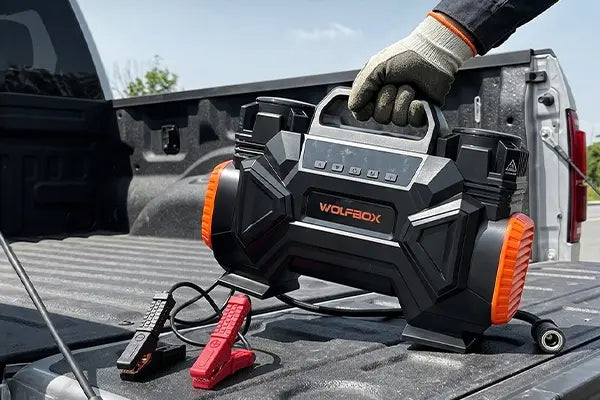
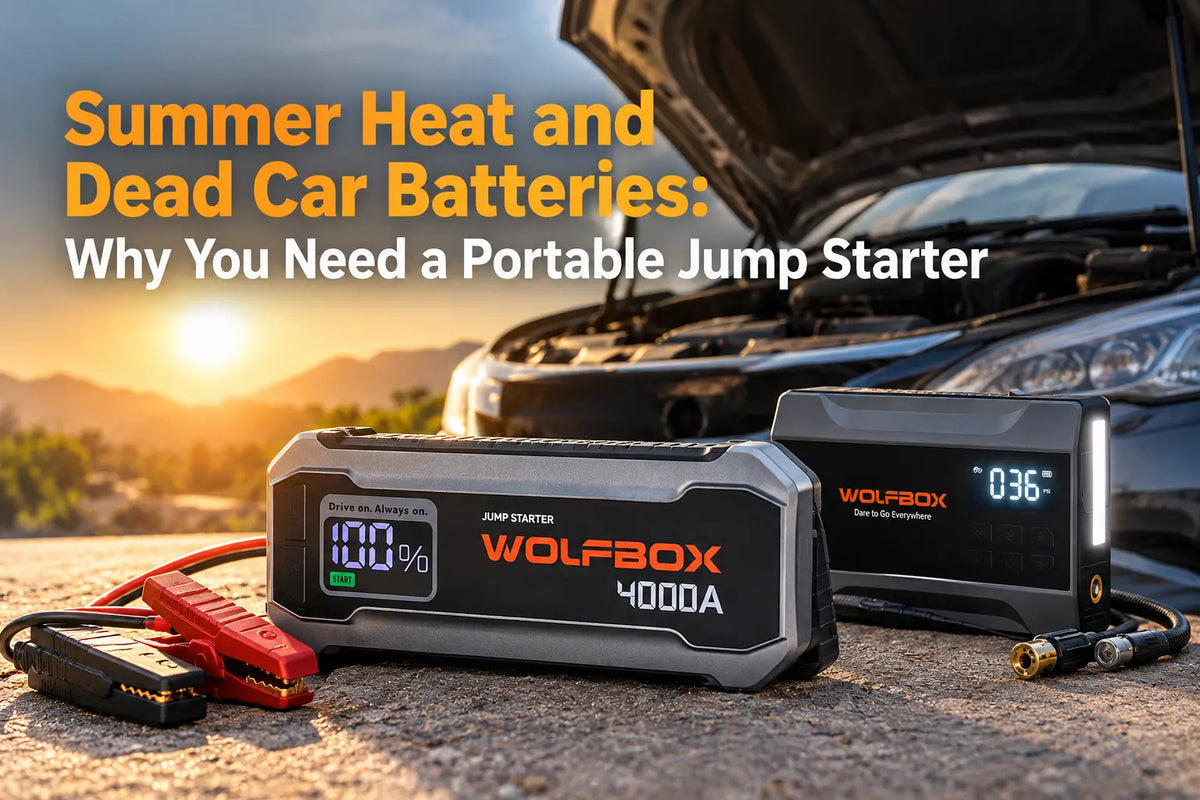
Summer heat kills more car batteries than winter cold does, and most drivers never see it coming until the engine won't turn over in a parking lot. A WOLFBOX MegaVolt24 or WOLFBOX MegaVolt 10Air handles that moment without a second car, a set of jumper cables, or a stranger willing to stop[1][2].
Why Summer Heat Kills Car Batteries Faster Than Winter Cold
Heat, not cold, is the number one cause of battery failure — AAA has said this for years, and the data keeps backing it up. High temperatures evaporate the fluid inside a battery and accelerate corrosion on the internal components, and AAA logged 1.83 million battery-related service calls in the summer of 2024 alone[3].
Location matters too: batteries in the coldest northern parts of the country last 58 months or longer on average, while batteries in the hottest southern regions often fail before 41 months[3]. Running the air conditioner constantly during a heat wave piles on more stress, since it draws harder on the alternator, which in turn works the battery harder every time the engine restarts after a short errand — stop-and-go summer traffic, engine off and on repeatedly, wears a battery down faster than one long, steady highway drive would.
A car that sat through a heat wave with the AC running hard and the alternator working overtime is exactly the kind of car that won't start the next morning. A WOLFBOX MegaVolt24 or WOLFBOX MegaVolt 10Air sitting in the trunk turns that morning into a five-minute delay instead of a tow-truck call.
Why "No Jumper Cables" Actually Matters
Jumper cables sound simple until the actual moment arrives and there's no second car around to use them. Traditional jump-starting needs another running vehicle, positioned close enough for the cables to reach, with an owner willing to stop and wait around for ten minutes — and that's assuming someone actually stops in the first place. A WOLFBOX MegaVolt24 or WOLFBOX MegaVolt 10Air removes that entire dependency — each one is a self-contained battery pack, not a pair of cables that only work if someone else shows up.
Parking garages, driveways at 6 a.m., rural roads with no traffic, a work parking lot on a weekend when the place is empty: all situations where a jumper-cable jump start simply isn't available, and a portable jump starter still works regardless.
What Actually Happens When You Jump-Start With One of These
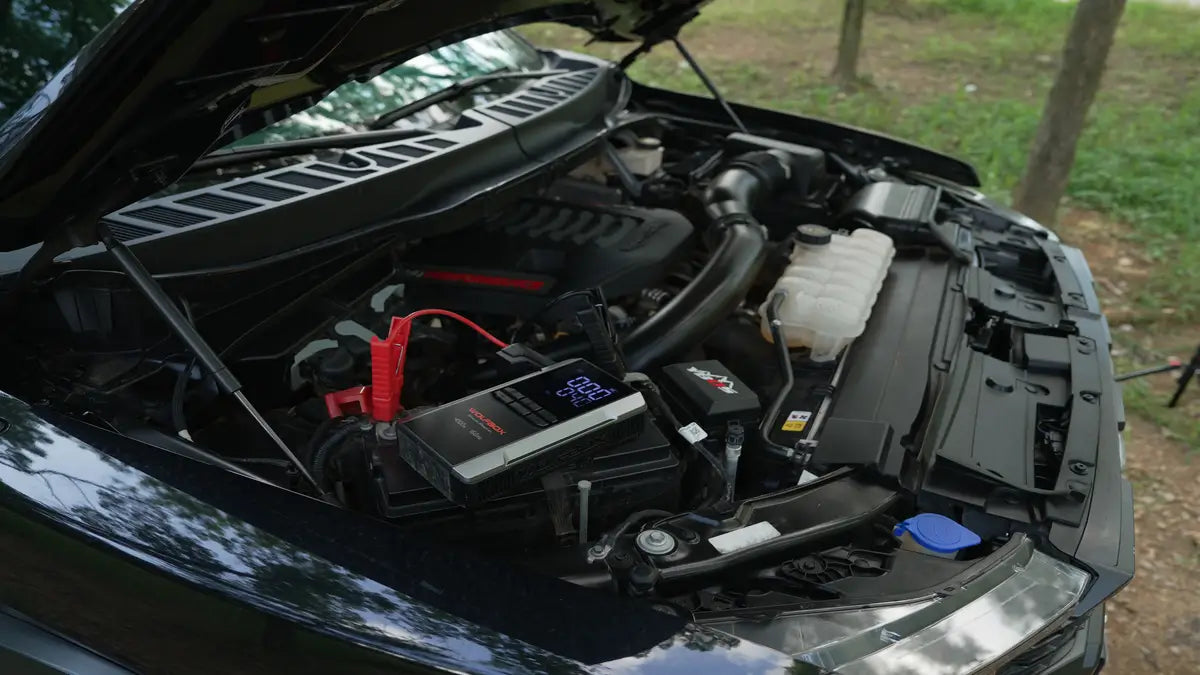
Connecting either unit is more straightforward than it sounds, and that simplicity is the whole point. Both the WOLFBOX MegaVolt24 and WOLFBOX MegaVolt 10Air use color-coded clamps that connect directly to the battery terminals, with an indicator light confirming a correct connection before any current flows.
If the battery is too far gone for a normal connection to register, a boost mode forces a start attempt anyway — a feature built specifically for the kind of battery that's been sitting through a heat wave and given out completely rather than just running low[4]. The whole process, start to finish, typically takes only a few minutes once the clamps are connected — no waiting on a tow truck, no flagging down a stranger.
Preventing the Next Dead Battery — and Backing It Up Anyway
Prevention helps, but it doesn't eliminate the risk entirely, which is exactly why a backup plan still matters. AAA recommends checking battery terminals for corrosion, testing the charging system alongside the battery itself, and avoiding letting a car sit unused for weeks at a time during peak heat[3]. None of that guarantees a battery survives a 100-degree week, though — heat damage builds up gradually and often shows no warning signs until the morning the engine won't turn over.
A WOLFBOX MegaVolt24 or WOLFBOX MegaVolt 10Air is the backup layer for exactly that gap: the maintenance did its job, and the battery still failed anyway, and now there's a plan for that too.
WOLFBOX MegaVolt24 vs. WOLFBOX MegaVolt 10Air
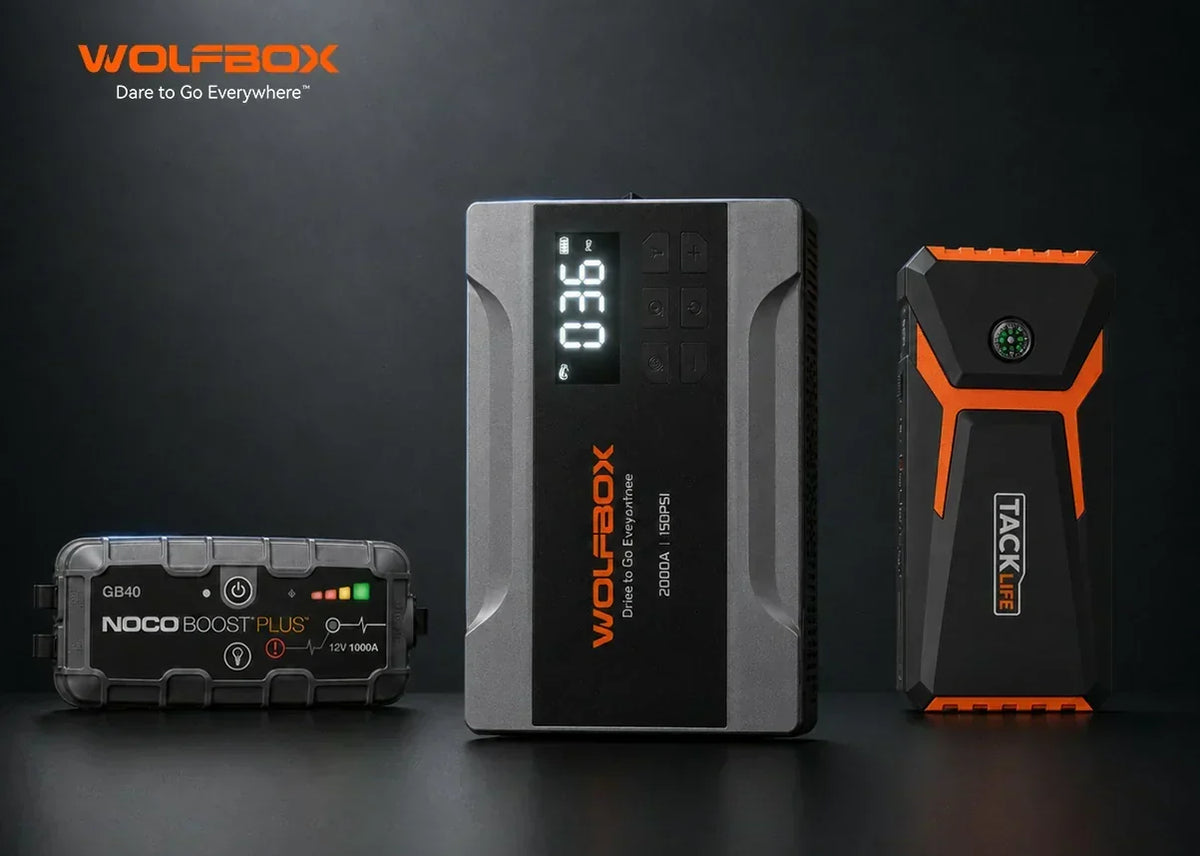
These two units aren't identical, and the difference matters depending on what a driver actually needs beyond a jump start[1][2].
| Spec | MegaVolt24 | MegaVolt 10Air |
|---|---|---|
| Peak current | 4,000A | 2,000A |
| Battery capacity | 24,000mAh / 88.8Wh | 37Wh |
| Engines started | Gas up to 10L, diesel up to 10L | Gas up to 5.0L |
| Tire inflator | None | 150 PSI max |
| USB-C output | 65W PD | 15W in |
| Flashlight | 3-mode: high beam, strobe, SOS | 200 lumens: high beam, strobe, SOS |
| Warranty | 30-month | 30-month |
Source: WOLFBOX official product pages[1][2].
Notice the WOLFBOX MegaVolt24 skips the tire inflator entirely — built as a pure jump starter and power bank, nothing more, nothing to add bulk or cost for a feature some drivers won't use. The WOLFBOX MegaVolt 10Air trades some peak current for that extra inflator function in a smaller package.
Lithium vs. Lead-Acid: The Weight and Charging Difference
Lithium is the battery chemistry inside both units, and it's the reason either one is small enough to actually carry around. Older jump-start packs ran on lead-acid batteries weighing anywhere from 15 to 40 pounds, while a lithium unit typically comes in under 3 pounds[5]. Charging follows the same pattern: a lead-acid jump box can take four to eight hours to recharge, while a lithium unit charging over USB-C is usually done in under two[5].
Lithium also holds its charge in storage far longer than lead-acid does, which matters for gear that might sit untouched in a glovebox for months between uses — a lead-acid pack left alone that long often needs a top-up before it's reliable again, while a lithium unit is generally still ready to go.
That difference is the reason a WOLFBOX MegaVolt24 or WOLFBOX MegaVolt 10Air can live in a glovebox instead of taking up half the trunk, and the reason it's actually realistic to keep one charged and ready rather than forgotten in a garage somewhere.
Real-World Reliability: What Independent Reviewers Say
A spec sheet only means something once a unit actually gets tested outside a lab. One independent review put the WOLFBOX MegaVolt24 through repeated jump-starts on a range of dead batteries and came away calling out the clamp design and boost function specifically for handling severely depleted batteries without a fuss[4].
That kind of hands-on result matters more than a peak-amp number printed on a box, since a jump starter that struggles with a genuinely dead battery isn't much use on the one day it actually gets tested for real. Reliability under those conditions is exactly what a summer heat wave produces — not a mildly weak battery, but one that's fully given out, corroded terminals and all.
A unit that performs well in that worst-case scenario is doing its actual job; a unit that only works on a mostly-fine battery isn't solving the problem this article is about.
Who Should Choose Which
Both units solve the same core problem, but the right pick depends on what else a driver wants the device to do.
Own a full-size truck, SUV, or diesel vehicle and mainly want maximum jump-starting power: the WOLFBOX MegaVolt24's 4,000A rating and 30-month warranty are built for that, without paying for a tire inflator that won't get used.
Want one device that covers a dead battery and a soft tire: the WOLFBOX MegaVolt 10Air adds the inflator function in a smaller, lighter package, trading some peak current for it.
Already carry a full-size air compressor separately and only need backup starting power: either unit works, but the WOLFBOX MegaVolt24 is the lighter, simpler option since the inflator would be redundant.
Frequently Asked Questions
Is summer heat really worse for car batteries than winter cold?
Yes. AAA has confirmed heat causes more battery failures than cold, since high temperatures evaporate battery fluid and speed up internal corrosion[3].
Do I need a WOLFBOX MegaVolt24 or a WOLFBOX MegaVolt 10Air if I already own jumper cables?
Depends on whether a second car is reliably available. Jumper cables only work with another running vehicle nearby, while a WOLFBOX MegaVolt24 or WOLFBOX MegaVolt 10Air works alone, which matters in a driveway at dawn or a parking garage with no one around.
Does the WOLFBOX MegaVolt24 have a tire inflator?
No. The WOLFBOX MegaVolt24 is a jump starter and power bank only — the tire inflator is a WOLFBOX MegaVolt 10Air feature.
How long does it take to recharge either unit?
Under two hours in most cases for either the WOLFBOX MegaVolt24 or WOLFBOX MegaVolt 10Air, thanks to lithium batteries and USB-C charging — a fraction of the four to eight hours a lead-acid jump box typically needs[5].
Can a WOLFBOX MegaVolt24 start a diesel truck?
Yes. The WOLFBOX MegaVolt24 is rated for diesel engines up to 10 liters — the same ceiling as the gasoline rating[1].
Is a portable jump starter worth it if my battery is still fairly new?
Yes, even then. AAA data shows batteries in hot climates fail years earlier than average, so a newer battery isn't a guarantee against a summer heat wave — which is exactly when a WOLFBOX MegaVolt24 or WOLFBOX MegaVolt 10Air earns a spot in the trunk[3].
Does summer heat that kills a car battery also affect the jump starter itself?
Not the same way. Lithium batteries like the ones inside a WOLFBOX MegaVolt24 or WOLFBOX MegaVolt 10Air handle a wide temperature range far better than the lead-acid chemistry inside a car battery, so the heat that stresses a car's battery isn't the same threat to the unit rescuing it.
Can I use a WOLFBOX MegaVolt24 or WOLFBOX MegaVolt 10Air to charge my phone while waiting for a tow truck anyway?
Yes. Both units double as USB power banks, so a phone can stay charged for calls or maps even on the rare occasion the jump start itself doesn't do the trick.
References
[1] WOLFBOX — MegaVolt24 Jump Starter Official Product Page: https://wolfbox.com/products/wolfbox-megavolt24-jump-starter
[2] WOLFBOX — MegaVolt 10Air Official Product Page: https://wolfbox.com/products/2000a-jump-starter-with-air-compressor-wolfbox-megavolt-10air
[3] CTV News / Consumer Reports — How Hot Weather Affects Your Car Battery and What to Do About It: https://ctvnews.ca/business/autos/article/how-hot-weather-affects-your-car-battery-and-what-to-do-about-it
[4] Pro Tool Reviews — WOLFBOX MegaVolt 24 Jump Starter Review: https://protoolreviews.com/wolfbox-megavolt-24-jumpstarter-review
[5] WOLFBOX — The Jump Starter Buying Trap: Why Peak Amps Lie — And What to Measure Instead: https://deals.wolfbox.com/blogs/jump-starter/the-jump-starter-buying-trap-why-peak-amps-lie-and-what-to-measure-instead

Leave a comment
All comments are moderated before being published.
This site is protected by hCaptcha and the hCaptcha Privacy Policy and Terms of Service apply.