









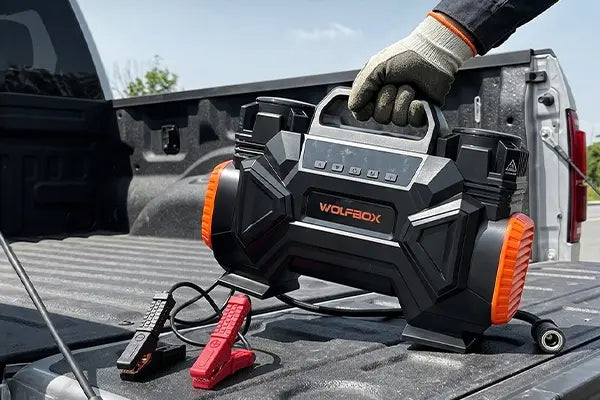

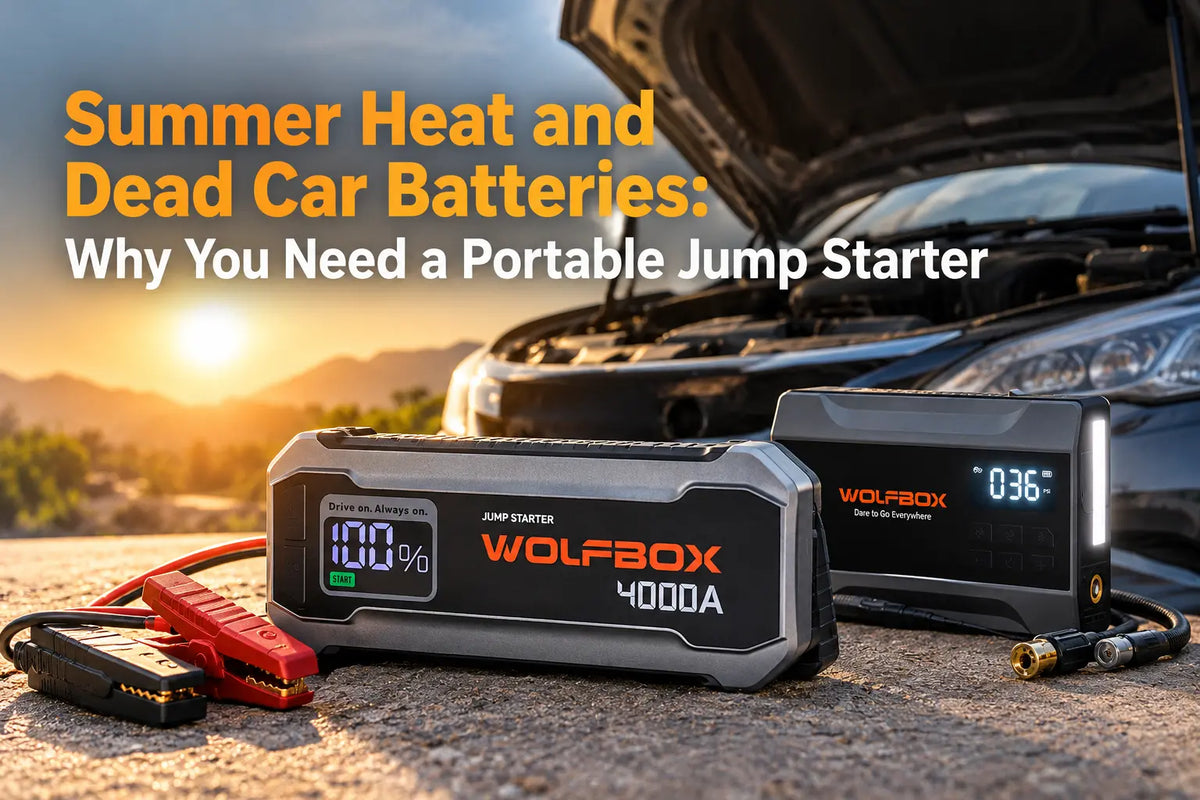
Hurricane season peaks in September, and that's exactly when a dead car battery turns from an inconvenience into a real problem. A car that's been sitting in a driveway for weeks, engine off, accessories quietly draining the battery in the background — that's a car that might not start the moment an evacuation order comes down. A WOLFBOX MegaVolt 24Air solves the part of hurricane prep most kits skip entirely: getting the car itself running when it matters most. [1][2]
Why Hurricane Season Raises the Stakes for a Dead Battery
NOAA marks September 10 as the statistical peak of Atlantic hurricane season — the single most active day for tropical activity, based on decades of storm data. [3] That peak lands right in the middle of a stretch, June through November, when a car might sit parked for days between storms, slowly bleeding charge from its battery the whole time. Add heat. Add humidity. Add a battery that was already a year or two old going into the season. By the time an evacuation order actually comes, a dead battery isn't a hypothetical — it's a real possibility sitting in the driveway. A WOLFBOX MegaVolt 24Air packed in the trunk can provide added peace of mind if a dead battery becomes an issue before or during an evacuation.
What Makes a Jump Starter "Lithium" — and Why That Matters for an Evacuation Kit
Lithium is the battery chemistry, and it's the reason a jump starter can sit untouched for months and still work the moment it's needed. Older jump starters ran on lead-acid batteries — heavy, slow to charge, and prone to losing their charge fast in storage, which makes them a poor fit for gear that's supposed to sit ready in a trunk for an entire hurricane season. A lithium battery holds its charge far longer. The WOLFBOX MegaVolt 24Air's lithium battery has been reported to hold a usable charge for several months in storage — meaning a unit packed into an evacuation kit in June doesn't need to be touched again until a storm actually shows up in October. [4] That's not a small detail. That's the entire point of emergency gear.
WOLFBOX MegaVolt 24Air: Specs That Matter for Emergency Prep
Specs only matter if they translate into something useful during an actual emergency, so here's what the numbers on the WOLFBOX MegaVolt 24Air mean once a storm is on the way.
| Spec | WOLFBOX MegaVolt 24Air | Why it matters for evacuation prep |
|---|---|---|
| Battery | 24,000mAh / 88.8Wh, lithium [1] | Holds a charge in storage for up to two years [4] |
| Peak current | 4,000A [1] | Starts gas engines up to 10L, diesel up to 10L [1] |
| Weight | ~3.5 lbs [5] | Light enough to grab and go, unlike a lead-acid booster pack |
| Tire inflator | 45L/min, 160 PSI max [1] | Fills a sedan tire from 30 to 36 PSI in 39 seconds [5] |
| USB-C output | 65W PD [1] | Charges a phone or laptop when the power's out |
| Flashlight | 400 lumens, SOS/strobe/high beam [1] | Useful during an outage, not just under the hood |
| Rating | IP64 [1] | Dust-tight, splash-resistant — not submersion-proof |
| Operating range | -4°F to 140°F [4] | Works in a hot trunk through storm season |
Source: WOLFBOX official product page [1], independent testing [4][5].
Four Functions, One Device: What's Actually in the Kit
A hurricane kit built from scratch means packing a jump starter, a tire inflator, a power bank, and a flashlight — four separate devices, four chargers, four things that can go missing exactly when you need them. The WOLFBOX MegaVolt 24Air replaces all four with one unit. [2] Dead battery? The jump-start function handles it without flagging down a stranger — which matters more than usual when everyone on the block is trying to evacuate at once. Soft tire from debris on the evacuation route? The inflator tops it off, no trip to a gas station that might already be closed. Phone dying right when you need maps and alerts? The power bank keeps it charged even after the grid goes down. And when the evacuation happens in the dark — because it usually does — there's a flashlight built in too.
Real-World Testing: What Independent Reviewers Found
A spec sheet is one thing. An actual dead battery in the middle of a real situation is another, and that's the test that matters more than any number printed on a box. One Popular Science reviewer ended up using the WOLFBOX MegaVolt 24Air to help a stranger during a 0°F cold snap after the stranger's own battery had failed — hooked up the jump starter, and the engine turned over almost immediately. [4] Cold isn't hurricane weather, obviously. But a unit that performs reliably in that kind of extreme has margin to spare in the heat and humidity that actually come with storm season, and unplanned tests like this one carry more weight than a manufacturer's own claims. Independent tire-inflation testing backs it up too: a sedan tire filled from 30 to 36 PSI in 39 seconds, an SUV tire in under two minutes. [5] That's fast enough to matter when a flat tire is standing between a family and an evacuation route with a closing window.
Two Starting Modes: What Happens When a Battery Is Really Dead
A battery that's been sitting through months of hurricane-season heat isn't just low — sometimes it's dead enough that a normal jump start won't even register a connection. The WOLFBOX MegaVolt 24Air handles that scenario with a dedicated Boost mode: if Standard mode doesn't get a response, holding the Boost button forces a start attempt even on a severely depleted battery. [5] That's the difference between a jump starter that works on paper and one that works on the actual dead battery a family finds when it's time to leave. A full jump-start cycle takes about five minutes, and the WOLFBOX MegaVolt 24Air is rated for up to 40 jump starts on a single charge — enough for more than one vehicle in a household, or more than one bad battery over a single storm season. [5]
Keeping It Charged Before the Storm Hits
Charge level going into a storm is what actually determines whether a WOLFBOX MegaVolt 24Air helps on evacuation day. The WOLFBOX MegaVolt 24Air's 65W USB-C port fully recharges the battery in about two hours. [1] That's a five-minute check and a two-hour wait, done once at the start of hurricane season and again any time the WOLFBOX MegaVolt 24Air gets used — not a chore, just a habit worth building into the same routine as checking flashlight batteries or restocking water. A full charge going into a storm makes all the difference; a drained, forgotten unit doesn't help anyone.
What This Device Won't Do
A WOLFBOX MegaVolt 24Air is not a whole-home backup generator — that's not what this device is for. Starting an engine, filling a tire, charging a phone, lighting up a dark trunk: that's the job. Running a refrigerator, powering a sump pump, keeping the lights on through a multi-day outage at home — that's a different category of equipment entirely, and anyone expecting whole-house backup needs an actual generator or a home battery system instead. A WOLFBOX MegaVolt 24Air covers the vehicle-and-device layer of a hurricane kit: the part where a dead car battery or a dead phone turns evacuation day into a crisis instead of just a stressful drive.
Who Should Add This to Their Kit
Not every driver needs the same emergency gear, but a few situations make a WOLFBOX MegaVolt 24Air worth the trunk space specifically.
Frequently Asked Questions
Is a lithium jump starter actually necessary for hurricane prep, or is that overkill?
Not overkill — necessary. A car that sits through hurricane season without regular driving is exactly the kind of car that develops a dead battery, and a WOLFBOX MegaVolt 24Air solves that specific problem without needing roadside assistance that might not be available during a mass evacuation.
How long can a WOLFBOX MegaVolt 24Air sit in a trunk before it needs a recharge?
Up to two years, based on reported storage testing. The WOLFBOX MegaVolt 24Air's lithium battery holds a usable charge that long, so a unit packed at the start of hurricane season is still ready months later without a mid-season top-up. [4]
Can this replace a home generator during a hurricane power outage?
No. A WOLFBOX MegaVolt 24Air handles vehicle jump-starting, tire inflation, and device charging — not whole-home power, which needs an actual generator or home battery system instead.
Is the WOLFBOX MegaVolt 24Air waterproof enough for flood conditions?
No, not for flood conditions. The WOLFBOX MegaVolt 24Air carries an IP64 rating, which covers dust and splashing water from any direction — not submersion in standing floodwater. [1]
Can a WOLFBOX MegaVolt 24Air jump-start a diesel truck?
Yes. The WOLFBOX MegaVolt 24Air is rated for diesel engines up to 10 liters, in addition to gasoline engines up to 10 liters. [1]
How many jump starts can I get from a WOLFBOX MegaVolt 24Air on one charge?
Up to 40, according to reported testing, with each full jump-start cycle taking about five minutes. That's enough headroom for more than one vehicle or more than one bad battery over the course of a single storm. [5]
What if the car battery is too dead for a normal jump start?
There's a Boost mode for that. Holding the Boost button on the WOLFBOX MegaVolt 24Air forces a start attempt on a severely depleted battery when Standard mode doesn't get a response. [5]
References
[1] WOLFBOX, "4-in-1 Jump Starter with Air Compressor Tire Inflator | MegaVolt 24Air" — Official Product Page
[2] WOLFBOX MegaVolt 24Air — Official Product Page
[3] NOAA, "Tropical Cyclone Climatology" — National Hurricane Center
[4] Popular Science, "I Tested the Wolfbox 4-in-1 Jump Starter With Air Compressor During a Real-World Emergency" — Popular Science Review
[5] Car and Driver, "Best Portable Tire Inflators of 2026, Tested" — Car and Driver Best Inflators


Leave a comment
All comments are moderated before being published.
This site is protected by hCaptcha and the hCaptcha Privacy Policy and Terms of Service apply.