








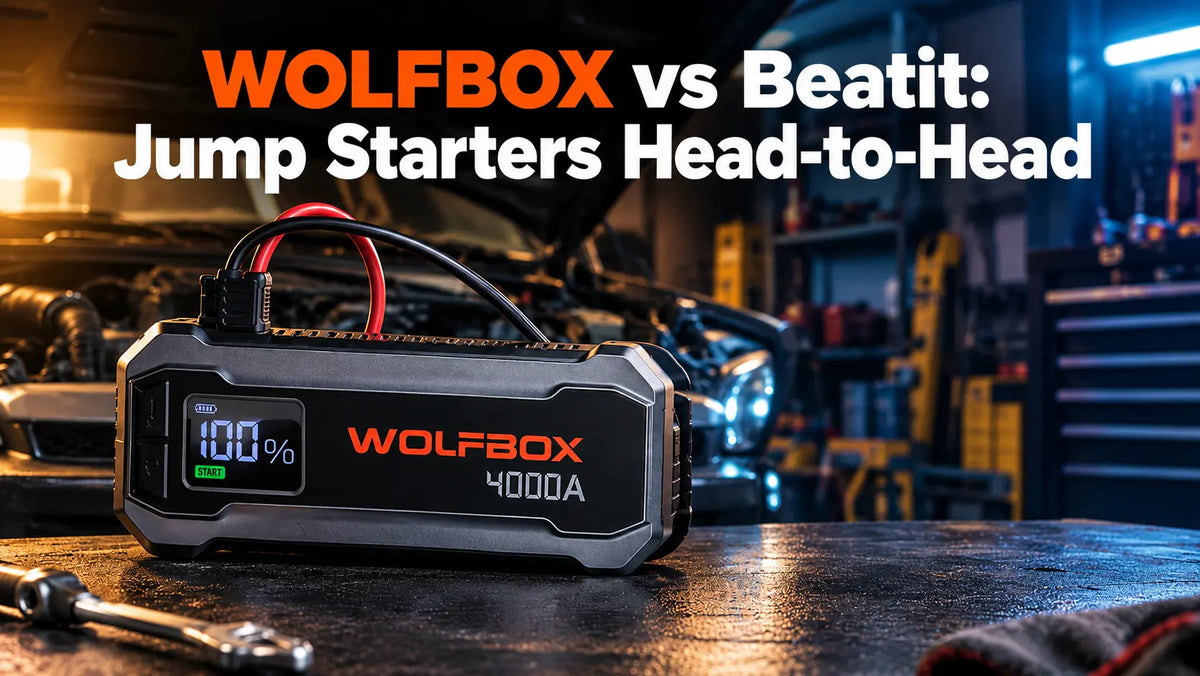
Traditional lead-acid booster packs and long jumper cables are a thing of the past, and compact, high-discharge lithium-ion jump starters are taking over. Modern units are small enough to store in the glove box without massive downsides in terms of how much current they can deliver to turn even larger engines.
In the high-capacity bracket, the WOLFBOX MegaVolt24 and the Beatit G18 QDSP represent two different design philosophies. The Beatit model follows everyday emergency jumping situations and combines them with everyday consumer conveniences. On the other hand, the WOLFBOX is the model you’re going for if you’re looking for an industrial-grade recovery device designed to take a beating.
So, which one of these is better?
WOLFBOX vs Beatit: Technical Specifications Comparison
Both the WOLFBOX MegaVolt24 and the Beatit G18 QDSP are excellent choices on paper, so let’s take a look at the numbers and stats.
|
Feature / Metric |
WOLFBOX MegaVolt24 |
Beatit G18 QDSP |
|---|---|---|
|
Peak Current |
4,000 Amps |
2,000 Amps |
|
Battery Capacity |
24,000 mAh (88.8 Wh) |
21,000 mAh (77.7 Wh) |
|
Max Engine Displacement (Petrol) |
Up to 10.0L |
Up to 8.0L |
|
Max Engine Displacement (Diesel) |
Up to 6.0L |
Up to 8.0L |
|
Consecutive Starts per Charge |
Up to 40 starts |
Up to 30–40 starts |
|
Recharge Input Architecture |
65W Bidirectional USB-C PD (~1.3–2 hrs) |
USB-C/DC (~3–5 hrs) |
|
Auxiliary Output Ports |
65W USB-C PD + 18W USB-A |
Dual USB QC3.0 + 10W Qi Wireless |
|
User Interface / Diagnostics |
Onboard multi-status HD LCD |
Cable-mounted 3-digit voltmeter |
|
Low-Voltage Override |
Yes |
Yes |
|
Enclosure Protection |
IP64 |
Non-rated high-impact ABS plastic |
|
Operating Temperature |
-4°F to 122°F (-20°C to 50°C) operating; -4°F to 140°F (-20°C to 60°C) storage |
Down to -4°F (-20°C) |
Peak Amperage and Sustained Cranking Current
Manufacturers highlight peak amperage on the packaging, but the electrical reality is a bit different. [4] [8] The theoretical discharge is one thing, and the pack can release it in the first milliseconds, but cell resistance and voltage sag can take that number down, especially when you need sustained cranking.
The Beatit G18 utilizes the Quick Discharge Start Power (QDSP) technology, which optimizes the cell balance inside the pack to discharge energy faster. While it can deliver a peak burst of 2,000A, in reality, you’re looking at somewhere between 250A and 400A of sustained cranking current. This is plenty for 4-cylinder or V6 engines found in sedans, hatchbacks, and crossovers, without straining the jump pack.
The WOLFBOX MegaVolt24 doubles the numbers, meaning you get a peak discharge of 4,000A. This extra headroom is essential when dealing with a stubborn engine that won’t start on the first crank. When the battery is drained and the voltage is below 9 volts, this kind of headroom means that this jump pack can keep the voltage at a minimum of 10.5 volts to power the electronics, while still providing enough to crank the engine. [1] [2] [3]
Engine Displacement and Compression
Engine displacement is only one part of the story. Compression ratio and starter motor gear reduction determine the load placed on the power pack.
Gasoline Engines with Lower Compression Ratio
Both the Beatit G18 and WOLFBOX MegaVolt24 can handle most common gasoline engines, with the Beatit model covering larger V8s like the Ford 5.0L Coyote, GM’s 6.2L Vortec or the Ram 5.7L Hemi. The WOLFBOX model expands that to gasoline engines up to 10.0L and diesel engines up to 6.0L, easily covering commercial vans, fleet trucks, and motorhomes. [1] [2] [3]
Diesel Engines with Higher Compression Ratio
Diesel engines have a higher compression ratio, so they can be a challenge for jump boxes. With no spark plugs, the thing that ignites diesel fuel is compression and heat. In addition to that, the glow plugs draw additional current, which can limit a jump pack’s ability to crank.
The Beatit G18 is rated for up to 8.0L diesel engines under normal ambient conditions, however if you have a big V8 that sat for a long time and the weather is cold, this jump pack will struggle and may lead to a thermal cutoff. On paper, the Beatit’s 8.0L diesel rating is the higher of the two: the WOLFBOX MegaVolt24 is rated for diesel engines up to 6.0L. What the MegaVolt24 gives up in rated displacement it makes up for in current headroom. Its 4,000A peak and 88.8Wh pack let it crank a diesel within that 6.0L rating while powering the glow plugs at the same time, without straining itself — and that margin matters most in cold weather, when the glow plugs draw extra current.[1] [2] [3]
Real-World Sub-Zero Performance and Thermal Degradation
Cold weather is the biggest culprit when it comes to starting a vehicle. AAA puts the loss for a standard lead-acid battery at about 35% of its cranking power at 32°F and roughly 60% at 0°F [7]. The problem is worsened by the fact that the engine needs more torque to start with the thicker oil. Lithium batteries suffer the same, as freezing temperatures slow the chemistry, leading to an increase in the internal resistance. [5]
At ambient temperatures of -4°F, neither pack will deliver its rated peak surge, because the lithium cells lose a substantial share of their output as the chemistry slows and internal resistance rises — a lithium pack works against the same physics as the lead-acid figures above, although the exact derating curve for either of these two models isn’t published. What matters for the comparison is the starting point: the Beatit G18 begins from a 2,000A ceiling, so it has less to give before it can no longer spin a larger diesel, while the MegaVolt24 begins from 4,000A and keeps a wider margin in reserve even after the cold takes its cut.[1] [2] [3]
Low-Voltage Override
Modern jump starters use a microprocessor-controlled safety clamp equipped with MOSFET switches. These offer a safety barrier, verifying proper polarity and checking for existing baseline voltage before opening the circuit. With that said, when the battery is fully depleted in a vehicle, the clamps will see no voltage and refuse to charge, which is where the low voltage override comes into play.
The Beatit G18 relies on an override directly on the smart cable module. Activating it forces the relay to close and bypasses the voltage detection circuit. The WOLFBOX MegaVolt24, on the other hand, features a dedicated BOOST button which, if you hold for 2 seconds, will activate forced-output mode. Like with the Beatit model, it bypasses voltage checks and wakes up the vehicle’s electronics.[1] [2] [3]
Field Recharging and Power Delivery
These jump packs are not just about jump-starting a car, and they can also be used as massive power banks. With that said, sometimes you may need to recharge them on the go, so let’s see how both of these do in these situations.
The Beatit G18 features 10W Qi wireless charging on the top housing, making it ideal for phone recharging on road trips, camping or emergencies. As for recharging the unit, you’re looking at 3 to 5 hours from a wall or vehicle outlet. The WOLFBOX MegaVolt24, on the other hand, features 65W bi-directional charging, meaning it can charge a lot more devices than just your phone. This also means that you can fully recharge the internal battery in about 2 hours. [1] [2] [3]
WOLFBOX vs Beatit: Which Jump Starter to Get?
Both the Beatit G18 and the WOLFBOX MegaVolt24 are excellent jump packs, covering different needs, so it’s crucial to make the right choice:
- The Beatit G18 QDSP is best for everyday urban commuters driving hatchbacks, sedans, CUVs, and SUVs, who want an affordable emergency jump starter for small to moderate engine displacement. The integrated wireless charging makes it a practical convenience for keeping your smartphones charged during daily errands or road trips
- The WOLFBOX MegaVolt24 is best for full-size pickup truck owners, high-compression diesel owners, fleet operators, and overlanders. Living in an area with sub-zero temperatures means you’ll want some headroom with the power coming out of the jump starter. You’re also not losing out on creature comforts, as the 65W charger can top off your phones, tablets, and laptops without breaking a sweat [1] [2] [3]
FAQs
Can a Jump Starter Start a Completely Dead Battery?
Yes, both the Beatit G18 and the WOLFBOX MegaVolt24 can jump-start a vehicle with a completely dead battery. They’re equipped with a low voltage override which bypasses the voltage meter, allowing you to crank a vehicle even if the 12V battery is a goner.
Are These Jump Packs Waterproof?
The WOLFBOX MegaVolt24 is rated IP64, meaning it is protected against dust ingress and water splashes, but it is not designed for immersion in water. The Beatit G18 QDSP does not publish an official IP rating on its product page. For users who need an IP-rated jump starter with a built-in air compressor, the WOLFBOX MegaVolt24Air is also rated IP64.
Can I Use a Jump Starter on a Hybrid or EV?
Yes, you can use a jump starter like the Beatit G18 or the WOLFBOX MegaVolt24. They connect to the 12V battery to give it a boost, so their current doesn’t go anywhere near the high-voltage battery, meaning everything is safe. [6]
How Long Can These Jump Starters Hold a Charge When Stored?
The WOLFBOX MegaVolt24 and the Beatit G18 both have low-self-discharge lithium-ion cells which are designed to retain a usable amount of power anywhere between 6 and 12 months when on standby. With that said, extreme weather can accelerate self-discharge, so it’s a good idea to check the battery level and top it off every couple of months.
References
[1] WOLFBOX MegaVolt24 4000A Jump Starter https://wolfbox.com/products/wolfbox-megavolt24-jump-starter
[2] WOLFBOX MegaVolt24 Review https://www.techgearlab.com/reviews/tools/jump-starter/wolfbox-megavolt24
[3] WOLFBOX MegaVolt24 Jump Starter: Get your vehicles started https://techigar.com/wolfbox-megavolt24-jump-starter-get-your-vehicles-started/
[4] The Jump Starter Buying Trap: Why Peak Amps Lie—And What to Measure Instead https://wolfbox.com/blogs/jump-starter/the-jump-starter-buying-trap-why-peak-amps-lie-and-what-to-measure-instead
[5] Cold Weather and Your Car Battery: What Lithium Jump Starters Actually Do in Freezing Temps https://wolfbox.com/blogs/jump-starter/cold-weather-and-your-car-battery-what-lithium-jump-starters-actually-do-in-freezing-temps
[6] The Hybrid and EV Driver's Jump Starter Guide: What's Different and What Still Works https://wolfbox.com/blogs/jump-starter/the-hybrid-and-ev-drivers-jump-starter-guide-whats-different-and-what-still-works
[7] Cold Weather Can Be Unkind to Battery https://www.ace.aaa.com/travel/eastcentral/motorists/cold-weather-can-be-unkind-to-battery.html
[8] The 7 Best Portable Jump Starters to Bring Your Vehicle Back to Life https://www.popularmechanics.com/cars/a38293716/best-portable-jump-starters/


Leave a comment
All comments are moderated before being published.
This site is protected by hCaptcha and the hCaptcha Privacy Policy and Terms of Service apply.