








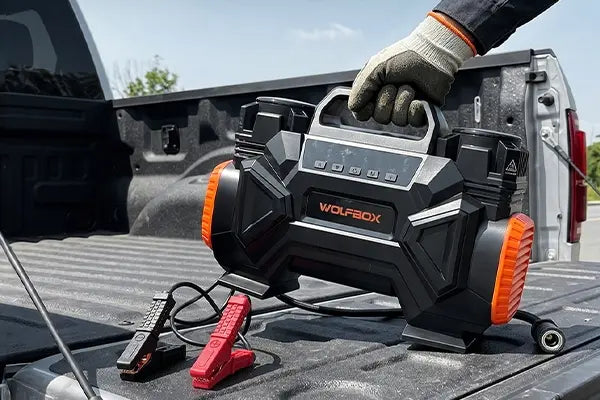
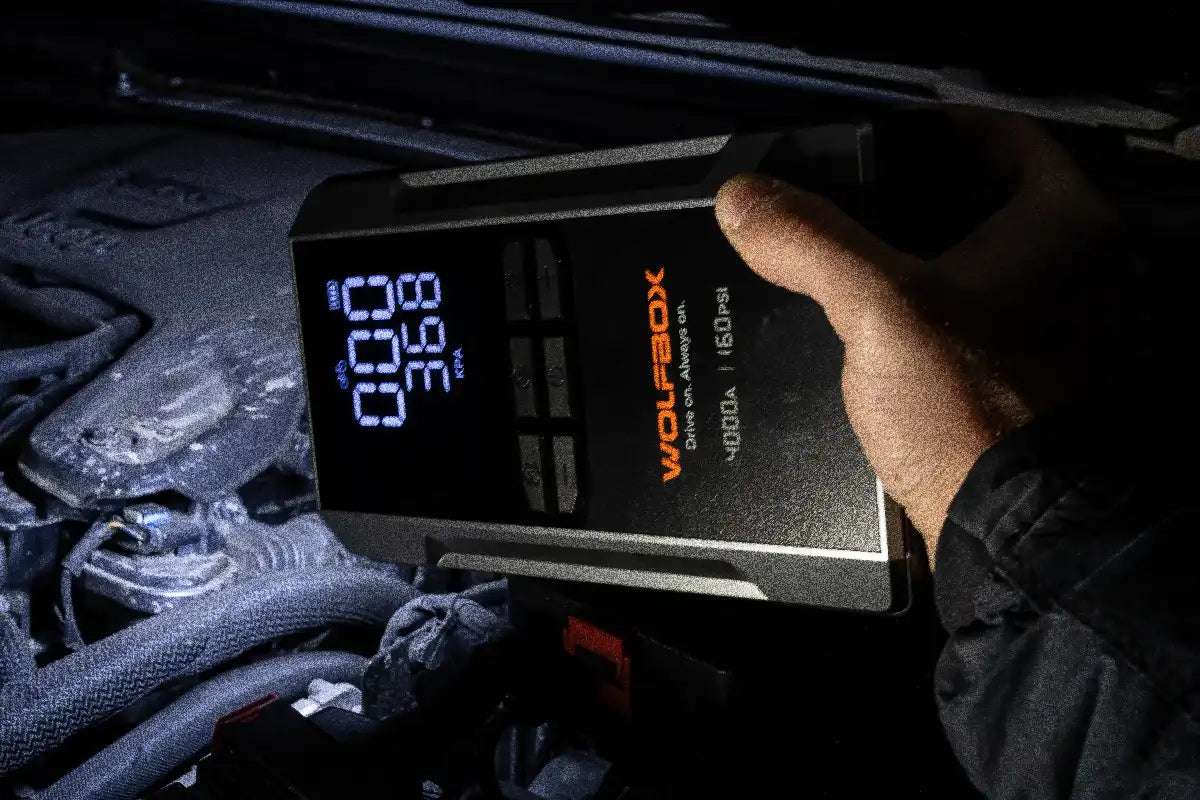
The spec that actually separates these two isn't amps. It's what kind of battery is inside. The CRAFTSMAN CMXCESM256 runs an internal AGM battery, the same lead-acid chemistry as a car battery, and puts out 1,200 peak amps with a 100 PSI compressor and a 200W AC inverter([1]). The WOLFBOX MegaVolt 24Air is lithium, 4,000 peak amps, 24,000mAh, with a 160 PSI compressor([2]). Peak amps is the short burst of current a jump starter sends into a dead battery to crank an engine. AGM, absorbent glass mat, is a sealed lead-acid design.
Lead-Acid vs Lithium Is the Real Fork
What's inside the case decides where a jump starter ends up living, and for the WOLFBOX MegaVolt 24Air and the CRAFTSMAN CMXCESM256 that matters more than any number on the box.
Start with the CRAFTSMAN CMXCESM256, which runs AGM. That's lead-acid, the same basic chemistry as the battery it's meant to rescue. That means weight, and it means the pack bleeds off charge while it sits, so it wants a top-up every few months whether it gets used or not. Miss a couple of those and the unit you reach for is flatter than the car battery. That's the maintenance cycle lead-acid signs you up for, and it's why a unit like this one lives on a garage shelf near an outlet rather than riding around in a vehicle the way the WOLFBOX MegaVolt 24Air is built to([1][2]).
Lithium batteries generally have a lower self-discharge rate, allowing them to retain their charge longer during storage. Popular Science's reviewer found that the WOLFBOX MegaVolt 24Air held its charge easily for several weeks through the temperature swings of an upstate New York winter. The review still recommends topping it up every six months to help ensure it's ready when needed([3]).
That's the argument for keeping the WOLFBOX MegaVolt 24Air in the trunk, which is where you want it anyway. Nobody's battery dies in the garage.
For a closer look at the differences, see this guide to lithium vs. lead-acid jump starters.
Amps and What They Actually Start
A bigger peak number isn't automatically better, but the gap here is wide enough to matter. The CRAFTSMAN CMXCESM256 is rated at 1,200 peak amps and listed for 4- to 8-cylinder engines([1]). The WOLFBOX MegaVolt 24Air is rated at 4,000 peak amps and covers gas engines up to 10 liters and diesel engines up to 6 liters([2]). Cylinder count and displacement aren't the same measure, but the practical read is clear: a big diesel is inside what the WOLFBOX MegaVolt 24Air is rated for and outside what the CRAFTSMAN unit claims. WOLFBOX puts the 24Air's pack at 24,000mAh / 88.8Wh with up to 40 jump starts on a full charge([2]), and a Popular Science reviewer started three vehicles with one, a crossover SUV, a 6-cylinder pickup, and a diesel F-350 that had been sitting, with enough left after the hardest start to go again([3]). Peak current ratings are squishy across brands, but that is a real-world data point rather than a spec-sheet one.
Both Have a Compressor, at Different Pressures
Each of these doubles as a tire inflator, which is the feature that keeps a jump starter from being single-use gear. The CRAFTSMAN CMXCESM256 has a built-in automatic compressor rated at 100 PSI([1]).
The WOLFBOX MegaVolt 24Air's compressor reaches 160 PSI at 45 liters per minute, and WOLFBOX lists roughly 1 minute 50 seconds to take a 37×12.5R17 tire from 35 to 40 PSI([2]). PSI, pounds per square inch, is the number printed inside the driver's door. For passenger cars, 100 PSI is plenty, since nothing on a sedan runs much past 40. The gap opens up on trailer and light-truck tires, which sit at considerably higher pressures, and on anyone who wants headroom above the number they're actually filling to.
The AC Outlet Is CRAFTSMAN's Best Card
Credit where it's due: one of these runs household plugs and the other doesn't. The CRAFTSMAN CMXCESM256 includes a 110V AC outlet with a 200W inverter, a 12V 6A DC port, two USB-C ports at 3A, and two USB-A ports at 2.4A([1]).
That AC outlet is genuinely useful for a trouble light, a small charger, or anything with a wall plug. The WOLFBOX MegaVolt 24Air answers with a 65W USB-C output, multiple USB-A ports, and a 160W DC output, plus a 400-lumen light with high beam, strobe, and SOS modes([2]). No AC outlet, though. Anyone who needs one should know that going in.
Specs Side by Side
|
Spec |
WOLFBOX MegaVolt 24Air |
CRAFTSMAN CMXCESM256 |
|---|---|---|
|
Battery |
Lithium, 24,000mAh / 88.8Wh([2]) |
Internal AGM lead-acid([1]) |
|
Peak amps |
4,000A([2]) |
1,200A([1]) |
|
Engines |
Gas up to 10L / diesel up to 6L([2]) |
4- to 8-cylinder([1]) |
|
Compressor |
160 PSI, 45 L/min([2]) |
100 PSI, automatic([1]) |
|
AC outlet |
None([2]) |
110V, 200W inverter([1]) |
|
USB |
65W USB-C plus USB-A([2]) |
Two USB-C 3A, two USB-A 2.4A([1]) |
|
DC output |
160W([2]) |
12V 6A([1]) |
|
Light |
400 lumens, 3 modes([2]) |
LED area light([1]) |
|
Jump starts per charge |
Up to 40([2]) |
Not published([1]) |
|
Ingress rating |
IP64([2]) |
Not published([1]) |
What Each One Is Really Built For
These two were designed around different buyers, and the feature lists give it away. A 200W inverter, a digital display, and 4-gauge booster cables add up to a bench tool that happens to jump cars, which is what the CRAFTSMAN CMXCESM256 is([1]).
Everything on the WOLFBOX MegaVolt 24Air points the other direction: an IP64-rated body, four functions in one case, and a 400-lumen light for working in the dark on a shoulder([2][3]). Neither approach is wrong. They're answers to different questions, and the question most drivers are actually asking is what to keep in the trunk.
Weight and Where Each One Lives
This is the part a spec sheet understates. A lead-acid pack with a 200W inverter and a compressor in the same housing is a shop tool, and the CRAFTSMAN CMXCESM256 is built as a power station with 4-gauge, 24-inch booster cables([1]). The WOLFBOX MegaVolt 24Air is built to ride in a trunk, carries an IP64 rating, which means dust-tight and protected against splashed water, and recharges in as little as two hours([2]).
Where a jump starter lives usually decides whether it ever gets used. A unit sitting on a garage shelf is no help in a grocery store parking lot at 8 p.m., and that is where most dead batteries actually happen.
Cold Mornings Favor the One in the Car
Jump starters mostly get used in winter, which pushes the storage question. At 32°F a car battery is already about 35 percent weaker than normal, and at 0°F it loses roughly 60 percent of its strength while the engine asks for up to twice the current([5]). The WOLFBOX MegaVolt 24Air is rated to operate from -4°F to 140°F([2]), and a Popular Science reviewer used one during a real 0°F cold snap to start a stranger's dead SUV, with the engine firing almost immediately once the clamps went on([3]).
The clamps run two modes: a normal start, plus a BOOST button for a battery too depleted to respond([2]). Popular Science's reviewer describes the forced-boost path as exactly what you want when a battery is too depleted to behave normally([3]).
The Four-Functions Argument
Buying one device instead of three is most of the appeal here. The WOLFBOX MegaVolt 24Air combines a jump starter, a 160 PSI compressor, a power bank with 65W USB-C, and a 400-lumen emergency light([2]).
Popular Science calls the WOLFBOX MegaVolt 24Air a strong option for a car emergency kit, since one multi-function device covers jobs a kit would otherwise need several separate items for([3]). The CRAFTSMAN CMXCESM256 makes a similar play with its compressor, inverter, USB ports, and work light([1]). The difference is what the combined package weighs and whether it fits behind a seat.
Safety and Certification
Both brands take this seriously, and the published detail differs. The WOLFBOX MegaVolt 24Air lists 10 safety protections, including spark-proof clamps and high and low temperature protection, plus UL 2743 certification, the safety standard written for portable power packs([2]), and carries a 24-month manufacturer warranty that WOLFBOX extends to 30 months on orders placed directly on wolfbox.com([4]).
The retailer listing for the CRAFTSMAN CMXCESM256 doesn't publish a protection count or certification detail alongside the specs([1]). That isn't a knock on the hardware, just a note on what each company puts in writing where a shopper can see it.
When the WOLFBOX MegaVolt 24Air Isn't the Right Pick
The WOLFBOX MegaVolt 24Air isn't the right buy for everyone. Anyone who wants a household AC outlet in their jump starter should look at a unit with an inverter, like the CRAFTSMAN CMXCESM256, since the WOLFBOX MegaVolt 24Air has none([1][2]). Vehicles with 24V starting systems need a different tool: WOLFBOX specs the 24Air's voltage at 12V, so it is built for 12V systems([2]). And a battery that's cracked, swollen, or badly corroded is a replacement, not a jump, no matter which unit is on hand.
Who Should Buy Which
- Anyone keeping a jump starter in the car year-round: the WOLFBOX MegaVolt 24Air, for lithium weight, IP64 sealing([2][3]).
- Truck and diesel owners: the WOLFBOX MegaVolt 24Air at 4,000A covers gas engines up to 10 liters and diesel engines up to 6 liters([2]).
- Anyone who needs a 110V outlet in the garage more than portability: the CRAFTSMAN CMXCESM256 with its 200W inverter([1]).
Frequently Asked Questions
Which has more starting power?
The WOLFBOX MegaVolt 24Air, at 4,000 peak amps against 1,200 on the CRAFTSMAN CMXCESM256([2][1]).
Is lithium better than AGM in a jump starter?
For portability, yes. The WOLFBOX MegaVolt 24Air uses a 24,000 mAh (88.8 Wh) lithium-ion battery and weighs 3.42 lb, while AGM jump starters typically use heavier lead-acid batteries. The MegaVolt 24Air is also rated to operate from -4°F to 140°F, making it suitable for a wide range of temperatures([1][2][3]).
Does the WOLFBOX MegaVolt 24Air have an AC outlet?
No. The WOLFBOX MegaVolt 24Air offers 65W USB-C, USB-A, and a 160W DC output, while the CRAFTSMAN CMXCESM256 includes a 110V outlet with a 200W inverter([2][1]).
Which inflator is stronger?
The WOLFBOX MegaVolt 24Air's, at 160 PSI and 45 liters per minute against 100 PSI on the CRAFTSMAN unit([2][1]).
Can either one start a diesel?
The WOLFBOX MegaVolt 24Air can start gas engines up to 10 liters and diesel engines up to 6 liters. The CRAFTSMAN CMXCESM256 listing specifies 4- to 8-cylinder engines rather than a diesel displacement rating([2][1]).
How many jumps per charge?
Up to 40 on the WOLFBOX MegaVolt 24Air, depending on engine and battery condition. The CRAFTSMAN listing doesn't publish a figure([2][1]).
What warranty comes with the WOLFBOX MegaVolt 24Air?
30 months when you buy it on wolfbox.com: a 24-month manufacturer warranty plus 6 months of complimentary extended protection. A further 12 months exists only as the optional paid 1-year extended warranty, which has to be purchased and activated separately([2][4]). WOLFBOX also lists FCC and UN38.3 certification, and compliance with CPSC consumer safety requirements([2]).
References
([1]) Lowe's: CRAFTSMAN 1200-Amp 12-Volt Portable Car Battery Jump Starter with Digital Display CMXCESM256: lowes.com/pd/CRAFTSMAN-1200-Amp-12-Volt-Portable-Car-Battery-Jump-Starter-with-Digital-Display/5013933463
([2]) WOLFBOX: MegaVolt 24Air Jump Starter with Air Compressor, Official Single-Product Page: wolfbox.com/products/jump-starter-with-air-compressor-tire-inflator-wolfbox-megavolt-24air
([3]) Popular Science: I Tested the Wolfbox 4-in-1 Jump Starter with Air Compressor During a Real-World Emergency: popsci.com/gear/wolfbox-4-in-1-jump-starter-with-air-compressor-review
([4]) WOLFBOX: Warranty Policy, manufacturer warranty by product category, complimentary extended protection, and paid 1-year extended warranty: wolfbox.com/pages/warranty-policy
([5]) AAA Hudson Valley: Cold Weather Is Hard on Your Car Battery, Here's What to Know: hudsonvalley.aaa.com/blog/cold-weather-car-battery

Leave a comment
All comments are moderated before being published.
This site is protected by hCaptcha and the hCaptcha Privacy Policy and Terms of Service apply.