








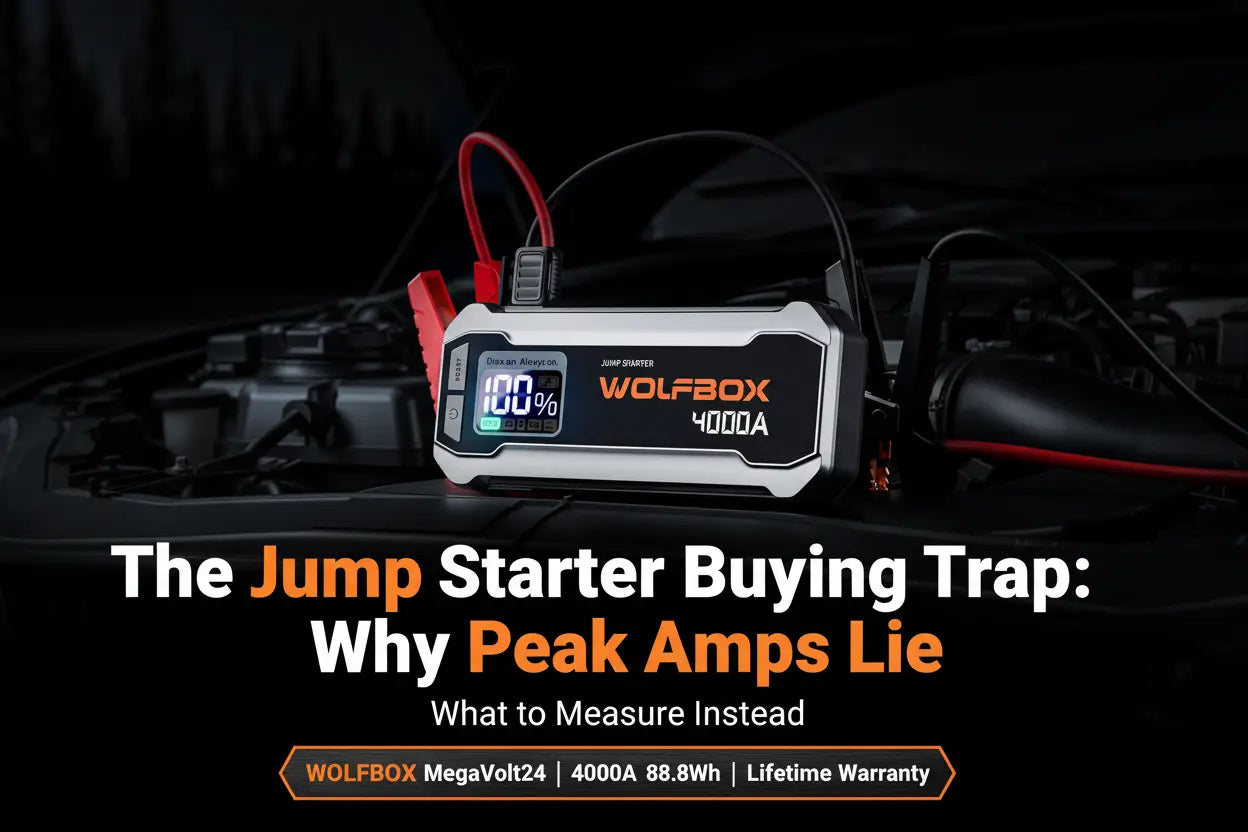
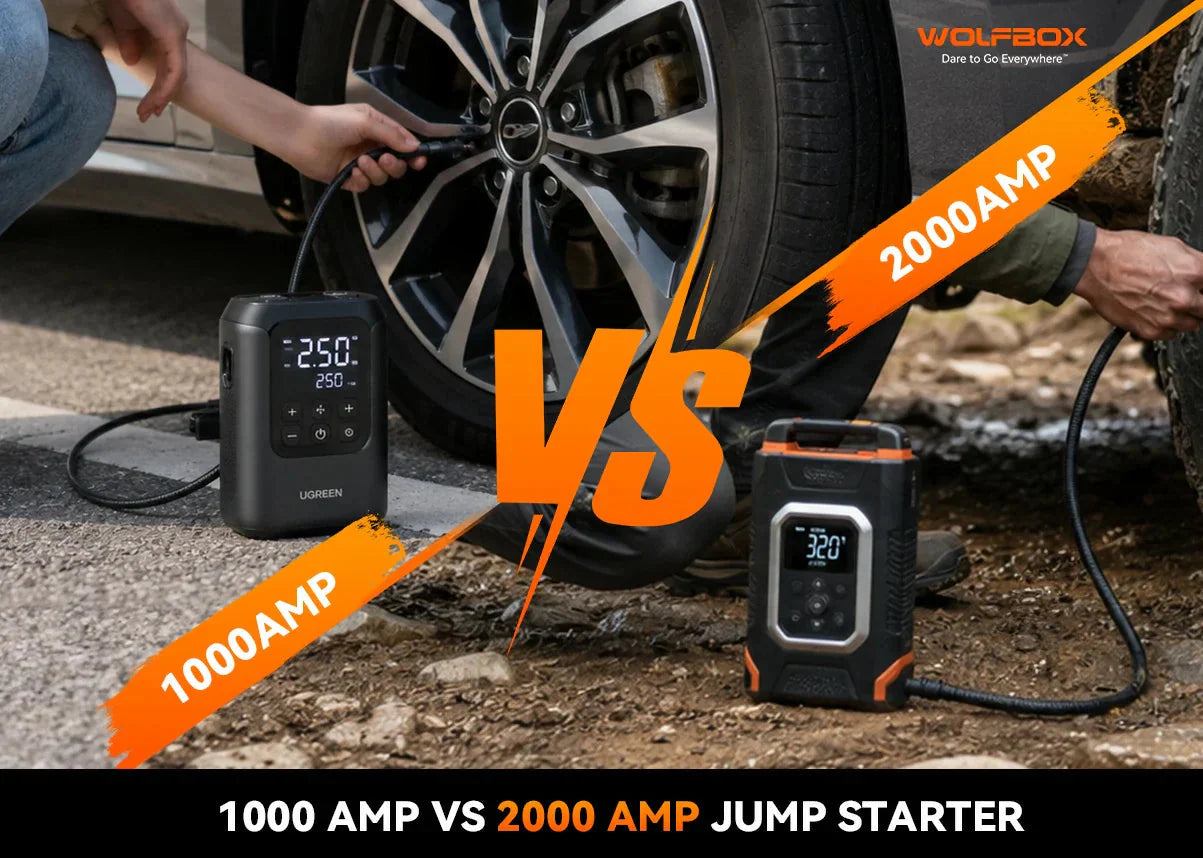
Walk into any auto parts store or scroll Amazon and you'll see jump starters promising '2000A,' '4000A,' sometimes '6000A.' A $35 unit and a $178 unit can both claim '4000 peak amps.' Neither number is regulated, tested against a standard, or comparable between brands.
This matters because starting an engine—especially a cold one—requires sustained current delivered over several seconds, not a burst that lasts milliseconds. The spec that predicts whether a jump starter actually works is cold cranking amps (CCA). Peak amps don't.
What 'Peak Amps' Actually Measures
Peak amps is the maximum instantaneous current a jump starter can deliver for a fraction of a second under ideal temperature conditions. There is no industry body that certifies or audits these claims.1 Manufacturers set their own test conditions—or describe no test conditions at all.
The number on the box tells you almost nothing about whether the unit will turn over your engine on a 20-degree morning with a half-dead battery. A starter motor pulling heavy loads during a cold start needs sustained current over several seconds. A peak that lasts milliseconds is irrelevant to that job.
Cold Cranking Amps: The Standard That Predicts Real-World Starting
CCA is defined by SAE standard J537. The test measures how many amps a 12V battery can deliver at 0 degrees F (-18 degrees C) for 30 seconds while maintaining a minimum voltage of 7.2V.1 That floor is the threshold below which most starter motors can't crank.
Three things make this spec meaningful:
- It measures sustained current delivery, not a peak burst
- It tests at a temperature where battery chemistry has already degraded significantly
- The 7.2V floor reflects what a starter motor actually needs to function
Vehicle manufacturers publish minimum CCA requirements for their engines. Most portable jump starter manufacturers don't publish CCA ratings—which is why peak amp claims fill the space instead.
Matching Amp Tier to Your Vehicle
|
Peak Amp Label
|
Approx. Sustained Current
|
Compatible Engines
|
|
~1000A
|
~300-500A sustained
|
4-cylinder gas, up to 2.0L
|
|
~2000A
|
~600-900A sustained
|
6-cylinder gas, most SUVs up to 6.0L
|
|
~4000A
|
~1200-1500A sustained
|
V8 gas up to 10.0L, diesel up to 10.0L
|
Minimum CCA requirements by vehicle type:
|
Vehicle
|
Typical CCA Needed
|
|
4-cylinder gas (1.4-2.0L)
|
350-450 CCA
|
|
6-cylinder gas (2.5-3.5L)
|
450-600 CCA
|
|
V8 gas (4.5-6.2L)
|
600-800 CCA
|
|
Light diesel (2.0-3.0L)
|
600-800 CCA
|
|
Heavy diesel / truck (6.0-10.0L)
|
900-1200+ CCA
|
The WOLFBOX MegaVolt24 is rated at 4000A peak with a 24,000mAh (88.8Wh) battery, covering gas engines up to 10.0L and diesel up to 10.0L.2 For pickup trucks, full-size SUVs, and diesel vehicles, this provides adequate headroom even when accounting for cold-weather capacity reduction.

The Cold Weather Variable Lithium Buyers Miss
Lithium jump starters have real advantages over lead-acid: lighter, faster to charge, slower to self-discharge, and capable of charging laptops and phones. But lithium chemistry slows in cold temperatures, and that reduction is significant.3
A lithium unit loses approximately 15 to 20 percent of its rated capacity at 32 degrees F (0 degrees C), and up to 40 percent below 14 degrees F (-10 degrees C). A jump starter rated '4000A' in a warm warehouse may deliver meaningfully less sustained current in a winter parking lot.
|
Factor
|
Lithium Jump Starter
|
Lead-Acid/AGM
|
|
Weight
|
Under 3 lbs typical
|
15-40 lbs
|
|
Charge time
|
~1.3 hrs via 65W USB-C
|
4-8 hrs
|
|
Monthly self-discharge
|
Less than 1%
|
3-5%
|
|
Cold performance at 0 degrees C
|
-15 to 20% capacity
|
Relatively stable
|
|
Cold performance at -10 degrees C
|
-30 to 40% capacity
|
Better relative performance
|
|
Storage without maintenance
|
12+ months
|
Degrades; needs maintenance charging
|
|
USB-C device charging
|
Yes (65W on MegaVolt24)
|
Rarely
|
For drivers in cold climates, picking a higher-capacity lithium unit—and pre-warming it inside the vehicle before use—is the practical answer. Lead-acid has better cold-temperature relative stability, but the weight, size, and charging disadvantages make it a poor everyday carry for most drivers.
What the MegaVolt24 Spec Sheet Actually Tells You
The WOLFBOX MegaVolt24 carries a 24,000mAh (88.8Wh) battery.2,4 The watt-hour figure is the standardized energy unit that lets you compare total capacity across brands. More Wh means more total jumps per charge and more capacity for device charging.
Specs that matter for real use:
- 4000A peak, covers 12V vehicles, gas up to 10.0L, diesel up to 10.0L
- 65W USB-C Power Delivery: charges the unit in roughly 1.3 hours; also charges laptops at full speed
- 12W USB-A output for phones and accessories
- 200-lumen LED flashlight with strobe and SOS modes
- IP64 rating: dust and splash resistant
- Operates from -4 degrees F to 140 degrees F
- Up to 40 jump starts per charge depending on vehicle type and battery condition
- Lifetime warranty2
Ten built-in safety protections—reverse polarity, no-spark, over-temperature, short-circuit, and others—protect the vehicle's electrical system from connection mistakes.

The Three Specs That Actually Differentiate Jump Starters
Battery capacity in watt-hours (Wh). Compare Wh directly across brands. It tells you how much total energy the device stores. At 88.8Wh, the MegaVolt24 is among the highest-capacity portable units available.2
Engine compatibility (gas and diesel, maximum displacement). Always check both fuel types. Diesel requires more cranking current than equivalent-displacement gas engines. If the listing only mentions gasoline, verify diesel compatibility separately before buying.
USB-C wattage. A 65W USB-C PD port means the unit genuinely works as a laptop emergency charger. A 15W port means phone charging only. That's the practical difference between a tool you leave in the trunk and one you carry daily.
Frequently Asked Questions
What is the difference between peak amps and CCA?
Peak amps is an unregulated marketing claim with no universal test standard. CCA (SAE J537) measures sustained current delivery at 0 degrees F for 30 seconds above a minimum voltage floor. CCA predicts real-world cold starts. Peak amps does not.
What rating do I need for a diesel truck?
Heavy diesel engines (6.0-10.0L) typically require 900 to 1200+ CCA equivalent. The WOLFBOX MegaVolt24 at 4000A peak and 88.8Wh covers diesel engines up to 10.0L and is the right tier for full-size trucks and diesel SUVs.
Does cold weather reduce a lithium jump starter's power?
Yes. Expect 15 to 20 percent capacity reduction at 32 degrees F and up to 40 percent below 14 degrees F. Keep the unit inside the vehicle in cold weather before use, and buy a higher-capacity unit if you regularly start vehicles in freezing temperatures.
How long will it hold a charge in storage?
Lithium jump starters self-discharge at less than 1 percent per month. Store at 50 to 80 percent charge for best long-term battery health. The MegaVolt24 stores reliably for a year or more without a maintenance charge.
Can the MegaVolt24 charge my laptop?
Yes. The 65W USB-C PD port charges most laptops at full speed. At 88.8Wh total capacity, you can fully charge a typical laptop battery and still have capacity remaining for a vehicle jump start.
Is a higher peak amp number always better?
Not for smaller vehicles. For a 4-cylinder gas car, a 2000A-rated unit is more than adequate. Higher capacity matters for large gas engines, diesel vehicles, and cold climates. Beyond matching the right tier to your vehicle, compare Wh capacity, USB-C wattage, and build quality—those specs differentiate good units from great ones.
References
- LiFePO4 Battery—Cold Cranking Amps (CCA) explained, SAE J537 standard definition: https://www.lifepo4-battery.com/News/cold-cranking-amps-cca-explained.html
- WOLFBOX MegaVolt24 product page—4000A, 88.8Wh, 65W USB-C, 200-lumen LED, IP64, lifetime warranty: https://wolfbox.com/products/wolfbox-megavolt24-jump-starter
- WOLFBOX Blog—Lithium vs Lead Acid Jump Starter, cold-weather performance data: https://wolfbox.com/blogs/jump-starter/lithium-vs-lead-acid-jump-starter
- Popular Science—WOLFBOX MegaVolt 24Air review, 88.8Wh capacity and specs verified: https://www.popsci.com/gear/wolfbox-4-in-1-jump-starter-with-air-compressor-review/
- TechGearLab—WOLFBOX MegaVolt24 independent review and test: https://www.techgearlab.com/reviews/tools/jump-starter/wolfbox-megavolt24
- Power-Sonic—What Are Cold Cranking Amps (CCA): https://www.power-sonic.com/what-are-cold-cranking-amps/
- WOLFBOX Blog—Wolfbox vs NOCO vs Tacklife honest comparison: https://wolfbox.com/blogs/jump-starter/wolfbox-vs-noco-vs-tacklife-jump-starter-honest-brand-comparison
- WOLFBOX Jump Starter collection page: https://wolfbox.com/collections/jump-starter-1


Leave a comment
All comments are moderated before being published.
This site is protected by hCaptcha and the hCaptcha Privacy Policy and Terms of Service apply.