








WOLFBOX Brands
WOLFBOX Brands
A dead battery can leave you stuck at the worst possible time—especially on cold mornings or long road trips. If you've ever wondered whether a 1000 amp or 2000 amp jump starter is right for your vehicle, you're not alone.
This guide breaks down the real differences between 1000A vs 2000A jump starters, including what each power level can handle, how engine size and weather affect performance, and which option fits sedans, SUVs, trucks, and diesel engines. You'll know exactly what amp jump starter you need for reliable starts in any situation.
Table of contents
An ampere (A) measures the electrical current a jump starter can deliver to your vehicle's battery. This current is what powers the starter motor and helps crank the engine.
Peak Amps refer to the maximum instantaneous current a jump starter can deliver in a very short burst, typically used at the moment the engine is first engaged. Cranking Amps (CA) or Cold Cranking Amps (CCA) measure how much current a battery can sustain for about 30 seconds while maintaining sufficient voltage to turn the engine over.
Smaller gasoline engines require less current to start compared to larger V8 engines. Diesel engines generally require significantly more power due to higher compression ratios and greater resistance during cold starts, which increases the load on the starter system.
To choose between the two, a clear understanding of the performance limits of these two categories is necessary.
Feature |
1000 Amp Jump Starter |
2000 Amp Jump Starter |
Engine Limit (Gas) |
Up to 6.0L gasoline engines |
Up to 7.0–8.0L gasoline engines |
Engine Limit (Diesel) |
Up to 3.0–4.0L diesel engines |
Up to 5.0–6.0L diesel engines |
Average Battery Size |
~10000–12000 mAh (or ~30–40Wh) |
~12000–20000 mAh (or ~40–70Wh) |
USB Fast Charge |
Often Standard |
Advanced Quick Charge |
Portability |
Highly Compact |
Compact to Medium |
A 1000A jump starter is typically suitable for most passenger vehicles with small to mid-size gasoline engines, generally up to around 3.0L–4.0L, depending on the model and conditions.
A 2000A unit provides more headroom and is better suited for larger gasoline engines and some light-duty trucks. However, diesel engines—especially larger displacement or cold-weather starts—often require higher-rated units beyond 2000A.
Smaller jump starters usually have lower battery capacity (measured in Wh), which limits the number of jump starts per full charge.
Higher-capacity 2000A models typically store more energy, allowing multiple jump starts and longer standby time before recharging is needed.
The standard 1000A units will typically have slower USB ports and can take hours to charge accessories. It can be patience-testing on a busy road trip at a slow speed. Higher-end models like 2000A often include USB-C fast charging, which allows quicker recharging of the jump starter itself and faster output for phones or accessories.
1000A jump starters are generally more compact and lightweight, making them easier to store in glove compartments or small storage spaces.
2000A models are slightly larger due to higher-capacity batteries but remain portable enough for trunk or under-seat storage.
In cold weather, battery performance decreases, and engines require more power to start due to increased mechanical resistance.
Higher-rated jump starters provide additional current headroom, which can improve reliability in low-temperature or high-load starting conditions.
A 1000A jump starter is not designed for extreme power demands, but for many everyday drivers, it already provides more than enough performance. It's ideal when your driving needs are simple, predictable, and focused on light to moderate vehicle use.
A 1000A unit is well-suited for most small to mid-size gasoline cars, especially 4-cylinder and many 6-cylinder engines. These vehicles require relatively low cranking power, making a 1000A jump starter sufficient for reliable emergency starts in most situations.
If you only need a jump starter as a backup tool, a 1000A model is often the most practical choice. It is designed for infrequent use — such as a dead battery after long parking periods, leaving lights on, or unexpected minor battery drain.
A 1000A jump starter is typically smaller and lighter, making it a strong fit for compact emergency kits. It's easy to store in a glove box, backpack, or under-seat compartment, which is ideal for drivers who prioritize portability over maximum power output.
The more powerful power source gives you a safety margin so you don't get in over your head. If your daily drive is demanding, it makes sense to invest in more power.
Cold weather slows chemical reactions in your lead-acid car battery. This thermal drop can cut your available starting power by 50%. This loss is compensated by a higher rating of 2000A, giving extra current. With this added capability, you can meet frost with confidence.
Big SUVs and pickup trucks are stuffed with high-displacement cylinders. It takes a lot of mechanical force to get these pistons started on their compression stroke. A small booster won't be able to turn these heavy components. The 2000A model has the physical punch you need to turn big crankshafts.
Premium Power Packs have complex internal circuits to safely manage high currents. These units use heavy copper clamps that prevent spark damage. You also get spark-proof protection and reverse polarity alarms to save your hands.
Choosing the right jump starter comes down to your engine size and vehicle type. A higher amp rating doesn't always mean "better" — it just means more starting power for larger or harder-to-start engines.
Most small cars have gasoline engines of less than three liters of displacement. The little motors run freely, even on a low battery. With a compact 1000A booster, the vehicles have more than enough current.
Family cars and work trucks have larger engines V6 or V8. These big blocks need a lot of current to get them going. For these mid-size and large vehicles, we recommend a 2000A or higher booster.
Diesel engines use hot compressed air to ignite their fuel. This design needs high cranking speeds, which will quickly drain a weak battery. The 1000A model is too weak for most diesel trucks. To meet these high compression demands, you need a booster in the 2000A to 3000A range.
Recreational vehicles have heavy accessories that can drain power systems quickly. You need a big reserve to jump these big engines in the outback. For these off-grid adventures, a tough 4000A model is your best bet. This power level will keep your mobile home running in the wild.
But roadside safety is more than just raw power. And you need to think about the build quality and other features of your emergency device.
Feature Type |
Basic Standard |
Premium Standard |
Battery Cell Type |
Standard Lithium |
High-Rate Polymer |
Clamp Material |
Thin Copper Plating |
Solid Heavy Copper |
Fast Charge Port |
USB 5V Out |
PD65W Two-Way Fast Charge |
Extra Tools |
Standard Light |
160 PSI Digital Air Compressor |
High-rate lithium polymer cells deliver consistent discharge rates during start attempts. These premium cells hold their charge for months in your glove box. Low-quality cells degrade quickly and lose power in hot weather. You should choose brands that use quality cells to avoid failure.
Smart cables feature a control box that monitors the electrical connection. This box guards against short circuits and backward connections. It prevents dangerous sparks if the metal clamps touch by accident.
Modern power packs do more than start your vehicle's engine. They also function as portable power stations for your smart gear. A two-way fast charge port allows you to top off your phone in minutes.
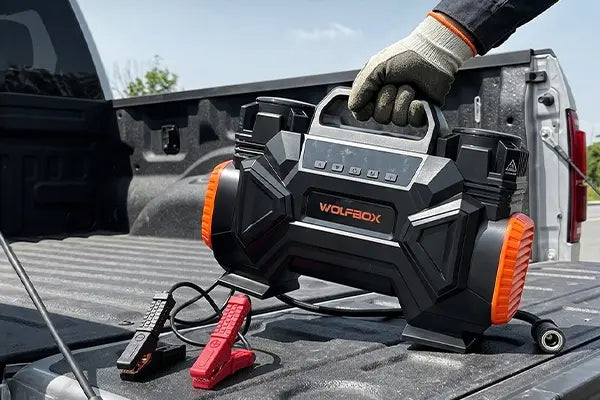
An all-in-one device like a jump starter with air compressor combines a battery booster with an air pump. This combo helps you handle two common roadside issues with one tool. You can inflate a flat tire and boost a dead battery at the same time.
Wolfbox offers a premium lineup of emergency power tools for smart drivers.
The WOLFBOX MegaVolt 10Air features a 2000A peak current and a 10000mAh battery. This model starts gasoline engines up to five liters. It also integrates a 150 PSI digital air compressor to inflate low tires quickly. This compact tool is a perfect addition to your vehicle trunk.
The WOLFBOX MegaVolt 16 Air raises the bar with 3000A of peak starting power. This device supports up to 8L gasoline and 6L diesel engines with ease. It features a larger 16000mAh battery and a 160 PSI air compressor. This mid-tier beast handles larger trucks and SUVs without breaking.
For maximum power, you can choose between the WOLFBOX MegaVolt 24 and the WOLFBOX MegaVolt 24Air. Both models deliver 4000A starting current to jump heavy 10L gas and diesel engines. The 24Air model features a digital 160 PSI tire pump for complete roadside readiness.
When you weigh a 1000 amp vs 2000 amp jump starter, your decision comes down to your personal driving needs. A smaller passenger vehicle in a warm climate requires only moderate starting power. However, larger family vehicles and cold winter mornings demand the robust performance of a 2000A or higher unit. Wolfbox offers premium all-in-one options that provide this peace of mind.
A 1000A jump starter is for smaller gasoline engines, while a 2000A model is better for larger engines, SUVs, and more demanding starts.
Yes. Higher amps provide more starting power and better reliability, especially for larger engines and cold weather.
It can work for compact SUVs, but most V6 or V8 SUVs need a 2000A jump starter for reliable starts.
Yes, a 2000A booster is an excellent choice for most passenger cars and mid-size trucks. It offers strong starting power and a generous battery reserve.
You need at least a 2000A jump starter for safe winter driving. Cold thickens engine oil and drains your car battery power very fast.
