











'My car is electric—I don't need a jump starter.' This turns out to be wrong in a very inconvenient way. Every production EV and hybrid sold today includes a 12V auxiliary battery that is separate from the main traction pack. When it fails—which it does, and increasingly so with connected vehicles—the car won't unlock, won't start, and won't let the traction battery deliver power to the motor. The jump starter you need is for this battery, not the big one.
AAA responded to over 33 million roadside calls in a single year, with battery issues accounting for roughly 7 million of them. [1] A separate survey found that 4 in 10 U.S. drivers carry nothing in their vehicle for a roadside breakdown. [2] Hybrid and EV drivers are in that count.
The 12V Auxiliary Battery: What It Does and Why It Matters
The 12V auxiliary battery in an EV or hybrid runs the low-voltage systems: door locks, alarm, infotainment screen, ECU, relay switches, and the control circuits for the onboard charger. Without 12V power, none of these operate—including the relays that allow the high-voltage traction pack to connect to the drive system. [3]
This is why a dead 12V battery in a Tesla or Prius doesn't just cause an inconvenience like a dark dashboard. It causes the car to not enter Ready mode, which means it cannot move at all, even with a full traction pack. The two battery systems are electrically isolated from each other; a full traction pack cannot save you from a failed 12V auxiliary.
In a Toyota Prius, the 12V auxiliary is typically an S46B24R AGM battery rated between 325 and 410 CCA. [4] The high-voltage pack's DC-DC converter recharges it while the car is in Ready mode. Ford F-150 Lightning owners should follow the vehicle owner's manual for the 12V jump-start terminals and sequence; the key point is the same: restore the low-voltage system first, and do not touch high-voltage components. [5]
Why EV and Hybrid 12V Batteries Fail More Often Than You'd Expect
Modern connected vehicles draw continuous power from the 12V battery even when parked. Over-the-air software updates run overnight. Cellular modems stay active for remote app connectivity. Infotainment displays wake to handle background processes. Every one of these draws from the 12V battery, not the traction pack.
The auxiliary batteries in hybrids are also physically smaller than in gasoline cars—typically 35–45 Ah versus the 50–75 Ah in a standard gasoline sedan. [4] A smaller capacity battery depleted by continuous parasitic loads reaches the failure threshold faster. Cold weather compounds this: lithium batteries lose usable capacity below freezing, and AGM batteries deliver less cranking current in cold conditions. [6]
The practical result is that hybrid and EV owners who leave their vehicles unused for 10–14 days without driving are more likely to encounter a dead 12V battery than a gasoline-car owner would be.
12V Battery Specs Across EV and Hybrid Platforms
Vehicle |
Typical 12V Battery |
Approximate CCA |
Chemistry |
Charging Source |
Toyota Prius / Camry Hybrid |
S46B24R (35–45 Ah) |
325–410 CCA |
AGM |
DC-DC converter from HV pack |
Tesla Model S / 3 / Y |
Varies by model/year; older lead-acid/AGM low-voltage batteries are commonly about 33–35 Ah |
Varies |
Lead-acid/AGM or lithium-ion, depending on model year |
DC-DC converter |
Ford F-150 Lightning |
Varies by model/year; follow owner manual for exact 12V battery and jump-start points |
Varies |
Varies by model/year |
DC-DC converter; follow owner manual for jump-start procedure |
Standard gasoline sedan |
50–75 Ah |
500–700 CCA |
Lead-acid or AGM |
Alternator |
CCA data for Prius auxiliary from Interstate Batteries MTX-S46B24R specification sheet. [4] EV 12V specifications vary by model year; consult your vehicle's owner manual for exact specifications.
How to Jump-Start an EV or Hybrid 12V Battery
The procedure differs from a standard gasoline jump-start in a few critical ways. Locate the 12V jump terminals in your specific vehicle first—they are not always at the battery itself. In many EVs and hybrids, they're under the hood in the engine bay or frunk, labeled and accessible without touching the high-voltage components.
- Do not connect to the high-voltage orange cables, the traction battery enclosure, or any orange-labeled connector
- Use Normal Start mode on the MegaVolt24, not Boost—hybrid 12V auxiliaries typically need 270–410 CCA, a much lower demand than a diesel engine start
- Connect red clamp to positive (+) terminal, black clamp to a chassis ground point away from the battery
- Follow your specific vehicle's owner manual—Tesla, Toyota, and Ford each have slightly different preferred jump-start locations and sequences
- After the vehicle starts or powers on, drive or run it for at least 20–30 minutes so the DC-DC converter can partially recharge the 12V battery

One thing to make clear: a portable jump starter does not touch, charge, or interact with the high-voltage traction pack. That system operates at 300–800V and requires factory service equipment for any work. A jump starter addresses only the 12V side.
What the MegaVolt24 Covers
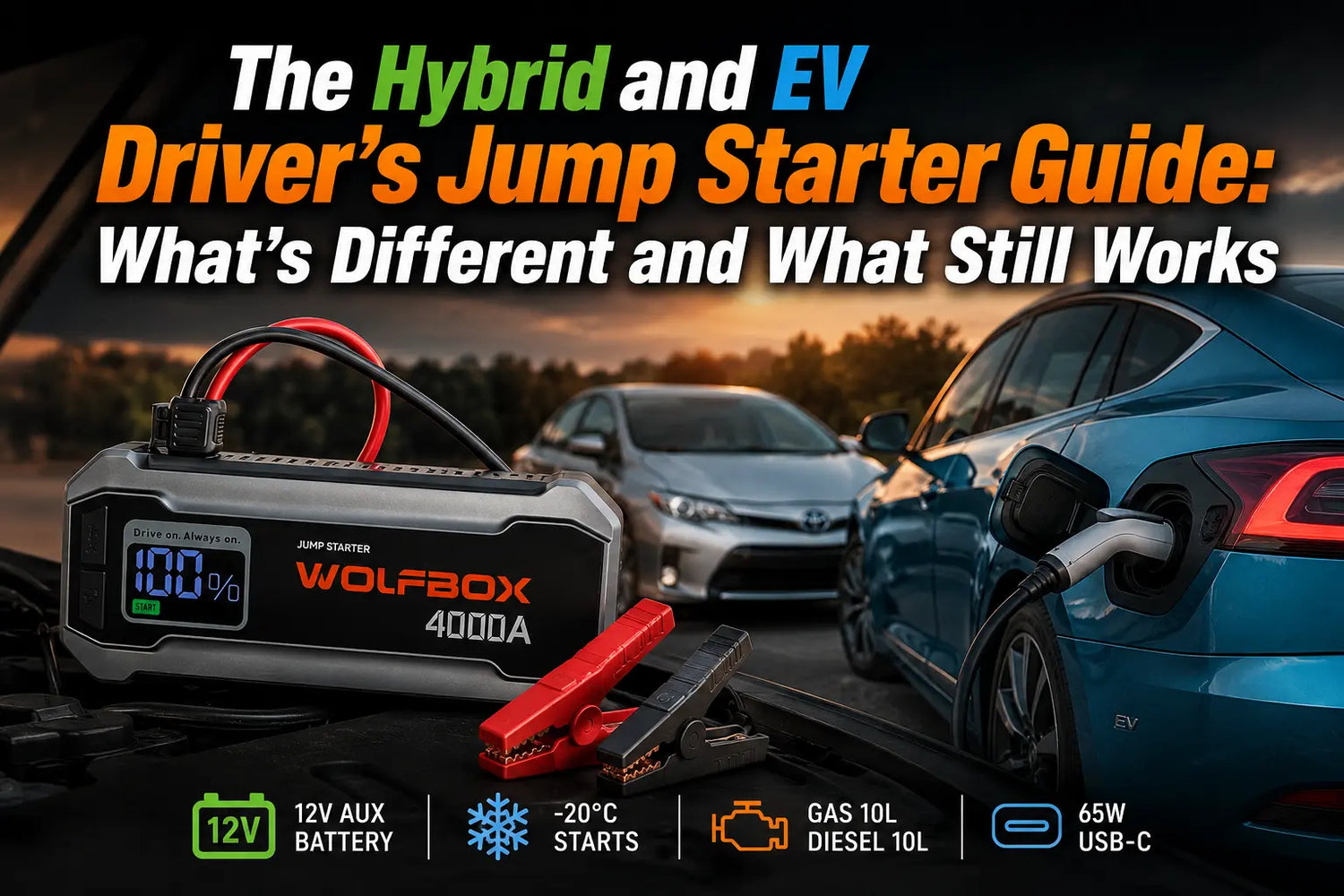
The Wolfbox MegaVolt24 delivers 4,000A peak current and 1,000A starting current from a 24,000 mAh (88.8 Wh) battery. It operates from -20°C to 60°C (-4°F to 140°F) and covers all 12V gasoline engines up to 10L and diesel up to 10L. [6][7] For hybrid 12V auxiliaries—which typically need under 410 CCA to start—the MegaVolt24 is substantially over-specified, which means it starts them reliably even with partial battery charge on the jump starter itself.
The 65W USB-C PD output serves a second purpose at roadside: charging a laptop, phone, or any USB-C accessory at full speed. For EV owners in particular, this is useful while waiting for a charge—power your work device from the same unit that jump-started the car. [7]

What a Jump Starter Cannot Do for an EV
- CAN: jump-start the 12V auxiliary battery to restore low-voltage systems
- CANNOT: charge the high-voltage traction pack or add driving range
- CANNOT: substitute for an EV charger if the traction pack is depleted
- CANNOT: resolve faults that require dealer service (e.g., BMS errors, contactor failure)
Frequently Asked Questions
Q: Do EVs and hybrids have a 12V battery?
A: Yes. Every production EV and hybrid has a 12V auxiliary battery separate from the traction pack. It powers locks, computers, and relays. A dead 12V battery prevents the vehicle from operating.
Q: Can I use the MegaVolt24 to jump-start a hybrid?
A: Yes—connect to the 12V auxiliary battery terminals per the vehicle's owner manual. The MegaVolt24's 4,000A peak covers hybrid auxiliary batteries, which typically need 270–410 CCA.
Q: Why does my Prius 12V battery keep dying?
A: Hybrid 12V batteries are smaller (35–45 Ah) than gasoline car batteries and face higher parasitic loads from connected features. Vehicles parked more than 10–14 days without running are at higher risk.
Q: Can the MegaVolt24 jump-start a Tesla?
A: It can jump-start the Tesla's 12V auxiliary battery when connected to the correct 12V terminals per Tesla's procedure. It does not interact with the high-voltage traction pack.
Q: Should I use Boost mode or Normal mode for a hybrid battery?
A: Normal Start mode. Hybrid 12V auxiliaries are smaller batteries that require less current than a large gasoline or diesel engine start.
Q: What should I do after jump-starting an EV or hybrid 12V battery?
A: Drive or run the vehicle for 20–30 minutes to allow the DC-DC converter to partially recharge the 12V battery. A battery that has failed multiple times should be tested and replaced.
Q: Will the jump starter add range to my EV?
A: No. A portable jump starter works on the 12V auxiliary system only. Traction pack range requires an EV charger.
References
[1] LED Skylite – Vehicle Emergency Kit: AAA 33 Million Roadside Calls, Battery Issues: https://www.ledskylite.com/vehicle-emergency-kit-what-to-keep-in-your-car/
[2] Kelley Blue Book – AAA Survey: 40% of Drivers Unprepared for Roadside Breakdown: https://www.kbb.com/car-news/aaa-survey-40-percent-unprepared-for-a-roadside-breakdown/
[3] Tesla Service Manual – 12V Auxiliary Battery (Remove and Replace): https://service.tesla.com/docs/ModelS/ServiceManual/en-us/GUID-90D436B7-2591-4F02-8471-778928E71F30.html
[4] Interstate Batteries – MTX-S46B24R Prius Auxiliary Battery, 410 CCA, 41 Ah: https://www.interstatebatteries.com/products/mtx-s46b24r/2015-toyota-prius-l418l-hybrid-auxiliary-battery
[5] Ford F-150 Lightning Owner Manual – Jump Starting the Vehicle: https://www.ford.com/support/vehicle/f150-lightning/2022/owner-manuals/
[6] Wolfbox MegaVolt24 User Manual – Operating Temperature -20°C to 60°C: https://device.report/manual/14727281
[7] Wolfbox MegaVolt24 Jump Starter Product Page: https://wolfbox.com/products/wolfbox-megavolt24-jump-starter
[8] Popular Science – Wolfbox 4-in-1 Jump Starter with Air Compressor Review: https://www.popsci.com/gear/wolfbox-4-in-1-jump-starter-with-air-compressor-review/
[9] Time – The Main Reason EV Drivers Call AAA: https://time.com/6556242/electric-vehicle-aaa-roadside-calls/
[10] Wolfbox – The Jump Starter Buying Trap: Peak Amps vs. CCA Explained: https://wolfbox.com/blogs/jump-starter/the-jump-starter-buying-trap-why-peak-amps-lie-and-what-to-measure-instead



Leave a comment
All comments are moderated before being published.
This site is protected by hCaptcha and the hCaptcha Privacy Policy and Terms of Service apply.