








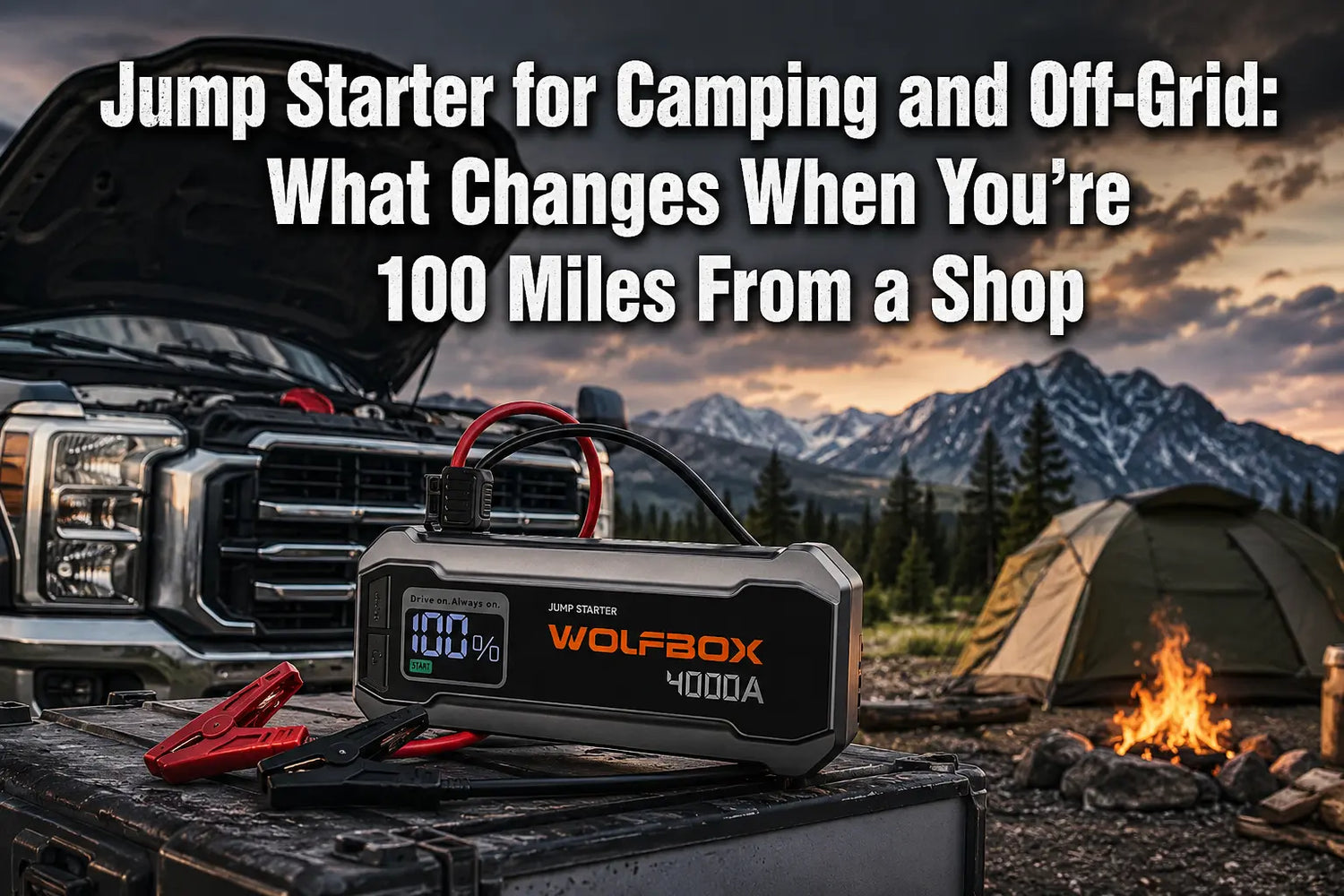
Day three of a backcountry trip in Wyoming. The F-250 won't start. Nearest shop: 94 miles. Cell signal: none. A jump starter sitting in a cold truck bed all week either has the capacity and cold-weather reserve to do this, or it doesn't.
Standard jump starter reviews are written for parking lots. Off-grid use is different: sub-freezing temperatures, diesel engines, a device that may have been sitting uncharged for months, and no fallback option if it fails. Each of those factors changes what you should buy.⁸
Cold Weather and Why Rated Capacity Is Not the Full Picture
Lithium-ion cells deliver less current in cold temperatures. A jump starter stored in a truck bed in January operates at a fraction of its rated capacity compared to a unit brought in from a warm cab — this is basic electrochemistry, not a defect. The practical response: bring the jump starter inside the tent or cab overnight in temperatures below 20°F. A cell that has been at 70°F for 30 minutes before a start attempt performs significantly better than one that has been sitting at 10°F all night.¹
TechGearLab's independent testing found the MegaVolt24 jump-started a 2010 Ford Explorer with a completely drained battery three times consecutively, using approximately 3% of total capacity per start.² That reserve headroom matters when you're remote and may need multiple attempts on a cold engine.
Diesel vs Gas: Why the Rating Numbers Are Not Interchangeable
Diesel engines use compression ignition with compression ratios of 14:1 to 25:1, compared to 8:1 to 12:1 in gasoline engines. The starter motor works harder to turn the engine over — and in cold weather, thicker diesel oil adds resistance on top of that. A unit rated for 'gas engines up to 8.0L' is not equivalent to one rated for 'diesel engines up to 8.0L.'³
Vehicle |
Engine |
Type |
Minimum Jump Starter Tier |
Ford F-250 / F-350 |
6.7L Power Stroke |
Diesel |
High-amp 3,000A+ lithium |
Ram 2500 / 3500 |
6.7L Cummins |
Diesel |
High-amp 3,000A+ lithium |
Chevy Silverado HD |
6.6L Duramax |
Diesel |
High-amp 3,000A+ lithium |
Ford F-150 |
5.0L V8 |
Gas |
2,000A+ lithium |
Toyota Tundra |
3.4L V6 Twin Turbo |
Gas |
1,500A+ lithium |
Jeep Wrangler |
3.6L V6 / 2.0L Turbo |
Gas |
1,000–1,500A lithium |
The Wolfbox MegaVolt24 is rated for gas and diesel engines up to 10.0L at 4,000 peak amps, confirmed by independent testing and official Wolfbox specifications.²⁵ It includes two start modes: Normal Start for standard conditions and Boost Start (press and hold two seconds to activate) for large diesel trucks, cold conditions, or heavily discharged batteries.⁴

Normal Start vs Boost Start: When to Use Each
Mode |
How to Activate |
When to Use |
Normal Start |
Connect clamps → device shows START → start vehicle |
Standard dead battery in normal conditions |
Boost Start |
Hold Boost button 2 seconds → connect clamps → start vehicle |
Diesel in cold weather, large engine, very low battery |
Storage Reality: Six Months in a Truck Bed
Lithium-ion batteries self-discharge even when not in use. Heat accelerates this — a jump starter stored through a Texas summer loses charge faster than one in a temperature-stable garage. The MegaVolt24's large LCD screen shows remaining battery percentage, removing guesswork about whether the unit is ready before a trip.²⁷
- Storage charge: 40–60%. Storing at 100% for extended periods accelerates capacity degradation in lithium cells.
- Storage temperature: 59–77°F (15–25°C). Avoid hot trunk storage through summer months.
- Maintenance interval: check every 3 months; top off to 60% if below 40%.
- Before a trip: fully charge 24–48 hours before departure.
- For off-season storage, bring the entire MegaVolt24 indoors rather than leaving it in a hot or freezing vehicle.
What 88.8 Wh Actually Covers in Camp
The MegaVolt24's 65W USB-C port and 10W USB-A port make it a functional camp power source, not a secondary feature. At 24,000 mAh / 88.8 Wh:⁴⁵
- Smartphone (10–15 Wh per charge): 4–5 full charges; Wolfbox states approximately 30 minutes to 90% via 65W USB-C
- Mirrorless camera battery (8–15 Wh): 3–4 full charges
- Satellite communicator (Garmin inReach, ~3.4 Wh): 15+ charges
- 13"–14" laptop: meaningful partial charge for emergency use

Off-Grid Packing Tiers by Trip Type
Trip Type |
What You Need |
Why |
Day trip, gas vehicle, within cell range |
1,500–2,000A, USB charging |
Standard dead battery — coverage and device charging |
Multi-day camping, gas engine, mild climate |
2,000–3,000A, 65W USB-C |
Multiple device charges + buffer for harder starts |
Overlanding, diesel or large gas, cold climate |
4,000A, Boost mode, 65W USB-C |
Diesel compression + cold weather require peak amp headroom |
Remote backcountry, diesel, winter |
4,000A, Boost mode, 65W USB-C |
No fallback — store the jump starter indoors and fully charge before departure |
Frequently Asked Questions
Q: Does the Wolfbox MegaVolt24 start diesel trucks?
A: Yes. Rated for gas and diesel up to 10.0L at 4,000 peak amps, confirmed by independent testing. Use Boost mode for cold-weather diesel starts.
Q: What is Boost Start and when should I use it?
A: Press and hold the Boost button for two seconds before connecting clamps. Use it for diesel engines, cold conditions, or vehicles with a very heavily discharged battery.
Q: How do I store a jump starter for 6 months?
A: Charge to 40-60%, store at room temperature (59-77°F), and check every 3 months. Bring the entire MegaVolt24 indoors for the off-season.
Q: Can I charge a laptop from the MegaVolt24?
A: Yes. The 65W USB-C port supports most 13"–14" laptops for emergency partial charges.
Q: What is the MegaVolt24's weather rating?
A: IP64 — protected against dust ingress and water spray from any direction, confirmed in independent testing.
Q: Does the MegaVolt24 protect against reversed clamp connections?
A: Yes. Reverse polarity protection is part of the 10-level protection system. The display shows a warning and the unit will not discharge if clamps are incorrectly connected.
Q: What is the warranty on the MegaVolt24?
A: Use Wolfbox warranty policy as the source of truth and confirm the current 30-month coverage before purchase or registration.⁶⁹
References
[1] Battery University — discharging at high and low temperatures: https://www.batteryuniversity.com/article/bu-502-discharging-at-high-and-low-temperatures/
[2] TechGearLab — Wolfbox MegaVolt24 review, Ford Explorer 3x start, IP64, LCD screen: https://www.techgearlab.com/reviews/tools/jump-starter/wolfbox-megavolt24
[3] SAE J537 — cold cranking amp standard: https://www.sae.org/standards/content/j537_201906/
[4] ProToolReviews — Wolfbox MegaVolt24 hands-on (Normal/Boost mode, 65W USB-C, 10W USB-A, 10-level protection, IP64): https://www.protoolreviews.com/wolfbox-megavolt-24-jumpstarter-review/
[5] Wolfbox MegaVolt24 official product page — 4,000A, 24,000 mAh / 88.8 Wh, 10.0L gas and diesel rating: https://wolfbox.com/products/wolfbox-megavolt24-jump-starter
[6] Wolfbox jump starter collection — MegaVolt24 product listing: https://wolfbox.com/collections/jump-starter-1
[7] Battery University — how to store lithium-ion batteries: https://batteryuniversity.com/article/bu-808-how-to-prolong-lithium-based-batteries
[8] Consumer Reports — portable jump starter buying guide: https://www.consumerreports.org/electronics-computers/jump-starters/
[9] Wolfbox warranty policy: https://wolfbox.com/pages/warranty-policy

Leave a comment
All comments are moderated before being published.
This site is protected by hCaptcha and the hCaptcha Privacy Policy and Terms of Service apply.