








There's a jump starter about 3 inches long in a lot of glove boxes right now. It fits between a flashlight and a folded parking permit. It was exactly what the buyer wanted when they ordered it.
On a cold January morning in Minnesota, it failed to start a 3.5L V6.
This isn't a story about a defective product. It's a story about a purchase decision optimized for the wrong variable. The buyer chose for size. They needed to choose for capability.
The Peak Amps Confusion
When drivers search for a jump starter, the instinct is to look for something compact — glove-box fit, lightweight, easy to store. The underlying question is reasonable: what's the smallest thing that will actually work?
The problem is that "actually work" requires a definition most buyers skip, and the specification that appears most prominently in marketing — peak amps — doesn't provide it. A jump starter rated at 2000 peak amps sounds robust. One rated at 1000 peak amps sounds less capable. But peak amp ratings are not standardized. There is no mandatory test protocol that defines when or how a manufacturer measures peak current [1]. A 2000A claim from one brand and a 1000A claim from another may represent completely different real-world performance.
The specification that actually predicts cold-weather cranking performance is CCA — Cold Cranking Amps — measured at 0°F (-17.8°C) per SAE J537 [1]. CCA tells you how much sustained current the device can deliver under the conditions that matter most. Many jump starter listings omit this number because it's less impressive-sounding than a peak amp figure.
Three Jump Starter Archetypes and When Each Makes Sense
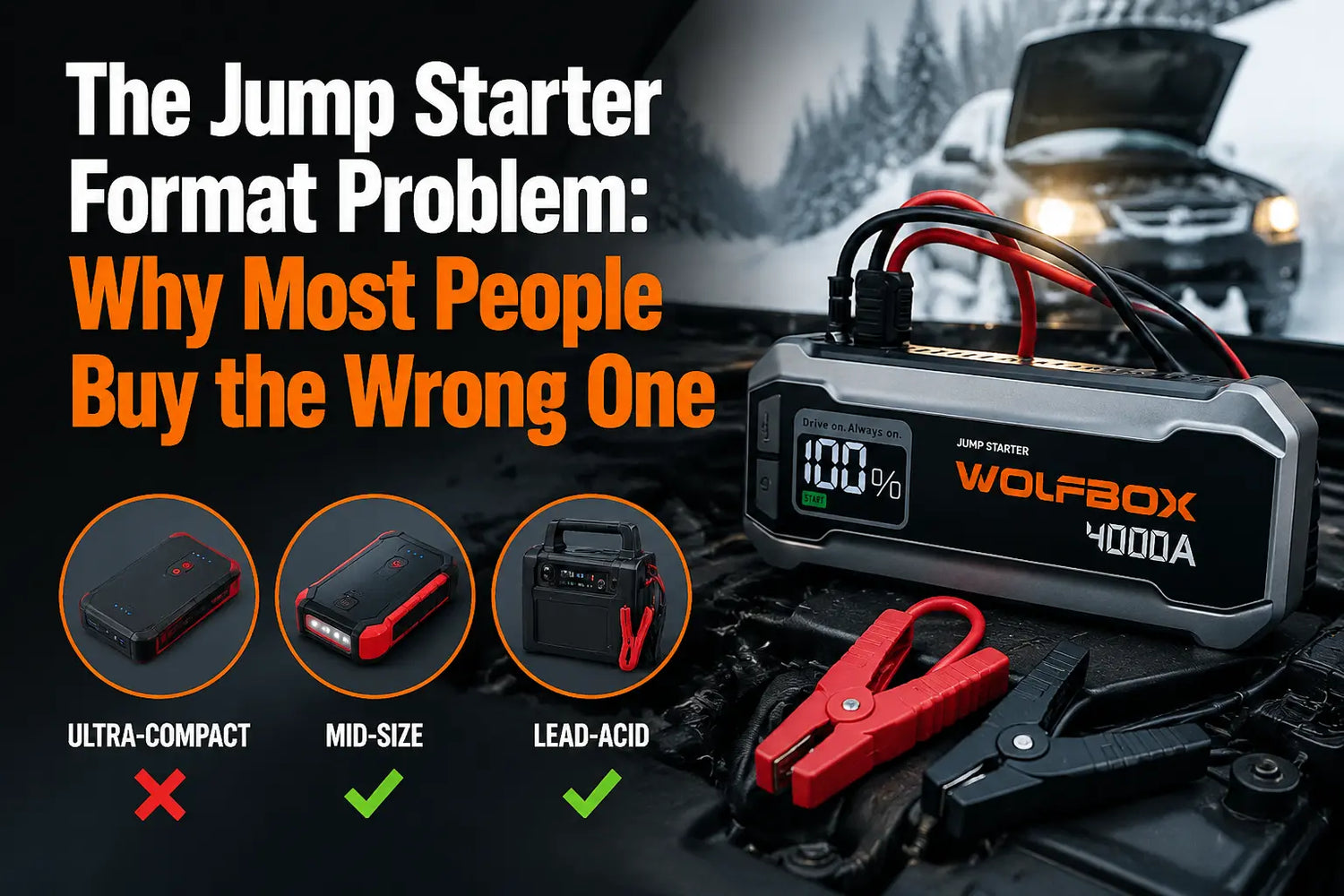
Ultra-Compact (Keychain / Glove Box Style)
Size and weight: typically 4–6 inches, under 8 oz. Capacity: 8,000–12,000 mAh. Rated for small gas engines up to 3.0–4.0L under normal conditions.
Where this works well: a compact car with a healthy battery on a mild-temperature morning. A sedan that sat for two weeks. An occasional battery drain situation.
Where it falls short: large displacement engines, diesel engines, any engine in serious cold, and older batteries with high internal resistance. Ultra-compact starters have less capacity margin — which matters most because cold is exactly when you need one.
Mid-Size Lithium (Most of the Category)
Size and weight: 8–12 inches, 1.5–3 lbs. Capacity: 15,000–24,000 mAh. Rated for gas engines up to 8L, diesel to 6L depending on model.
This is the reliable daily-driver choice for most full-size cars, SUVs, and gas-engine trucks under normal conditions. The key maintenance requirement: store at 50–80% charge if not used regularly, and recharge every 3–6 months. Lithium cells in storage at very low charge levels can degrade permanently.
Traditional Lead-Acid Pack
Size and weight: 15+ inches, 15–20+ lbs. AGM battery-based, typically 18–23Ah.
Lead-acid packs consistently handle diesel, large V8s, and cold weather without significant capacity degradation — cold affects lithium chemistry far more than AGM. The trade-offs are weight, bulk, and a slow recharge cycle after use (typically 12–16 hours). They make the most sense stored in a work truck or garage for infrequent use, or for diesel engine owners in cold climates who need reliable performance over portability.
The Cold Weather Variable Nobody Reads Before Buying
Lithium-ion chemistry is temperature-sensitive. At room temperature (77°F/25°C), lithium cells perform at rated capacity. At 32°F (0°C), usable capacity drops approximately 15–20%. At 14°F (-10°C), the drop is approximately 30–40% [2].
The practical consequence: a jump starter that starts a V6 easily at 70°F may struggle with the same engine at 10°F, because both the jump starter's output and the car battery's receiving capacity are degraded simultaneously by cold. Ultra-compact starters are most exposed because they start with less capacity margin. A mid-size lithium starter with substantially higher rated output has meaningful reserve to absorb cold-weather degradation and still deliver sufficient cranking current.
Peak amp ratings tested at room temperature don't capture this. The marketing number is measured under ideal conditions, not the conditions under which you actually need the device.
The Wolfbox MegaVolt24: What Right-Sized Actually Means
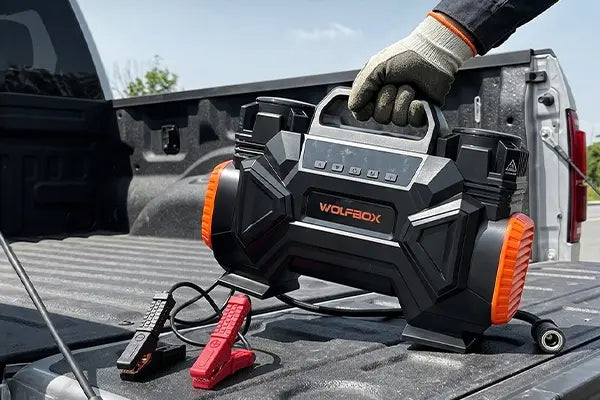
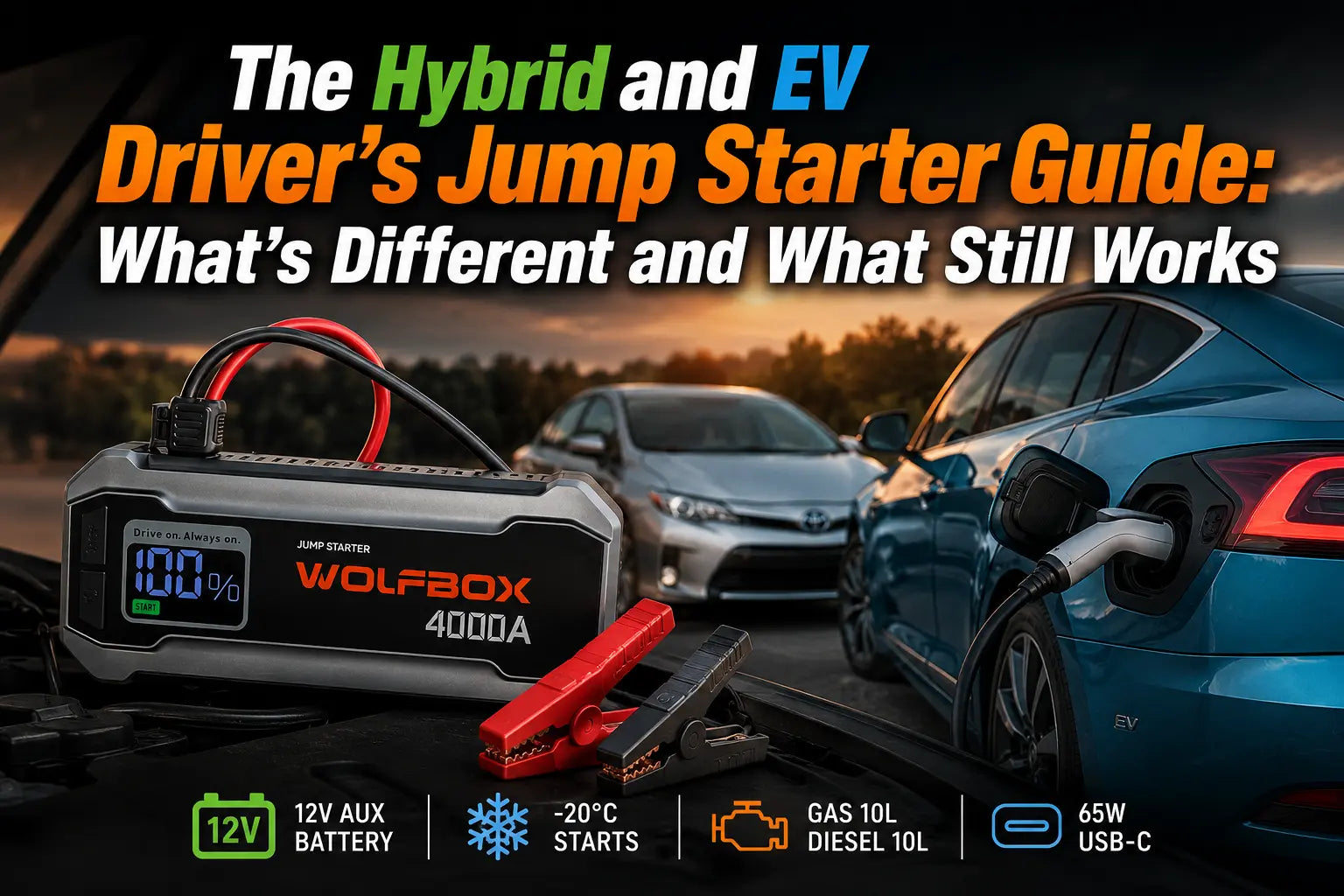
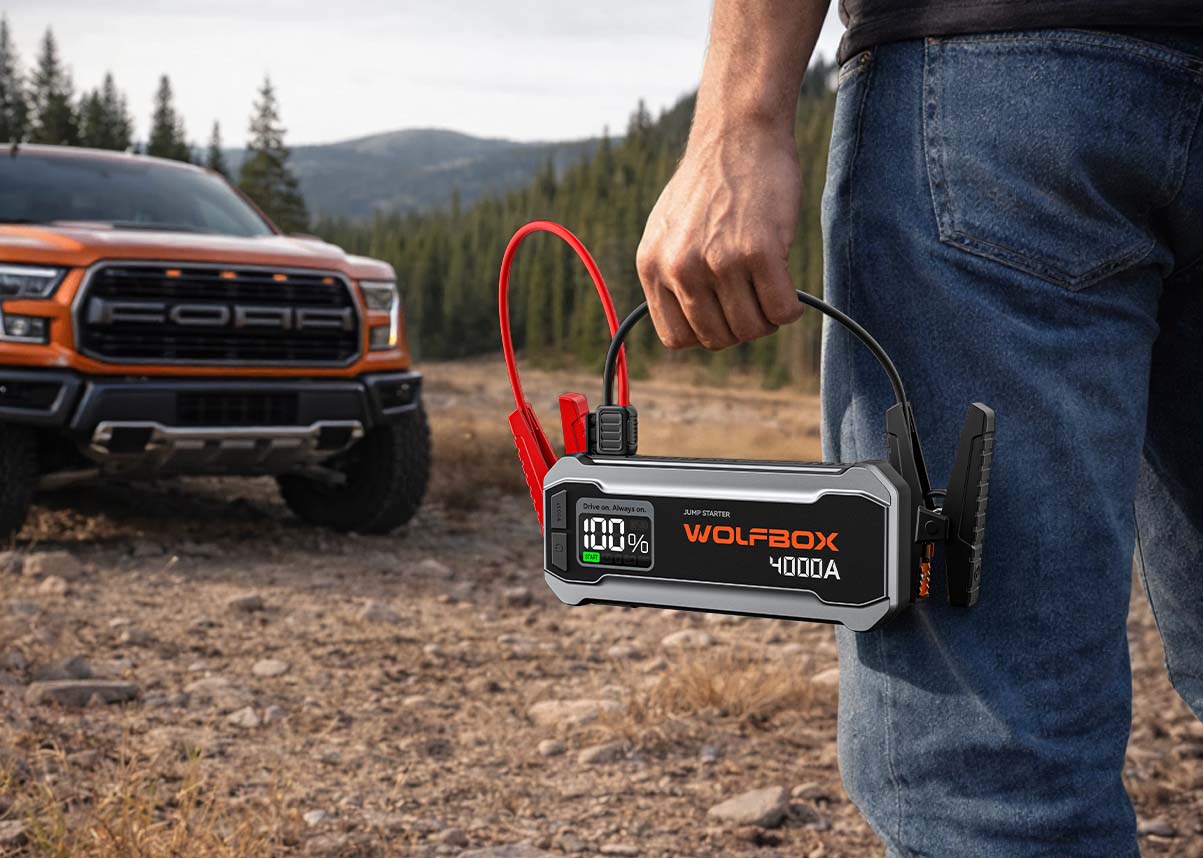
The Wolfbox MegaVolt24 is not compact. Rated at 4000A and positioned for 10L/12V vehicle starts, it is a mid-to-upper-capacity lithium starter for drivers who want margin rather than a glove-box emergency-only unit [5][6][7].
What justifies its footprint isn't the peak amp number — it's the combination of capacity margin with multi-function utility:
- 65W USB-C PD: charges a laptop, phone, or tablet at full speed — the same USB-C standard as a MacBook charger
- 18W USB-A: standard device charging alongside
- 4000A rated output: at -10°F cold degradation, sufficient reserve for most full-size gas engines that compact starters struggle with at the same temperature
- Size context: larger than a glove-box starter, but fits in a center console, under a seat, or in the cargo area of an SUV
The honest framing: if you drive a compact car with a newer battery in a mild climate, a mid-size starter may be more than you need. If you drive a truck, larger SUV, or diesel vehicle — or if you live somewhere with real winter — optimizing for "fits in glove box" is often optimizing for the wrong thing [3][4][5].

One Practical Decision Framework
Answer three questions before buying:
- What is the largest engine you'll ever need to start? If it's a diesel truck or a V8 in a cold climate, eliminate ultra-compact options immediately.
- What is the coldest morning in your climate? Subtract approximately 35% from the effective capacity of any lithium starter you're evaluating if that temperature falls below 14°F (-10°C). Does the device still have enough margin for your engine?
- Will the device do anything else useful? A jump starter with 65W USB-C charging can replace a separate power bank in your car kit. A device that only jumps cars is a single-function item taking up the same space.
Buyers who answer these questions before buying make a different decision than buyers who search "compact jump starter" and click the first result.

Frequently Asked Questions
Q: What does peak amps mean and why doesn't it match real-world performance?
Peak amps measure maximum instantaneous current output under manufacturer-defined test conditions that are not standardized. Cold Cranking Amps (CCA), measured under SAE J537 at 0°F (-17.8°C), is the more meaningful specification for real-world cold-weather cranking [1][2].
Q: How cold is too cold for a lithium jump starter?
Most lithium jump starters lose output as temperature drops. If the pack has been sitting in a freezing car, warming it indoors for 10–15 minutes before use can improve available current [3].
Q: Can a compact jump starter handle a diesel engine?
Most ultra-compact jump starters (under 12,000 mAh) are not rated for diesel engines. Diesel requires significantly higher cranking current. Check the manufacturer's engine compatibility specifications before purchasing.
Q: How often should I charge my lithium jump starter?
Store at partial charge and recharge every 3–6 months. Lithium cells stored at very low charge levels can degrade permanently over time [4].
Q: Is the MegaVolt24 compatible with 24V vehicles?
The Wolfbox MegaVolt24 is designed for 12V vehicle electrical systems. It is not rated for 24V systems used in most heavy-duty commercial trucks [5].
References
[1] SAE International — J537 Storage Batteries Standard: https://www.sae.org/standards/content/j537_201604/
[2] Battery University — How to Measure CCA: https://www.batteryuniversity.com/article/bu-902a-how-to-measure-cca/
[3] Battery University — Discharging Batteries at High and Low Temperatures: https://www.batteryuniversity.com/article/bu-502-discharging-at-high-and-low-temperatures
[4] Battery University — How to Store Batteries: https://www.batteryuniversity.com/article/bu-702-how-to-store-batteries
[5] Wolfbox MegaVolt24 Official Product Page — 12V jump starter specifications: https://wolfbox.com/products/wolfbox-megavolt24-jump-starter
[6] Popular Science — Wolfbox MegaVolt24 Air 4-in-1 Jump Starter Review: https://www.popsci.com/gear/wolfbox-4-in-1-jump-starter-with-air-compressor-review/
[7] Pro Tool Reviews — Wolfbox MegaVolt 24 Jump Starter Hands-On Review: https://www.protoolreviews.com/wolfbox-megavolt-24-jumpstarter-review/

Leave a comment
All comments are moderated before being published.
This site is protected by hCaptcha and the hCaptcha Privacy Policy and Terms of Service apply.