








You're 30 miles from the nearest cell signal, and your engine won't turn over in the cold morning air. It's a scenario that happens to overlanders every season. And the difference between a frustrating two-hour wait and a five-minute fix is whether you packed the right overland jump starter.
Choosing the best jump starter for overlanding isn't the same as choosing one for city driving. The requirements are significantly different. This guide covers everything you need to know, including why the Wolfbox MegaVolt24 remains the ultimate purchase for a steadfast fix.
Why Overlanding Puts Unique Demands on a Jump Starter?
A portable jump starter that works fine in a suburban parking lot may fall short in the backcountry. There are reasons why overland use raises the bar on every key spec.
1. Cold Temperatures Kill Batteries Faster
Battery capacity drops dramatically in cold weather. A fully charged automotive battery at 32°F delivers only about 65% of its rated capacity. At 0°F, that drops to around 40%.
Meanwhile, the engine's oil thickens in the cold, requiring more cranking power to turn over. The battery has less power available at the exact moment the engine demands more.
A quality overland jump starter needs to handle such issues reliably. You need a device rated for cold-weather starts, specifically one that maintains its output at around -4°F.
The low temperature is the real-world morning average in mountain camping from Colorado to British Columbia. A jump starter rated for this range handles any weather condition.
2. Larger Engines Need Higher Peak Amp Output
Most overlanding vehicles are not compact sedans. A lifted Ford Bronco, a Toyota Tundra, a Ram 1500 TRX, a Jeep Wrangler with a 3.6L or 2.0T engine – need significantly more cranking power.
A jump starter rated at 1000 or 1500 peak amps may be able to start a small engine on a warm afternoon. But it struggles with a large-displacement 4x4 on a cold morning.
The best jump starter for overlanding starts at 2500 peak amps for serious capability. However, it ideally reaches 3500 to 4000 amps for the large gas and diesel engines that populate most overland rigs.
3. Long Gaps Between Trips Require Long Charge Retention
City drivers may use vehicles and, most likely, jump starters every day. Overlanders may take two or three major trips per year, with months of storage between them.
A portable jump starter that holds its charge for 4 to 6 weeks doesn't serve overlanding purposes. You need a device that retains a usable charge for months in storage.
4. Remote Locations Eliminate Roadside Assistance as a Backup
In a city, a dead battery is an inconvenience. In a backcountry camping scenario, roadside assistance can't reach you. There may not be cell service even to place the call.
The overland jump starter in your kit becomes the only option. That reality changes the standard for what "good enough" means. Reliability and output matter more there.
What to Look for in the Best Jump Starter for Overlanding?
1. Peak Amp Output: Start Here
Peak amps determine whether it can deliver enough current to crank a cold, large-displacement engine. For most overlanding vehicles (gas or diesel), 3000 to 4000 peak amps covers the full range.
If you're driving a diesel truck or a vehicle with a particularly large engine, 4000A is the right baseline. For gas engines up to about 6.5L, 3000A handles the job comfortably in most conditions.
2. Battery Capacity: More Than Just Jump Starting
The battery capacity of the jump starter (measured in mAh) determines two things. First, you get how many times you can jump-start a vehicle per charge.
And second, how useful the device is as a power bank for charging, GPS, cams, and other devices. 20,000 mAh or higher capacity pulls double duty as a power source without depleting its jump-start reserves.
3. Cold-Weather Rating: Mandatory for Mountain and Winter
Check the operating temperature specification carefully. A jump starter rated to 14°F (-10°C) will fail on a mountain morning in the shoulder season.
For genuine overland jump starter reliability, look for a -4°F (-20°C) rating. It's the temperature range that covers the worst-case scenarios for camping in Northern US and Canadian backcountry conditions.
4. Charge Retention: The Forgotten Spec for Seasonal Users
Most jump starter listings don't prominently display charge retention data. Look for units that specify 6 to 12 months of charge retention.
The Wolfbox MegaVolt24 retains its charge for up to 12 months in storage. You can charge it after your fall trip, store it in your kit all winter, and pick up where you left off in the spring.
5. Output Ports: Dual-Purpose Value at Camp
Look for USB-A, USB-C with Power Delivery (at least 60W, ideally 100W), and a 12V DC output for accessories. A 100W USB-C PD port charges a laptop in about 90 minutes.
It particularly matters if you're working remotely from a basecamp. The same goes for topping up navigation devices before a long day of trail driving.
6. Safety Protections: Essential When Working Near Batteries
Automotive battery work poses real electrical risks that can cause damage or injury. A quality jump starter for off-road use should include intelligent clamp protection.
It should detect + prevent reverse polarity connections, short circuits, overcharge, and over-discharge. Those are essential in remote settings, especially when working in low light, in the cold, or under stress.
Read more: The Jump Starter Buying Trap
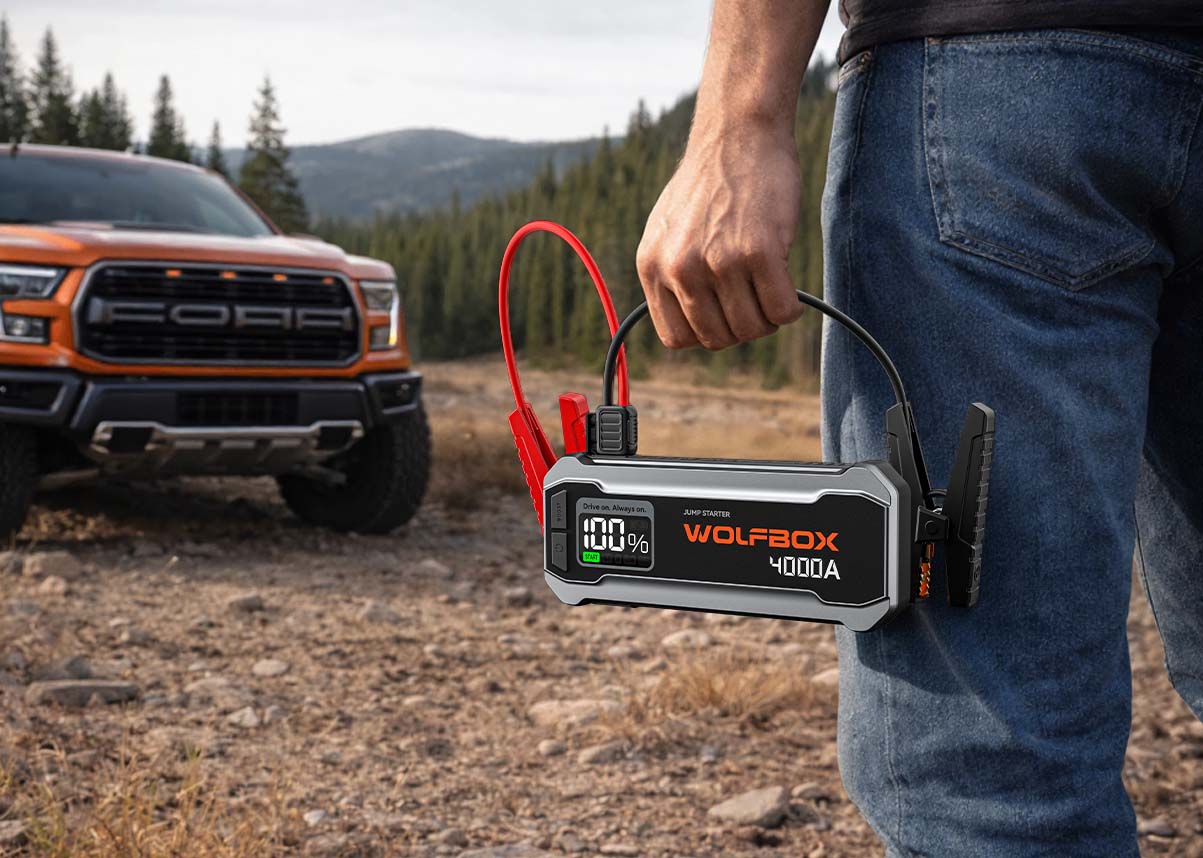
Wolfbox MegaVolt24 4000A: Built for Overland and Off-Road Use
1. 4000 Peak Amps for Any Off-Road Engine
Its 4000 peak amps are enough to handle large-displacement gas engines and most diesel 4x4 platforms. You can run a Jeep Wrangler 392, a Ford Bronco Raptor, a Toyota Land Cruiser, or a diesel-equipped truck.
The MegaVolt24's output can cover the engine without checking spec sheets against the displacement rating first. It seems easy when you're packing gear at 5 am, with no intention of second-guessing your choices.
2. 24,000 mAh Capacity Powers Engine + Camp Devices
The 24,000 mAh battery capacity is one of the highest in its class. It provides enough stored energy for multiple jump starts per charge. It seems useful when you're helping a fellow overlander in addition to covering your own vehicle.
It also functions as a serious power bank at camp. The USB-C PD 100W output charges a modern laptop in roughly 90 minutes and a smartphone in under 45 minutes. Meanwhile, the USB-A ports handle multiple devices simultaneously.
3. Rated to -4°F for Mountain and Cold-Season Reliability
The Wolfbox MegaVolt24's cold-start rating of -4°F is among the more aggressive temperature specifications. It remains functional in extreme conditions, not just "cold for the suburbs".
You can handle high-altitude colds in the Sierra Nevada or a shoulder-season trip in the Canadian Rockies. That reliability comes from the battery chemistry and the design of the jump cables.
4. 12-Month Charge Retention for Infrequent Adventurers
The MegaVolt24 holds its charge for up to 12 months in storage. Many drivers take two or three overlanding trips per year with significant time between them.
That's where the spec makes the device reliable. Charge it once after you return from a trip, store it in your kit, and it's ready when you head out next time.
5. Smart Clamp System with Full Safety Protection Suite
The smart clamp system detects reverse polarity connections before current flows and automatically prevents engagement. It also protects against short circuits, overcharge, overdischarge, and overheating.
An overlander may attempt jump-starting in low light, in the cold, or under pressure. Those protections eliminate the risk of damaging the jump starter, the vehicle's electronics, or themselves.
6. Built-In LED Flashlight with Strobe and SOS Modes
The built-in LED flashlight on the MegaVolt24 isn't an afterthought. Instead, it's bright enough to illuminate an engine bay in the dark and includes strobe and SOS modes for emergency signaling.
A reliable hands-free light source integrated into the jump starter is the kind of detail. And it makes a real difference at 2 am when you're troubleshooting an engine problem at a dark campsite.

Wolfbox MegaVolt24 Specs Decoded for Overland Use
|
Spec |
What It Means |
Why It Matters Overland |
|
4000A Peak Amps |
Maximum current burst to start the engine |
Handles large gas and diesel 4x4 engines reliably |
|
24,000 mAh Capacity |
Total stored energy |
Multiple jumps per charge; also charges devices at camp |
|
USB-C PD 100W |
High-speed device charging |
Phones, tablets, and GPS units all charge quickly |
|
12V DC Output |
Powers 12V accessories |
Compatible with air compressors, lights, and tire pumps |
|
-4°F Cold Start |
Minimum operating temperature |
Works in mountain mornings and winter off-road conditions |
|
LED Flashlight + Strobe |
Built-in emergency light |
Hands-free lighting at camp or roadside |
|
Smart Clamp Safety |
Reverse polarity + short circuit protection |
Safe to use on unfamiliar or older batteries |
|
12-Month Charge Retention |
How long does it hold a charge in storage |
Ready after months between trips |
How to Use Your Overland Jump Starter Correctly
- Power off both vehicles or, for a single dead battery situation, ensure all vehicle electronics are off.
- Identify the battery terminals. Red is positive (+), black is negative (−). Clean away any corrosion on the terminal with a rag.
- Connect the red clamp to the positive terminal of the dead battery first.
- Connect the black clamp to an unpainted metal ground point on the engine block or chassis.
- Power on the Wolfbox MegaVolt24 using the unit's button. Wait for the ready indicator.
- Attempt to start the engine. If it doesn't start within 3 to 5 seconds, wait 60 seconds before trying again.
- Once the engine starts, disconnect the black clamp first, then the red clamp. Power off the MegaVolt24.
- Let the engine run for at least 15 to 20 minutes to begin recharging the vehicle battery.
Cold-Weather Jump Starting: What's Different
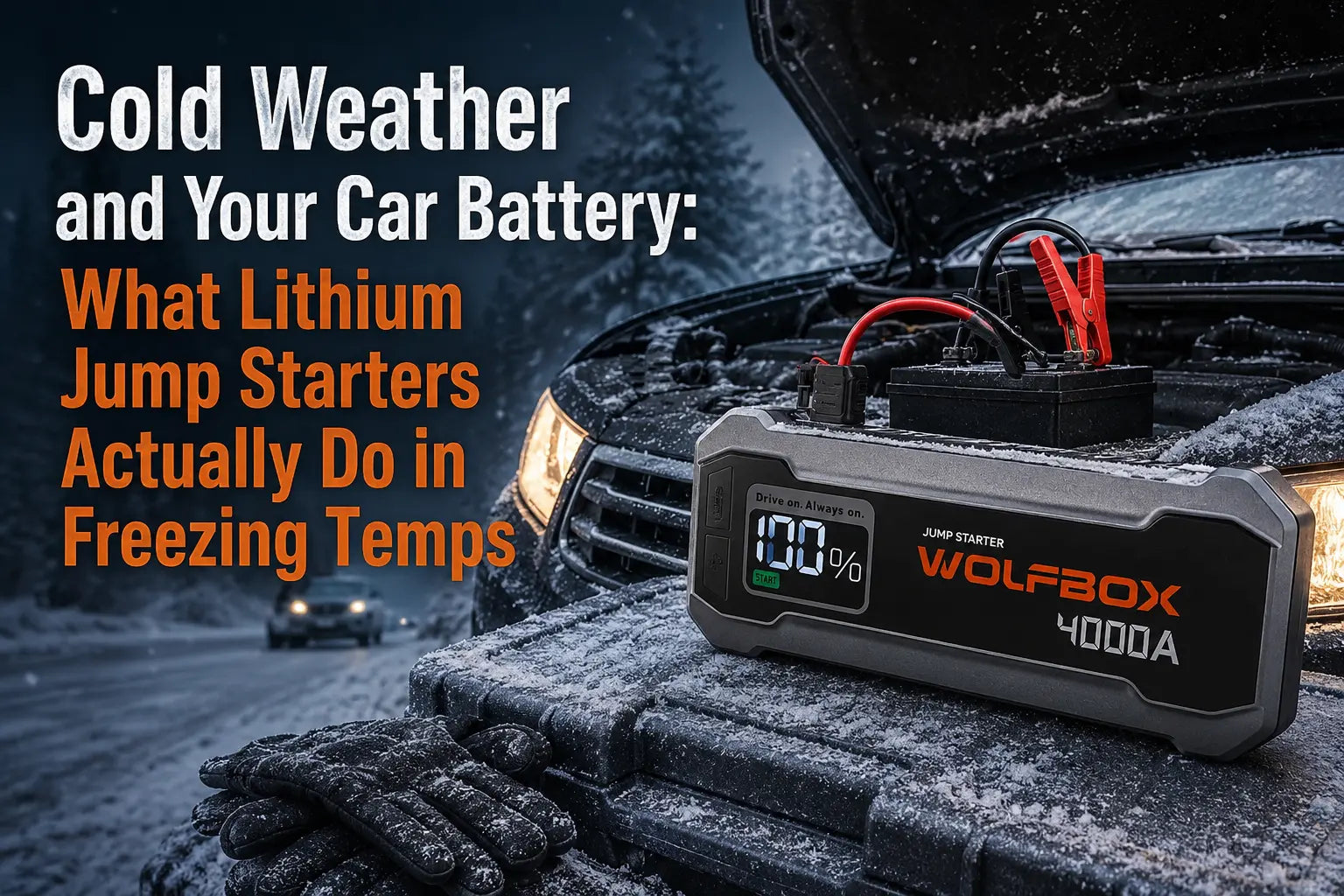
Cold conditions require a small adjustment to the standard procedure. Before attempting a cold-weather jump start, let the MegaVolt24 warm up slightly by leaving it inside the cab for 10 to 15 minutes.
Also, give the dead battery a moment to absorb a surface charge before cranking. Connect the clamps, power on the MegaVolt24, and wait 90 seconds before attempting to start.
Conclusion
A dead battery in the backcountry, at a campsite, or on a road trip can quickly turn into a serious problem without the right overland jump starter. Remote travel demands more than city driving, especially in terms of cold-weather performance, reliability, and long charge retention.
For overlanding, camping, and road trips, key needs stay the same: strong peak power, cold-start capability, and dependable storage life. These ensure you’re prepared when help isn’t available.
Wolfbox delivers jump starters built for these outdoor scenarios, providing reliable performance for off-road travel, camping, and long-distance road trips, helping you stay powered wherever your journey takes you.
Frequently Asked Questions (FAQs)
1. What is the best jump starter for overlanding?
The best jump starter for overlanding combines high peak amp output, a cold-start rating at or below -4°F, long charge retention, and a large enough battery capacity to serve as a power bank at camp.
2. Can a jump starter handle a diesel truck off-road?
Yes. Diesel engines require more cranking power than equivalent gasoline engines in cold conditions. The Wolfbox MegaVolt24's 4000 peak amps can handle diesel engines up to 10L displacement.
3. How long does the Wolfbox MegaVolt24 hold its charge?
The Wolfbox MegaVolt24 retains its charge for up to 12 months in storage under normal conditions. It seems sufficient for seasonal trips and overlanders who need the device ready without maintenance.
4. Can I use a jump starter as a power bank while camping?
Yes. The MegaVolt24's USB-C PD 100W port charges laptops, cameras, GPS, and tablets. The USB-A ports handle phones and smaller devices. The 24,000 mAh capacity is enough to charge multiple devices.
5. How many times can the MegaVolt24 jump-start a vehicle per charge?
Under normal conditions, the Wolfbox MegaVolt24 provides enough capacity for approximately 30 jump starts. For large-displacement engines that draw more current per start, that number is lower.

Leave a comment
All comments are moderated before being published.
This site is protected by hCaptcha and the hCaptcha Privacy Policy and Terms of Service apply.