








The jump starter shows three bars. The clamps are on. The key turns. Two slow cranks, then nothing.
This happens to a lot of drivers every January — not because they bought a bad product, but because nobody explained what lithium cells actually do in a 15°F parking lot. The device that started the same car effortlessly in October is now delivering a fraction of that performance, and the spec sheet gave no warning.
The Chemistry Is Temperature-Dependent
Lithium-ion cells store energy through electrochemical reactions between anode, cathode, and electrolyte solution. At room temperature, ions move freely through the electrolyte and the reaction is efficient. As temperature drops, the electrolyte becomes more viscous — ion movement slows, internal resistance increases, and the cell delivers less current for the same state of charge [1].
At 32°F (0°C), a lithium cell typically delivers approximately 60–80% of its rated room-temperature capacity. At 14°F (-10°C), usable capacity drops to approximately 60–70%. At -4°F (-20°C), many cells reach 50% or below — and some hit their low-temperature protection cutoff and shut off output entirely [1].
The peak amp number on the package was measured at approximately 68–77°F (20–25°C). That number is not a cold-weather number.
Why Cold Hurts Both Sides of the Jump
Cold weather degrades both sides of the jump-starting equation at the same time.
A depleted car battery's ability to accept surface charge and deliver cranking current is reduced in cold temperatures. The engine itself requires more current to crank when oil viscosity is high [5]. A battery that was borderline in September — old, partially degraded, technically functional — often reaches its actual failure point in the first week of sustained below-freezing temperatures.
In a serious cold-weather scenario, the jump starter delivers less than rated output, the car battery accepts charge less efficiently, and the engine demands more current to crank. The margin that worked in October no longer exists.
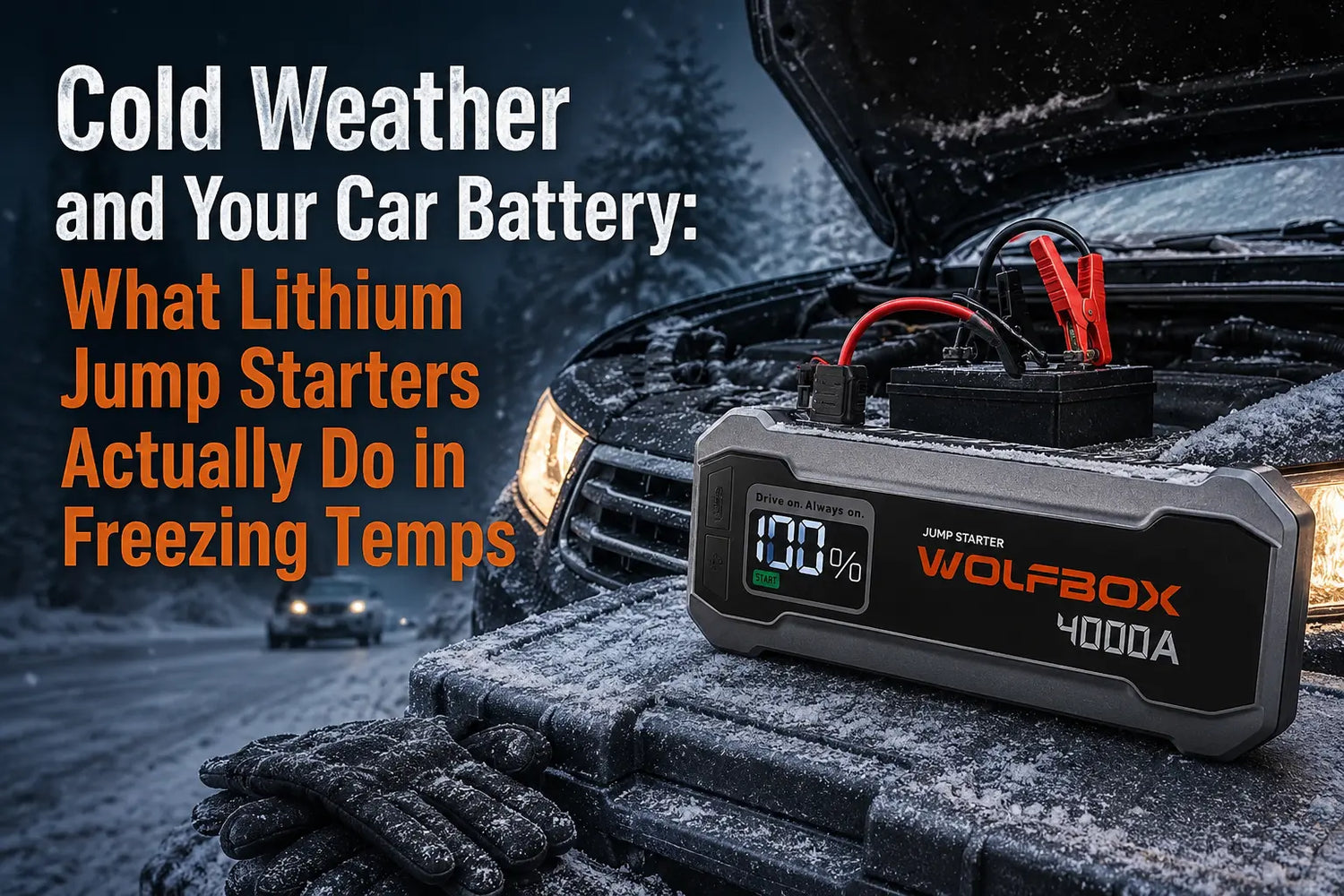
This is why compact keychain-style jump starters — often rated at 800–1,500 peak amps — struggle disproportionately in serious cold. At 50% cold degradation, an 800A-rated device delivers roughly 400A. The Wolfbox MegaVolt24 is rated at 4000A peak with a 24,000 mAh capacity and a minimum operating temperature of -4°F (-20°C) [2][3]. At 50% cold degradation, it still delivers approximately 2,000A — well above the sustained cranking requirement for most passenger vehicles and light trucks [3].

The Pre-Warm Technique
Before concluding the jump starter is defective, do this: take it inside. Ten to fifteen minutes in a heated space — a car cabin with the heat running, a jacket pocket, any room above freezing — restores much of the cold-weather capacity loss.
Lithium cells that are cold-soaked and then warmed to room temperature return to near their rated capacity without any lasting damage from the cold event [1][4]. If warming the device for 15 minutes restores full function, the device is working correctly.
What Peak Amps Doesn't Tell You
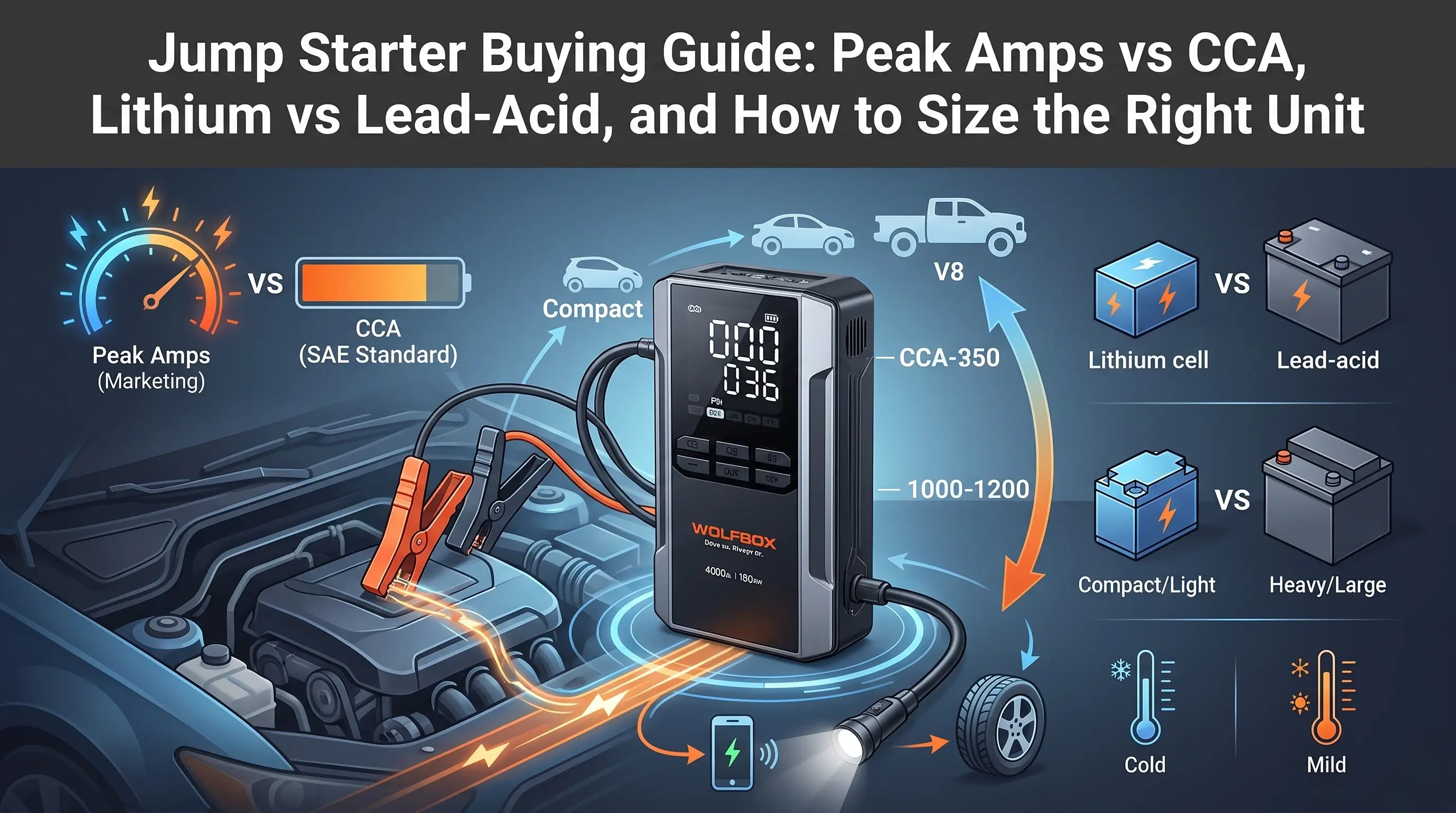
Every peak amp rating on every consumer jump starter is tested at room temperature. There is no regulatory standard requiring cold-weather testing, no SAE-standardized protocol for jump starter cold performance the way SAE J537 standardizes car battery CCA testing.
Cold Cranking Amps (CCA) measures a battery's sustained current delivery at 0°F (-17.8°C). Most jump starter manufacturers don't publish a CCA equivalent because it would be substantially lower than the peak amp headline number.
When evaluating a jump starter for cold-climate use, the relevant question is not "what is the peak amp rating?" but "what is the rated capacity, and what is the minimum operating temperature?" A higher-capacity device has more margin to absorb cold-weather degradation before falling below functional threshold [3][6].
Winter Preparation That Actually Matters
Storage location: keep the jump starter in the cabin, not the trunk. In sub-freezing weather, trunk temperatures equal outdoor ambient. The cabin warms up during driving. A device stored under the front seat arrives at a cold parking lot noticeably warmer than one pulled from the trunk.
Charge before the cold season. Lithium self-discharge is approximately 1–2% per month at room temperature. A device that went into fall at 60% may be at 45% by January. Wolfbox recommends maintaining 50–80% charge during storage and recharging every 3–6 months [2][7].
For diesel engines or climates that regularly drop below 0°F (-18°C): prioritize rated capacity over portability. The capacity margin is the buffer consumed by cold-weather degradation.
During the Jump Attempt in Cold Weather
If the device is cold and warming is not immediately possible: connect the clamps and wait 60–90 seconds before attempting to crank. This allows the depleted car battery to receive surface charge before being asked to start the engine.
Use Boost Start Mode if the device has it. The MegaVolt24 includes Boost Start Mode specifically for deeply discharged batteries [2][7].
After a successful start, keep the engine running for at least 15–20 minutes. The alternator will begin recharging the depleted car battery. If the battery is genuinely failing — not just cold-stressed — a successful cold jump start is the beginning of the diagnosis, not the resolution.

Frequently Asked Questions
Q: My jump starter shows full charge but won't start the car in cold weather. Is it defective?
Probably not. Cold temperature reduces lithium output by roughly 30–40% at 14°F (-10°C). Bring the device inside for 10–15 minutes and try again. If it works after warming, it is functioning correctly.
Q: Does using a jump starter in cold weather permanently damage it?
No. Cold discharge does not cause permanent damage. Storing at very low charge through extended cold periods can cause some degradation, but normal cold-weather use does not damage the cells.
Q: At what temperature does a lithium jump starter stop working?
The MegaVolt24 has a rated operating floor of -4°F (-20°C). Below that, the device's low-temperature protection may prevent output. Warming the device above -4°F is required.
Q: Should the jump starter go in the trunk or the glovebox?
The cabin — glovebox or under a seat. Trunk temperatures in extreme cold equal outdoor ambient. The cabin stays warmer during driving.
Q: What is CCA and why don't jump starters publish it?
Cold Cranking Amps measures sustained current delivery at 0°F (-17.8°C) per SAE J537. Most jump starters publish only peak amps — tested at room temperature — because the CCA figure is substantially lower.
References
[1] Battery University — Low-temperature performance of lithium-ion batteries: https://batteryuniversity.com/article/bu-410-charging-at-high-and-low-temperatures
[2] Popular Science — Wolfbox MegaVolt24 Air 4-in-1 field review: https://www.popsci.com/gear/wolfbox-4-in-1-jump-starter-with-air-compressor-review/
[3] Pro Tool Reviews — Wolfbox MegaVolt 24 Jump Starter review: https://www.protoolreviews.com/wolfbox-megavolt-24-jumpstarter-review/
[4] ScienceDaily — Research summary on why lithium-ion batteries fail in cold weather: https://www.sciencedaily.com/releases/2021/08/210826111716.htm
[5] FuelEconomy.gov — vehicle maintenance and efficiency guidance: https://www.fueleconomy.gov/feg/maintain.jsp
[6] Road & Track — Best Jump Starters roundup: https://www.roadandtrack.com/car-gear/car-accessories/g46099042/best-jump-starters/
[7] Wolfbox official jump starter collection: https://wolfbox.com/collections/jump-starter

Leave a comment
All comments are moderated before being published.
This site is protected by hCaptcha and the hCaptcha Privacy Policy and Terms of Service apply.