








A jump starter sized for a compact sedan will often stall out on a diesel pickup, while a unit built for a full-size truck is more bulk and expense than a small SUV actually needs. The fix isn't guessing based on price or a big number on the box — it's matching cold cranking amps (CCA) to what your specific engine actually requires.
The Number That Actually Matters: CCA, Not Peak Amps
Cold Cranking Amps is a standardized measurement defined under SAE J537: it's how much current a 12-volt battery can deliver at 0°F for 30 seconds while staying above 7.2 volts [1]. That's the figure that predicts whether a device will actually turn your engine over. "Peak amps," the number splashed across most jump starter packaging, has no equivalent industry standard behind it, which is why two units with wildly different peak-amp claims can perform almost identically in practice.
Small four-cylinder engines generally need somewhere around 300–450 CCA. A V8 pickup or full-size SUV climbs into the 600–800 CCA range. Diesel trucks, because of their higher compression ratios, often need 950 CCA or more just to crank reliably [2][3]. Since SUVs, trucks, RVs, and mixed household fleets span this entire range, one jump starter rarely fits every vehicle equally well — the trick is sizing to the largest engine you'll actually need to start.
Engine Size to CCA: A Quick Reference
| Engine Type | Typical Displacement | CCA Generally Needed | Jump Starter Tier to Look For |
| Compact 4-cylinder gas | Up to 2.0L | 300–450 CCA | Entry-level pack, 1,500–2,000A peak |
| Mid-size gas engine | 2.0L–4.0L | 400–600 CCA | Mid-tier pack, 2,000–3,000A peak |
| Large V6/V8 gas engine | 4.0L–6.2L | 600–800 CCA | High-output pack, 3,000–4,000A peak |
| Light-to-medium diesel | Up to 6.6L | 950–1,100 CCA | Maximum-tier pack, 4,000A peak, diesel-rated |
Treat these as starting points, not gospel. A weak or aging battery, thick winter-grade oil, and cold ambient temperatures all push the real requirement higher than the numbers above suggest — check your battery's own CCA label when you can.
Where MegaVolt 24Air and MegaVolt 10Air Actually Land
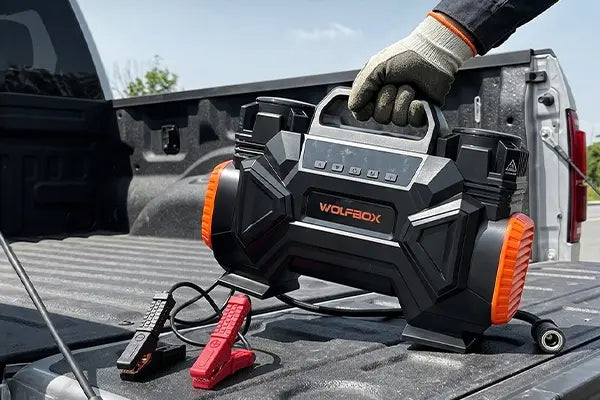
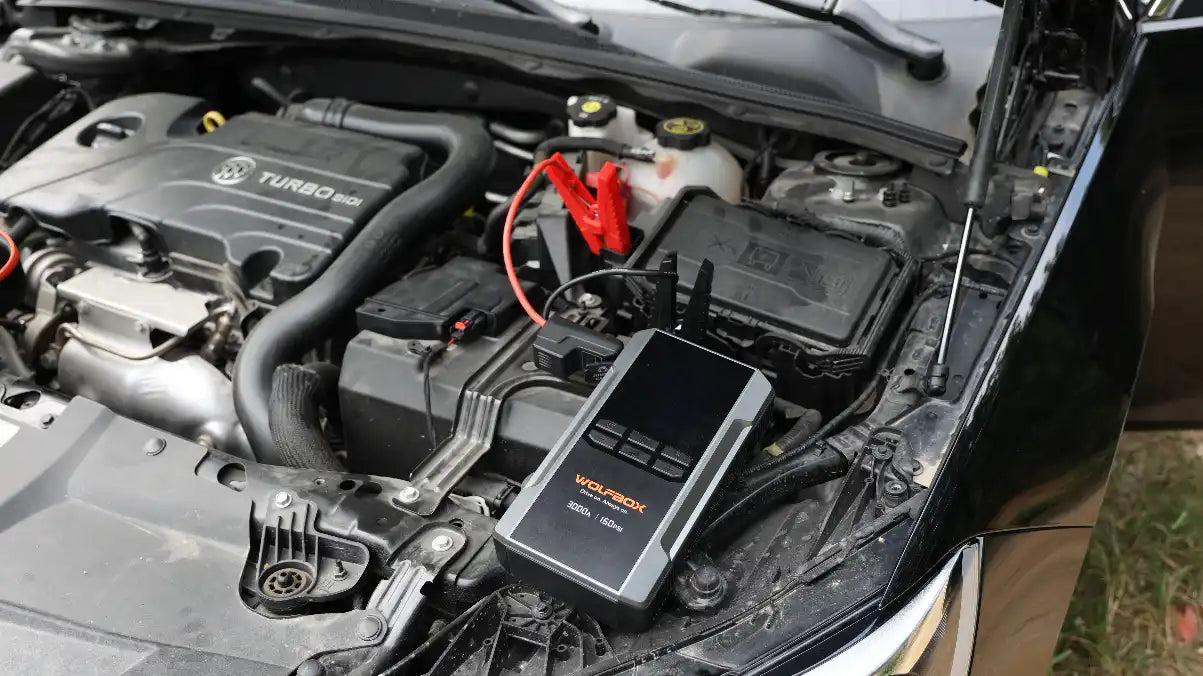
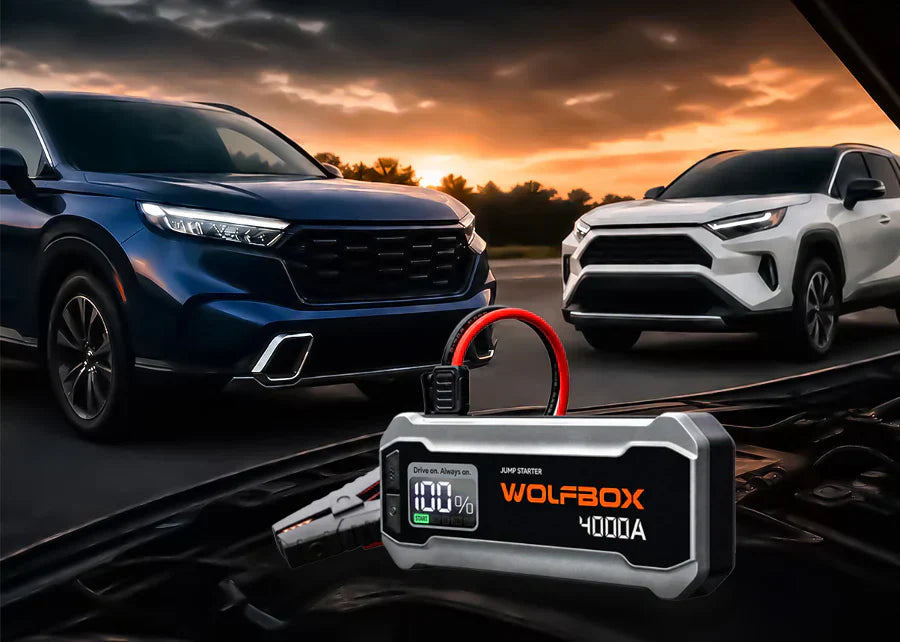
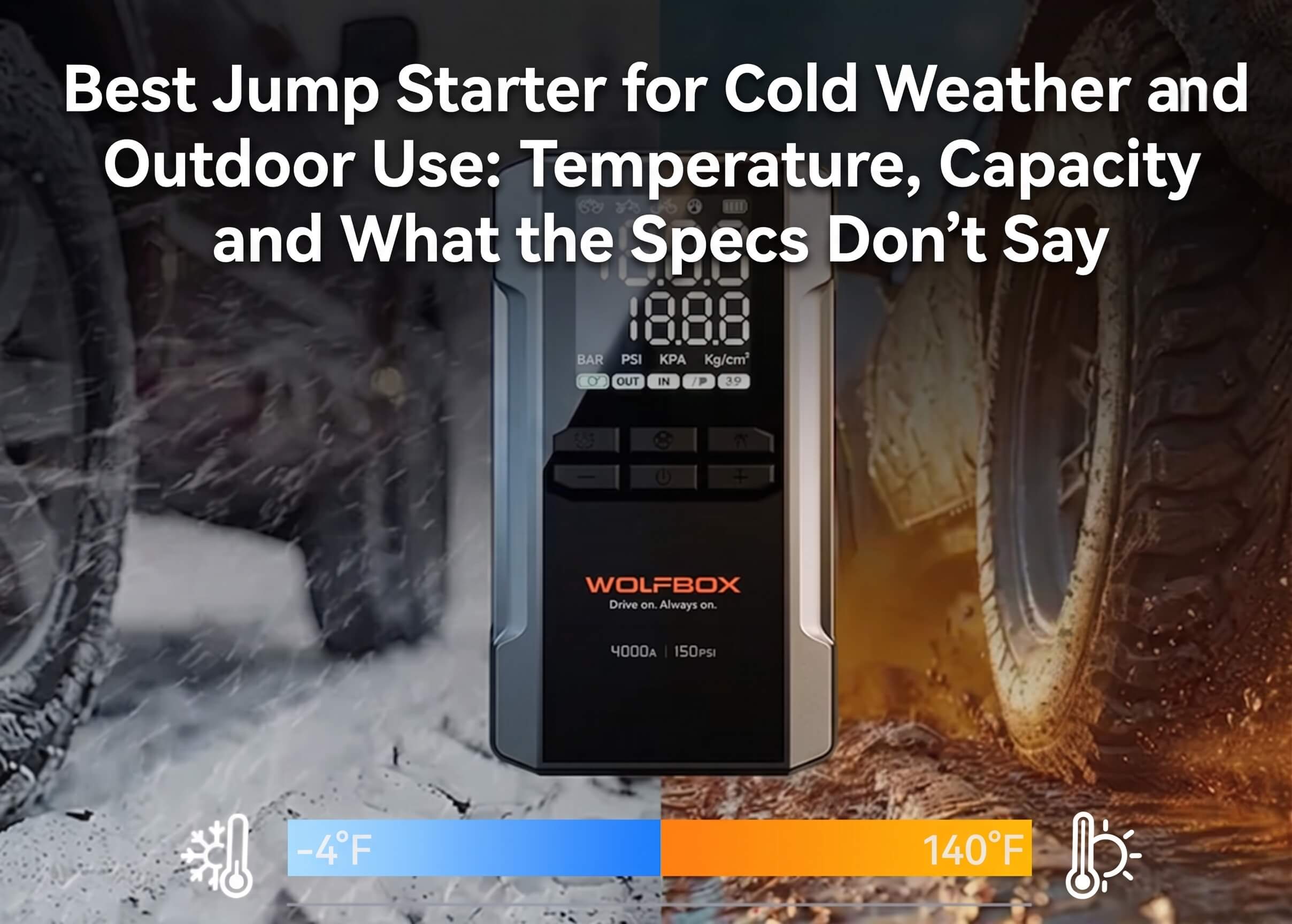
Wolfbox sells two jump starter platforms right now, and they're built for different ends of that table. The MegaVolt 24Air runs on a 24,000mAh (88.8Wh) lithium battery and puts out 4,000A of peak current, rated to start 12V gas engines up to 10L and diesel engines up to 10L, with up to 40 jump starts on a full charge depending on the vehicle and battery condition [4][5][6]. That's squarely in the top tier — a reasonable pick for full-size trucks, 3/4-ton and 1-ton diesel pickups, larger SUVs, and RVs with sizable engines.
The MegaVolt 10Air is the smaller sibling: a 2,000A unit with a 10,000mAh (37Wh) battery, rated for gasoline engines up to about 5L, delivering roughly 20–30 jump starts per charge [7][8][9]. It's a sensible choice for compact and mid-size gas SUVs and sedans, or as a lighter backup unit for a second household vehicle — but it's not the one to reach for on a diesel truck.
| Spec | MegaVolt 24Air | MegaVolt 10Air |
| Peak Current | 4,000A | 2,000A |
| Battery Capacity | 24,000mAh / 88.8Wh | 10,000mAh / 37Wh |
| Rated Engine Coverage | Up to 10L gas / 10L diesel | Up to 5L gas |
| Jump Starts per Charge | Up to 40 | 20–30 |
| Air Compressor | 45L/min, up to 160 PSI | Up to 150 PSI |
| USB-C Output | 65W PD | USB-C, lower wattage ceiling |
| Operating Temperature | −4°F to 140°F | −4°F to 140°F |
| Water/Dust Resistance | IP64 | IP64 |
Source: Wolfbox official product listings and independent testing [4][5][6][7][8][9].
Sizing for a Multi-Vehicle Household
If your driveway has more than one type of vehicle — say, a truck and a commuter car, or an SUV and a motorcycle — size to the largest engine, not the smallest. A 4,000A-class unit will comfortably start a small car, a motorcycle, or a lawnmower battery, but the reverse doesn't hold: a 2,000A unit bought for a compact car will often struggle or fail outright on a diesel truck [2][3]. Some households simply keep two units — a high-output one in the truck, a lighter one in the daily driver — rather than shuttling a single device between vehicles.
What RV Owners Need to Think About Differently
RVs complicate the picture in two ways: larger chassis engines on Class A and Class C motorhomes, and long stretches of dormancy between trips that drain both the vehicle's starting battery and the jump starter's own charge. A few habits matter more here than for a daily-driven car:
- Store the unit at roughly 50–80% charge rather than topping it off to 100% or letting it sit fully depleted for months.
- Recharge every 3–4 months during off-season storage — lithium packs self-discharge slowly, but they don't hold charge forever.
- Keep the unit in the RV's cabin instead of an exterior storage bay, where temperature swings are more extreme.
- Check your RV's actual chassis engine against the jump starter's rated coverage. Some Class A diesel motorhomes exceed what any personal jump starter — including a 4,000A unit — is designed to handle, in which case a professional-grade booster or roadside service is the safer call.
For most gas-powered Class B/C RVs and standard tow vehicles, though, a 4,000A unit like the MegaVolt 24Air fits comfortably within its rated 10L gas/10L diesel range [4][5].
Common Mistakes to Avoid
Don't buy based on an unqualified peak-amp number with no CCA context — that's precisely the gap that leads buyers astray, since peak-amp claims aren't standardized the way CCA is [1][2]. And be skeptical of any jump starter marketed as working for "all vehicles" without reference to a specific engine size or fuel type; a legitimate recommendation should always tie back to displacement, fuel type, or vehicle class.
Frequently Asked Questions
**What CCA rating do I need for a full-size truck?**
Full-size gas V8 trucks (4.0L–6.2L) generally need 600–800 CCA, while diesel trucks up to 6.6L can require 950–1,100 CCA.
**Can one jump starter cover both my SUV and my motorcycle?**
Yes — a higher-capacity unit rated for larger engines will also start smaller ones, since the limiting factor is having enough current, not too much.
**Do RVs need a different jump starter than trucks?**
Not a different type of device, but RV owners should size to their actual chassis engine and pay closer attention to charge levels during long storage gaps between trips.
**How often should I recharge a jump starter that mostly sits unused?**
Roughly every 3–4 months is a reasonable interval to offset natural self-discharge in lithium packs.
**Is a 2,000A jump starter enough for a diesel truck?**
Generally no. Diesel engines need higher CCA due to their compression ratios, which typically exceeds what a 2,000A-class unit like the MegaVolt 10Air is rated to handle.
References
[1] SAE J537 Automotive Lead-Acid Battery Testing for Cranking Performance, TestingLab — https://www.testinglab.com/sae-j537-automotive-lead-acid-battery-testing-for-cranking-performance
[2] How Many Amps to Jump Start a Car? Buyers Guide — https://www.autotoolsuppliers.com/how-many-amps-to-jump-start-a-car/
[3] How Many Amps To Start A Car: 200-400 Cold Cranking Amps — https://www.alibaba.com/product-insights/how-many-amps-to-start-a-car-200-400-cold-cranking-amps-typically-needed.html
[4] WOLFBOX MegaVolt 24Air Official Product Page — https://wolfbox.com/products/jump-starter-with-air-compressor-tire-inflator-wolfbox-megavolt-24air
[5] I tested the Wolfbox 4-in-1 Jump Starter with Air Compressor, PopSci — https://www.popsci.com/gear/wolfbox-4-in-1-jump-starter-with-air-compressor-review/
[6] WOLFBOX MegaVolt 24Air Official Product Page (US) — https://wolfbox.com/products/jump-starter-with-air-compressor-tire-inflator-wolfbox-megavolt-24air
[7] WOLFBOX 2000A Jump Starter with Air Compressor, Newegg listing — https://www.newegg.com/p/0MD-06DG-00007
[8] WOLFBOX 2000A Jump Starter with Air Compressor, Best Buy listing — https://www.bestbuy.com/product/wolfbox-2000a-jump-starter-with-air-compressor-up-to-5l-gas-engine-12v-jump-box-with-150psi-tire
[9] WOLFBOX MegaVolt10 Air Instruction Manual — https://manuals.plus/asin/B0FNWHS4DQ

Leave a comment
All comments are moderated before being published.
This site is protected by hCaptcha and the hCaptcha Privacy Policy and Terms of Service apply.