








A jump starter that cranks a truck without hesitation in July can feel noticeably weaker at 14°F. That's not a defect — it's basic lithium chemistry. Ion movement slows down in the cold, internal resistance climbs, and usable capacity drops. Knowing roughly how much it drops, and adjusting how you store and use the unit, matters more than any single peak-amp number on the box.
How Much Capacity Cold Actually Costs You
The capacity loss isn't linear — it accelerates the further temperatures fall below freezing, based on published research on lithium-ion behavior in low temperatures [1][2].
| Ambient Temperature | Approximate Capacity Loss | What That Means in Practice |
| 32°F (0°C) | 15–20% | Noticeable, but still generally usable for a standard jump-start |
| 14°F (−10°C) | 30–40% | Meaningfully reduced output; fewer jump-starts per charge |
| −4°F (−20°C) | 40–50% | Significant reduction; a full charge and boost mode both start to matter |
For context, lead-acid (AGM) batteries also lose capacity in the cold, but through a different mechanism, and they generally retain less of their rated capacity near freezing than lithium does — commonly cited around 70–80% versus roughly 80–85% for lithium [2][3]. Where lithium loses ground is at deeper cold: it needs a reduced charge rate below freezing, while AGM is more forgiving on that front even as its own output drops.
AGM vs. Lithium, Side by Side
| Factor | AGM (Lead-Acid) | Lithium |
| Capacity Near 32°F | Roughly 70–80% of rated | Roughly 80–85% of rated |
| Capacity Below 14°F | Degrades further, but charge-tolerant | Drops 30–50%; charge current must be reduced |
| Charging in Sub-Freezing Temps | Generally tolerant of normal charge rates | Needs reduced charge current — commonly 0.1C between 32°F and 14°F, 0.05C below that [1] |
| Weight for Equivalent Output | Heavier | Significantly lighter |
| Self-Discharge Over Months | Faster | Slower, but not zero |
Neither chemistry "wins" outright in cold climates. Lithium holds more of its capacity right around freezing and weighs a fraction of an equivalent AGM pack, but it demands more careful charge management once temperatures drop further. AGM tolerates sloppier charging habits but loses more capacity near freezing and carries more weight for the same output.
Storage Habits That Actually Extend Reliability
A jump starter sitting in a vehicle, garage, or camper through winter benefits from a few specific habits, not just "keep it charged":
- Store at roughly 50–80% charge for long dormancy periods — not topped off to 100%, and not left to run flat.
- Recharge every 3–4 months during storage. Self-discharge continues even when the unit is switched off.
- Skip unheated exterior compartments for extended storage if local winter lows regularly exceed the unit's rated minimum operating temperature.
- Let the unit warm up briefly indoors before a jump-start if it's been sitting exposed to extreme cold for hours — a warmed pack delivers closer to its rated output than one straight out of a freezing trunk.
Where MegaVolt 24Air and MegaVolt 10Air Sit for Cold-Climate Use
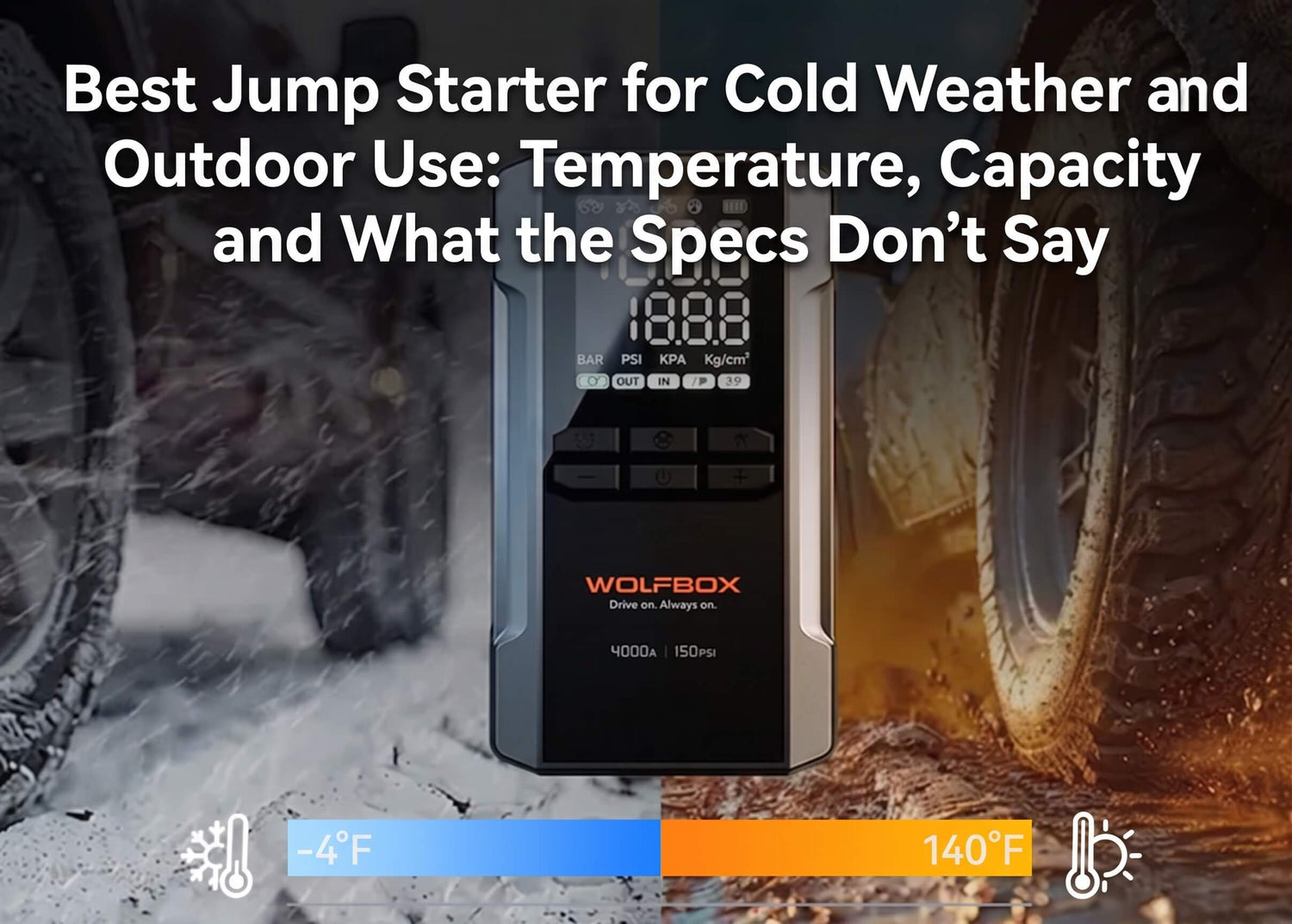
Both current Wolfbox jump starters carry the same rated operating range, −4°F to 140°F, but they're not interchangeable once you factor in engine size and cold-weather derating [4][5]. The MegaVolt 24Air runs a 24,000mAh (88.8Wh) battery with 4,000A peak current, rated for gas engines up to 10L and diesel up to 10L, and includes a BOOST mode built for tougher starts — the kind more common when a battery is already weak and the pack itself is running at reduced cold-weather capacity [4]. For overlanders, winter travelers, and diesel truck owners in northern climates, that combination of high peak current and wide operating range makes it the safer sizing choice, since diesel engines already demand more CCA before cold derating even enters the picture.
The MegaVolt 10Air shares the same −4°F to 140°F rating but runs a smaller 10,000mAh (37Wh) battery with 2,000A peak current for gas engines up to roughly 5L [6][7]. It remains a workable cold-weather option for compact and mid-size gas vehicles, but anyone with a diesel engine or a larger truck should size up — cold-weather capacity loss stacks on top of diesel's already-higher CCA requirement, not instead of it.
| Spec | MegaVolt 24Air | MegaVolt 10Air |
| Rated Operating Temperature | −4°F to 140°F | −4°F to 140°F |
| Peak Current | 4,000A | 2,000A |
| Battery Capacity | 24,000mAh / 88.8Wh | 10,000mAh / 37Wh |
| Rated Engine Coverage | Up to 10L gas / 10L diesel | Up to 5L gas |
| Boost Mode for Hard Starts | Yes | Standard start mode only |
Source: Wolfbox official specifications and independent product testing [4][5][6][7].
Why Diesel Owners Should Size Up, Not Match the Minimum
Diesel engines already need more CCA than a comparable gas engine because of their higher compression ratios. That baseline requirement doesn't go away in cold weather — it compounds with capacity loss rather than being replaced by it. A diesel truck needing roughly 950–1,100 CCA in mild weather may effectively need meaningfully more once a 30–40% cold-weather reduction is factored in at 14°F. That's the practical reason overlanders and diesel truck owners in colder regions are generally steered toward the highest peak-current tier available, rather than matching the bare minimum rated for their engine at room temperature.
Self-Discharge and Why It Sneaks Up on Seasonal Users
Every rechargeable battery loses some charge over time even sitting untouched — lithium packs lose it more slowly than lead-acid, but not at zero. For overlanders and seasonal RV owners who might not touch their jump starter for several months between trips, that slow drain matters: a unit charged to 100% in October can read meaningfully lower by January. Checking the charge level before a trip, rather than assuming a pack left "fully charged" months earlier is still there, is a small habit that prevents the device from failing exactly when it's needed.
A Practical Cold-Weather Checklist
- 1. Confirm the unit's rated minimum operating temperature against your actual winter lows.
- 2. Keep it charged to at least 50% through the cold months, checked monthly if it's rarely used.
- 3. Store it in the vehicle's cabin rather than the trunk or an unheated exterior compartment when practical.
- 4. Size up to a higher peak-current unit for diesel engines or larger trucks to offset cold-weather derating.
- 5. Let a cold-soaked unit warm up briefly before attempting a jump-start for the best possible output.
None of this means lithium jump starters are unreliable in winter — with reasonable charge habits, they remain a light, practical option for cold-climate roadside emergencies. The point is simply that cold weather changes the math, and it's worth knowing by how much.
Frequently Asked Questions
**How much capacity does a lithium jump starter lose in freezing weather?**
Roughly 15-20% at 32F, increasing to about 30-40% at 14F and 40-50% at -4F, based on general lithium-ion cold-weather performance data.
**Is AGM or lithium better for cold-weather jump starters?**
Lithium retains more of its rated capacity near freezing (roughly 80-85% versus 70-80% for AGM), but needs reduced charge current in deeper cold. AGM tolerates normal charging better but loses more capacity near freezing and weighs more.
**What operating temperature is the MegaVolt 24Air rated for?**
-4F to 140F, per Wolfbox's official specifications.
**Should a jump starter be stored fully charged over winter?**
No, a partial charge of roughly 50-80% is generally better for long-term battery health than storing at 100% or letting it run flat.
**Do diesel trucks need a bigger jump starter in cold climates?**
Yes. Diesel engines already need more CCA than gas engines, and cold-weather capacity loss adds to that requirement rather than replacing it, which is why a higher peak-current unit is the safer choice.
References
[1] Lithium-Ion Batteries under Low-Temperature Environment, PMC — https://pmc.ncbi.nlm.nih.gov/articles/PMC9698970/
[2] Using Lithium Batteries in Cold Weather, ReLiON Battery — https://www.relionbattery.com/knowledge/using-lithium-batteries-in-cold-weather
[3] How Temperature Affects Lithium-Ion Battery Capacity, Bonnen Batteries — https://www.bonnenbatteries.com/battery-capacity-vs-temperature-how-temperature-affects-lithium-ion-battery-capacity/
[4] WOLFBOX MegaVolt 24Air Official Product Page — https://wolfbox.com/products/jump-starter-with-air-compressor-tire-inflator-wolfbox-megavolt-24air
[5] I tested the Wolfbox 4-in-1 Jump Starter with Air Compressor, PopSci — https://www.popsci.com/gear/wolfbox-4-in-1-jump-starter-with-air-compressor-review/
[6] WOLFBOX 2000A Jump Starter with Air Compressor, Newegg listing — https://www.newegg.com/p/0MD-06DG-00007
[7] WOLFBOX MegaVolt10 Air Instruction Manual — https://manuals.plus/asin/B0FNWHS4DQ

Leave a comment
All comments are moderated before being published.
This site is protected by hCaptcha and the hCaptcha Privacy Policy and Terms of Service apply.