











A phone plugged into a jump starter's old-style USB port might sit there charging at a crawl for an hour. Plug the same phone into a port with 65W USB-C Power Delivery, and it's topped up in a fraction of the time. That gap is the entire reason "USB-C" on a spec sheet doesn't tell you much on its own — what matters is whether Power Delivery is actually behind it, and how many watts it can push.
What USB-C Power Delivery Actually Does
USB-C is just the connector shape. Power Delivery (PD) is the separate protocol that lets a charger and a device negotiate voltage and current in real time, instead of being locked to the old 5–15W ceiling of basic USB [1][7]. A PD-capable port advertises what it can supply, the connected device requests what it needs, and the two settle on a safe wattage — all in milliseconds. Without PD, a USB-C port still works, but caps out around 15W regardless of the connector [1][2].
What 65W Actually Charges at Full Speed — and What It Doesn't
The honest way to think about a 65W port is device by device, because the number describes the ceiling the port can supply, not a guarantee that every device pulls that much.
| Device | Typical Charging Power Needed | Full Speed on 65W PD? | Full Speed on Legacy 18W? |
| Smartphone | 15–30W | Yes | Yes — most phones cap below 18W anyway |
| iPad or mid-size tablet | 20–30W | Yes | No, noticeably slower |
| 13"–14" ultrabook | 45–65W | Yes, at or near full speed | No, meaningfully slower |
| 15"–16" high-power laptop | Often 90W+ | Charges, but below the laptop's fastest possible rate | No, very slow |
The takeaway: 65W comfortably covers phones and tablets, and gets most compact laptops close to their fastest charging speed. Where it falls short is the small category of high-wattage gaming or workstation laptops that ship with 90W or larger chargers — those will still charge on a 65W port, just not at their absolute peak rate.
Where MegaVolt 24Air and MegaVolt 10Air Fit
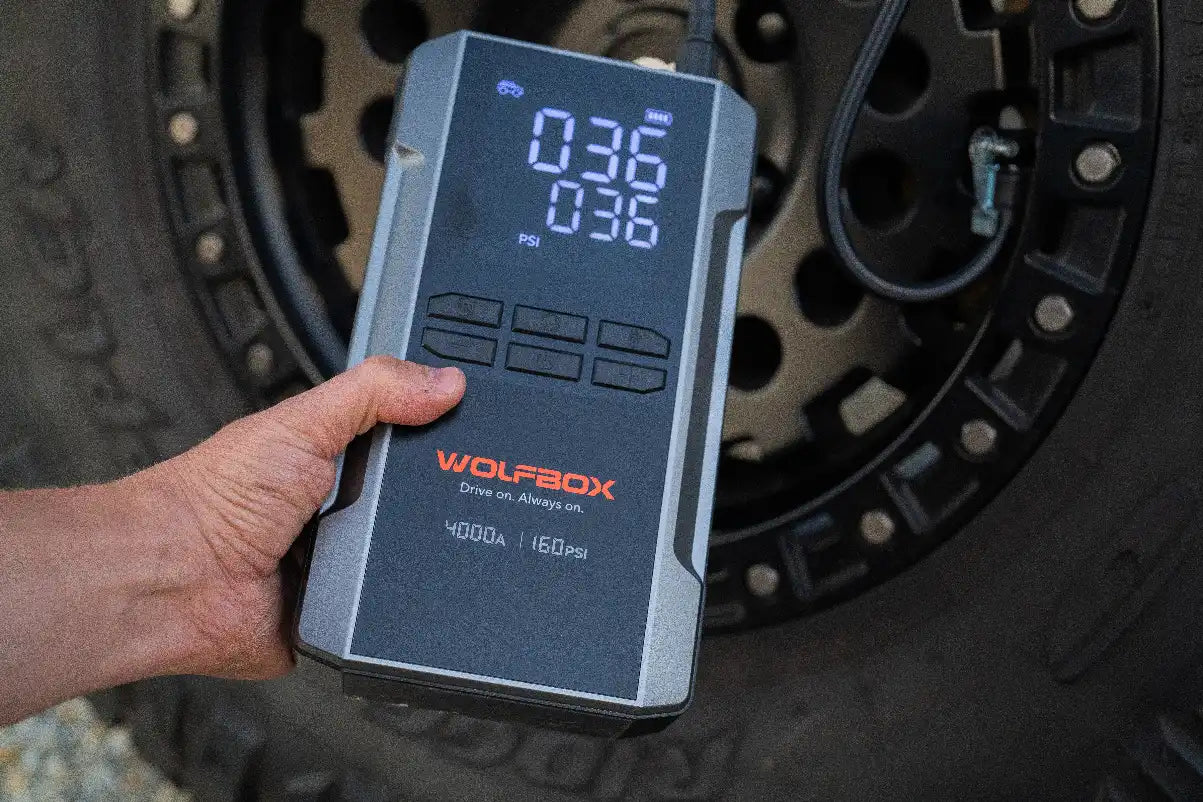
The MegaVolt 24Air pairs a 24,000mAh (88.8Wh) battery with 65W USB-C PD output, alongside its 4,000A jump-starting capability and 45L/min air compressor rated up to 160 PSI [3][4]. That combination makes it a genuinely dual-purpose device — a jump starter for engines up to 10L gas or 10L diesel on one side, and on the other, a power bank that can fast-charge a phone, a tablet, or most standard laptops during a road trip, a camping weekend, or just a long day away from an outlet [3][4].
The MegaVolt 10Air is the smaller counterpart: a 10,000mAh (37Wh) battery with 2,000A of jump-starting current for gas engines up to about 5L, plus a 12W USB-A output for charging phones and small devices — its USB-C port is a 15W input for recharging the unit, not a device output [5][6]. It's built for a smaller footprint and lighter carry, not for pushing the highest wattage — buyers who mainly need to top off a phone will find it plenty capable, but it isn't the pick for fast-charging a laptop.
| Spec | MegaVolt 24Air | MegaVolt 10Air |
| Battery Capacity | 24,000mAh / 88.8Wh | 10,000mAh / 37Wh |
| Peak Jump-Start Current | 4,000A | 2,000A |
| USB-C Port | 65W PD (20V⎓3.25A) | Input only (15W); devices charge via 12W USB-A |
| USB-A Output | Up to 18W | Present |
| Air Compressor | 45L/min, up to 160 PSI | Up to 150 PSI |
| Water/Dust Resistance | IP64 | IP64 |
| Recharge Time (dead to full) | Roughly 2 hours with a 65W+ charger | Up to ~3.5 hours (15W input, so slower than the 24Air) |
Source: Wolfbox official specifications and independent product testing [3][4][5][6].
A Few Real Scenarios Where the Difference Shows Up
A phone charging overnight in the car won't notice much difference between 65W and 18W, since most phones cap their own draw well under either ceiling. But someone charging a 13-inch laptop between job sites will feel the gap directly — near-full-speed on 65W PD versus a trickle on 18W that can lag behind active use. And anyone charging two devices at once from the same port — a tablet plus a phone, say — benefits from the larger total wattage budget, since splitting output between devices reduces what each one gets.
- Phones: fast charging on the 24Air (65W PD); the 10Air tops off phones through its 12W USB-A.
- Tablets: full-speed only on the 65W-equipped MegaVolt 24Air.
- Compact laptops (45–65W): near-full-speed on the MegaVolt 24Air.
- High-wattage laptops (90W+): still charges, just not at peak rate, on either unit.
- Dash cams, EV accessories: comfortably within either unit's output budget.
How This Compares to a Standalone Power Bank
Dedicated power banks with no jump-starting function sometimes edge out 65W in raw wattage. What a jump starter with integrated PD offers instead is consolidation — one device instead of two separate purchases, without giving up much on charging speed to gain the jump-start function. For someone who already carries a power bank and a separate jump starter in the trunk, that's a real reduction in what needs to be packed.
What to Check Before You Buy
Look at the actual wattage printed on the listing or the manual for the exact model you're considering — "USB-C" by itself says nothing about whether PD is present or what ceiling it supports. Some budget jump starters use a USB-C connector without full PD negotiation behind it, which caps real-world charging speed regardless of what the port looks like.
Frequently Asked Questions
**Does 65W USB-C PD charge a MacBook Pro at full speed?**
It charges 13-14 inch models at or near full speed. Larger 15-16 inch MacBook Pro models that ship with higher-wattage chargers will charge faster than on an 18W port, but not necessarily at their absolute peak rate.
**What's the actual difference between USB-C and USB-C PD?**
USB-C is the connector shape. Power Delivery is the separate charging protocol that negotiates higher wattage over that connector — a USB-C port without PD support is typically capped around 15W.
**Can the MegaVolt 24Air replace my laptop charger while traveling?**
For most standard ultrabooks in the 45-65W range, yes, at or near full speed. For gaming or workstation laptops needing 90W or more, it will still charge the device, just more slowly than the original charger.
**Does the MegaVolt 10Air support fast charging too?**
No. The 10Air's USB-C is a 15W input for recharging the unit, not a device output. Phones and small devices charge from its 12W USB-A port, which tops off devices but is not PD fast charging.
**How long does the MegaVolt 24Air itself take to recharge from empty?**
Roughly two hours using a 65W or higher PD charger.
References
[1] PD Charging 101: What Is USB-C Power Delivery & How It Works, LockNCharge — https://www.lockncharge.com/blog/industry-news/pd-charging-101
[2] The bewildering world of USB-C charging, explained, PCWorld — https://www.pcworld.com/article/2331534/the-bewildering-world-of-usb-c-charging-explained.html
[3] WOLFBOX MegaVolt 24Air Official Product Page — https://wolfbox.com/products/jump-starter-with-air-compressor-tire-inflator-wolfbox-megavolt-24air
[4] I tested the Wolfbox 4-in-1 Jump Starter with Air Compressor, PopSci — https://www.popsci.com/gear/wolfbox-4-in-1-jump-starter-with-air-compressor-review/
[5] WOLFBOX 2000A Jump Starter with Air Compressor, Newegg listing — https://www.newegg.com/p/0MD-06DG-00007
[6] WOLFBOX MegaVolt10 Air Instruction Manual — https://manuals.plus/asin/B0FNWHS4DQ
[7] USB Charger (USB Power Delivery), USB-IF — https://www.usb.org/usb-charger-pd


Leave a comment
All comments are moderated before being published.
This site is protected by hCaptcha and the hCaptcha Privacy Policy and Terms of Service apply.