








Jumper cables have worked the same way for decades: two cars, four clamps, and a willing second driver. Portable lithium jump starters remove that dependency entirely, and that single difference is reshaping which tool drivers reach for first in 2026 [1].
How Each Option Actually Works
Jumper Cables
Jumper cables transfer current directly from a running vehicle's alternator and battery to a dead one. There's no internal battery to charge, no electronics to fail, and a set of quality cables can last for decades of occasional use [2].
Portable Jump Starters
A portable jump starter carries its own battery, so it needs no second vehicle. Modern lithium units also include a battery management system (BMS) that adds protections cables cannot offer on their own, including reverse-polarity detection and spark-proof connection [3].
Where Each Option Actually Wins
| Factor | Jumper Cables | Portable Jump Starter |
| Requires a second vehicle | Yes | No |
| Built-in reverse-polarity protection | No | Yes, on most modern units |
| Needs charging or maintenance | No | Yes, periodic recharge required |
| Usable in isolated locations | Only with another car present | Yes, self-contained |
| Current price | Check the current local price | Check the current WOLFBOX price by model and region |
| Extra features | None | USB-C charging, air compressor, flashlight on multi-function units |
When Cables Are Still the Practical Choice
Cables remain sensible in a few specific situations: shop environments where a running donor vehicle is always nearby, budget scenarios where a basic cable set is genuinely all that’s needed, and as a backup for drivers who already carry a jump starter but want a zero-maintenance fallback [2][3].
Why Lithium Packs Are Gaining Ground
The core advantage is independence. A jump starter works whether or not another car is around — in an empty parking garage, on a remote trail, or at 2 a.m. when no other driver is willing to stop [4]. Built-in smart protections also reduce the risk of a bad connection damaging a vehicle's electronics, something bare cables cannot detect or prevent [3].
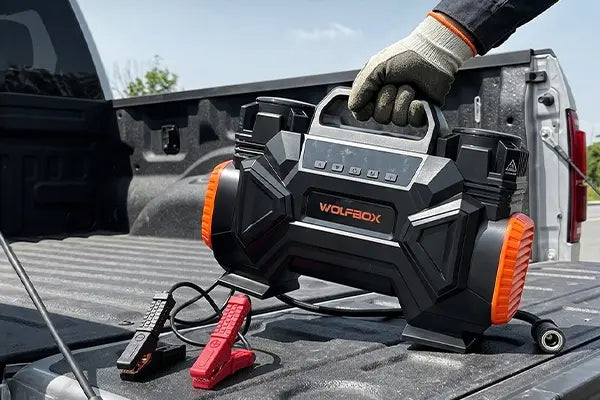
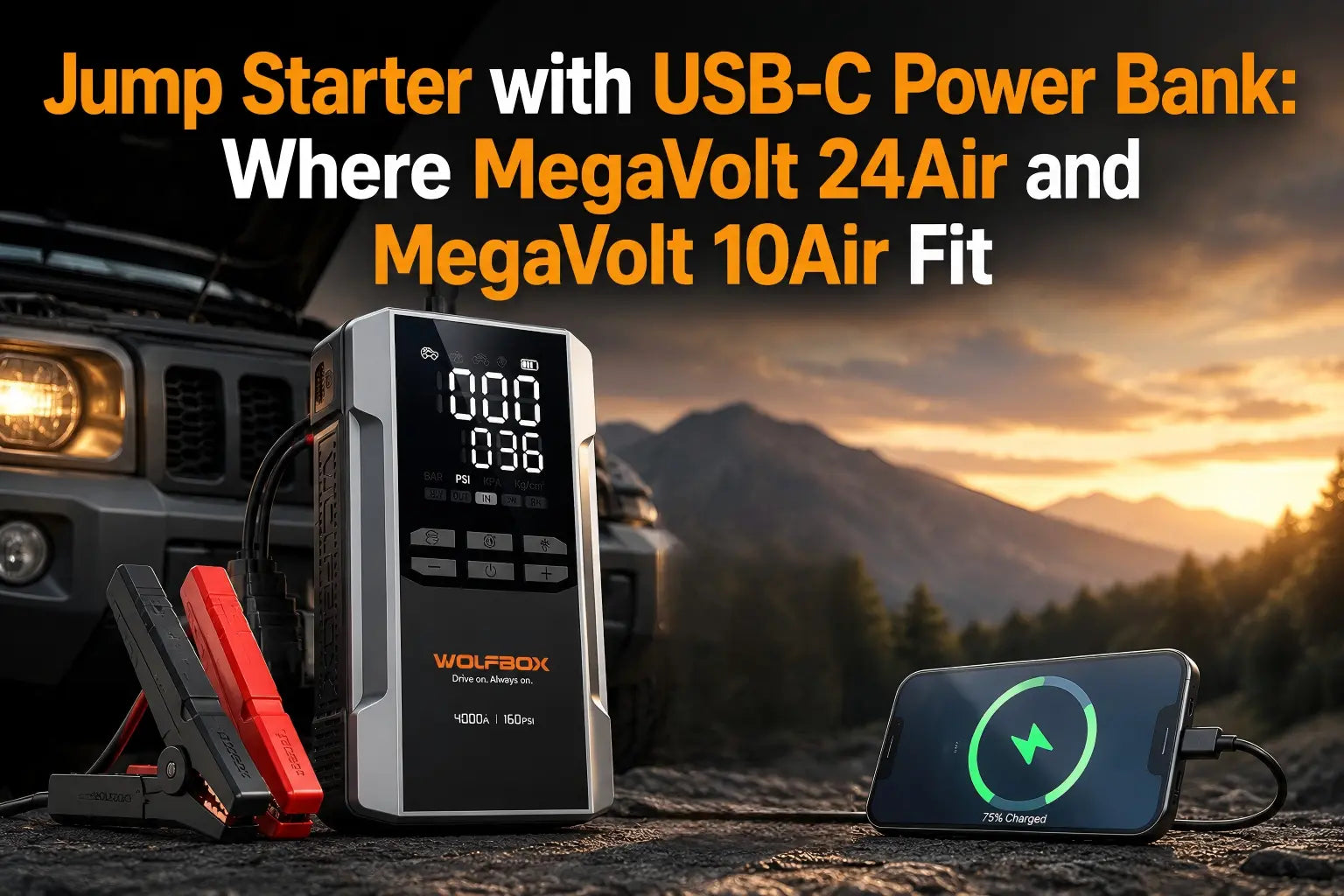
The WOLFBOX MegaVolt 24Air illustrates the category's current ceiling: 4,000A peak current from a 24,000 mAh (88.8Wh) battery, 65W USB-C PD output, and a built-in 160 PSI air compressor, independently verified by Popular Science [5]. Pro Tool Reviews confirmed the base MegaVolt 24's dual start modes and reverse-polarity protection in hands-on testing [6]. The more compact MegaVolt 10Air covers lighter-duty vehicles with the same core safety features [7].
MegaVolt 24Air vs. a Standard Jumper Cable Set
| Specification | MegaVolt 24Air | Standard Jumper Cables |
| Independent operation | Yes | No — requires donor vehicle |
| Peak output | 4,000A | Depends entirely on donor vehicle |
| Safety protections | Reverse polarity, spark-proof, over-temperature | None built-in |
| Additional functions | USB-C PD charging, 160 PSI air compressor, flashlight | None |
| Current price | Check the current WOLFBOX price by model and region | Check the current local price |
Source: WOLFBOX official product page [8] and Popular Science independent review [5].
Frequently Asked Questions
Are lithium jump starters actually safer than jumper cables?
Most modern lithium units include a battery management system with reverse-polarity and spark-proof protection — safeguards that bare jumper cables don't have.
Do I still need jumper cables if I own a jump starter?
Many drivers keep both. Cables need no charging and work as a zero-maintenance backup if a jump starter's battery happens to be low.
Why is a jump starter more expensive than jumper cables?
A jump starter carries its own rechargeable battery, safety electronics, and often added functions like USB-C charging or an air compressor — none of which a simple cable set includes.
Can a jump starter replace a car battery permanently?
No. It provides a temporary boost to start the engine. A battery that repeatedly needs jumping should be tested and likely replaced.
What's the biggest downside of relying only on jumper cables?
You need a second running vehicle nearby. In an empty lot, a remote area, or at night, that requirement can leave you stranded regardless of how good your cables are.
References
[1] WOLFBOX MegaVolt 24Air Official Product Page: https://wolfbox.com/products/jump-starter-with-air-compressor-tire-inflator-wolfbox-megavolt-24air
[2] Midtronics — Jump Starter vs. Booster Cables: Which is Better for Battery Emergencies: https://www.midtronics.com/blog/jump-starter-vs-booster-cables/
[3] Clore Automotive — 5 Reasons Why a Jump Starter Outperforms Booster Cables: https://cloreautomotive.com/five-reasons-why-a-jump-starter-beats-booster-cables-every-time/
[4] WOLFBOX MegaVolt 10Air Official Product Page: https://wolfbox.com/products/wolfbox-2000a-jump-starter-with-air-compressor-wolfbox-megavolt-10air
[5] Popular Science — WOLFBOX 4-in-1 Jump Starter with Air Compressor Review: https://www.popsci.com/gear/wolfbox-4-in-1-jump-starter-with-air-compressor-review/
[6] Pro Tool Reviews — WOLFBOX MegaVolt 24 Jump Starter Review: https://www.protoolreviews.com/wolfbox-megavolt-24-jumpstarter-review/
[7] WOLFBOX Jump Starter Collection — Official Page: https://wolfbox.com/collections/jump-starter-1
[8] WOLFBOX MegaVolt 24Air Product Page (EU): https://eu.wolfbox.com/products/jump-starter-with-air-compressor-tire-inflator-4-in-1-wolfbox-megavolt-24air


Leave a comment
All comments are moderated before being published.
This site is protected by hCaptcha and the hCaptcha Privacy Policy and Terms of Service apply.