








Canned air runs out at the worst possible moment. It's rather common to get stuck halfway through cleaning a keyboard full of crumbs or a PC case coated in a year of dust. That's why electric air dusters have taken over. That's also why the Wolfbox vs Opolar air duster question comes up so often.
Both brands sell rechargeable, cordless dusters that promise to replace those disposable cans for good. Still, they land in very different places on power, runtime, and how loud they get while doing the job.
This guide breaks down the Wolfbox MF200 against Opolar's classic rechargeable duster on the three mandatory factors: airflow, battery life, and noise. We'll also look at how electric dusters outmatch canned air regarding convenience. You can choose the electric duster that best fits your cleaning routine.
WOLFBOX vs Opolar Air Duster: The Quick Answer
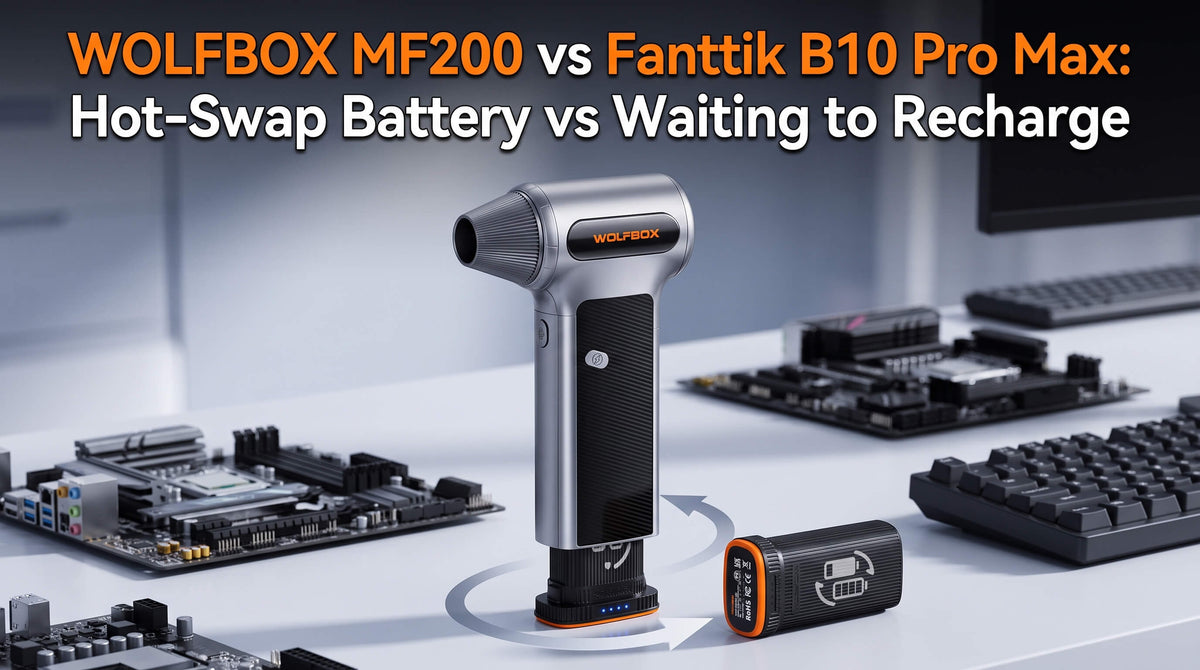
The Wolfbox MF200 outputs significantly more raw airflow, up to 210+ MPH at 110,000 RPM. It uses a swappable battery system that lets you keep cleaning without waiting to recharge. [1]
Opolar's rechargeable duster tops out around 33,000 RPM with roughly 28 m/s (about 63 MPH) of airflow. Its fixed, non-swappable battery lasts about 30 minutes per charge.
Opolar's lower price may seem appealing for light, occasional use. However, the MF200's power and battery handle regular PC maintenance, car detailing, or longer sessions more effectively.
Where MF200 and Opolar Dusters are Similar
The performance gap becomes clearer in the following discussion. Nonetheless, both share the same basic approach to replacing canned air.
- Both are cordless, rechargeable, brushless-motor air dusters to replace disposable compressed air cans.
- Both charge over USB, so neither needs a dedicated wall charger or proprietary cable.
- Both include multiple nozzle attachments for different cleaning tasks, from keyboards to tight electronics.
- Both are marketed as eco-friendly alternatives that eliminate the recurring cost of buying canned air.
Where Wolfbox Diverges from the Other
The real differences show up the moment you turn on the two units. The gaps are exactly why the two units end up serving different kinds of buyers. [1] [2]
- Wolfbox's MF200 spins at up to 110,000 RPM; Opolar's classic duster tops out around 33,000 RPM.
- The MF200 uses a removable, swappable 6000mAh battery; Opolar's built-in battery isn't swappable mid-session.
- Wolfbox backs the MF200 with a 30-month warranty; Opolar's standard warranty terms are shorter.
- The MF200 looks somewhat costlier at first, while reflecting its higher motor speed and swappable battery design.

Airflow: How Much Power Do You Need?
More RPM means more airflow speed. That RPM translates to forced clearing of stubborn dust, pet hair, and sawdust faster (with fewer passes). It directly affects how many passes a cleaning job takes.
The Wolfbox MF200's 210+ MPH rating puts it well ahead of Opolar's roughly 63 MPH output. That difference shows up when tackling thick dust buildup, PC radiators, or car interiors.
WOLFBOX MF200's Airflow Numbers
Wolfbox specifications position the MF200 toward the high-powered electric duster category. The numbers hold up whether you're clearing dust from a PC tower or blasting sawdust off a workbench.
- 110,000 RPM brushless motor delivering 210+ MPH airflow. [1]
- Three adjustable speed settings, so full power isn't the only option when working around delicate components.
- It looks "legitimately premium" with no creaky plastic or cheap-feeling buttons. [3]
Opolar's Airflow Numbers
Opolar's classic rechargeable duster targets a lighter-duty use case. That's not necessarily a downside; it simply reflects a different design goal than the MF200.
- Around 33,000 RPM, producing approximately 28 m/s (roughly 63 MPH) of airflow.
- Enough for routine keyboard and light electronics dusting but noticeably less forceful on thicker or more stubborn debris.
- The lighter airflow may seem like an advantage for very delicate components, like camera sensors.
Battery Life: Swappable vs Fixed
The Wolfbox MF200's swappable battery system means you can keep a charged spare on hand. That design choice changes how each duster fits into a longer cleaning session. [4]
Opolar's fixed 6000mAh battery can continuously run for about 30 minutes. It takes roughly three hours to charge, with no way to extend a session beyond that single charge.
WOLFBOX's Hot-Swap System
The removable battery is arguably the MF200's biggest practical advantage over fixed-battery options. It may sound minor, but it becomes obvious the first time a battery dies halfway through a job.
- The 6000mAh battery pops out and swaps in seconds. You can continue a long cleaning session without a charging pause.
- A full charge takes about 2.5 to 3 hours over USB-C. Wolfbox rates the battery for 500+ uses before any significant capacity loss. [1] [3]
- Many users need to run extended sessions more often, like detailing a car interior or cleaning a server closet.
- Keeping a second charged battery with the Wolfbox MF200 on hand can effectively double the runtime with zero downtime.
Opolar's Single-Charge Limit
Opolar's fixed-battery design keeps things simple but caps how long a single session can run. That simplicity feels like a feature, not a limitation, especially if sessions are already short.
- Around 30 minutes of continuous runtime on a full charge.
- Recharging takes roughly 3 hours, during which the duster is unusable unless you own a second unit.
- Such a limitation rarely matters in practice for quick, occasional cleaning tasks.
Noise: What to Expect from Each
Neither Wolfbox nor Opolar publishes independently verified decibel ratings. Therefore, the exact side-by-side noise comparisons are hard to pin down with certainty.
Multiple hands-on tests confirm that higher RPM means more noise. OSHA suggests that sustained exposure above 85 decibels requires hearing protection. [5]
Why Noise Numbers Are Hard to Compare
A few practical factors make apples-to-apples noise comparisons tricky across brands. It also means you should treat any specific decibel claim with some healthy skepticism.
- Neither company's official product page lists a third-party-tested decibel rating.
- Treat any specific number as an estimate, not a guarantee.
- Keep the MF200's size and sound in mind if you're extremely noise-sensitive. [3]
- The MF200's built-in motor spins roughly three times faster than Opolar's motor.
- Expect the MF200 to run louder at full power, even without any exact dB ratings.
Practical Ways to Keep It Quieter
A few habits reduce noise regardless of which duster you own. It requires little awareness of when and how you're using the tool, not any extra purchases.
- Use the lowest speed setting that still gets the job done; both units offer multiple speed modes for exactly this reason.
- Keep cleaning sessions short and targeted rather than running the unit continuously at full power.
- If you're noise-sensitive or working in a shared space, close a door or clean during hours when the noise won't disturb others. [3]
Why Ditch Canned Air in the First Place
Canned air isn't just wasteful; it becomes risky when misused. Even the operational cost adds up fast compared to a one-time electric duster. [6]
Switching to either the Wolfbox MF200 or an Opolar duster removes the recurring expense. It also resolves the safety concerns tied to the propellant gas.
Real Cost of Canned Air Over Time
The math on canned air gets worse the more often you clean. Add it up over a few years, and the difference becomes hard to ignore.
- A single can of compressed air typically costs $7 to $10 and lasts only a handful of short bursts before it's empty.
- Regular users, like IT technicians or PC builders, can spend well over $100 a year on canned air alone.
- You can recover an electric duster's upfront cost within a year or two, where every cleaning session is free.
A Safety Angle Most Buyers Don't Consider
Canned air has a safety dimension that rarely comes up in product comparisons. It's not the main reason most people switch, but it's a genuine factor worth knowing about.
- The US Consumer Product Safety Commission has proposed banning certain propellant levels in aerosol duster products. [7]
- It has documented more than 1,000 deaths and roughly 21,700 treated injuries linked to inhalant misuse within ten years.
- Electric air dusters use ambient room air moved by a motor. Without pressurized propellant, they carry no such risk.
- Some households and workplaces move away from canned air, independent of which electric duster they choose.

Beyond the Spec Sheet: Build Quality and Everyday Use
Build quality and ergonomics affect how much a duster gets used after the first week. It doesn't matter how impressive the airflow rating looks on paper.
What Independent Testing Found
- The MF200 "feels solid in hand" with a comfortable grip even during extended use.
- Independent reviews praised the included carrying case for keeping the unit, batteries, and nozzles organized. [1] [3]
- The case protects the unit well in a drawer, but offers less protection if you toss it loosely into a bag or toolbox.
- These impressions from reviews help weigh the MF200's advantages.
What It Means for Daily Dusting
- Build quality confirms whether a duster can survive years of regular handling.
- A duster that feels flimsy after a few weeks of use often ends up unused in a drawer.
- Swappable batteries and detachable nozzles introduce more moving parts.
- Those parts make overall build quality more important for long-term reliability.
Which One Should You Buy: WOLFBOX or Opolar
Choose the Wolfbox MF200 if you clean regularly, tackle thicker dust or debris, or want the flexibility of a swappable battery for longer sessions. Choose an Opolar duster if your needs are lighter, occasional keyboard or electronics dusting, and a lower upfront price matters more.
Choose WOLFBOX MF200 If You –
- Clean PCs, cars, or workshop equipment often enough that runtime and power matter.
- Want the option to buy a spare battery and never wait on a recharge mid-session.
- Are comfortable paying more upfront for a longer warranty and higher-output motor.
Choose Opolar Duster If You –
- Need occasional keyboard or light electronics dusting, not heavy-duty cleaning.
- Want a lower price point with lower airflow and fewer features.
- Need to replace canned air for the first time and want to test electric dusters.
Getting the Most Out of Your Electric Air Duster
Electric air dusters work best in short, targeted bursts rather than one long, continuous blast. A little routine care keeps the motor and battery healthy for years. A few minutes of good habits save a lot of frustration, and possibly a repair or replacement, down the line.
Best Practices for PC and Electronics Cleaning
- Hold cooling fans still with a finger or toothpick while blowing air across them. High-speed airflow can spin fan blades fast enough to generate damaging back-voltage.
- Start on the lowest speed setting around sensitive components like camera sensors or exposed capacitors. Increase power only when needed to avoid potential damage.
- Clean in a well-ventilated area and hold the unit a few inches away from surfaces. Never press the nozzle, even firmly, directly against surfaces of the intended item. [2] [3]
Care and Maintenance Tips
- Keep batteries charged to at least a partial level during storage rather than letting them sit fully depleted for months.
- Wipe down nozzles and the intake vent occasionally to prevent dust buildup from restricting airflow over time. [3] [4]
- Store the unit and any spare batteries somewhere temperature-moderate, as extreme heat or cold affects battery performance.
Conclusion
The Wolfbox vs Opolar air duster comes down to how often you clean and how much power is needed. The Wolfbox MF200 wins on raw airflow, swappable battery convenience, and warranty length. It's also the stronger pick for regular or heavier cleaning tasks. [2]
Opolar's lighter, lower-cost duster gets the job done for occasional dusting. It's a reasonable entry point for ditching canned air for good. Either way, stop throwing money at disposable cans; a win regardless of which electric duster ends up on your desk.
Frequently Asked Questions (FAQs)
Is the Wolfbox MF200 more powerful than Opolar's air duster?
Yes. The MF200 spins at up to 110,000 RPM with 210+ MPH airflow. Those numbers are noticeably higher than Opolar's 33,000 RPM and 63 MPH rating for a classic rechargeable duster.
Does the Wolfbox MF200 have a swappable battery?
Yes. The MF200 uses a removable 6000mAh battery that you can swap for a charged spare in seconds. Opolar, by contrast, has a fixed, non-removable battery.
How loud is an electric air duster compared to canned air?
Neither brand publishes an independently verified decibel rating. However, higher-RPM units generally run louder. Sustained exposure above 85 decibels may require hearing protection.
Are electric air dusters safer than canned air?
Electric dusters move ambient air with a motor. It completely removes the inhalant misuse risk tied to canned air products that caused many deaths and thousands of injuries within the US alone.
Which is better for a first-time buyer, Wolfbox or Opolar?
It depends on how often you'll use it. Opolar makes sense for occasional, light dusting. Meanwhile, the MF200 is the better investment for regular PC maintenance, car detailing, or heavier cleaning tasks.
References
[1] Wolfbox: "Wolfbox MF200 Compressed Air Duster - Swappable Battery Cartridge" – https://wolfbox.com/products/compressed-air-duster-mf200
[2] Wolfbox: "Wolfbox MF200 Air Duster Review 2026" – https://wolfbox.com/blogs/air-duster/wolfbox-mf200-air-duster-review-2026
[3] Gear Diary: "Wolfbox MF200 Compressed Air Duster Review" – https://geardiary.com/2025/11/10/wolfbox-mf200-review/
[4] Wolfbox: "Wolfbox Air Duster Review: Battery Life, PSI, and HEPA Filter Test" – https://wolfbox.com/blogs/air-duster/wolfbox-air-duster-review
[5] OSHA: "Occupational Noise Exposure" – https://osha.gov/noise
[6] AllForMailers: "Canned Air is Dead: Why You Need to Switch to an Electric Duster Today" – https://allformailers.com/canned-air-is-dead-why-you-need-to-switch-to-an-electric-duster-today/
[7] US Consumer Product Safety Commission: "Banned Hazardous Substances: Aerosol Duster Products" – https://www.federalregister.gov/documents/2024/07/31/2024-16716/banned-hazardous-substances-aerosol-duster-products-containing-more-than-18-mg-in-any-combination-of

Leave a comment
This site is protected by hCaptcha and the hCaptcha Privacy Policy and Terms of Service apply.