
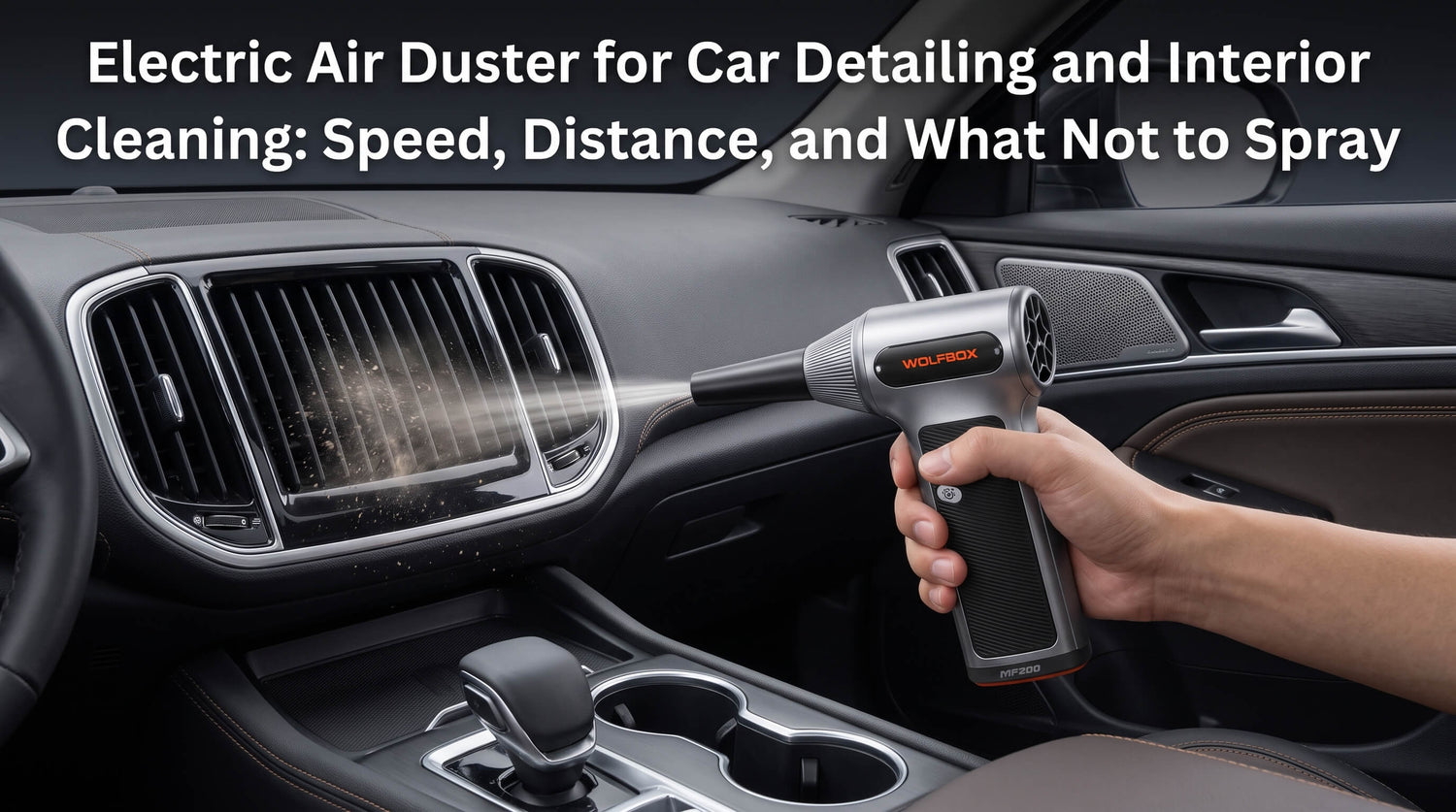
An electric air duster uses a powerful stream of air to remove dust, debris, and hard-to-reach particles from areas that are difficult to clean with traditional tools — under the seat rails, behind the dash bezel, inside air vents, and in the gaps between the console and seats. But effective cleaning requires more than maximum airflow. Leather is not vinyl, a speaker grille is not a USB port, and a vent slat can take far more airflow than a touchscreen bezel. [4][7]
The MF200 gives you three speed settings rather than one fixed blast, which is the main reason it works across a full interior instead of just the dashboard. [1] Here is where each speed actually belongs. [2][5]
Where Air Actually Helps in a Car
A vacuum and a microfiber cloth handle most of a car interior fine. Air earns its place in the spots those tools cannot reach: seat track channels packed with sand, the gap under the handbrake, the perforations in a speaker grille, the ridges around a vent bezel. If you are only wiping down the dash and seats, you may not need this step at all — the value shows up in the crevices.
Speed by Interior Surface
| Surface / Component | Speed Setting | Distance | Why This Setting |
| Dashboard air vents | High speed | 3 inches | Vent slats are rigid plastic; the highest speed clears years of built-up dust in one pass |
| Speaker grilles | Medium speed | 4 inches | Enough force to clear the mesh without pressing directly on the cone underneath |
| Seat track mechanisms | High speed | 3–4 inches | Sand and grit lodge in metal channels; this is the one spot that tolerates the highest speed |
| Door jamb seams and hinges | Medium-to-high speed | 3–4 inches | Clears debris from weatherstrip grooves without forcing it deeper into the hinge |
| Center console crevices | Medium speed | 3 inches | Cupholder bases and shifter surrounds are plastic but often have exposed wiring nearby |
| USB / 12V port openings | Low speed | 4–5 inches | A strong blast pushes lint and debris further into the connector instead of out |
| Infotainment screen bezel | Low speed | 5 inches | The screen itself should never take direct airflow at close range |
Leather Is the Surface People Get Wrong
Leather does not actually need an air duster for everyday dust — a microfiber cloth does that job better. Where air helps is in the stitching grooves and seams where a cloth cannot reach. Keep it to low speed, five to six inches away, and keep the nozzle moving. Holding a steady blast against leather at close range dries out the surface faster than normal wear does, especially on treated or aniline leather that has not been conditioned recently.
Glass and Screens
Windows and the infotainment display take low speed only, from five inches or more, and only to knock loose dust free before a wipe-down — not as a standalone cleaning method. Never run the duster while glass cleaner or any liquid is still wet on a surface; you will spread the liquid rather than remove the dust under it.
Fabric Seats Need Patience, Not More Airflow
Cloth upholstery holds onto dust differently than leather — it gets trapped in the weave rather than sitting on top. Mid speed at four inches lifts the loose stuff, but ground-in dirt and stains are a vacuum-and-fabric-cleaner job. No amount of airflow pulls out what is already worked into the fibers.
What Not to Spray
- Open USB or 12V ports at high speed from under four inches — this drives debris deeper into the connector rather than out
- Leather or vinyl held at close range for more than a few seconds at a time — repeated close-range airflow dries out conditioning treatments faster than normal use
- Liquid cleaner that is still wet on any surface — air spreads it instead of drying it evenly
- Paper speaker cones from under three inches at high speed — the cone material can flex under concentrated pressure
- Any surface that is currently wet from rain or a spill — moisture gets pushed into gaps and electronics rather than removed
Why This Beats a Can for Interior Work
Canned air has one real weak point for car interiors: tilt the can while reaching into a footwell or under a seat rail, and the propellant can come out as liquid rather than gas, leaving a residue on trim or upholstery that is genuinely annoying to clean off. [3] The MF200 uses a brushless motor with no propellant at all, so there is no tilt-angle limitation and nothing to leave behind. [1] [6]
How Long a Full Detail Takes
A full pass — vents, console, seat tracks, door panels, speaker grilles — usually runs ten to fifteen minutes of actual airflow time. The MF200 is sold in one-, two-, or three-battery configurations (the Lite, Enduro, and UltraEnduro packs) at different prices; each battery is two 3,000 mAh cells in series (3,000 mAh × 2), and one battery alone covers a typical detail without needing to swap mid-session. [1] A second or third battery matters more if you are doing multiple vehicles back to back.
Frequently Asked Questions
What speed should I use on dashboard vents?
High speed at 3 inches, angled into the vent slats. This is one of the few spots in a car interior that can take the highest speed setting without risk.
Can I use an air duster on leather seats?
Only on seams and stitching, using low speed from 5–6 inches. For general surface dust on leather, a microfiber cloth works better and carries no risk of drying out the material.
Is it safe to blow air into car USB ports?
Use low speed from 4–5 inches, never a close-range high-speed blast. Strong airflow directed straight into a port pushes debris further in rather than out.
Will one battery charge get through a full interior detail?
Yes for most vehicles. A full detail runs about 10–15 minutes of active airflow, which one battery (two 3,000 mAh cells, 3,000 mAh × 2) covers comfortably.
Does canned air leave residue in a car interior?
It can, especially when the can is tilted while reaching into a footwell or seat track. A direct-blow electric duster has no propellant, so there is nothing to leave behind regardless of angle.
References
- [1] WOLFBOX MF200 Official Product Page: https://wolfbox.com/products/compressed-air-duster-mf200
- [2] WOLFBOX Air Duster Review Blog: https://wolfbox.com/blogs/air-duster/wolfbox-air-duster-review
- [3] WOLFBOX Air Duster Collection: https://wolfbox.com/collections/best-air-duster
- [4] TechSpray — Everything You Need to Know About Air Duster: https://www.techspray.com/everything-you-need-to-know-about-air-duster-but-were-afraid-to-ask
- [5] WOLFBOX MF200 Six-Month Use Guide: https://wolfbox.com/blogs/air-duster/the-wolfbox-mf200-air-duster-a-6-month-hands-on-perspective
- [6] WOLFBOX Electric Air Duster vs Canned Air Guide: https://wolfbox.com/blogs/air-duster/electric-air-duster-vs-canned-air-cost-consistency-and-what-happens-when-the-can-runs-cold
- [7] WOLFBOX Best Electric Air Duster for PC Guide: https://wolfbox.com/blogs/air-duster/best-electric-air-duster-pc-2026

Leave a comment
This site is protected by hCaptcha and the hCaptcha Privacy Policy and Terms of Service apply.