







Before anything else: confirm the firearm is unloaded and verified clear before you clean it, and follow the manufacturer's cleaning instructions for your specific model. Everything below assumes that step is already done.
Most cleaning kits still lean on canned air to dry a bolt carrier group after brushing, but the can runs out mid-cleaning more often than people expect, and it leaves a light film if you spray too close. An electric duster solves the running-out problem outright — it just needs to be used differently depending on the part. [7]
Why the Airflow Type Matters Here
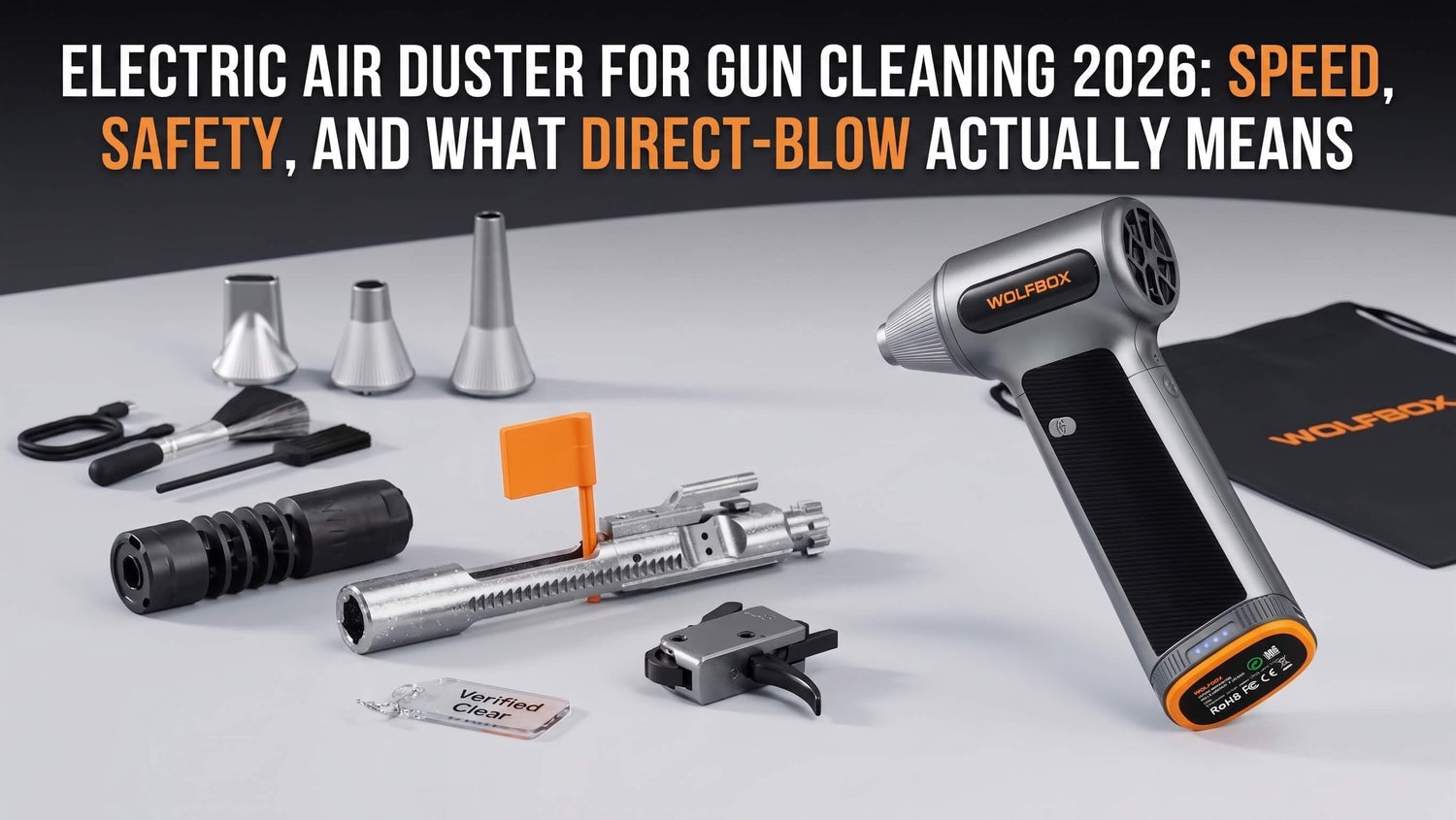
Canned air relies on HFC propellant, and if the can is tilted or held too close it can discharge liquid propellant that leaves a film on parts during the drying step. [3][4] An electric duster like the MF200 moves ambient air with a brushless motor — no propellant, no chemical interaction with Hoppe's No. 9 or a CLP-based cleaner during drying. [6] That difference matters most right after brushing, when parts are still wet with solvent. [5]
Speed by Component
| Component | Speed Setting | Distance / Angle | What to Watch For |
| Bolt carrier group (BCG) | High speed | 4–5 inches, direct | Solid metal part — tolerates the highest speed well |
| Barrel bore | High speed | Straight through, chamber to muzzle | Flush in one direction only to push solvent and debris out the muzzle end |
| Trigger group / fire control | Low-to-medium speed | 5–6 inches | Small springs and pins can shift under strong airflow at close range |
| Magazine well / feed area | Medium speed | 4–5 inches | Keep airflow moderate near feed lips, which are thin and can bend |
| Suppressor baffles | Low-to-medium speed | Indirect angle, 5+ inches | Never blast straight through — see below |
| Furniture and accessory rails | Medium-to-high speed | 4 inches | General debris only; no sensitive parts nearby |
What Air Does and What It Does Not Do
Air is the drying step, not the cleaning step. The sequence still goes: solvent, brush, wipe, then air to clear whatever the wipe missed — carbon dust in the BCG rails, solvent pooled in the firing pin channel. Skipping straight to air without brushing first just moves carbon around instead of removing it.
The One Part You Should Not Blast Directly
Suppressor baffle stacks are the exception to "more airflow is fine." Sending air straight through the bore axis can drive carbon deeper into the baffle gaps instead of clearing it, because the internal geometry traps rather than channels airflow. Work the exterior and any accessible baffle edges from an angle instead, staying at five inches or more.
Noise Around Other People
At full speed the MF200 sounds roughly like a hair dryer — fine outdoors or in a garage, less fine in an apartment or a shared cleaning bench at a range. [2][6] Low and mid speed handle most of the drying work here anyway, since firearm components do not need maximum airflow the way a heatsink fin stack does. [6]
One Battery, One Cleaning Session
A full cleaning pass — BCG, barrel, trigger group, exterior — uses air in short bursts rather than continuously, so a single battery — two 3,000 mAh cells in series (3,000 mAh × 2) — covers a normal session without needing a swap. [6] The MF200 is also sold in one-, two-, or three-battery packs, so carrying a charged spare matters more if you are cleaning several firearms in one sitting, which is where a spent battery mid-session actually becomes a problem with other cordless tools.
Frequently Asked Questions
What speed is safe for a bolt carrier group?
High speed at 4–5 inches, applied directly. The BCG is solid metal and handles the highest speed without issue.
Can I use an electric air duster on a suppressor?
Only at an angle from 5 inches or more, targeting the exterior and accessible baffle edges. Never send air straight through the baffle stack — it can drive debris deeper in rather than out.
Does air duster use replace cleaning solvent?
No. It is the drying step after solvent and brushing, not a substitute for either. Skipping the brush step and going straight to air just redistributes carbon rather than removing it.
Is it safe to use near cleaning solvents?
Let the solvent sit and do an initial wipe-down before hitting it with concentrated air — this limits aerosolizing wet solvent and keeps the duster doing its actual job, which is clearing loosened debris.
How loud is the MF200 for indoor cleaning?
Quieter at low and mid speed, closer to a hair dryer at full speed. Most drying tasks here do not need full speed anyway.
References
- [2] WOLFBOX Air Duster Review Blog: https://wolfbox.com/blogs/air-duster/wolfbox-air-duster-review
- [3] WOLFBOX Electric Air Duster for Gun Owners Guide: https://wolfbox.com/blogs/air-duster/the-electric-air-duster-for-gun-owners-what-psi-filtration-free-design-and-noise-level-actually-mean
- [4] TechSpray — Everything You Need to Know About Air Duster: https://www.techspray.com/everything-you-need-to-know-about-air-duster-but-were-afraid-to-ask
- [5] Chemtronics — Ultimate Guide to Canned Air / Aerosol Dusters: https://www.chemtronics.com/ultimate-guide-to-canned-air-aerosol-dusters
- [6] WOLFBOX MF200 Official Product Page: https://wolfbox.com/products/compressed-air-duster-mf200
- [7] WOLFBOX Air Duster Collection: https://wolfbox.com/collections/best-air-duster


Leave a comment
This site is protected by hCaptcha and the hCaptcha Privacy Policy and Terms of Service apply.