








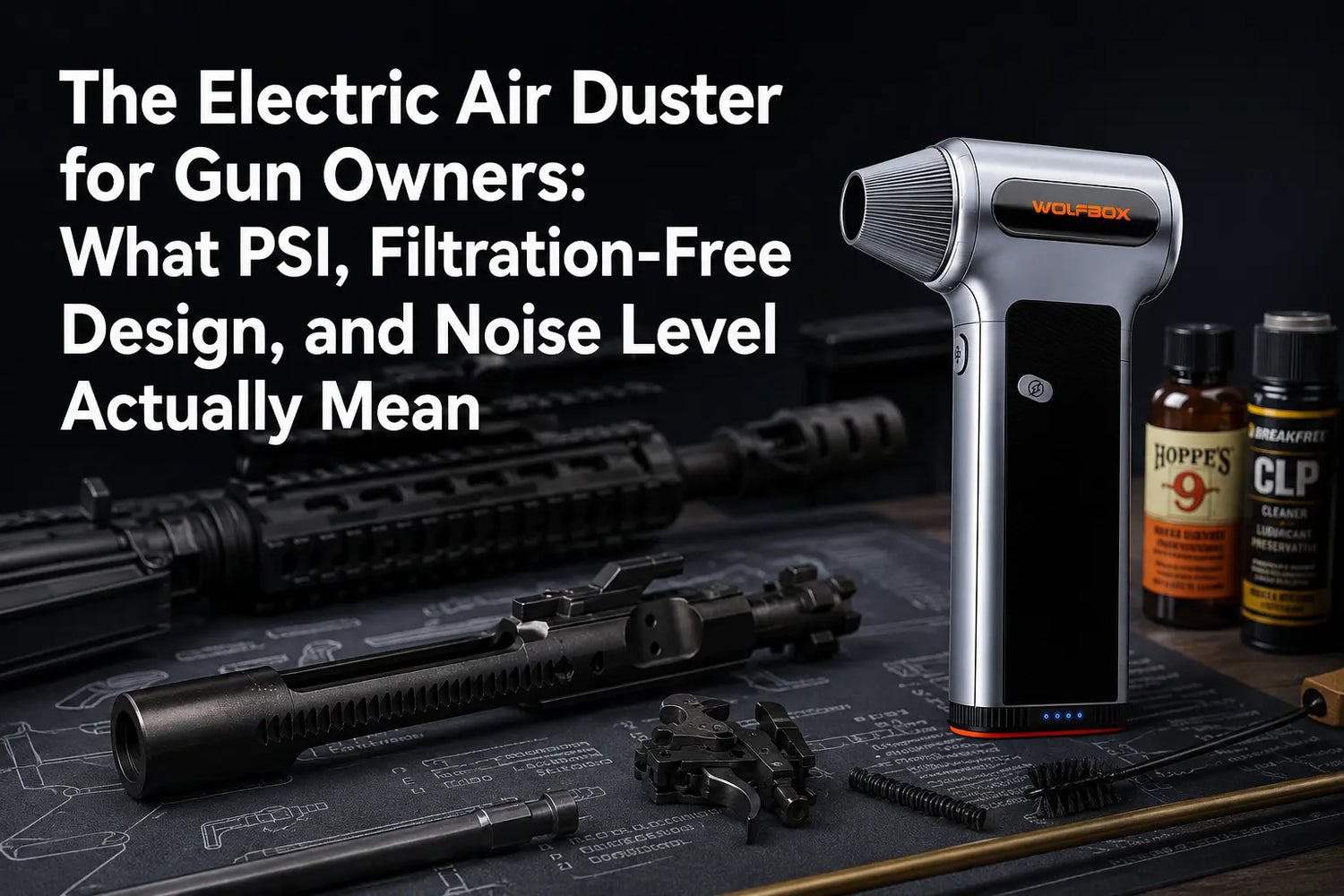
The main error people make using compressed air on a firearm isn't too little pressure—it's the wrong angle at the wrong distance, which pushes fouling deeper instead of clearing it. A second error is assuming air replaces patches and solvents, which it doesn't. The MF200 is a useful tool in a gun cleaning workflow when you understand exactly what role it fills.
Electric air dusters have become standard in PC and camera maintenance because they deliver consistent, controllable airflow without the moisture or propellant that comes out of a canned aerosol. Those same properties make them practical for firearm components—with technique differences worth knowing before you start.
What the MF200 Actually Delivers
The MF200 runs at 110,000 RPM and produces up to 210+ MPH (approximately 87.5 m/s) airflow at the Speed 3 setting, with 0.62 lb of wind pressure at the nozzle. [1] Three speed settings—Low, Medium, High—let you adjust output for different components. The 6,000 mAh removable battery provides up to 100 minutes of runtime at Speed 1, and approximately 10 minutes at full Speed 3. [1]
It includes four nozzle attachments and two brushes. For firearm work, the narrow cone nozzle is the most useful—it concentrates airflow for trigger groups and bolt carrier crevices, and the angle can be adjusted to direct the air tangentially rather than straight into a component.
One thing the MF200 is not: a filter or dryer. It moves ambient room air. Whatever particulates or humidity are in the air will be carried along with the airflow. Clean in a reasonably uncontaminated environment, and don't use it to dry a bore that still has solvent in it—patches do that job.

PSI by Component: Speed Setting and Distance
Pressure, angle, and distance all matter. The table below covers the most common firearm cleaning applications.
|
Component |
Recommended Setting |
Nozzle Distance |
Angle |
Notes |
|
Bolt Carrier Group (BCG) |
Speed 2–3 |
2–4 inches |
Tangential sweep |
Loosens and clears carbon; pre-treat with solvent for baked-on fouling |
|
Trigger Group / FCG |
Speed 2 |
3–5 inches |
Tangential |
Avoid directing flow straight into pivot pin bores |
|
Barrel Chamber (post-patch) |
Speed 1–2 |
2–4 inches from end |
Down-bore angle |
Use after patches are clean; not for removing wet solvent |
|
Suppressor Baffles |
Speed 2 |
3–5 inches |
Tangential sweep |
Never blast directly in—residue packs into baffle gaps under direct pressure |
|
Handguard / Rail System |
Speed 2–3 |
2–4 inches |
Direct |
Steel and aluminum rails are straightforward; no special precaution needed |
|
Optic Lens / Red Dot Window |
Speed 1 |
4–6 inches |
Oblique |
Low setting only—high-velocity airflow from close range can abrade coatings |
|
Polymer Lower / Frame |
Speed 1–2 |
3–5 inches |
Direct |
Thin polymer walls around mag well can flex under Speed 3 at very close range |
Filtration-Free Design: What It Means in Practice
The MF200 is a direct-blow unit—there is no filter medium in the airflow path. Air enters the motor housing from the intake vents and exits through whichever nozzle is attached. This is why it moves air efficiently without restriction, and why electric dusters in general don't introduce moisture the way aerosol propellants can. [1]
The practical implication for gun cleaning: the quality of the air delivered depends on the environment. In a typical indoor cleaning room with normal dust levels, this is a non-issue. In a dusty shop or garage with airborne sawdust or metallic particles, those particles travel with the airflow into your firearm. Clean in a reasonably controlled space when cleaning precision components like a trigger group or gas tube.
Solvent compatibility is straightforward. Hoppe's No. 9, Break-Free CLP, Ballistol, and similar petroleum-based gun solvents are safe in the vicinity of the MF200. Don't submerge the nozzle or motor housing in solvent, and wipe off any solvent contact on the exterior with a dry cloth. The ABS housing and aluminum components handle normal solvent exposure without damage. [2]
Noise Level at an Indoor Cleaning Bench
The MF200 at Speed 3 produces approximately 72–75 dB at 3 feet—in the range of a loud conversation or a kitchen exhaust fan. [3] No hearing protection is needed for typical cleaning durations. Speed 1 drops to roughly 60–65 dB. Unlike aerosol cans, which release a hissing burst, the MF200 motor produces a consistent tone that most people find less startling.
For an indoor range armorer station, this is well within acceptable levels. The motor sound doesn't carry the sharp percussive quality of compressed air from a shop compressor.

Where Air Cleaning Fits in the Workflow—and Where It Doesn't
Air duster use makes sense at specific points in a cleaning sequence. It does not replace any of them:
- Wet solvent and patches remove bulk carbon and copper fouling from the bore—air alone does not
- Bronze brush or chamber brush breaks up fouling the solvent has loosened—air follows, not precedes
- Air duster clears residue from surfaces and crevices after mechanical and chemical cleaning
- Light oil application with a patch or cloth finishes the process—air doesn't apply protection
Safety note: Verify that the firearm is completely unloaded and the action is clear before beginning any cleaning step, including air duster use. [4]
MF200 Specs for Gun Cleaning Reference
|
Specification |
Value |
|
Max Airflow |
210+ MPH (approximately 87.5 m/s) |
|
Motor Speed |
110,000 RPM |
|
Wind Pressure |
0.62 lb at nozzle |
|
Speed Settings |
3-Gear (Low / Medium / High) |
|
Battery |
6,000 mAh removable, USB-C charge in 2.5–3 hours |
|
Runtime at Speed 1 |
Up to 100 minutes |
|
Runtime at Speed 3 |
Approximately 10 minutes |
|
Included Nozzles |
4 nozzles + 2 brushes |
|
Weight |
0.84 lb (approximately 381 g) |
|
Warranty |
30 months |
Frequently Asked Questions
Q: Can the MF200 be used to clean a firearm?
A: Yes, for clearing loosened carbon fouling from BCGs, trigger groups, handguards, and chambers. Use it after solvent and patches, not instead of them.
Q: What speed should I use for a bolt carrier group?
A: Speed 2 or 3 at 2–4 inches, sweeping tangentially across the surface. Avoid directing flow straight into tight crevices.
Q: Does the MF200 release moisture into the airflow?
A: No. It moves ambient room air without aerosol propellant or moisture. Unlike canned air, there is no risk of propellant-related moisture discharge.
Q: Can I use it on an optic lens?
A: At Speed 1 from 4–6 inches at an oblique angle, yes. Speed 3 at close range risks abrasion to lens coatings.
Q: Is the MF200 safe around gun solvents like Hoppe's or CLP?
A: Yes. Common petroleum-based gun solvents are safe in proximity to the unit. Do not submerge the nozzle or motor housing in solvent.
Q: Does it replace a bore snake or patches for barrel cleaning?
A: No. Patches and mechanical brushes remove fouling; the MF200 clears residue from surfaces and crevices after mechanical cleaning is complete.
Q: How loud is it during use?
A: Approximately 72–75 dB at Speed 3 measured at 3 feet—comparable to a loud conversation. No hearing protection is needed for typical cleaning sessions.
References
[1] Wolfbox MF200 Air Duster Product Page – Specs and Features: https://wolfbox.com/products/compressed-air-duster-mf200
[2] Wolfbox Air Duster Guide – Electronics, 3D Printers, Camera Lenses: https://wolfbox.com/blogs/air-duster/best-air-duster-for-electronics-3d-printers-camera-lenses
[3] Wolfbox MF200 Compressed Air Duster Review – Gear Diary: https://geardiary.com/2025/11/10/wolfbox-mf200-review/
[4] NRA Basic Firearm Safety Rules: https://www.nra.org/safety-and-education/
[5] Wolfbox Air Duster FAQ – Can I Use It for Gun Cleaning?: https://wolfbox.com/blogs/air-duster/best-air-duster-for-electronics-3d-printers-camera-lenses
[6] Wolfbox MF200 Official Product Page – Specs and Runtime: https://wolfbox.com/products/compressed-air-duster-mf200
[7] Wolfbox MF200 Official Product Page – Weight, Wind Pressure, and Warranty: https://wolfbox.com/products/compressed-air-duster-mf200

Leave a comment
This site is protected by hCaptcha and the hCaptcha Privacy Policy and Terms of Service apply.