









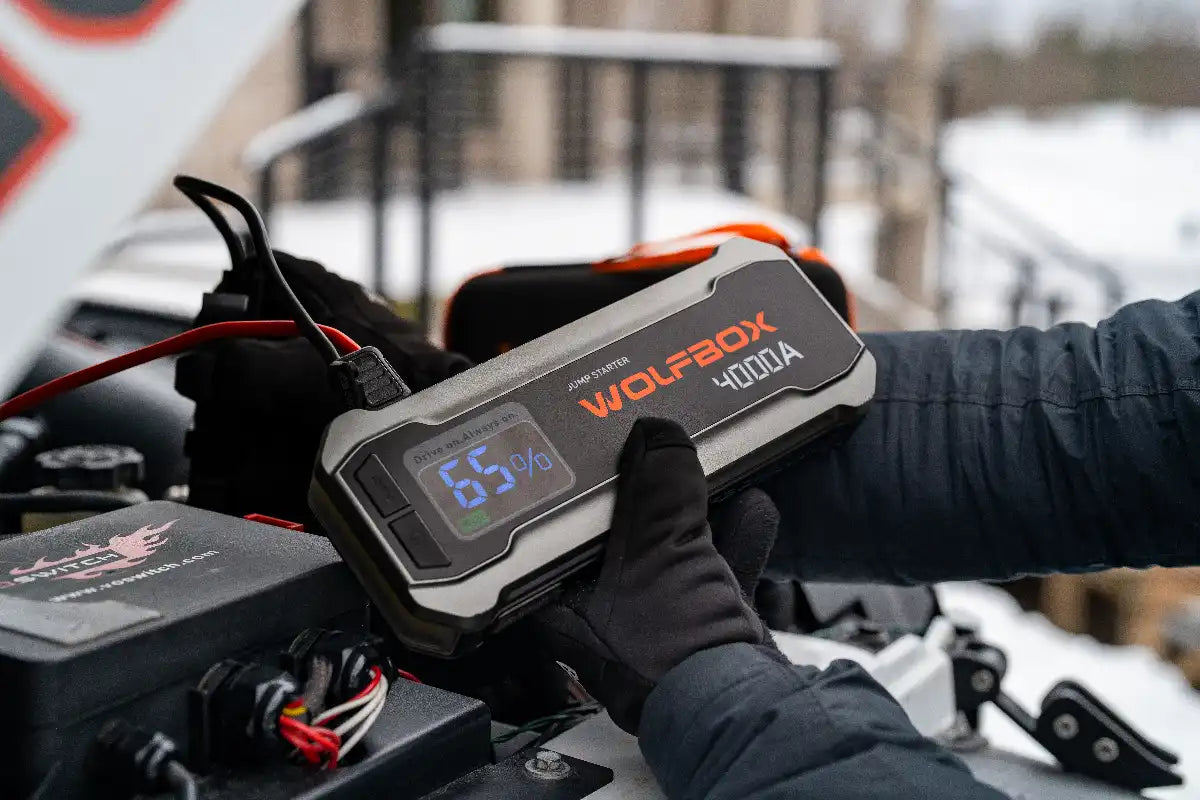
October is the time of year when battery problems start to show up for different reasons. Motorcycles, boats, convertibles and classic cars may be heading into winter storage, while daily drivers are getting ready for colder mornings. Both situations involve a 12V battery, but the solution is not the same.
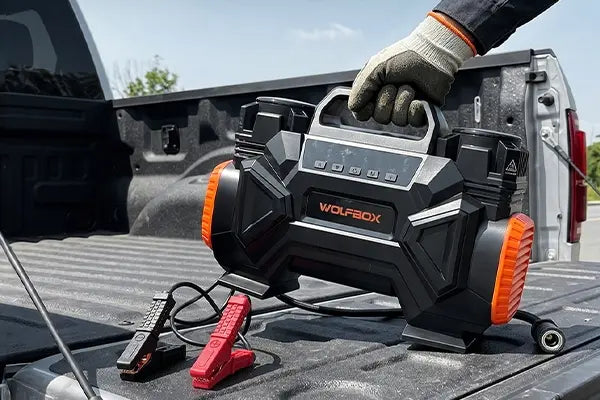
A battery tender is designed to keep a parked battery charged over time. The WOLFBOX MegaVolt24, instead, is made for emergencies when a vehicle will not start. It delivers up to 4000A of peak current from a 24,000 mAh lithium battery and is compact enough to keep in the car ([1]).
In this comparison, we look at how battery maintainers and portable jump starters differ, when each one is useful and which option makes more sense for your garage or trunk.
Battery Maintainer vs Jump Starter: What Is the Difference?
A battery maintainer and a jump starter solve two different problems. A maintainer is designed to keep a parked battery charged over time, usually while the vehicle is connected to a nearby power outlet. A jump starter is made for the moment the battery is already too weak to start the engine ([2]).
The difference becomes clear when you look at the power they deliver. Battery maintainers and low-amp chargers usually work at around 1 to 2A and can take several hours to recharge a battery ([2]). The WOLFBOX MegaVolt24, on the other hand, can deliver up to 4000A of peak current for the few seconds needed to crank an engine. It is rated for gas and diesel engines up to 10L ([1]).
That 4000A figure refers to peak amps, meaning the short burst of current available during startup. It is different from CCA, or cold cranking amps, which is used to rate a car battery under cold-weather test conditions ([3]). The MegaVolt24 uses a peak-amp rating because its job is to provide a quick burst of power to start the engine, rather than recharge the vehicle battery.
How Does a Battery Maintainer Work?
A battery maintainer is made for vehicles that stay parked for long periods. It connects to the battery with clips, plugs into a wall outlet and supplies a small amount of current while monitoring the battery voltage ([4]).
This is known as a float charge. The maintainer keeps a fully charged battery at a steady voltage to make up for the charge it naturally loses over time. For a 12V flooded lead-acid battery, the recommended float level is around 13.5V ([5]).
The WOLFBOX MegaVolt24 works differently. It is designed to provide a short burst of power when the engine will not start, then be disconnected once the vehicle is running.
A maintainer also needs time and access to an outlet. A lead-acid battery can take 12 to 16 hours to reach a full charge, and after the first 5 to 8 hours it may still be only around 70% charged ([5]). That makes it useful for storage, but not for a dead battery at the roadside or in a parking lot. In those situations, the MegaVolt24 is the more practical tool ([1])([2]).
What Happens When the Battery Is Already Dead?
The WOLFBOX MegaVolt24 is made for the moment the battery no longer has enough power to start the engine. Inside the MegaVolt24 is a 24,000 mAh, 88.8 Wh lithium battery, with enough capacity for up to 40 jump starts per charge ([1]).
Everything needed for the jump is already in the unit, so there is no need to find another car or a wall outlet. A 3.8-inch display shows how much charge is left, while the 65W USB-C port can be used both to recharge the MegaVolt24 and to power compatible devices. A 65W PD charger brings the MegaVolt24 back to a full charge in about 1.5 hours ([1]).
WOLFBOX also lists 10 built-in protection functions. The casing has an IP64 rating, so it is protected against dust and can handle water splashes ([1]). Its published operating range goes from -4°F to 140°F.
Winter Storage or Daily Driving: Which Tool Do You Need?
If a vehicle will sit unused for most of the winter, a battery maintainer is usually the better choice. AAA recommends this type of charger for vehicles that are not driven every day, including classic cars, motorcycles and other seasonal vehicles ([4]). The WOLFBOX MegaVolt24 is not designed to stay connected to a battery during long-term storage.
For a car that stays on the road through winter, the situation is different. Winter can expose a battery that seemed perfectly fine a few weeks earlier. At 0°F, a car battery may have around 60% less power available, and cold, thicker engine oil makes the starter work harder too ([3]). That is why the first really cold morning is often when a weak battery finally gives up.
The lithium pack inside a jump starter is affected by low temperatures as well. At 32°F, a lithium cell may deliver around 60 to 80% of its normal capacity, and at -4°F that figure can fall to 50% or less ([6]). Even at that level, the MegaVolt24 can still provide about 2,000A, which remains above the 1,000A minimum we recommend for most cars ([2])([6]).
What Reviewers Found in Real-World Testing
In its test, TechGearLab measured 82.3 Wh of usable energy ([7]). The MegaVolt24 also started a fully drained 2010 Ford Explorer three times in a row, using about 3% of the battery pack for each start. The reviewer estimated that a full charge could also recharge a phone around 4 to 6 times ([7]).
There were a few downsides. The clamps are short and fairly bulky, which can make them awkward to attach when there is little space around the battery ([7]).
The MegaVolt24 measured 3.2 lb and 9.3 × 3.9 × 1.5 inches, and received an overall score of 82 out of 100 ([7]). Despite the relatively large battery pack, it is still compact enough to keep in the car, which gives it a practical advantage over a plug-in maintainer that normally stays at home.
Jump Starter vs Battery Maintainer: Quick Comparison
|
Feature |
WOLFBOX MegaVolt24 |
Battery Maintainer |
|---|---|---|
|
Main purpose |
Starts a dead battery |
Keeps a parked battery charged |
|
Power output |
Up to 4000A peak |
Around 1 to 2A |
|
How fast it works |
Starts the engine in seconds |
Takes hours to recharge a battery |
|
Power source |
Built-in 24,000 mAh / 88.8 Wh lithium battery |
Wall outlet |
|
Roadside use |
Yes |
No |
|
Engine compatibility |
Gas and diesel engines up to 10L |
Not applicable |
|
Starts per charge |
Up to 40 |
Not applicable |
|
Extra features |
65W USB-C power bank and LED light |
Maintains the battery with a float charge |
|
Operating range |
-4°F to 140°F |
Best suited to use near a power outlet |
|
Recharge time |
About 1.5 hours with a 65W PD charger |
Not applicable |
Sources: WOLFBOX official MegaVolt24 product page ([1]), WOLFBOX jump starter vs battery charger guide ([2]), AAA ([4]) and Battery University ([5]).
When the WOLFBOX MegaVolt24 May Not Be the Best Choice?
The WOLFBOX MegaVolt24 is not designed to maintain a battery during long periods of storage. If a motorcycle, boat or classic car will sit unused through the winter, a plug-in maintainer is the better option because it can keep the battery charged over time ([4]). AAA also warns that allowing a battery to go completely flat can shorten its life, even if it is recharged later ([8]).
A jump starter can get the engine running, but it cannot bring an old battery back to life. Car batteries typically last around three to five years, and AAA suggests having them checked annually once they reach their third year ([8]). If you find yourself reaching for the jump starter every few days, it is time to have the battery and charging system inspected.
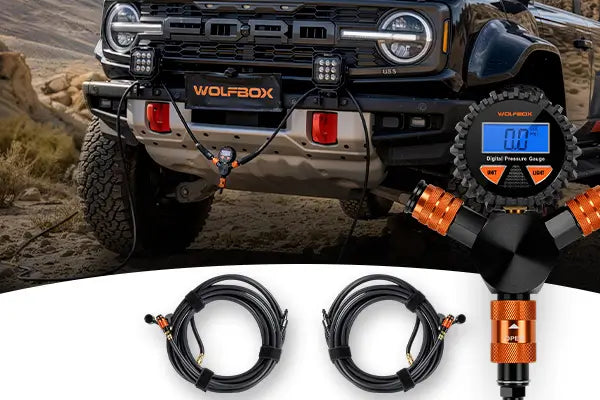
Tire inflation is another point to consider. The standard MegaVolt24 does not have a built-in compressor. The MegaVolt 24Air combines the same 4000A peak output with a built-in compressor that can reach 160 PSI ([9]).
Who Is the WOLFBOX MegaVolt24 Best For?
The WOLFBOX MegaVolt24 is a practical choice for several types of drivers:
- Daily commuters in cold weather: with 4000A of peak current and up to 40 jump starts per charge, it can be useful when low temperatures make the battery harder to start ([1])([3]).
- Drivers with cars, pickups or larger engines: the MegaVolt24 supports gas and diesel engines up to 10L, which makes it useful if you have more than one type of vehicle at home ([1]).
- People who cannot plug in where they park: street parking and apartment garages are not always practical for a battery maintainer. The MegaVolt24 can be charged elsewhere in about 1.5 hours, then stored in the car until it is needed ([1]).
- Owners of seasonal vehicles: in this case, both tools can be useful. A maintainer keeps the battery charged during storage, while the MegaVolt24 provides backup power when the vehicle goes back on the road ([1])([4]).
Frequently Asked Questions
Is the WOLFBOX MegaVolt24 better than a battery tender?
It depends on what you need. The WOLFBOX MegaVolt24 is made to start a dead battery quickly, while a battery tender type maintainer is designed to keep a parked battery charged over a longer period ([1])([4]).
Can a battery maintainer jump-start a car?
No. A maintainer usually supplies around 1 to 2A and works slowly over several hours ([2]). If the engine will not start and you need power immediately, you need a jump starter such as the WOLFBOX MegaVolt24, which is rated at 4000A peak ([1]).
Can I leave the WOLFBOX MegaVolt24 connected to a stored vehicle?
No. The MegaVolt24 should be disconnected once the engine is running. If the vehicle will stay parked for weeks or months, use a battery maintainer instead ([4])([5]).
How often should I recharge the WOLFBOX MegaVolt24 when it is not in use?
WOLFBOX recommends recharging it every three months and storing it at around 50 to 80% charge ([10]). With a 65W PD charger, a full recharge takes about 1.5 hours ([1]).
Does the WOLFBOX MegaVolt24 work in freezing weather?
Yes. The MegaVolt24 is rated to operate down to -4°F ([1]). Cold weather reduces lithium battery performance, but even with a 50% drop in output, the unit can still deliver around 2,000A ([6]).
Do I need both a jump starter and a battery maintainer?
In some cases, yes. If one of your vehicles spends weeks or months parked, a battery maintainer can keep its battery charged during storage. A jump starter such as the MegaVolt24 serves a different purpose: you keep it ready for the day a vehicle will not start, especially when you are away from a power outlet ([1])([4]).
References
([1]) WOLFBOX MegaVolt24 4000A Jump Starter - Official Product Page: https://wolfbox.com/products/wolfbox-megavolt24-jump-starter
([2]) WOLFBOX - Jump Starter vs Battery Charger: Which One Is Best for Your Car?: https://wolfbox.com/blogs/jump-starter/jump-starter-vs-battery-charger
([3]) WOLFBOX - How Many Amps to Jump Start a Car: Choose the Right Jump Starter: https://wolfbox.com/blogs/jump-starter/how-many-amps-to-jump-start-a-car
([4]) AAA South Jersey - Keeping Your Car Battery Fresh: https://southjersey.aaa.com/digital-publication/keeping-your-car-battery-fresh
([5]) Battery University - BU-403: Charging Lead Acid: https://batteryuniversity.com/article/bu-403-charging-lead-acid
([6]) WOLFBOX - Cold Weather and Your Car Battery: What Lithium Jump Starters Actually Do in Freezing Temps: https://wolfbox.com/blogs/jump-starter/cold-weather-and-your-car-battery-what-lithium-jump-starters-actually-do-in-freezing-temps
([7]) TechGearLab - WOLFBOX MegaVolt24 Review: https://www.techgearlab.com/reviews/tools/jump-starter/wolfbox-megavolt24
([8]) AAA - How Long Do Car Batteries Last?: https://www.aaa.com/autorepair/articles/how-long-do-car-batteries-last
([9]) WOLFBOX MegaVolt 24Air 4-in-1 Jump Starter with Air Compressor & Tire Inflator - Official Product Page: https://wolfbox.com/products/jump-starter-with-air-compressor-tire-inflator-wolfbox-megavolt-24air
([10]) WOLFBOX - How to Charge a Jump Starter Properly: https://wolfbox.com/blogs/jump-starter/how-to-charge-a-jump-starter-properly



Leave a comment
All comments are moderated before being published.
This site is protected by hCaptcha and the hCaptcha Privacy Policy and Terms of Service apply.