








Most EV and hybrid owners assume a dead battery is someone else's problem. It isn't. Every electric and hybrid vehicle on the road today still depends on a small 12-volt auxiliary battery, and when that battery fails, the car will not start — no matter how much charge sits in the traction pack [1].
The 12V Battery Hiding Inside Every EV
The high-voltage traction pack that powers the motor and the 12V auxiliary battery are two separate systems. The 12V battery runs the low-voltage electronics: the infotainment screen, central locking, onboard computer, and the relay that actually switches the high-voltage system on. If that small battery drops below its wake-up threshold, the car cannot activate the traction pack, and it will not respond to the key fob or start button [1][2].
This is why an EV with a fully charged main battery can still leave you stranded. The traction pack has plenty of energy, but the vehicle has no way to turn it on.
Why EV and Hybrid 12V Batteries Fail More Often
Three factors combine to make 12V failures more common in EVs and hybrids than in a typical gas car:
- Modern EV and hybrid electronics can create continuous standby demand while the vehicle is parked
- Many EV 12V batteries are physically smaller than a conventional car battery, since engineers assume the DC-DC converter will keep it topped up during driving
- The 12V battery only recharges through the DC-DC converter, and only while the high-voltage system is actively running — so a car parked for weeks gets no top-up at all
Because auxiliary-battery capacity varies by vehicle, smaller 12V batteries generally have less reserve during extended parking. Check the vehicle manual for the specified battery and maintenance guidance.
What Never to Jump-Start on an EV
The high-voltage traction battery is not jump-startable, and it should never be treated as one. HV packs run at 200 to 800 volts and require specialized service equipment, not a portable jump starter. Only the 12V auxiliary battery is a valid jump-start target [1].
Some models, including certain Tesla configurations, provide dedicated 12V jump terminals under the hood that are separate from the physical battery location. Always confirm the terminal location in the owner's manual before connecting anything [4].
Jump-Starting the 12V Battery: The Process
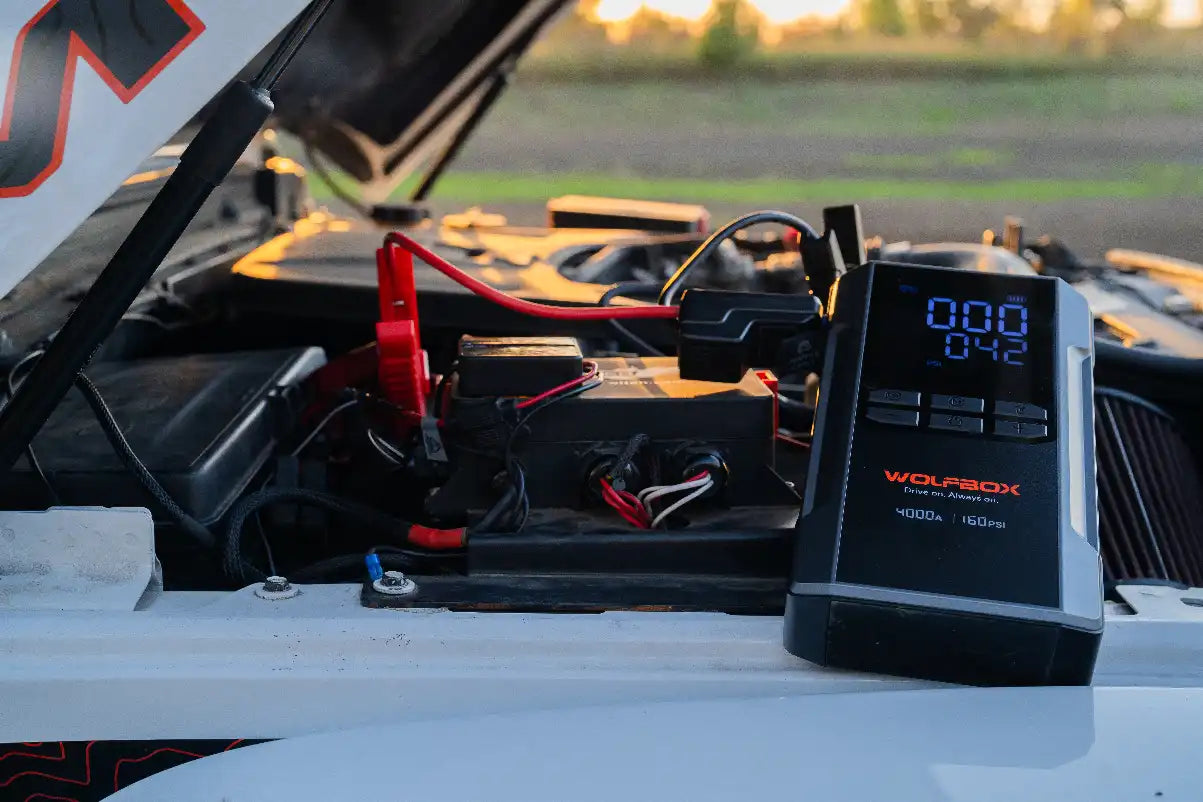
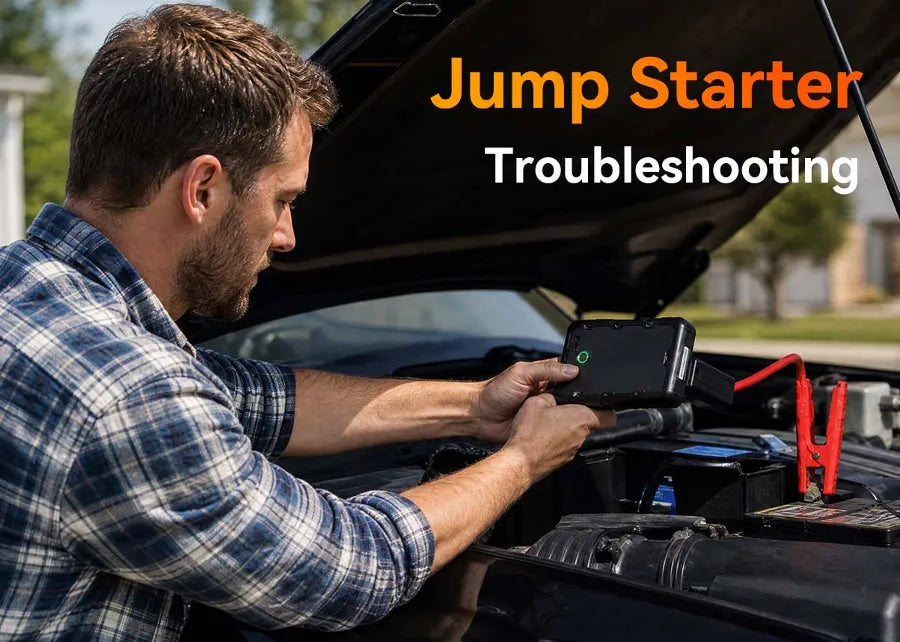
- Locate the 12V jump terminals using the owner's manual — the location varies by make and model
- Connect the positive clamp to the positive terminal
- Connect the negative clamp to a metal chassis ground point, away from the battery itself
- Connect the jump starter, wait roughly 30 seconds, then attempt to start the vehicle
- If the first attempt fails, wait about a minute before trying again, and avoid repeated attempts in quick succession
- After a successful start, drive or idle for 30 to 60 minutes so the DC-DC converter can recharge the 12V battery
If the 12V battery needs jumping more than once within a short period, that is a signal it needs professional testing and likely replacement, not repeated jump-starts [2].
Why a Portable Jump Starter Fits EV Ownership Better Than Cables
Jumper cables require a second running vehicle, which is exactly the resource an EV owner is least likely to have on hand in an apartment garage or a remote trailhead. A self-contained jump starter with built-in reverse-polarity protection removes that dependency entirely [5].
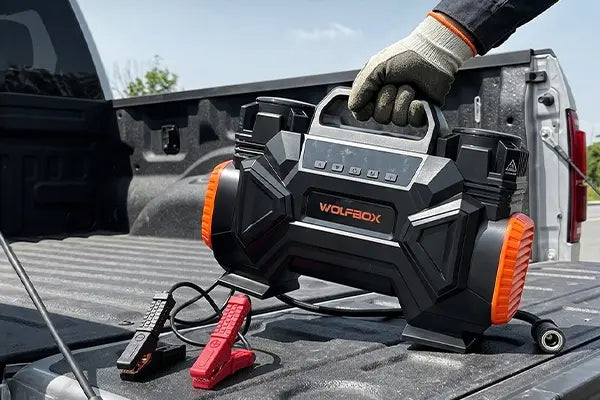
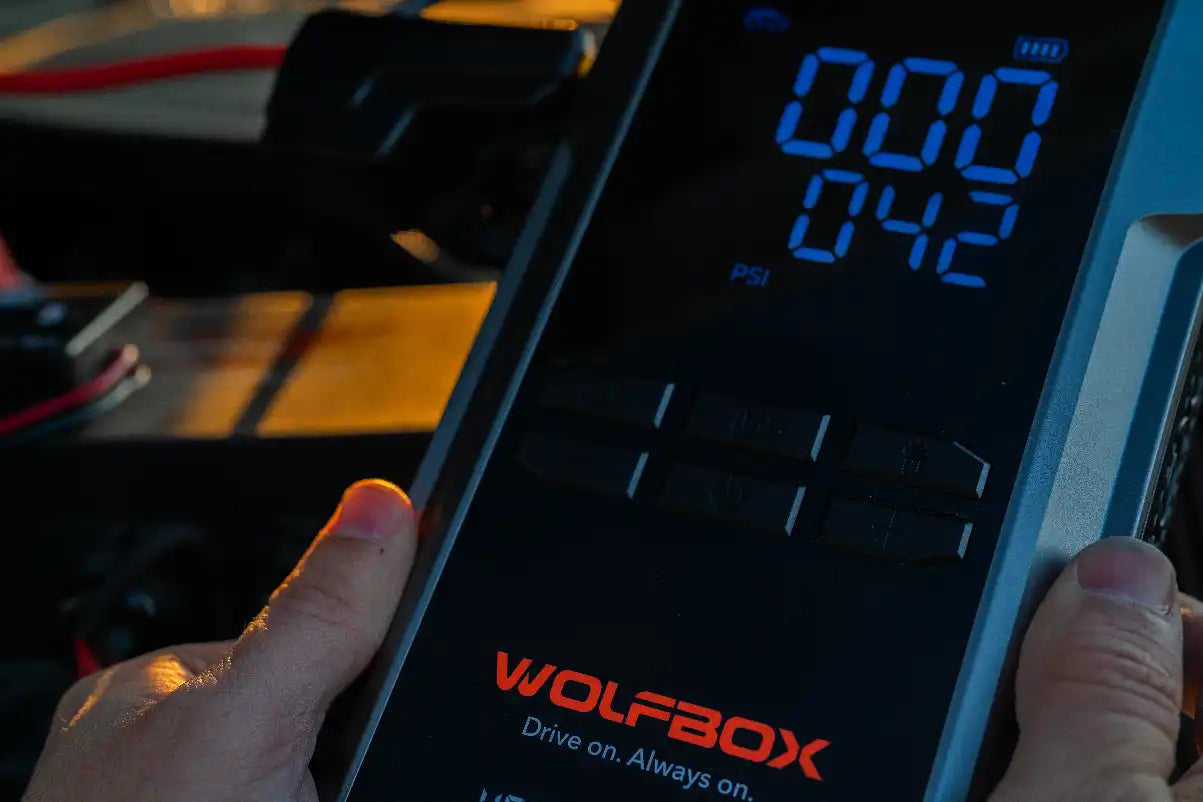
The WOLFBOX MegaVolt 24Air delivers 4,000A of peak current from a 24,000 mAh (88.8Wh) battery, supports 65W USB-C PD output, and includes an air compressor rated to 160 PSI — specs independently confirmed by Popular Science's hands-on test [6]. Pro Tool Reviews separately verified its dual start modes and reverse-polarity protection [7]. For lighter-duty EV and hybrid 12V systems, the MegaVolt 10Air offers a more compact footprint with the same core safety protections, according to WOLFBOX's official product listing [4][8].
MegaVolt 24Air Specifications Relevant to EV Owners
| Specification | MegaVolt 24Air |
| Peak current | 4,000A |
| Battery capacity | 24,000 mAh (88.8Wh) |
| USB-C output | 65W PD |
| Air compressor | 160 PSI |
| Jump starts per charge | Up to 40, depending on vehicle and battery condition |
| Operating temperature | -4°F to 140°F |
| Safety protections | Reverse polarity, spark-proof, over-temperature |
Source: WOLFBOX MegaVolt 24Air official product page and Popular Science independent test [1][6].
After the Jump: What EV Owners Should Do Next
A single successful jump is not the end of the story. Drive or idle for at least 30 minutes so the converter can rebuild the 12V charge, and if the same battery dies again within days, have it tested rather than jumping it repeatedly — a battery that keeps failing is degrading, not just discharged [2][3].
Frequently Asked Questions
Do electric vehicles need a jump starter?
Yes. Every EV and hybrid has a 12V auxiliary battery that powers the control systems needed to activate the high-voltage system. If it fails, the car will not start, even with a fully charged traction pack.
Can I jump-start a Tesla with a portable jump starter?
Yes, through the 12V auxiliary battery's jump terminals, which are typically located under the hood separate from the physical battery. Always confirm the exact terminal location in the owner's manual.
Why does my EV's 12V battery die more often than a gas car's battery?
Modern EV infotainment systems draw more standby power, and the 12V batteries used in many EV platforms are physically smaller, leaving less buffer during extended parking.
What should I never jump-start on an EV?
Never attempt to jump the high-voltage traction battery. It operates at 200 to 800 volts and requires specialized service equipment, not a portable jump starter.
What should I do after successfully jump-starting my EV's 12V battery?
Drive or idle for 30 to 60 minutes so the DC-DC converter can recharge the battery. If it fails again within days, have it professionally tested.
References
[1] WOLFBOX MegaVolt 24Air Official Product Page: https://wolfbox.com/products/jump-starter-with-air-compressor-tire-inflator-wolfbox-megavolt-24air
[2] WOLFBOX — Wolfbox Jump Starter Review: 2000A Jump Starter with Air Compressor: https://wolfbox.com/blogs/jump-starter-with-air-compressor/wolfbox-jump-starter
[3] Midtronics — Jump Starter vs. Booster Cables: https://www.midtronics.com/blog/jump-starter-vs-booster-cables/
[4] WOLFBOX MegaVolt 10Air Official Product Page: https://wolfbox.com/products/wolfbox-2000a-jump-starter-with-air-compressor-wolfbox-megavolt-10air
[5] Clore Automotive — 5 Reasons Why a Jump Starter Outperforms Booster Cables: https://cloreautomotive.com/five-reasons-why-a-jump-starter-beats-booster-cables-every-time/
[6] Popular Science — WOLFBOX 4-in-1 Jump Starter with Air Compressor Review: https://www.popsci.com/gear/wolfbox-4-in-1-jump-starter-with-air-compressor-review/
[7] Pro Tool Reviews — WOLFBOX MegaVolt 24 Jump Starter Review: https://www.protoolreviews.com/wolfbox-megavolt-24-jumpstarter-review/
[8] WOLFBOX Jump Starter with Air Compressor Collection — Official Page: https://wolfbox.com/collections/jump-starter-with-air-compressor

Leave a comment
All comments are moderated before being published.
This site is protected by hCaptcha and the hCaptcha Privacy Policy and Terms of Service apply.