










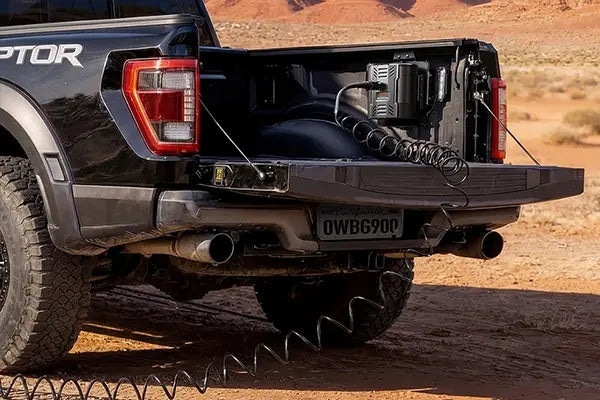

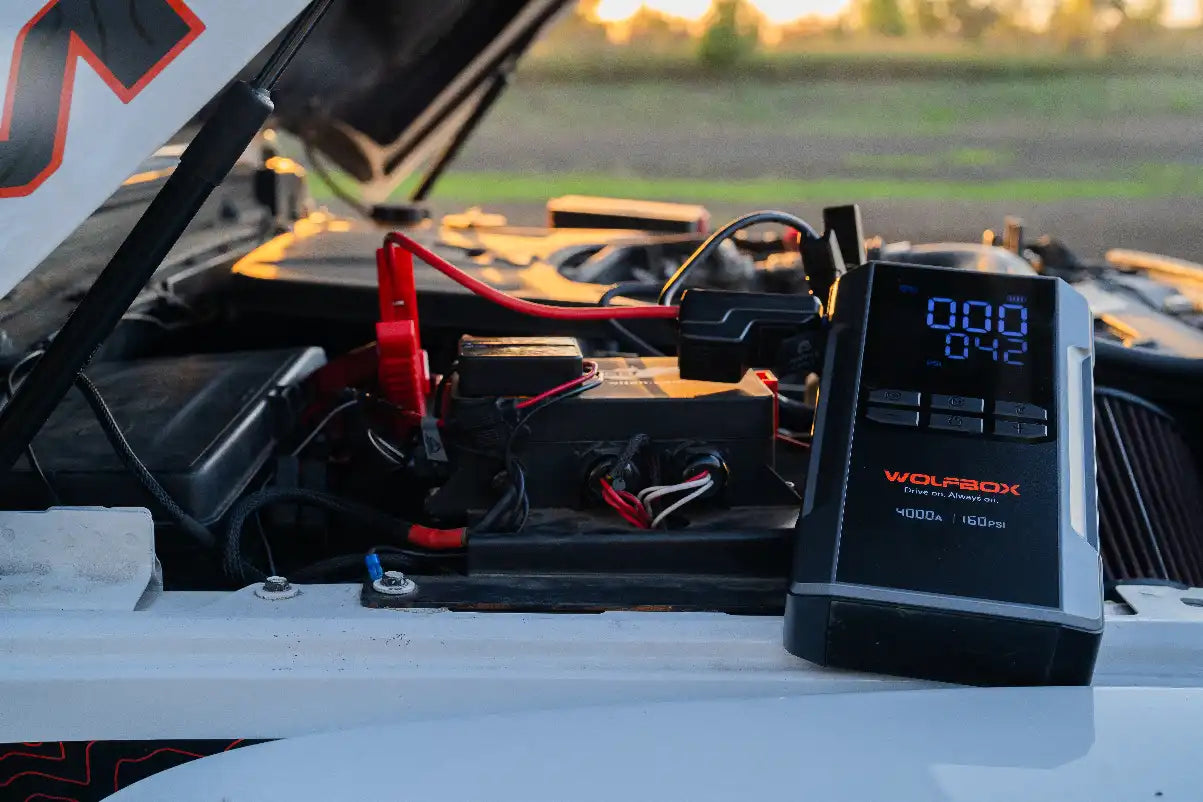
Day 3 of a backcountry trip, and the F-250 will not turn over. The nearest service station is 94 miles out. In that moment the number printed on the side of your jump starter means nothing — what matters is whether it can actually deliver current at whatever temperature it sat at overnight in the truck bed.
A camping jump starter has to clear a higher bar than a garage one: it needs to survive weeks between charges, tolerate freezing overnight lows, and still crank a diesel engine if that is what you drive. Here is what actually changes for off-grid use, and which of the two WOLFBOX models fits which situation. [6][7]
Garage Use vs. Off-Grid Use Are Not the Same Test
A jump starter that lives in a climate-controlled garage gets charged regularly and used occasionally — a forgiving life. One that rides in a truck bed through a week of camping sees freeze-thaw cycles, sits unused for months at a time, and has to work on the first attempt with no backup plan. Lithium cells lose 15–20% of usable capacity near freezing and can lose 30–40% in sustained sub-zero conditions, so a unit that starts your truck fine in July may struggle in a January trailhead parking lot with the same charge level. [8]
Diesel Needs More Than Gas Does — By a Lot
Diesel engines rely on compression to reach ignition temperature (compression ratios from 14:1 up to 23:1) instead of a spark, and that takes noticeably more cranking current, especially once temperatures drop.
| Engine Type | Displacement | Typical CCA Required | Cold Weather (below 20°F) Recommendation |
| Gas engine | 2.0–3.5L | 300–500 CCA | 400–600 CCA |
| Gas engine (truck) | 4.0–5.0L | 500–700 CCA | 600–800 CCA |
| Light diesel | 2.0–3.5L | 600–750 CCA | 750–900 CCA |
| Medium diesel (pickup) | 4.5–6.7L | 750–950 CCA | 900–1,100 CCA |
| Heavy diesel (HD truck) | 7.3–10.0L | 950–1,100 CCA | 1,100+ CCA |
The MegaVolt 24Air is rated for gas and diesel engines up to 10L with 4,000A peak current, which covers the heavy diesel row in this table with room to spare. [1] The MegaVolt 10Air, at 2,000A, is built for gas engines up to 5L — fine for a car or a smaller SUV, not enough margin for a diesel pickup in cold weather. [2] [3]
What Cold Actually Does to Capacity
Both models are rated to run from -4°F to 140°F, but "rated to run" and "runs at full strength" are different claims. [1][2] Usable capacity drops well before the rated limit:
| Temperature | Approximate Usable Capacity | What This Means in Practice |
| 68°F / 20°C | ~100% | Full rated capacity available |
| 32°F / 0°C | ~80–85% | Still reliable; noticeable but not concerning |
| 14°F / -10°C | ~65–75% | A cold-soaked unit starts to lose real margin on larger engines |
| 0°F / -18°C | ~55–65% | Worth pre-warming the unit before attempting a start |
| -4°F / -20°C (rated minimum) | ~50–60% | At the edge of the rating — marginal for a large diesel |
The practical fix is simple: below 20°F, sleep with the unit in the cab or the tent rather than leaving it in the truck bed overnight. A unit that spent the night at cabin temperature starts an engine far more reliably than one that cold-soaked at ambient overnight. [8]
Keeping a Charge Between Trips
- Charge fully before leaving, not the morning you pack
- For storage past 3 months, keep the unit around 40–60% charge rather than full or empty — lithium cells hold up better that way [8]
- Top off every 3–6 months even if it is sitting in a drawer
- Keep it out of a locked cab in summer heat — sustained temperatures above 104°F degrade the cells faster than cold does
The MegaVolt 24Air's 24,000 mAh (88.8 Wh) pack gives enough buffer that even at reduced cold-weather output, most passenger vehicles and light diesels still get a reliable start on the first or second attempt. [1]
Doubling as Camp Power
The MegaVolt 24Air's 65W USB-C port is enough to actually charge a laptop, not just top off a phone — a 15-inch laptop battery typically holds 45–70 Wh, so the 24Air's 88.8 Wh capacity gets you roughly one to two full laptop charges depending on the machine. [1] Phone and GPS charging barely dents it across a weekend.
The 10Air's USB-C port is input only (15W, for recharging the unit); it charges a phone or GPS through its 12W USB-A output, which is fine for those but will not keep a laptop charged under load — worth knowing before you count on it for remote work at a campsite. [2]
MegaVolt 24Air vs. MegaVolt 10Air for Camping
| Specification | MegaVolt 24Air | MegaVolt 10Air |
| Peak current | 4,000A | 2,000A |
| Battery capacity | 24,000 mAh (88.8 Wh) | 37 Wh |
| USB-C port | 65W PD (laptop capable) | 15W input |
| USB-A output | 18W (QC 3.0) | 12W (5V/2.4A) |
| Air compressor | 160 PSI, 45 L/min | 150 PSI, 25 L/min |
| LED flashlight | 400-lumen | 200-lumen |
| IP rating | IP64 | IP64 |
| Operating temperature | -4°F to 140°F | -4°F to 140°F |
| Warranty | 30 months | 30 months |
| Engine coverage | Gas and diesel up to 10L | Gas up to 5L |
Popular Science independently tested the 24Air and confirmed the 4,000A rating, 24,000 mAh (88.8 Wh) capacity, 65W USB-C port, 160 PSI compressor, and IP64 rating. [4] Pro Tool Reviews separately verified the base MegaVolt 24's dual start modes and reverse-polarity protection. [5] If you drive a diesel pickup, tow a trailer, or want laptop charging at camp, the 24Air is the one that actually covers those needs — the 10Air is built for smaller gas engines and phone-level charging, not as a lighter version of the same job.
Frequently Asked Questions
Can the MegaVolt 24Air start a diesel truck?
Yes, for engines up to 10L. For a large-displacement diesel in cold weather, keep the unit in the cab overnight rather than the truck bed before attempting a start.
How cold is too cold for a lithium jump starter?
Both models are rated to -4°F, but usable capacity drops well before that. Between 0°F and 32°F, pre-warm the unit indoors or in the cab for the most reliable start.
Can the MegaVolt 24Air actually charge a laptop?
Yes — the 65W USB-C port supports laptop charging, good for roughly one to two full charges depending on the laptop. The 10Air also doubles as a portable power bank, with a 15W USB-C port and a 12W USB-A port for charging phones, tablets, GPS devices, and other small electronics.
How long can it sit unused between trips?
Lithium cells self-discharge around 2–5% per month, so a full charge holds up fine for 3–6 months. Top it off every few months if it is sitting between trips.
Does the MegaVolt 24Air double as a tire inflator?
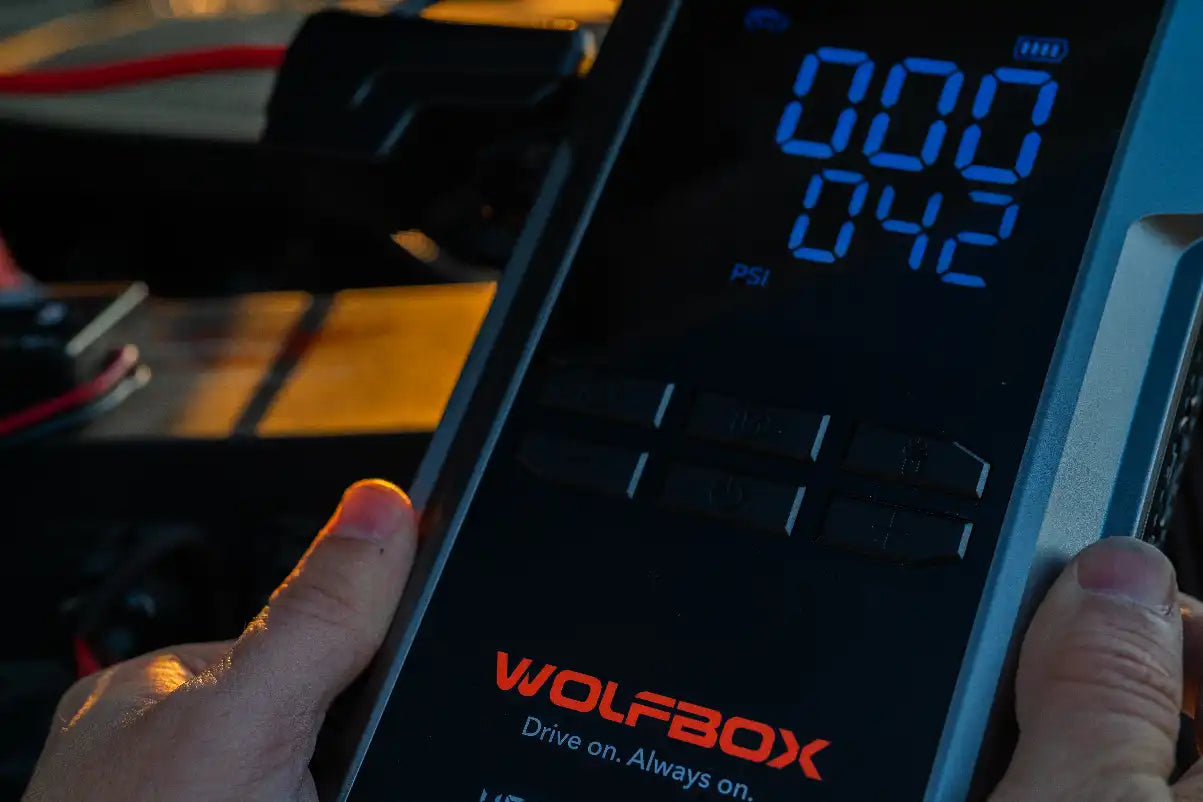
Yes, up to 160 PSI at 45 L/min, with a digital gauge and automatic shutoff.
Which model makes sense for a gas SUV at a campsite?
The 10Air handles gas engines up to 5L and covers phone and GPS charging fine. Go with the 24Air if you need diesel starting capability or laptop-level charging.
References
- [1] WOLFBOX MegaVolt 24Air Official Product Page: https://wolfbox.com/products/jump-starter-with-air-compressor-tire-inflator-wolfbox-megavolt-24air
- [2] WOLFBOX MegaVolt 10Air Official Product Page: https://wolfbox.com/products/wolfbox-2000a-jump-starter-with-air-compressor-wolfbox-megavolt-10air
- [3] WOLFBOX MegaVolt Jump Starter Blog Review: https://wolfbox.com/blogs/jump-starter-with-air-compressor/wolfbox-jump-starter
- [4] Popular Science — WOLFBOX MegaVolt 24Air Full Test: https://www.popsci.com/gear/wolfbox-4-in-1-jump-starter-with-air-compressor-review/
- [5] Pro Tool Reviews — WOLFBOX MegaVolt 24 Review: https://www.protoolreviews.com/wolfbox-megavolt-24-jumpstarter-review/
- [6] WOLFBOX Jump Starter Collection: https://wolfbox.com/collections/jump-starter-1
- [7] WOLFBOX Warranty Policy: https://wolfbox.com/pages/warranty-policy
- [8] iPowerQueen — Lithium Batteries in Cold Weather: https://ipowerqueen.com/blogs/knowledge/the-ultimate-guide-to-lithium-batteries-in-cold-weather


Leave a comment
All comments are moderated before being published.
This site is protected by hCaptcha and the hCaptcha Privacy Policy and Terms of Service apply.