






Go stand in your garage and find the nearest working outlet. Odds are it's behind the shelving unit, above the bench on the far wall, or buried behind whatever got stacked in front of it back in July. That one detail decides more about which air duster you should own than any spec WOLFBOX or anyone else prints. Not watts, not CFM. How far the mess sits from power.
The DataVac ED-500 plugs in: 500 watts, 0.75 horsepower, 70 CFM, twelve feet of cord([1]). CFM, cubic feet per minute, is how much air a tool actually moves. The WOLFBOX MF200, the MF200PRO that replaces it, and the WOLFBOX MF500PRO all run on swappable battery packs, so the outlet question never comes up at all([2][3]).
Corded vs. Cordless: Which Offers More Flexibility?
The main difference between the DataVac ED-500 and WOLFBOX air dusters is their power source. The corded DataVac ED-500 weighs 2.76 pounds and can run continuously while plugged in, making it suitable for extended cleaning sessions without battery interruptions.[1] However, its 12-foot power cord limits mobility and may require an extension cord when cleaning areas far from an outlet.
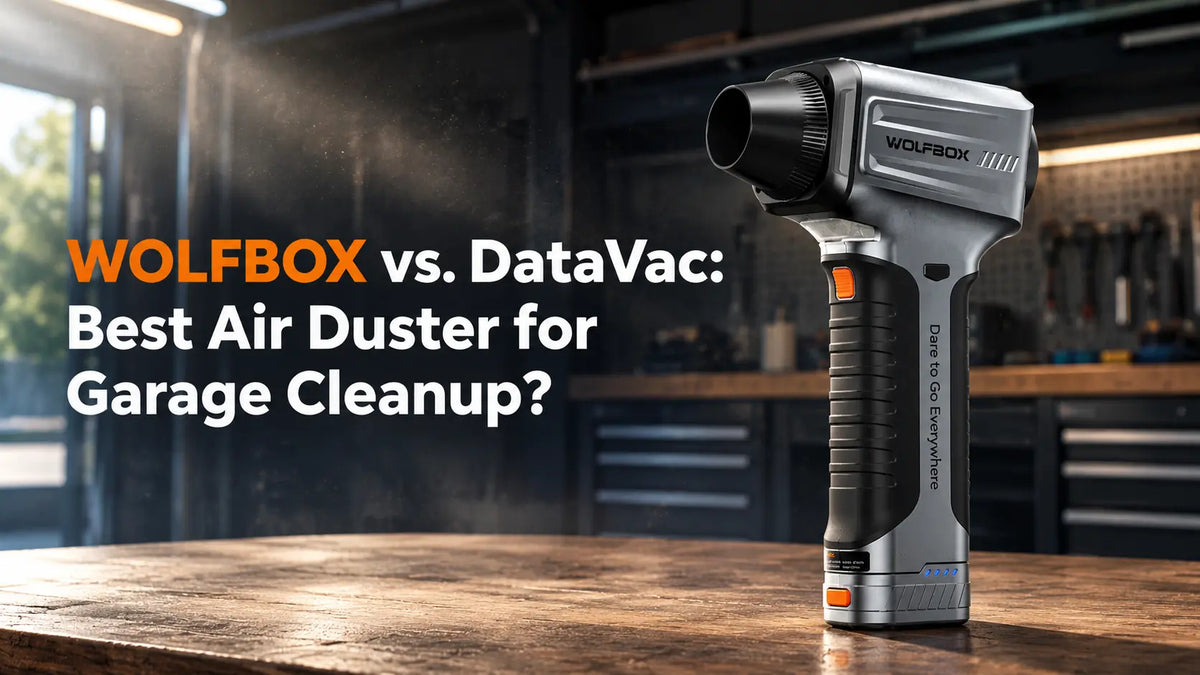
The cordless WOLFBOX models offer more freedom of movement. The MF200 weighs 0.84 pounds, the MF200PRO weighs 0.98 pounds, and the MF500PRO weighs 3.2 pounds.[2][3] Without a power cord, they are easier to carry between workbenches, vehicles, and other areas where outlets may not be readily accessible.
The choice comes down to how you clean. If you primarily work near an outlet and need uninterrupted operation for extended periods, the DataVac ED-500 has an advantage. If you value portability and need to clean in different locations, a cordless WOLFBOX model may be a better fit. Keep in mind that cordless models depend on battery capacity and may need recharging or a battery swap during longer cleaning sessions.
What the Numbers Mean
When comparing WOLFBOX air dusters with the DataVac ED-500, remember that power, airflow volume, airspeed, and thrust measure different aspects of performance.
The DataVac ED-500 lists 500 watts, 0.75 HP, and 70 CFM.[1] Watts and horsepower are units of power, while CFM measures airflow volume. The WOLFBOX MF200 lists 82 CFM and 110,000 RPM, giving it a higher published airflow rating than the ED-500: 82 versus 70 CFM.[1][4]
The MF200PRO delivers airflow speeds of up to 196+ MPH, while the MF500PRO lists 840 watts and 1,150 grams of thrust.[2][3] These figures measure different performance characteristics and cannot be directly compared.
Two Tiers of WOLFBOX Tool, Two Different Messes
Picking between the WOLFBOX MF200PRO and the WOLFBOX MF500PRO is easier than it looks, because the jobs barely overlap. The MF200PRO is the precision tool, and the direct replacement for the MF200: 0.98 pounds, four nozzles, and airflow dialed anywhere between 1 and 100 percent for keyboards, tool chests, engine bays, and the dust on everything stored above head height([2]).
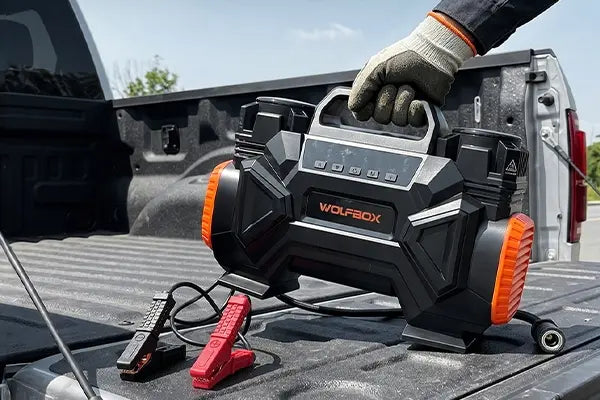
The WOLFBOX MF500PRO is the garage-scale one: 3.2 pounds, 840 watts, and enough thrust to move wet leaves off a driveway, with round, flat, and long nozzles in the box([3]). Wccftech points out that traditional leaf blowers run 8 to 10 pounds, which is the comparison the WOLFBOX MF500PRO is really making([5]).
MF200 vs MF200PRO: What the Upgrade Actually Changes
The MF200PRO builds on the MF200 with more precise airflow control and added convenience features. The MF200 offers three preset speed settings, while the MF200PRO adds 1–100% stepless airflow control, a dedicated Turbo button, and a display showing the selected setting.[2]
Both models feature a swappable battery, USB-C charging, and four nozzles. The MF200PRO also adds a built-in LED with steady and flashing modes, plus overheat protection. It weighs 0.98 lb, compared with 0.84 lb for the MF200.[2]
Runtime differs by speed setting: the MF200PRO is rated for up to 14 minutes at 100% airflow and about 200 minutes at 5%, while the MF200 is rated for up to 100 minutes on its lowest setting.[2]
Specs Side by Side
|
Spec |
WOLFBOX MF200 |
WOLFBOX MF200PRO |
WOLFBOX MF500PRO |
DataVac ED-500 |
|---|---|---|---|---|
|
Power source |
Swappable battery([2]) |
Swappable battery([2]) |
Swappable battery([3]) |
Corded, 12-ft cord([1]) |
|
Motor |
252W, 110,000 RPM([4]) |
252W([2]) |
840W([3][5]) |
500W, 0.75 HP([1]) |
|
Thrust/air pressure |
0.62 lb([4]) |
270g([2]) |
1,150g([3][5]) |
Not published([1])
|
|
Weight |
0.84 lb([4]) |
0.98 lb([2]) |
3.2 lb([3]) |
2.76 lb([1]) |
|
Runtime |
Up to 100 min, lowest speed |
14 min at 100%, 200 min at 5%([2]) |
18 min at 100%, 230 min at 5%([3]) |
Unlimited while plugged in([1]) |
|
Attachments |
4 nozzles, 2 brushes
|
4 nozzles, 2 brushes
|
3 nozzles([3]) |
4 nozzles and a detailing kit |
The Real Runtime
Runtime varies with airflow settings. The WOLFBOX MF500PRO is rated for about 18 minutes at full speed and 230 minutes at 5% airflow, while the MF200PRO is rated for 14 minutes at 100% and about 200 minutes at 5%.[2][3] The MF200 offers up to 100 minutes on its lowest setting, with one independent test recording 23 minutes at medium speed.[6]
All three WOLFBOX models feature swappable batteries, allowing users to carry a spare for longer cleaning sessions. For comparison, the corded DataVac ED-500 offers continuous operation when a suitable power outlet is available within reach of its 12-foot cord.
Which Air Duster Fits Your Garage Tasks?
Different garage tasks call for different airflow characteristics. The WOLFBOX MF500PRO delivers 840 watts of power and 1,150 g of thrust, making it suitable for clearing leaves, grass clippings, and other loose debris.[3] For more precise cleaning, the MF200PRO offers airflow speeds of up to 196+ MPH and adjustable airflow from 1% to 100%, helping tackle sawdust, dust on workbenches, and debris in tight spaces.[2]
For electronics and delicate components, the DataVac ED-500 includes four nozzle types and a four-piece detailing tool kit for targeted cleaning.[1] Choosing the right tool depends on the debris, the cleaning area, and the level of airflow control required.
For more workshop cleaning tips and advice on choosing the right tool, see the air duster guide for workshop use.
A Practical Garage Cleaning Order
Work from top to bottom to keep dust and debris from settling on areas you've already cleaned.
1. Start with the ceiling and shelves. Remove dust and cobwebs from rafters, light fixtures, and shelf tops.
2. Move to workbenches and storage. Clean work surfaces, tool chests, drawers, and other hard-to-reach areas.
3. Finish with the floor. Clear away fallen dust and debris, then sweep or collect anything left behind.
Noise in a Room With Concrete Walls
High-speed air dusters generate noticeable noise as they push air at high velocity, especially at maximum power. In enclosed spaces like garages, the sound can seem even louder due to reflections from hard walls and floors.
For a more comfortable cleaning experience, use a lower airflow setting when full power isn't necessary, avoid prolonged operation at maximum speed, and wear hearing protection when appropriate.
When the WOLFBOX Dusters Aren't the Right Call
None of the WOLFBOX dusters is the right pick for every garage. Anyone cleaning one bench, always within reach of an outlet, who wants a tool that never needs charging, will get more out of a corded unit like the DataVac ED-500 than out of the MF200PRO([1][2]). Jobs that need the dust captured rather than relocated call for a shop vac with a filter([7][2][3]). And the WOLFBOX MF500PRO is overkill for electronics work; at 840 watts and 1,150 grams of thrust, it belongs on leaves and floors, not on a circuit board([3]).
Who Should Buy Which
- Garage cleanup past the reach of an outlet, leaves included: the WOLFBOX MF500PRO at 3.2 pounds with a swappable pack([3]).
- Detail work on tools, benches, PCs, and car interiors: the WOLFBOX MF200PRO at 0.98 pounds, with 1 to 100 percent stepless airflow and a Turbo button for the stubborn spots([2]).
- One bench, one outlet, no batteries to think about: a corded duster like the DataVac ED-500([1]).
Frequently Asked Questions
Is a cordless or corded air duster better for garage cleanup?
A cordless air duster offers more flexibility when cleaning vehicles, workbenches, and areas away from power outlets. A corded model is convenient for extended cleaning sessions near an outlet without needing to recharge a battery.
How long does the WOLFBOX MF500PRO run per charge?
The WOLFBOX MF500PRO is rated for approximately 18 minutes at full power and up to 230 minutes at 5% airflow. Actual runtime depends on the selected setting and usage conditions.[3]
What is the difference between the MF200 and MF200PRO?
The MF200PRO adds 1–100% stepless airflow control, a dedicated Turbo button, a setting display, and a built-in LED. Both models feature swappable batteries and USB-C charging, while the MF200PRO weighs slightly more.[2]
Can an air duster be used to clean electronics?
Yes, but use a low airflow setting and an appropriate nozzle to reduce the risk of damaging delicate components. Power off the device before cleaning and follow its manufacturer's cleaning instructions.
Do air dusters collect dust like a vacuum?
No. Air dusters blow dust and debris away from surfaces rather than collecting them. If you need to contain dust instead of redistributing it, use a suitable vacuum with an appropriate filter.
Are air dusters noisy?
High-speed air dusters can produce noticeable noise, particularly at maximum power. Use a lower setting when possible and wear hearing protection when appropriate.
References
([1]) B&H Photo Video: Metro DataVac Electric Duster ED-500 Product Listing: bhphotovideo.com/c/product/599911-REG/METRO_DataVac_ED_500_DataVac_Electric_Duster_Model.html
([2]) WOLFBOX: MF200PRO Air Duster Official Product Page: wolfbox.com/products/compressed-air-duster-mf200
([3]) WOLFBOX: MF500PRO Air Duster and Handheld Blower Official Product Page: wolfbox.com/products/wolfbox-mf500pro-air-duster-handheld-blower-for-leaves-outdoor-cleanup
([4]) WOLFBOX: Best Electric Air Duster for a Gaming PC in 2026, MF100 vs MF200: wolfbox.com/blogs/air-duster/best-electric-air-duster-for-a-gaming-pc-in-2026-mf100-vs-mf200
([5]) Wccftech: WOLFBOX MF500Pro Packs 168MPH Airflow, a Swappable Battery and More Into a 3.2lb Body: wccftech.com/wolfbox-mf500pro-leaf-blower-168mph-swappable-battery-169-99
([6]) Gough's Tech Zone: Quick Review, Generic Air Duster vs WOLFBOX Super Power Turbofan MF100 and MF200: goughlui.com/2026/05/22/quick-review-generic-air-duster-vs-wolfbox-super-power-turbofan-mf100-mf200
([7]) WOLFBOX: Air Duster Review, Battery Life, PSI and Filter Test: wolfbox.com/blogs/air-duster/wolfbox-air-duster-review


Leave a comment
This site is protected by hCaptcha and the hCaptcha Privacy Policy and Terms of Service apply.