







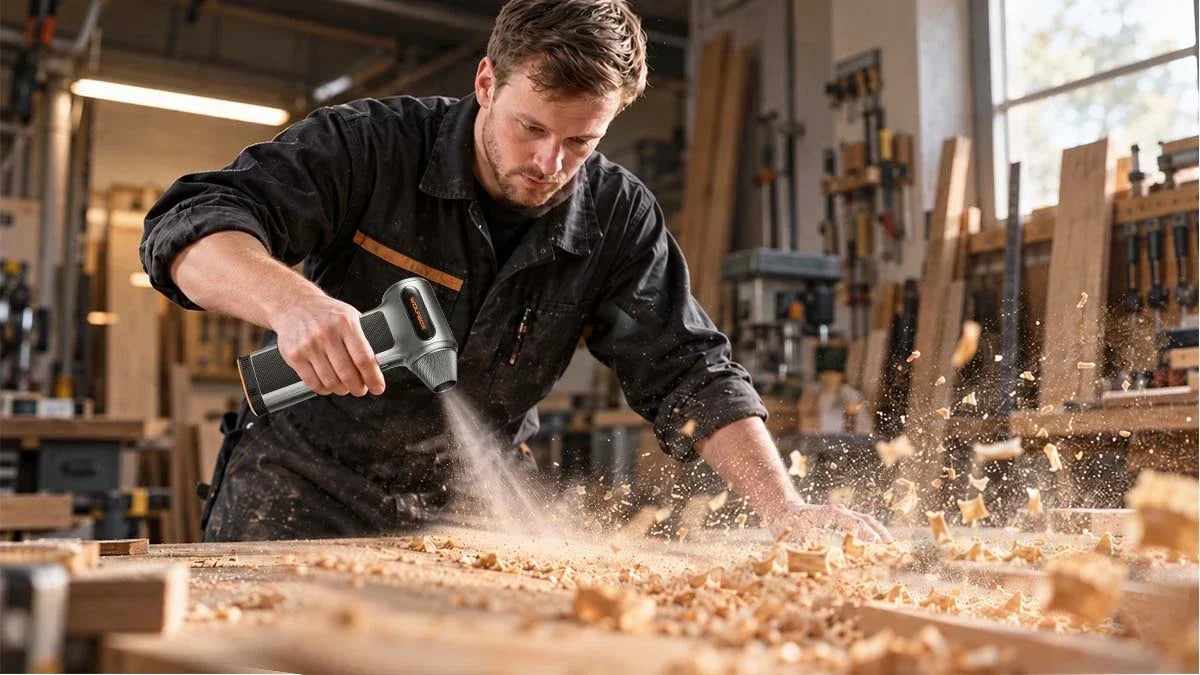
Most workshops already have a compressor. So, it's only fair to ask why you'd need anything else. The honest answer? A workshop air duster mostly handles a different job than your compressor. More specifically, a workshop air duster enables quick, targeted cleanup.
It doesn't require dragging out a hose or firing up the tank for thirty seconds. You may need to clear metal shavings off a workbench, blow sawdust out of tool vents, or reach gaps that your compressor's fixed nozzle can't quite angle into.
Only a dedicated duster can solve these issues. This guide covers why the extra tool is worth the price, what to check, and which best air dusters for workshop tools are worth a look. We'll also discuss how to use one safely around real shop equipment.
Why Your Workshop Needs a Dedicated Duster (Not Just Your Compressor)
A dedicated air duster handles fast, frequent cleanup jobs where a shop compressor is overkill. You won't even need a hose run or a warm-up cycle.
A compressor is still the right tool for pneumatic equipment and heavier jobs. [1] For quick daily cleanup, a compact electric air duster is comparatively faster to use.
Take Cleaning Power Anywhere Around the Workshop
A cordless duster pounces upon the mess wherever it is. A bench in the corner, a car up on a lift, or a tool cabinet – your compressor hose is too much or can't reach.
There's no dragging a coiled line across the floor or working around a fixed drop point. That freedom to walk over and use it is a superior daily convenience than it sounds.
Reach Tight Spaces and Hard-to-Clean Areas
A focused nozzle directs airflow into narrow gaps, vents, grooves, and seams. A wide compressor nozzle or a rag can't reach these spots cleanly. Consider clearing chips from a vise, dust from a tool's motor housing, or debris from a drawer track. [2]
That's where the focused nozzle can clear out everything smoothly. Interchangeable nozzle tips let you switch easily between a wide blast and a narrow stream. Use the blast for a whole bench and the stream for a single connector or seam.
Handle Quick Cleanup Without Setting Up the Compressor
A simple cleanup usually takes just thirty seconds. Involving a compressor means running a hose, checking the tank pressure, and coiling everything back up afterward.
A dedicated duster skips everything. Just grab it, use it, and set it back down. Over a full workday of small cleanups, that saved setup time adds up more than it seems.
Why an Electric Air Duster Is Better for Workshop Use Than Canned Air
Many workshops continue to clean up daily between tasks. An electric duster holds up better than disposable cans in cost, consistency, and control.
Canned air was never built for repeated, heavy-duty shop use. It shows the weakness the moment you start cleaning more than a keyboard. [3]
A shop going through several cans a week is paying for that convenience. And the total cost adds up fast compared to a one-time rechargeable purchase.
Reusable for Frequent Workshop Cleaning
A rechargeable duster handles daily cleanup indefinitely on one unit. Meanwhile, a shop that uses canned air regularly buys and tosses cans on a schedule that adds up fast in both cost and waste.
More Control Over Airflow
Canned air gives you one output level that fades as the can empties. Meanwhile, an electric duster's adjustable speed settings let you drop to a gentle setting for delicate parts. You can even step up to full power for stubborn sawdust or metal shavings. [4]
More Practical for Larger and Repeated Jobs
It can be a full workbench cleanup, a dusty tool cabinet, or clearing out a project after a sanding session. That's a lot to ask of a single can, which loses pressure steadily as you use it.
An electric duster delivers full-strength airflow from the first burst to the last. [5] That consistency matters for bigger jobs where you can't afford to lose power halfway through.
Key Features to Consider in a Workshop Air Duster
The right specs for a workshop duster look different from those for one built for a desk. Workshop debris tends to be heavier, and the jobs also run longer.
Check the following five factors against how your shop uses a duster day to day. The "best" air duster means the one that matches your cleanup requirements.
Airflow Output (CFM/Velocity)
Higher airflow can clear heavier debris, such as metal shavings and sawdust, more quickly than air dusters designed mainly for light dusting. [6]
Nozzle Attachments and Reach
A variety of nozzle shapes, flat, round, and extended, determines how well the duster reaches into vents, grooves, and tight equipment gaps.
Corded vs Battery-Powered
A battery-powered unit goes anywhere in the shop without a cord. Meanwhile, a corded model trades portability for unlimited runtime at a workbench.
Noise Level
A shop is generally more tolerant of motor noise than a home office. However, check whether you'll use it near coworkers or on a shared floor.
Durability
A workshop duster should handle regular exposure to dust and metal shavings. Even the occasional drop should hold up better than a consumer gadget.
WOLFBOX Air Dusters for Workshop Use
The WOLFBOX air duster lineup spans light desk-and-bench cleanup to a heavier-duty option for sustained shop use. [7] So, the right pick depends on how demanding your typical cleanup job is.
Each model maps to a different point on that scale, from compact and portable to genuinely heavy-duty.
Summary Comparison: WOLFBOX MF100 vs MF200 vs MF500PRO
|
Specification |
MF100 |
MF200 |
MF500PRO |
|---|---|---|---|
|
Weight |
0.66 lb |
0.84 lb |
3.2 lb |
|
Battery |
6,000mAh, built-in |
2 x 3,000mAh, swappable |
6 x 3,000mAh, swappable |
|
Power/Airflow |
Up to 100 MPH |
Up to 196 MPH |
840W, 1,150g thrust |
|
Speed Control |
3-gear adjustable |
3-gear adjustable |
Stepless + turbo boost |
|
Runtime (lowest speed) |
Up to 100 minutes |
Up to 100 minutes |
Up to 230 minutes |
|
Best For |
Small bench, desk |
Everyday shop cleanup |
Heavy, sustained cleanup |
WOLFBOX MF200
The MF200 runs on a swappable battery system with two 3,000mAh cells that click in and out. So, you can swap in a fresh battery without waiting to recharge mid-job. [4]
It delivers up to 210 MPH of airflow across three speed settings and weighs about 0.84 lb. The airflow covers most everyday workshop cleanup without requiring a heavier tool.

WOLFBOX MF100
The MF100 is the lighter, more compact option at 0.66 lb. It also comes with a single built-in 6,000mAh battery and up to 100 minutes of runtime on its lowest setting.
The MF100 seems like a reasonable pick for a smaller workspace or a secondary duster. You can keep it at a specific bench rather than carrying it around the whole shop. [8]

WOLFBOX MF500PRO
For heavier, more sustained cleanup, the MF500PRO is built around an 840W motor. You can get 1,150g of thrust with a swappable 3,000mAh×6 battery pack. The stepless speed control ranges from a gentle setting up through a turbo boost mode. [9]
Weighing about 3.2 lb, it's noticeably heavier than the MF100 or MF200. However, that weight comes with more sustained power for a shop that regularly clears heavier debris. You won't need such power for tasks like dusting off a keyboard.

Workshop Safety Tips for Using an Air Duster
A few basic habits keep an air duster safe around real shop equipment and materials. Most of the precautions take no extra time once they're routine.
None of them take too much time, but they matter the moment something goes wrong. A shop that treats a duster casually is more likely to cause an avoidable injury or damage a tool.
Wear Eye and Ear Protection
Flying debris and motor noise are both real risks in a shop setting. Keep safety glasses and hearing protection on hand when using a duster.
Keep Pressure Appropriate for Electronics
OSHA's compressed air standard requires cleaning pressure to stay under 30 PSI. A higher dead-end pressure can force air through skin and cause serious injury. [10]
Skip the Propellant Risk Entirely
An electric duster has no liquid chemical propellant to worry about in the first place. It removes one of canned air's real hazards around a shop full of flammable solvents and hot equipment.
Always Ventilate the Area
Blowing dust and debris into the air without containing it can create a breathing hazard in an enclosed shop. So, clean near an open door, window, or exhaust fan.
Use the Right Grip and Nozzle Technique
Hold the nozzle a few inches back; don't press it directly against a surface. Also, angle it away from your face and others nearby, especially when clearing metal chips or wood dust.
Conclusion
A dedicated air duster is more like a complementary gadget for your compressor in a workshop. It handles the fast, frequent cleanup jobs that don't justify running a hose every time. To find the right air duster, match it to the cleanup job.
A compact model like the MF100 or MF200 covers most everyday bench and tool cleanup. [4] [8] Whereas a shop clearing heavier debris regularly gets more out of the MF500PRO's added power. [9]
Whichever fits your workshop, the WOLFBOX lineup gives you a rechargeable option for repeated, practical, and convenient use. [7] That too, without the ongoing cost or hassle of canned air. Measure your cleanup job against the specs, and choosing the right duster for your bench becomes easy.
Frequently Asked Questions (FAQs)
1. What is the best air duster for workshop tools?
It depends on your cleanup load. WOLFBOX MF100 and MF200 cover most everyday bench and tool cleanup. Meanwhile, the MF500PRO's higher-output motor is a better fit for shops that regularly clear heavier debris.
2. Can an electric air duster replace compressed air?
For cleanup and dusting tasks, yes. An electric duster gives you adjustable, consistent airflow without a hose or tank. For powering pneumatic tools, you'll still need a compressor, as a duster can't run air tools.
3. Is higher RPM better for an air duster?
Not necessarily on its own. RPM contributes to airflow output. However, usable velocity and pressure depend on the motor and fan design. Compare the airflow speed and the thrust specs rather than RPM.
4. Can you use an air duster on power tools?
Yes. A duster works well for external cleanup (clearing dust/debris from vents, housings, and grooves). Stick to a lower speed setting around delicate components. Always turn off the tool first.
5. Corded vs. rechargeable – which is better?
It depends on how you'll use it. A rechargeable duster goes anywhere in the shop without a cord. Meanwhile, a corded model offers unlimited runtime at a fixed workbench without needing to track battery charge.
6. How much airflow does a workshop actually need compared to a desk duster?
Workshop cleaning generally calls for more airflow than light electronic dusting. There is no universal CFM threshold, but higher airflow helps move larger amounts of sawdust, wood chips, and other debris more efficiently. For example, the WOLFBOX MF200 delivers up to 82 CFM, providing substantially more airflow than compact dusters designed primarily for light-duty desk and electronics cleaning.
References
[1] Air Tool Lab: "Air Duster Vs Air Compressor: Which Cleans Better and Why?" – https://airtoollab.com/air-duster-vs-air-compressor/
[2] WOLFBOX: "Electric Air Duster for Car Detailing and Interior Cleaning" - https://wolfbox.com/blogs/air-duster/electric-air-duster-car-detailing-speed-distance
[3] Tech Believers: "Electric Air Dusters: Do They Actually Beat Canned Air?" – https://techbelievers.com/blog/electric-air-dusters-do-they-actually-beat-canned-air
[4] WOLFBOX: "MF200 Compressed Air Duster - Swappable Battery Cartridge" – https://wolfbox.com/products/compressed-air-duster-mf200
[5] WOLFBOX: "Electric Air Duster vs Canned Air: Which Is Better in 2026?" – https://wolfbox.com/blogs/air-duster/electric-air-duster-vs-canned-air
[6] WOLFBOX: "Wolfbox Air Duster Review: Battery Life, PSI & HEPA Filter Test" – https://wolfbox.com/blogs/air-duster/wolfbox-air-duster-review
[7] WOLFBOX: "Best Air Dusters for PC, Car, and Home Cleaning" – https://wolfbox.com/collections/best-air-duster
[8] WOLFBOX: "MF100 Compressed Air Duster" – https://wolfbox.com/products/compressed-air-duster-mf100
[9] WOLFBOX: "MF500PRO Air Duster – Handheld Blower" – https://wolfbox.com/products/wolfbox-mf500pro-air-duster-handheld-blower-for-leaves-outdoor-cleanup
[10] Occupational Safety and Health Administration: "1910.242(b) Compressed Air Used for Cleaning" – https://www.osha.gov/laws-regs/regulations/standardnumber/1910/1910.242


Leave a comment
This site is protected by hCaptcha and the hCaptcha Privacy Policy and Terms of Service apply.