






The Short Answer
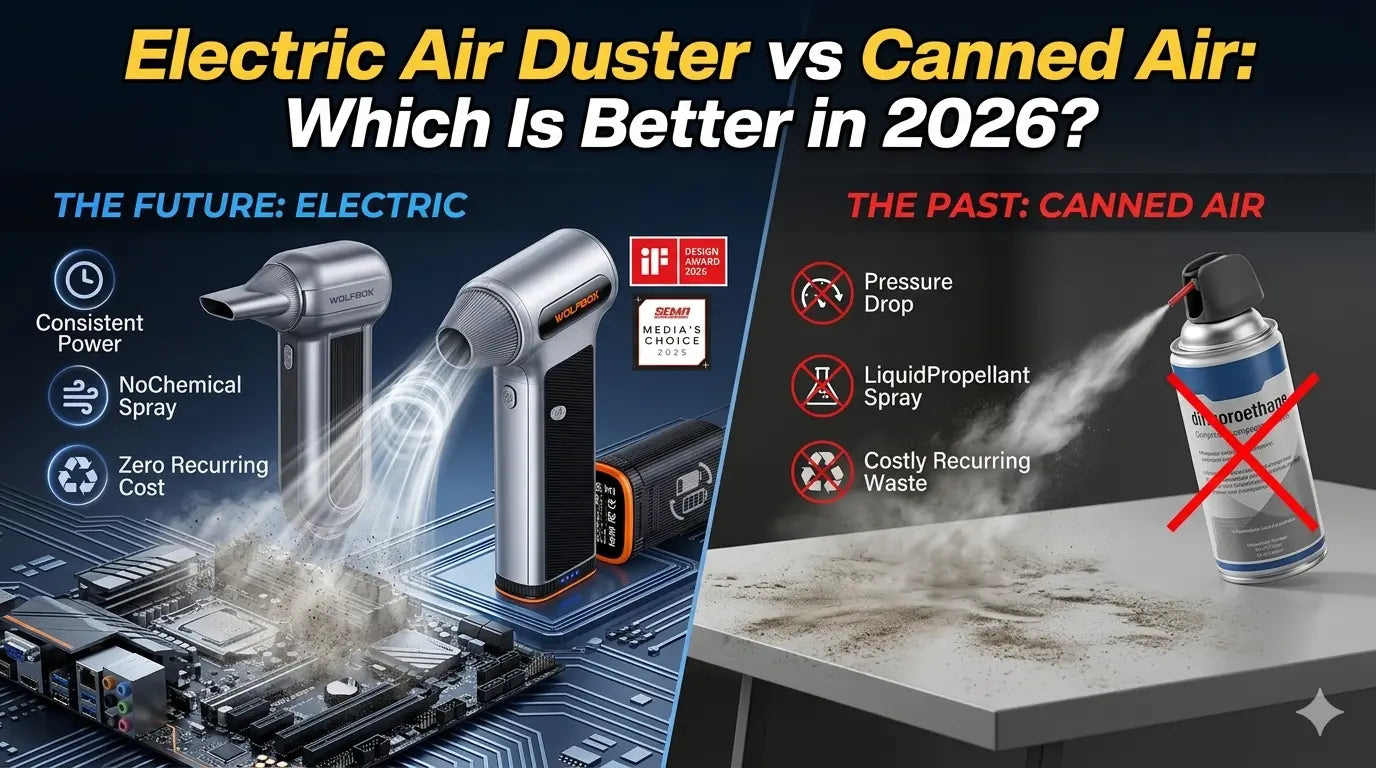
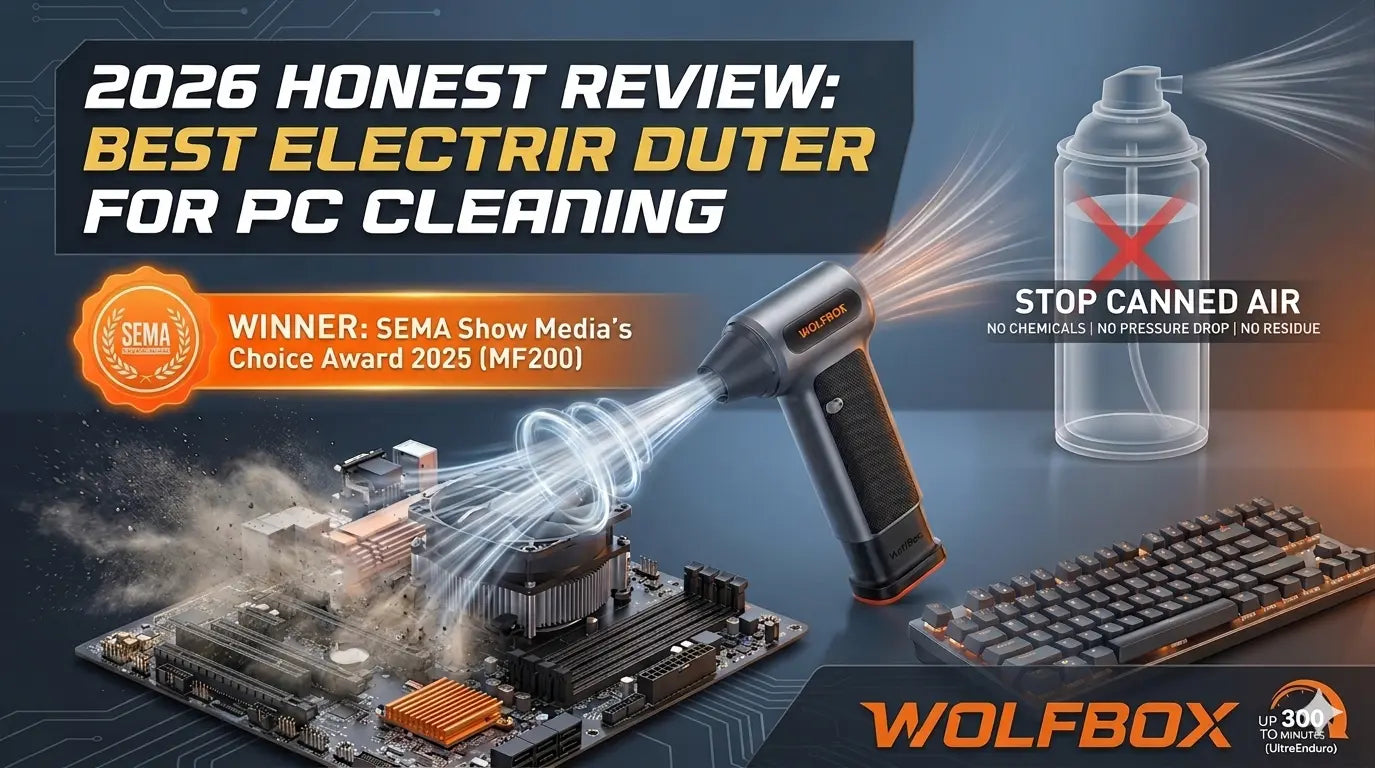
Electric air dusters are better than canned air for regular use in 2026. They deliver consistent full-power airflow throughout the session, produce zero chemical waste, cost less over time, and never risk spraying cold liquid propellant onto your electronics. The Wolfbox MF100 (150,000 RPM, 45 m/s, from $62.99) and MF200 (87.5 m/s, swappable battery, from $104.99) are the leading options this year.

The Real Problems with Canned Air
Canned compressed air has served PC builders and electronics technicians for decades, but four fundamental limitations have not gone away:
- The pressure drops steadily as the can empties. By the second half of the can, the blast is often too weak to dislodge packed dust from a GPU heatsink or CPU fan.
- Tilting the can beyond about 45° causes liquid difluoroethane (the propellant) to spray. This cold, chemical mist can freeze circuit board traces, damage electrolytic capacitors, and leave residue on camera sensors.
- Each can is a single-use item. At $7–$10 per can, a regular PC builder or detailer can spend over $100 a year on canned air — for something that largely evaporates into the atmosphere.
- Difluoroethane (HFC-152a) is a hydrofluorocarbon with a global warming potential roughly 140 times higher than CO₂. Canned air canisters are not recyclable in most municipalities.
How Electric Air Dusters Work
Electric air dusters replace the pressurized canister with a small brushless motor spinning at 80,000 to 150,000 RPM. The spinning impeller draws in ambient room air and accelerates it through a nozzle. Because the airflow comes from the environment rather than a stored chemical, there is no propellant, no cold spray, no residue, and no depleting reservoir. Speed controls — standard on both Wolfbox models — let you dial in the right pressure for the task: gentle on a camera sensor, full power on a packed PC case.
Head-to-Head Comparison
|
Category
|
Electric Air Duster (Wolfbox MF100/MF200)
|
Canned Air
|
|
Airflow consistency
|
Full power from start to finish
|
Decreases steadily as can empties
|
|
Cold spray risk
|
None — no propellant
|
Yes — tilting causes liquid spray
|
|
Cost per use
|
~$0 (rechargeable battery)
|
$7–$10 per can
|
|
Long-term cost
|
One-time purchase
|
$100–$200+ per year for regular use
|
|
Environmental impact
|
Zero chemical waste; USB-C rechargeable
|
Non-recyclable can, HFC-152a propellant
|
|
Speed control
|
Yes — 3 settings
|
No — fixed, declining pressure
|
|
Runtime
|
100–240 minutes per charge
|
~10–15 minutes continuous per can
|
|
Propellant inhalation risk
|
None
|
Yes — difluoroethane is commonly misused
|
|
Travel
|
USB-C charge, compact
|
Banned as carry-on on most airlines
|
|
Nozzle attachments
|
Multiple included
|
Single straw
|
|
Warranty
|
42 months (Wolfbox)
|
None (single-use product)
|

When Canned Air Still Makes Sense
There are a few narrow scenarios where reaching for a can is still reasonable:
- A one-off cleaning where you have no electric duster on hand and do not want to wait for delivery
- Remote locations with absolutely no charging access (though USB power banks largely solve this)
- Situations where the instant availability of gas-station or hardware-store stock matters
For anyone who cleans electronics, keyboards, cameras, or vehicles more than once or twice a year, the electric option pays for itself within a few months and keeps producing better results indefinitely.
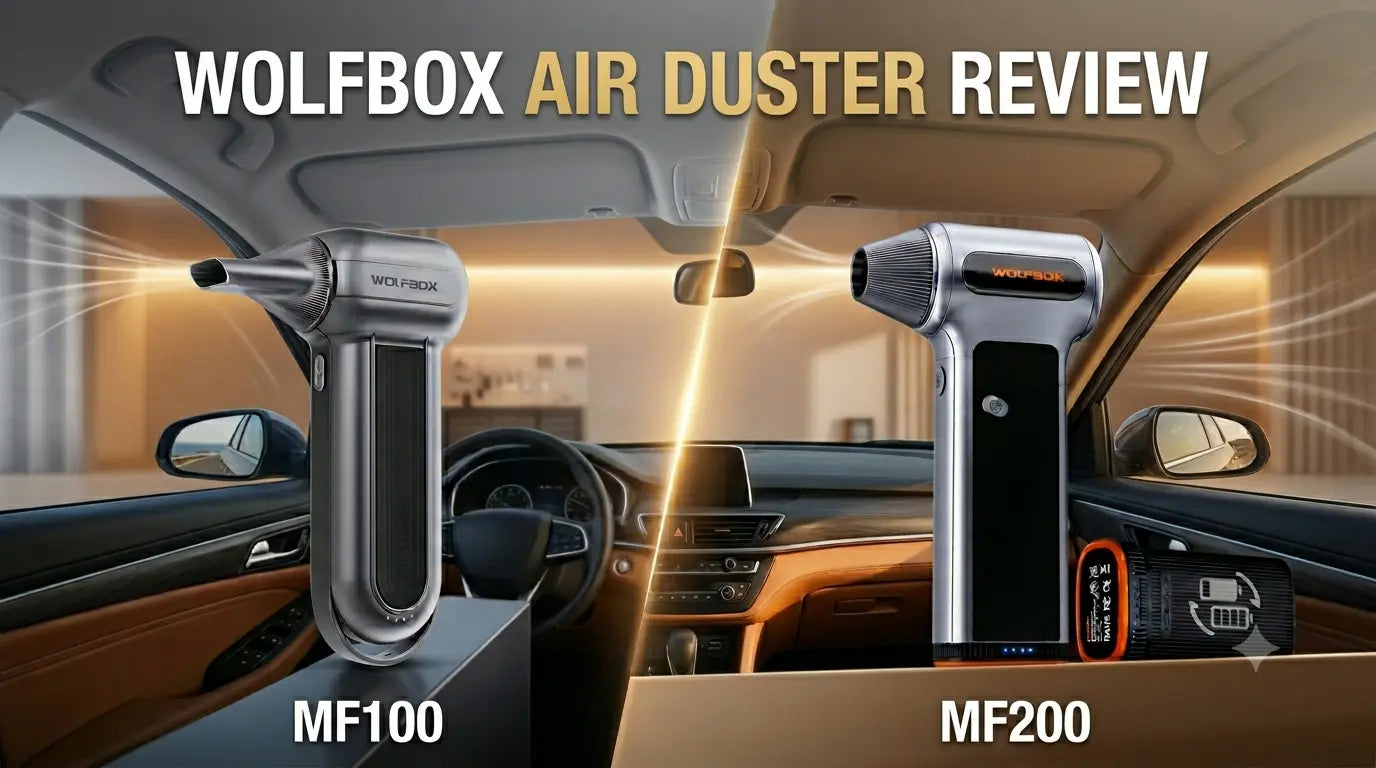
Wolfbox MF100 vs MF200: Choosing Your Electric Duster
|
Feature
|
Wolfbox MF100
|
Wolfbox MF200
|
|
Best for
|
Occasional PC/keyboard cleaning, travel
|
Heavy-duty detailing, long sessions, automotive
|
|
Motor speed
|
150,000 RPM
|
110,000 RPM
|
|
Max airflow
|
45 m/s
|
87.5 m/s
|
|
Battery
|
Built-in 3000 mAh × 2
|
Swappable 6000 mAh cartridge
|
|
Runtime at lowest speed
|
Up to 100 min
|
Up to 240 min
|
|
Weight
|
0.66 lb
|
0.84 lb
|
|
Notable recognition
|
—
|
2025 SEMA Show Media's Choice Award
|
|
Starting price
|
$62.99 USD
|
$104.99 USD (Lite Pack)
|
Frequently Asked Questions
Q: Is an electric air duster better than canned air?
A: Yes, for regular use. Electric air dusters maintain consistent full-power airflow throughout every session, produce no cold spray or chemical waste, and cost less over time. A single Wolfbox MF100 at $62.99 replaces hundreds of disposable cans.
Q: Do electric air dusters perform as well as a full can of compressed air?
A: Better, in most cases. The Wolfbox MF100 delivers 150,000 RPM and 45 m/s of airflow — stronger than a fresh can at its peak — and maintains that power until the battery is empty, which takes up to 100 minutes.
Q: Are electric air dusters safe for PC components?
A: Yes. Electric dusters use ambient air with no chemical propellant. There is zero risk of cold spray, liquid residue, or freezing damage to circuit boards, capacitors, or GPU components.
Q: Can I use an electric air duster on a camera lens?
A: Yes, using the lowest speed setting. The 3-speed control on both MF100 and MF200 allows precise airflow adjustment — gentle enough for optical glass and mirrorless sensors when used correctly.
Q: What makes the Wolfbox MF200 stand out?
A: The MF200 features a hot-swappable battery cartridge — carry a spare, swap mid-session, and never pause for a recharge. It delivers the highest airflow in the Wolfbox lineup at 87.5 m/s and earned the 2025 SEMA Show Media's Choice Award for automotive detailing performance.
The Verdict
In 2026, the electric air duster wins on every practical measure. The Wolfbox MF100 is the right starting point for individuals who clean occasionally. The MF200 is built for professionals, automotive detailers, and anyone who needs continuous runtime without stopping to recharge. Both are available at wolfbox.com with free shipping and a 42-month warranty.

Leave a comment
This site is protected by hCaptcha and the hCaptcha Privacy Policy and Terms of Service apply.