







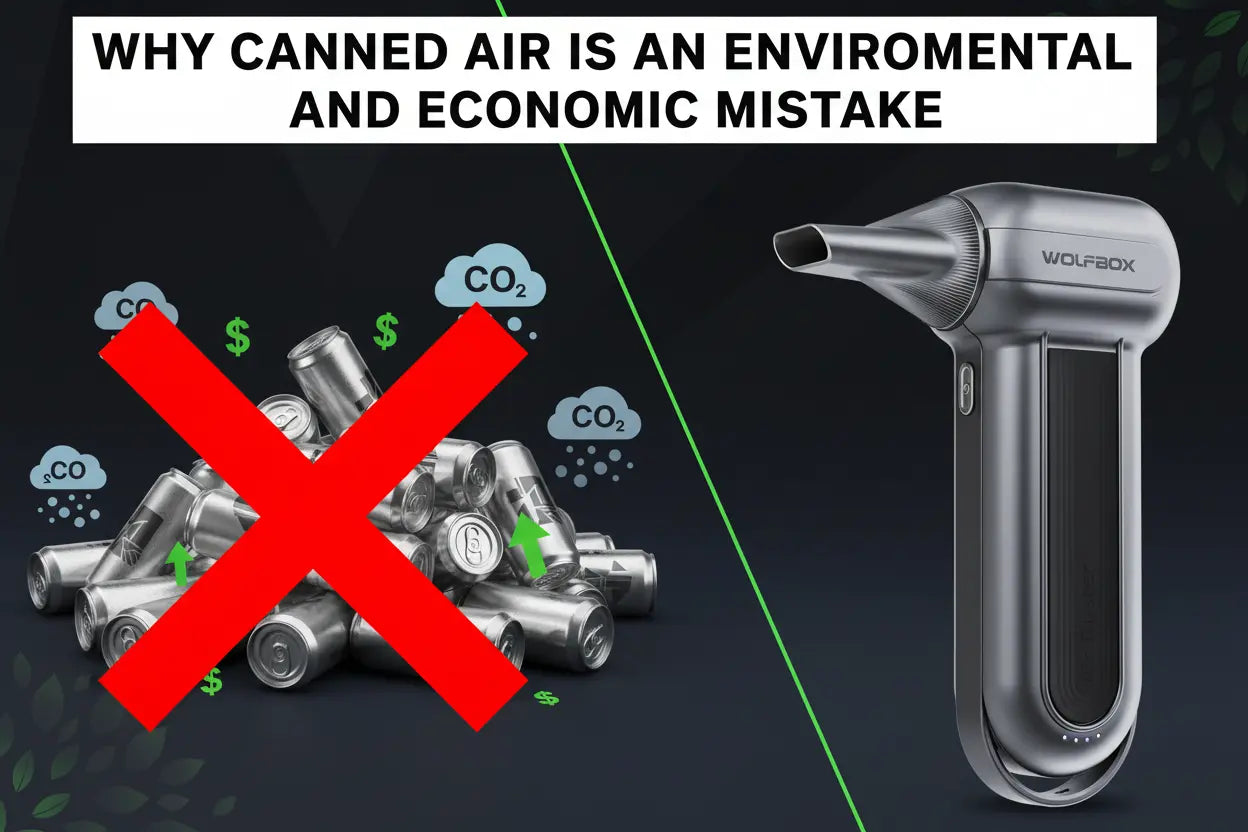
A 10-ounce can of compressed air costs about $10. Use one per quarter cleaning your PC and keyboard: $40 a year, $200 over five years. Use one per month—which is common for PC builders, photographers, and mechanical keyboard users—and you've spent over $600 before replacing your first component.
The cost alone is enough reason to reconsider. But every can also release its entire propellant load into the atmosphere, and the warming impact of that propellant is considerably larger than most buyers realize.
The Propellant Problem
Most canned air products use HFC-134a (tetrafluoroethane) as the propellant—the gas that actually pushes air out of the can. HFC-134a has a global warming potential (GWP) of 1,430, meaning each kilogram released traps the equivalent warming of 1,430 kilograms of CO2 over 100 years.[1]
A standard 10-ounce can holds approximately 200 to 300 grams of propellant. Every gram of it vents into the atmosphere when the can is used. There is no recovery mechanism in a consumer aerosol can—the gas is the product.
Quarterly use over five years means releasing roughly 3 to 5 kg of HFC-134a: the equivalent of over 4,000 kg of CO2 in warming impact from one person's cleaning habit. The U.S. EPA has established regulatory programs phasing down HFC use under the Kigali Amendment to the Montreal Protocol.[2] The EU banned HFC-134a in new automotive applications in 2017.
Some products have moved to HFC-152a (GWP approximately 124) or HFO-1234ze (near-zero GWP). But regardless of which propellant a given product uses, every can releases all of it when used. There is no low-emission version of the canned air model.
The Cost Math
|
Cost Factor
|
Canned Air
|
WOLFBOX MF200 Electric Air Duster
|
|
Upfront cost
|
~$10/can
|
~$99
|
|
Cost per cleaning session
|
~$2.50-$5 (1/4 to 1/2 can)
|
~$0 (negligible electricity)
|
|
Break-even sessions
|
—
|
20-40 sessions
|
|
1-year cost (quarterly cleaning)
|
~$40
|
~$99
|
|
5-year cost (quarterly cleaning)
|
~$200
|
~$99
|
|
5-year cost (monthly cleaning)
|
~$600+
|
~$99
|
|
Estimated GWP impact, 5 years quarterly
|
~4,300-7,150 kg CO2 eq.
|
0
|
For monthly users, the MF200 pays for itself within three months. For quarterly users, it breaks even within the first year. From year two onward, the cost difference is entirely canned air's.

Why Canned Air Also Falls Short on the Actual Job
Pressure in a can drops as it empties. The first burst from a fresh can is reasonable. Halfway through, pressure has fallen noticeably. At the end, some users tilt the can sideways to access the remaining liquid—which releases liquid propellant onto components rather than air, and can cause freeze damage to circuit boards.
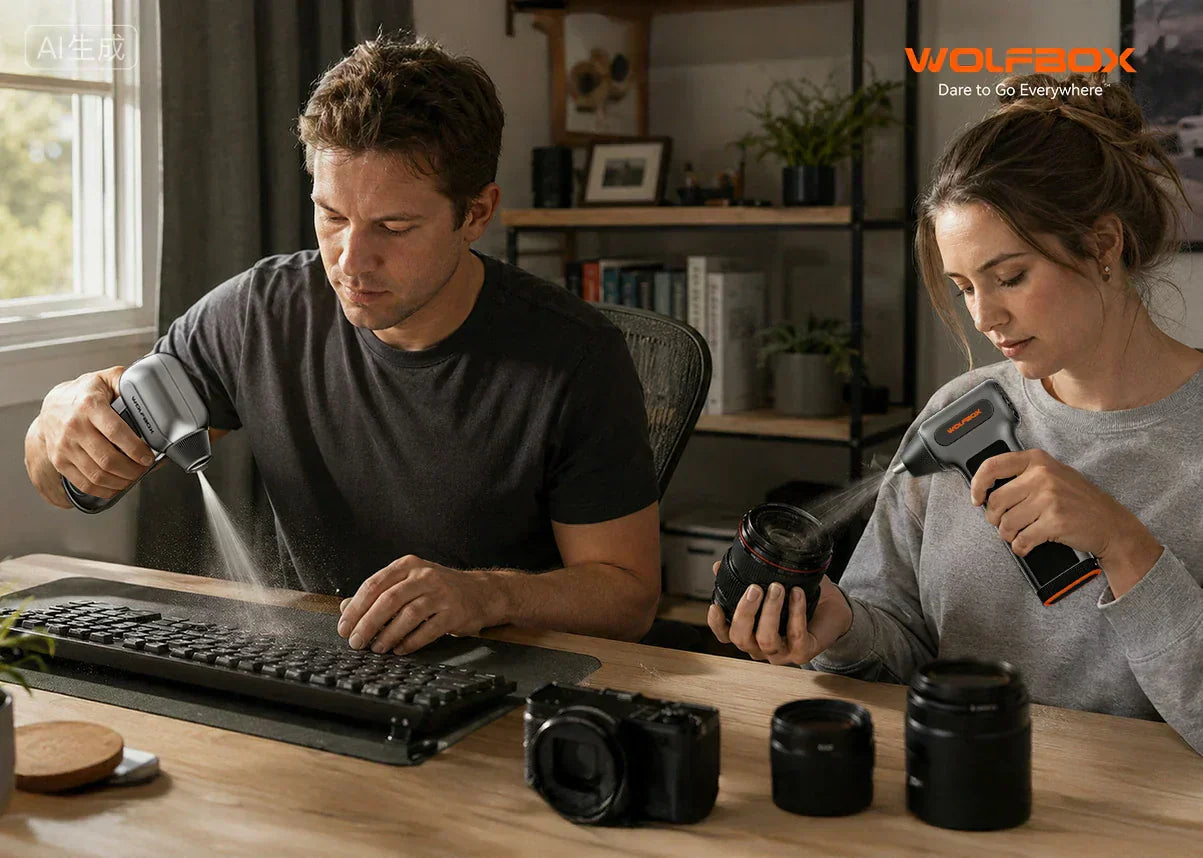
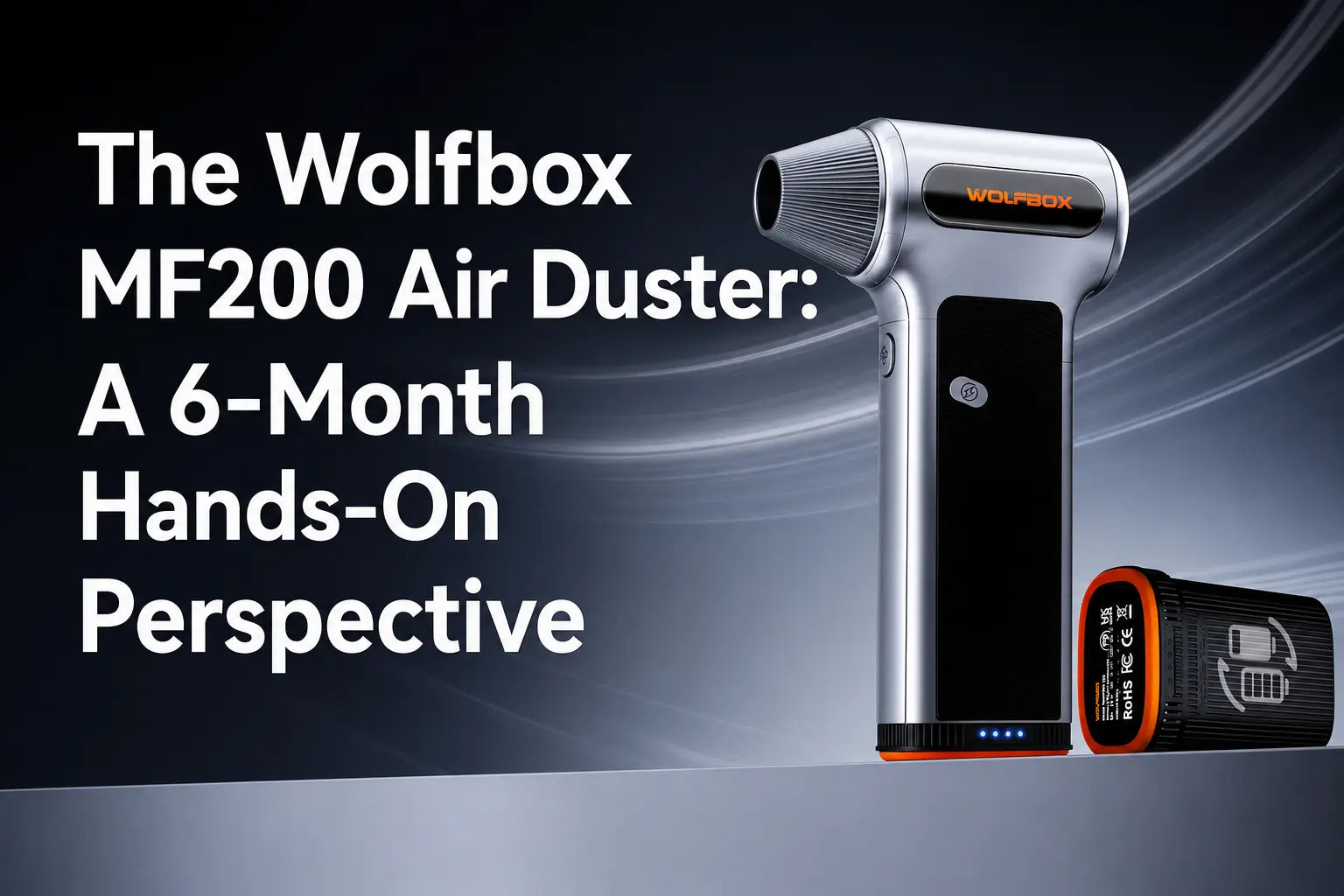
Electric dusters deliver consistent, adjustable airflow from the first use to the hundredth. The WOLFBOX MF200 generates up to 210 MPH airflow with a swappable 6,000mAh battery.[3] Three speed settings let you match pressure to the surface: low for a camera lens or exposed circuit board, high for caked dust in a GPU heatsink or 3D printer enclosure.
The WOLFBOX MF100 delivers up to 45 m/s airflow with a dual 3,000mAh battery and up to 100 minutes of runtime at low speed.[4] It's a capable option for occasional tasks and lighter cleaning. The MF200's hot-swap battery is designed for extended sessions where you'd otherwise burn through two or three cans.

Matching Settings to the Task
|
Task
|
Speed Setting
|
Distance
|
Notes
|
|
Membrane keyboard
|
Low
|
3-5 inches
|
Angled, not straight down
|
|
Mechanical keyboard (under switches)
|
Medium
|
2-4 inches
|
Work between keycaps
|
|
PC case fans and filters
|
Medium
|
4-6 inches
|
Direct toward an exhaust vent
|
|
GPU heatsink fins
|
Medium
|
4-6 inches
|
Blow along fin channels, not across them
|
|
Camera body exterior
|
Low
|
6+ inches
|
Keep nozzle away from lens opening
|
|
3D printer extruder area
|
Medium
|
3-5 inches
|
Tangential angle to avoid displacing material
|
The Hot-Swap Battery: Why It Matters for Real Sessions
The MF200's swappable 6,000mAh battery cartridge installs in about five seconds.[3] When one charge runs down mid-session, drop in a second charged battery and keep going. The depleted battery charges via USB-C in approximately 2.5 hours while you finish the job.
For a PC builder doing a full system teardown, or a photographer cleaning multiple camera bodies in one sitting, this means no stopping and no reaching for a half-empty can. It's the practical difference between a tool designed for real cleaning sessions and one that runs out at the worst point.
Frequently Asked Questions
What propellant is in canned air, and why does it matter?
Most canned air uses HFC-134a (GWP 1,430) or HFC-152a (GWP approximately 124). HFC-134a is 1,430 times more potent per kilogram than CO2 as a greenhouse gas. Every can releases its full propellant load into the atmosphere during use, with no recovery possible.
Is electric duster airflow actually comparable to canned air?
At medium to high settings, electric dusters are stronger and more consistent than canned air. The WOLFBOX MF200 produces up to 210 MPH—more than most canned products deliver even when full. Canned air pressure drops continuously as the can depletes; electric dusters maintain constant output throughout.
When does the electric duster pay for itself?
At roughly $2.50 to $5 per cleaning session, the MF200 at approximately $99 breaks even in 20 to 40 sessions. Quarterly cleaning means break-even within the first year. Monthly or more frequent use is typically 2 to 3 months.
Is it safe to use on a motherboard or GPU?
Power down and unplug the component first. Do not use on energized electronics. Maintain 4 to 6 inches of distance from sensitive parts and use a low speed setting. Do not direct high-speed airflow at bare capacitors or fine SMD components at close range.
What is the difference between the MF100 and MF200?
The MF100 has a built-in dual 3,000mAh battery and delivers up to 45 m/s with up to 100 minutes of runtime at low speed. The MF200 has a swappable 6,000mAh battery cartridge, delivers up to 210 MPH, and is built for longer sessions where hot-swap capability eliminates downtime. Both charge via USB-C.
Can I take it on a plane?
Airline rules vary and should be confirmed before travel. The MF200's 22.2Wh battery cartridge is well below the standard 100Wh carry-on limit, but individual airline policies differ.
References
- Winsen Sensor—R-134a properties, HFC-134a GWP 1,430 sourced from IPCC Fifth Assessment Report: https://www.winsen-sensor.com/knowledge/r-134a-refrigerant.html
- U.S. EPA—HFC acceptable substitutes and phase-down programs: https://www.epa.gov/mvac/acceptable-refrigerants-and-their-impacts
- WOLFBOX MF200 product page—210 MPH, 6,000mAh swappable battery, 3 speeds, 4 nozzles: https://wolfbox.com/products/compressed-air-duster-mf200
- WOLFBOX air duster review blog—MF100 vs MF200 comparison, runtime, battery capacity: https://wolfbox.com/blogs/air-duster/wolfbox-air-duster-review
- Popular Science—WOLFBOX MF100 review, specs verified: https://www.popsci.com/gear/wolfbox-compressed-air-blower-review/
- TechSpray—What's inside a compressed air can: HFC-134a vs HFC-152a vs HFO propellants: https://www.techspray.com/whats-inside-a-compressed-air-canned-air-can
- WOLFBOX best compressed air duster 2026 blog: https://wolfbox.com/blogs/news/best-compressed-air-duster-in-2026
- WOLFBOX air duster collection page—MF100 and MF200 current pricing: wolfbox.com/collections/air-duster

Leave a comment
This site is protected by hCaptcha and the hCaptcha Privacy Policy and Terms of Service apply.