








The best portable air compressor for car tires should get you back on the road, fast. It doesn't matter whether you're dealing with a slow leak or a flat tire on a remote trail. Nobody wants to limp to a gas station on a warning light. Only a good inflator can turn that stressful moment into a two-minute fix.
This guide gets you through everything that makes an inflator worth buying. We'll compare the main power types and show you exactly how to use one. Our focus on two standout WOLFBOX options – the HyperFlow 60D and the MegaVolt 24Air will reveal the capability of a modern high-performance unit.
What Is the Best Portable Air Compressor for Car Tires?
A portable air compressor for car tires is a small, battery- or 12V-powered pump. Drivers/vehicle owners keep it inside the car to inflate tires on the go. And the best portable air compressor for car tires delivers accurate pressure, fast airflow, and reliable auto shut-off. Such modern units have come a long way from the traditional, noisy, slow pumps.
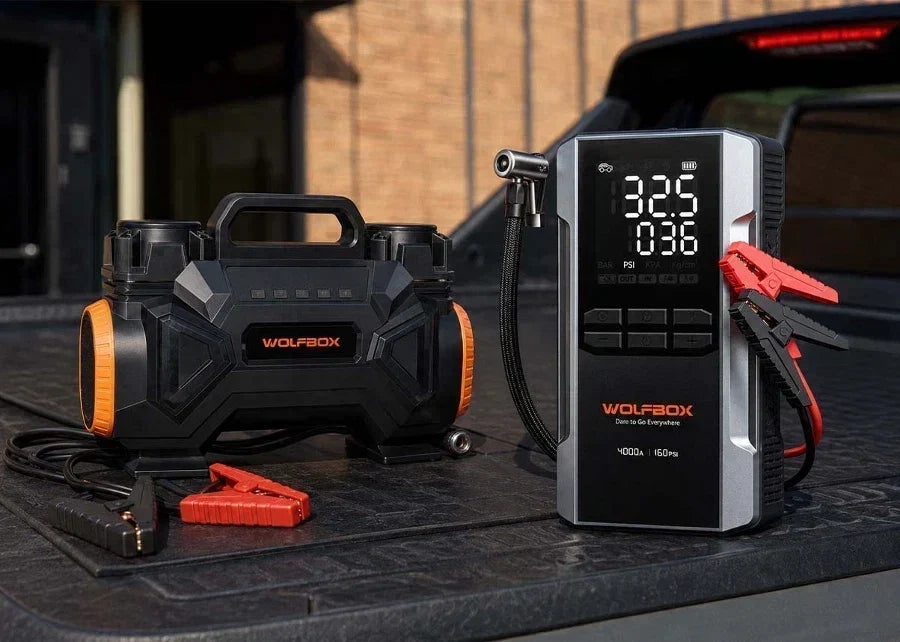
The WOLFBOX HyperFlow 60D comes with serious airflow and continuous runtime for oversized tires. [1] Meanwhile, the WOLFBOX MegaVolt 24Air packs a jump starter with an air compressor into one compact device for roadside emergencies. [2] Between the two, most drivers can find a portable tire inflator that matches how and where they actually drive.
Common Causes of Low Tire Pressure
Tires naturally lose about 1 to 2 psi per month as air seeps through the rubber. [3] That loss speeds up as temperatures drop, as cold air contracts and lowers pressure by roughly 1-2 psi for every 10°F (about 2% of placard pressure. [4]
Small nail punctures, worn valve stems, and simple neglect add to the problem. AAA has found that many drivers don't check tire pressure regularly, which can lead to flat tires from slow leaks. [5]
Safety Risks of Under-Inflated Tires
Underinflated tires flex more, allowing excess heat to build up. NHTSA's crash research found that tires underinflated by 25% or more are roughly 3x more likely to be involved in a tire-related crash. Earlier NHTSA estimates linked flat tires and blowouts to hundreds of fatalities. [6]
Hidden Costs
Beyond safety, underinflated tires quietly cost you money. The Fuel Economy reports that keeping tires at the recommended pressure can improve gas mileage by 0.6% on average, and up to 3% in some cases. It's because low pressure increases rolling resistance, forcing the engine to work harder. [7]
Drawbacks of Relying on Gas-Station Pumps
You'll often find gas station air pumps broken, out of service, or attached to a meter that shuts off before you've added enough air. AAA data shows flat tires remain one of the top reasons drivers call for roadside help nationwide, alongside dead batteries and lockouts. [8]
The Peace of Mind from Having Your Own Inflator: Always Ready, Anywhere
A portable air compressor for car tires sits in your trunk. And it's ready to work in a parking lot, on a highway shoulder, or twenty miles down a dirt trail with no cell signal. Check the pressure, plug in, and fix it yourself in a few minutes.
What Makes the Best Portable Air Compressor for Car Tires?
The best portable air compressor for car tires balances raw performance (PSI, CFM, and inflation speed). Everyday usability features such as auto-shutoff, a clear digital display, and a reasonably long hose are also present.
Maximum PSI
Maximum PSI indicates the maximum pressure the pump can achieve. Larger trucks or off-road tires often run 50 to 80 psi, whereas most passenger cars only need 30 to 35 psi. Therefore, a compressor rated well above the hard limit can provide sufficient headroom.
Airflow (CFM)
CFM (cubic feet per minute) measures how much air the pump moves. It's the most important factor in inflation speed. A higher CFM rating at a given PSI means less time standing around waiting.
Inflation Speed
Inflation speed combines PSI, CFM, and cylinder design into one number: how long it takes to fill a tire from zero. The speed can vary a lot between a compact sedan tire and a 35-inch off-road tire.
Pressure Accuracy
Accuracy determines whether the compressor stops at exactly the pressure you set or leaves you a few pounds off. A tolerance of plus or minus 2 psi is a steady benchmark; anything looser makes it easy to over- or under-inflate without realizing it. [9]
Duty Cycle
Duty cycle is the time the compressor can run continuously before it needs to cool down. It's expressed as a percentage or a straight time limit. A 100 percent duty cycle means it can run nonstop, especially important if you're airing up four tires or four vehicles back-to-back.
Auto Shut-Off
Auto-shutoff stops the pump once your target pressure is reached. It also protects against accidental overinflation, which can stress the tire and shorten its lifespan.
Digital Pressure Display
A digital display shows your current and target pressure in real time, usually to one decimal place. Many newer units also let you switch between psi, bar, and kPa.
Cooling Performance
Cooling performance determines how long a compressor can work before thermal protection shuts it down. Dual-cylinder designs paired with active cooling fans handle sustained use better than small single-cylinder pumps.
Hose Length
A longer hose lets you reach every tire on your vehicle without repositioning the compressor itself. Look for at least 10 feet of usable hose length for typical passenger vehicles, and more for larger rigs.
Power Source
Power source shapes where and how you can use the compressor. Corded 12V units get plugged into your car's outlet, whereas cordless models run on an internal battery.
Build Quality
Build quality shows up in details like metal versus plastic housings, sealed valve connections, and immunity to dust/vibration. A well-built compressor can save you from having to replace a cheap one in a year or two.
Portable vs Cordless vs Hardwired: Which Type Is the Best for You?
Portable 12V compressors plug into your car's outlet, offering the most consistent power. Meanwhile, cordless models trade some raw power for the freedom to inflate anything without having to start your engine.
In comparison, hardwired units mount permanently for drivers who air up constantly. The ultimate choice comes down to how often you use it and what you're inflating.
Corded 12V compressors (like the WOLFBOX HyperFlow 60D) draw power directly from your battery. [1] Therefore, you'll get consistent output and no need to charge the battery beforehand.
Such a model marks the strongest possible option for general high-CFM off-road and RV use. [10] An internal battery's capacity no longer limits you.
Cordless compressors run on a rechargeable battery. So, you can inflate a stroller tire, bike tire, or even a basketball without being near your car at all.
The WOLFBOX MegaVolt 24Air takes it further. It's a cordless jump starter with an air compressor and a power bank, for daily commuters who want one compact tool for multiple emergencies. [2]
Hardwired or permanently mounted compressors are wired directly into the vehicle's electrical system. They're ready at all times, which serious off-roaders and overlanders prefer for frequent trail use.
They come with additional costs that also require installation. The option seems better for drivers who air down and reinflate tires on nearly every outing.
Daily commuters should go well with a compact cordless or corded 12V unit. Meanwhile, off-road and overland drivers benefit most from a high-CFM dual-cylinder compressor or a hardwired setup.
How Fast Should a Good Portable Tire Inflator Be?
A good portable tire inflator should fill a sedan tire within 5 minutes and an SUV tire in around 5 to 8 minutes. Larger 33- to 35-inch off-road tires, understandably, take longer, especially when airing back up from a low trail pressure.
Inflation speed depends on three things: CFM output, cylinder design, and motor power. A single-cylinder compressor with a small motor might move barely 1 CFM. In contrast, a dual-cylinder design with a higher-output motor can move 5 CFM or more at the same pressure.
A typical budget compressor usually delivers around 1 to 2 CFM at 30 psi. However, higher-performance dual-cylinder units complete the same job significantly faster, without needing to pause or cool down partway.
For Off-Road Adventures
Superior tire inflating speed means convenience and safety. The less time you spend stopped on a trail shoulder or highway edge airing up a tire, the less exposure you have to passing traffic or unpredictable terrain.
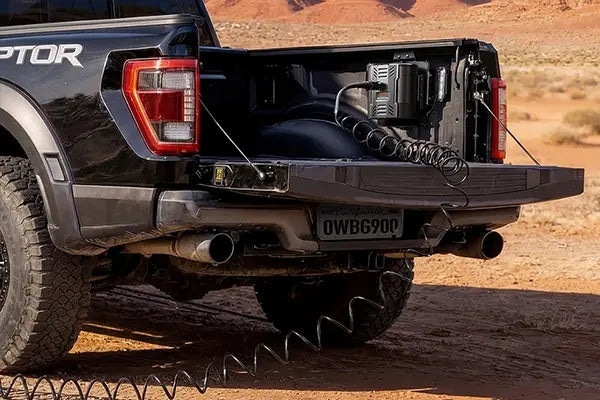
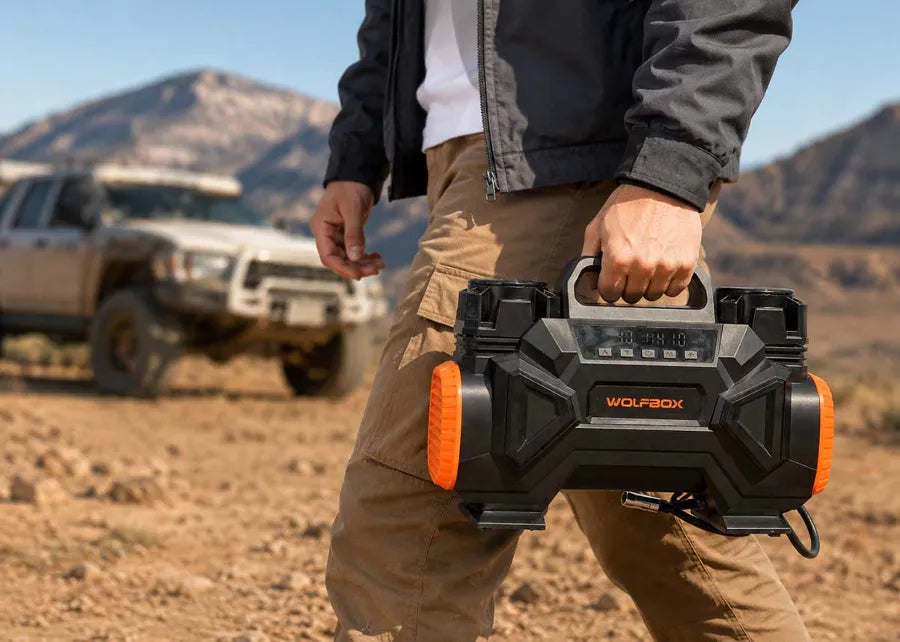
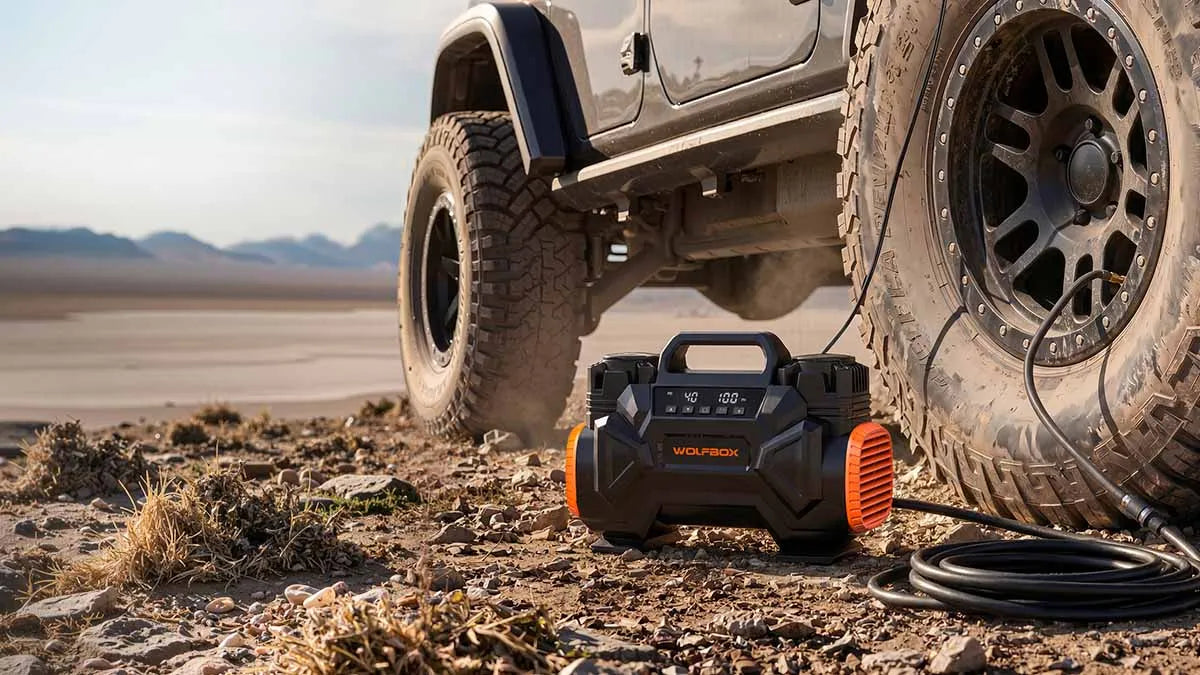
The WOLFBOX HyperFlow 60D is built around such concepts. It can inflate a 37×12.5R17 off-road tire from 10 to 40 psi under three minutes, thanks to its dual-cylinder design and 100 percent duty cycle at 40 psi. [1] [10]
Wolfbox Best Portable Air Compressors for Car Tires
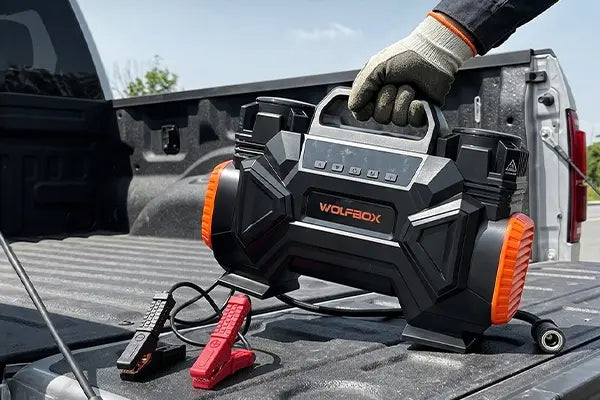
WOLFBOX HyperFlow 60D
It pairs a dual 60mm-cylinder with a 1020W motor to deliver 5.1 CFM at 40 psi and 3.9 CFM at 80 psi. Such output is backed by a robust 100 percent duty cycle at 40 psi for up to 60 minutes of continuous runtime.
Dual cooling fans keep the motor from overheating during back-to-back inflation sessions. There's an auto-stop feature that holds pressure within ±2 psi of your target. [1]
And the 25.4-foot hose reaches all four corners of larger rigs without dragging the compressor through the dirt. Overlanders, RV owners, and off-roaders can rely on its ability to air up multiple oversized tires in one session.

WOLFBOX MegaVolt 24Air
The model takes a different approach. It combines a 45-liter-per-minute, 160-psi air compressor with a 4000A jump starter, a portable power bank, and an LED emergency light in one compact unit. [2]
The built-in 24,000mAh battery can jump-start a dead 12V vehicle. Its range includes gas or diesel engines up to 10 liters, with roughly 40 jump-starts on a full charge. Meanwhile, the built-in compressor can take a standard SUV tire from 25 to 35 psi in a minute. [11]
It's a solid jump starter with an air compressor, suitable for daily commuters and road-trippers. The one compact tool can handle both a dead battery and a low tire, with no separate gear.

Both Wolfbox models solve a different version of the same problem. You can get air into a tire fast without waiting on a gas station or a tow truck.
Off-road and RV drivers airing up large tires get more value from the HyperFlow 60D. Commuters can get an all-purpose emergency tool with the MegaVolt 24Air.
Step-By-Step: How to Use a Portable Air Compressor for Car Tires
Using a portable air compressor for car tires takes a few minutes. Off-road drivers who reinflate after airing down follow the same process, with a few extra steps.
Preparation: Find Your Recommended PSI
Check the sticker on your driver's side door jamb or your owner's manual for the manufacturer's recommended cold tire pressure. Never use the number printed on the tire's sidewall as the tire's maximum pressure; it's the recommended one.
NHTSA's TireWise program recommends monthly pressure checks with an accurate gauge. [12] A tire can look normal even after losing a significant amount of air. Always check tire pressure on cold tires before driving or after the car has sat for at least 3 hours.
Step-by-Step Inflation
- Remove the valve stem cap and set it somewhere you won't lose it.
- Connect the compressor's hose firmly onto the valve stem until the hissing stops.
- Turn on the compressor and set your target PSI on the digital display.
- Let the compressor run until it reaches your target pressure, then shut off automatically.
- Disconnect the hose, check the reading with a tire gauge, and replace the valve cap.
- Repeat the same steps for each tire, including the spare if it's accessible.
Off-Road Use
Off-roaders often lower their tire pressure to 15–20 psi or lower before driving on sand, rocks, or mud. Lower pressure increases the tire’s footprint, which can improve traction on uneven or loose surfaces.
To air down, you can manually release air from the valve or use a dedicated tire deflation tool for faster and more consistent pressure adjustment across all four tires.
Once you're back on pavement, reinflate your tires to the vehicle manufacturer's recommended PSI before driving at highway speeds. Driving with underinflated tires at high speeds can cause excessive heat buildup and increase the risk of tire damage.
Common Mistakes That Waste Time and Cause Leaks
- Not fully seating the hose on the valve stem, allowing air to leak out as fast as it goes in.
- Inflating hot tires to the cold-pressure number, leaving them underinflated once they cool down.
- Skipping the spare tire, then discovering it's flat exactly when you need it.
- Guessing at PSI instead of checking the door jamb sticker, causing over- or under-inflation.
- Unplugging the compressor before the reading stabilizes, giving you an inaccurate final pressure.
Conclusion
Choosing the best portable air compressor for car tires means matching the tool to how you actually drive. Commuters want something compact and easy to grab for a quick top-off, whereas off-road and RV drivers need serious CFM and duty cycle to handle oversized tires repeatedly.
You may choose corded, cordless, or hardwired. Nonetheless, having your own inflator means you're never stuck waiting on a broken gas station pump or an expensive tow.
You should try WOLFBOX's HyperFlow 60D for heavy-duty performance or the MegaVolt 24Air for all-in-one emergency readiness. Most drivers should find a portable tire inflator from Wolfbox's lineup that keeps them moving no matter what the road throws at them.
Frequently Asked Questions (FAQs)
1. Can one inflator fit all vehicles?
Most portable air compressors work across sedans, SUVs, trucks, motorcycles, and bike tires. The main things to check are the maximum PSI and CFM outputs. A compressor rated for passenger cars will struggle to meet the pressure demands of large truck or RV tires.
2. Are Wolfbox products good for daily use or only for off-road use?
Both models work well for daily use, though they're built for slightly different situations. The MegaVolt 24Air's compact, cordless design suits daily commuters. Meanwhile, the HyperFlow 60D's higher CFM and duty cycle make it the better pick for drivers who regularly air up large or multiple tires.
3. What PSI should I use?
Use the number listed on your vehicle's door jamb sticker or in the owner's manual. Most passenger cars run somewhere between 30 and 35 psi. However, the correct number varies by vehicle, load, and tire size, so check your specific vehicle's recommendation.
References
[1] Wolfbox: "WOLFBOX HyperFlow 60D" – https://wolfbox.com/products/off-road-air-compressor-high-cfm-dual-cylinder-tire-inflator-wolfbox-hyperflow-60d
[2] Wolfbox: "Wolfbox MegaVolt 24Air" – https://wolfbox.com/products/jump-starter-with-air-compressor-tire-inflator-wolfbox-megavolt-24air
[3] Apollo Tyres: "Can tyres lose air without a puncture?" – https://www.apollotyres.com/en-in/stories/blogs/tyre-guides/can-tyres-lose-air-without-puncture/
[4] Tire Guide Pro: "Temperature Effects on Tire Pressure: Hot vs Cold Weather Explained" – https://tireguidepro.com/tire-pressure-temperature-effects/
[5] AAA Newsroom: "Roadside Breakdowns Preventable with Proper Maintenance, Finds AAA" – https://newsroom.aaa.com/2015/10/roadside-breakdowns-preventable-with-proper-maintenance-finds-aaa
[6] National Highway Traffic Safety Administration (NHTSA): "Tire-Related Factors in the Pre-Crash Phase" – http://crashstats.nhtsa.dot.gov/Api/Public/ViewPublication/811617
[7] Fuel Economy: "Keeping Your Vehicle in Shape" – https://fueleconomy.gov/feg/maintain.jsp
[8] AAA: "Roadside Assistance" – https://ace.aaa.com/automotive/roadside-assistance.html
[9] Federal Register: "Federal Motor Vehicle Safety Standards" – https://www.federalregister.gov/documents/2005/04/08/05-6741/federal-motor-vehicle-safety-standards-tire-pressure-monitoring-systems-controls-and-displays
[10] CarBuzz: “Wolfbox HyperFlow 60D: The Portable Air Pump That Runs Non-Stop” – https://carbuzz.com/wolfbox-hyperflow-60d-air-pump-prime-day/
[11] F150Gen14: "Wolfbox MegaVolt24 Air Jump Starter with Air Compressor Review" – https://www.f150gen14.com/2026/05/11/wolfbox-megavolt24-air-jump-starter-with-air-compressor-review/
[12] National Highway Traffic Safety Administration (NHTSA): "Tire Safety Ratings and Awareness (TireWise)" – https://nhtsa.gov/vehicle-safety/tires

Leave a comment
This site is protected by hCaptcha and the hCaptcha Privacy Policy and Terms of Service apply.