







Standing in an aisle full of portable air compressors, all roughly the same size, is confusing. Some cost $40, while others go over $300. And there's no clear label on the box telling you how long it will actually take to fill your tires.
It comes down to five performance numbers: PSI, CFM, duty cycle, tire size, and power source. Get those five right, and you'll have a compressor that finishes the job without making you wait twenty minutes or trip a thermal cutoff mid-inflation.
Getting even one parameter wrong can mean a bulky-looking unit leaves you waiting twenty minutes for one tire. This guide breaks down exactly what size air compressor you need for your car tires, by vehicle type, pressure spec, and driving situation. [1]
Physical Size Won't Tell If a Compressor Can Handle Your Tires
Two portable compressors that look nearly identical on a store shelf can differ by more than double in real inflation performance. One fills a truck tire in under two minutes, while the other takes five and shuts itself off to cool. [1] [5]
Neither number tells you anything about how the unit performs once it's pushing air into a tire. What determines whether a compressor can handle your specific tires is a set of four measurements on the specification sheet, not the weight of the case. [5]
The Four Specs to Compare: Max PSI, CFM, Duty Cycle, and Power Source
- Max PSI: Can it reach the required tire pressure, with headroom left over?
- CFM: How fast does it actually move air into the tire?
- Duty Cycle: How long can it run before it needs to cool down?
- Power Source: Where can you realistically plug it in and use it?
Start with Your Tires, Not the Compressor
Every decision, from CFM to duty cycle, depends on the pressure and air volume your tires require. [1] Skip this step, and you'll most likely inflate to the wrong setting or pick a compressor that can't handle the job once you're on a trail or road trip. [2]
Where to Find Your Recommended PSI (Door Placard, Not the Sidewall)
You'll find the target PSI printed on the tire information placard inside the driver's door jamb. The sidewall number marks the tire's maximum safe pressure, not the recommended driving pressure. [3]
Confusing the two is one of the more common inflation mistakes drivers make. NHTSA crash stats show that vehicles with tires 25% or more below the recommended pressure were about three times as likely to be involved in a tire-related crash. [2] [3]
Typical Pressure Ranges: Passenger Cars, SUVs, Light Trucks, LT/RV Tires
As a general reference, most passenger cars call for 30–35 PSI. Meanwhile, many light trucks and SUVs list 35–45 PSI on their placard. [3]
LT-rated and RV tires often run higher, commonly 50–80 PSI depending on load range and axle weight. Those are starting points only: always confirm the exact number from your own vehicle's placard. [4]
Why Tire Diameter and Width Change the Air Volume Required
A 33-inch off-road tire holds far more internal air volume than a compact car's 15-inch tire, even at the same target PSI. [4] That means more time and more CFM to bring it up to pressure.
That's why a compressor that struggles on truck tires can still feel plenty fast on a small sedan. Width matters too: a wider tire like a 305/70R17 holds more air than a narrow 225/65R17 at identical diameters. [1]
PSI: Can the Compressor Reach Your Tire's Required Pressure?
The recommended cold tire pressure is your actual target number. A compressor's maximum PSI rating is the highest pressure it can theoretically produce, measured at zero airflow. [5]
A compressor rated for exactly 35 max PSI will struggle and slow dramatically as it nears that ceiling, even if your tire only needs 32 PSI. The unit's effective pumping range sits well below its max rating. [1]
As a practical rule, look for a compressor with a max PSI rating at least 20-30% above your tire's target pressure. It keeps the unit operating in a comfortable range where it remains efficient and doesn't overwork. [5]
CFM: How Airflow Affects Tire Inflation Speed
CFM stands for cubic feet per minute. It measures the rate of airflow a compressor delivers. The number, not the max PSI rating, governs how long you'll wait for each tire to fill. [5]
However, CFM ratings are usually measured under specific test conditions. Many budget compressors advertise CFM at 0 PSI, an impressive but unrealistic number. When the tire reaches real working pressure, the actual airflow drops. [1]
CFM at Different Pressures: Why the Rating Matters
A compressor's CFM output drops as target pressure rises, basic physics for any air compressor. But manufacturers vary widely in how they rate it. [5]
Look specifically for CFM figures rated at 40 PSI or higher rather than at 0 PSI. That number reflects what you'll get once a tire is already partly filled, not just at the start. [1]
How Tire Size and Starting Pressure Affect Inflation Time
Consider a tire that starts at 15 PSI and needs to reach 35 PSI. It'll take longer to fill than one starting at 28 PSI heading to the same target, since the compressor has to push more total air volume. [5]
More total air volume to add, plus larger tire size, compounds it further. That's why oversized truck and off-road tires benefit disproportionately from higher CFM. [1]
Why Duty Cycle Matters When You Inflate More Than One Tire
Duty cycle is the amount of continuous operating time a compressor can sustain before it needs to cool down. It's expressed as a percentage of runtime within a single cycle. [5]
A 100% duty cycle at a given pressure means the unit can run continuously at that pressure without a forced rest. Meanwhile, a 50% duty cycle means it should rest about as long as it runs before it cools enough to work again. [1]
It becomes important the moment you're airing up four large tires back to back, or servicing more vehicles in one session. A low duty cycle turns a "quick air-up" into a stop-and-wait pattern, adding several minutes of idle time across each set. [1]
Once that thermal cutoff trips, most compressors need about ten to thirty minutes to cool back down before running again. It turns a one-task stop into an unexpected delay. [5]
Power Source: 12V, Battery, or Direct-to-Battery?
A standard 12V accessory socket is convenient and works fine for smaller compressors. However, it also limits how much current the unit can draw, usually 10–15 amps. [1]
Cordless battery-powered units add portability away from the vehicle but trade off runtime. The battery becomes the limiting factor, not the compressor motor. [5]
Those units draw more current than a standard socket and fuse can safely handle. So, check the compressor's rated amperage draw against the fuse rating of whichever 12V outlet you plan to use. [1]
What Size Air Compressor Do I Need for Car Tires by Vehicle Type?
The following table is a quick-reference starting point. Always confirm the exact numbers against your own vehicle's placard.
| Vehicle Type | Typical PSI | CFM Needed | Duty Cycle Priority |
|---|---|---|---|
| Passenger Cars and Crossovers | 30–35 PSI | 1.0–1.5 CFM | Low; light-duty is usually fine |
| SUVs and Pickup Trucks | 35–45 PSI | 1.5–2.5 CFM | Medium; look for 50%+ duty cycle |
| RVs, LT Tires, and Trailers | 50–80 PSI | 2.5+ CFM | High; 75–100% duty cycle recommended |
| Off-Road and Oversized Tires (33″+) | 10–40 PSI (trail to street) | 4–5+ CFM | Very High; 100% duty cycle recommended |
Passenger Cars and Crossovers
Most passenger tire sizes need only 30–35 PSI and modest airflow. A compact 1.0–1.5 CFM unit on a standard 12V socket handles routine top-offs on one or two tires without issue. [1]
SUVs and Pickup Trucks
Higher target pressures and larger tire volumes mean SUVs and pickups benefit from a compressor rated for at least 1.5–2.5 CFM with a 50% or better duty cycle. It makes the difference between finishing four tires in a few minutes or waiting through cooldown intervals. [5]
RVs, LT Tires, and Trailers
LT and trailer tires combine high target PSI with large internal volume, a demanding combination. A higher-CFM unit with a strong 75% or better duty cycle prevents waiting through cooldown gaps between each wheel. [1]
Off-Road and Oversized Tires: When a Dual-Cylinder Compressor Earns Its Cost
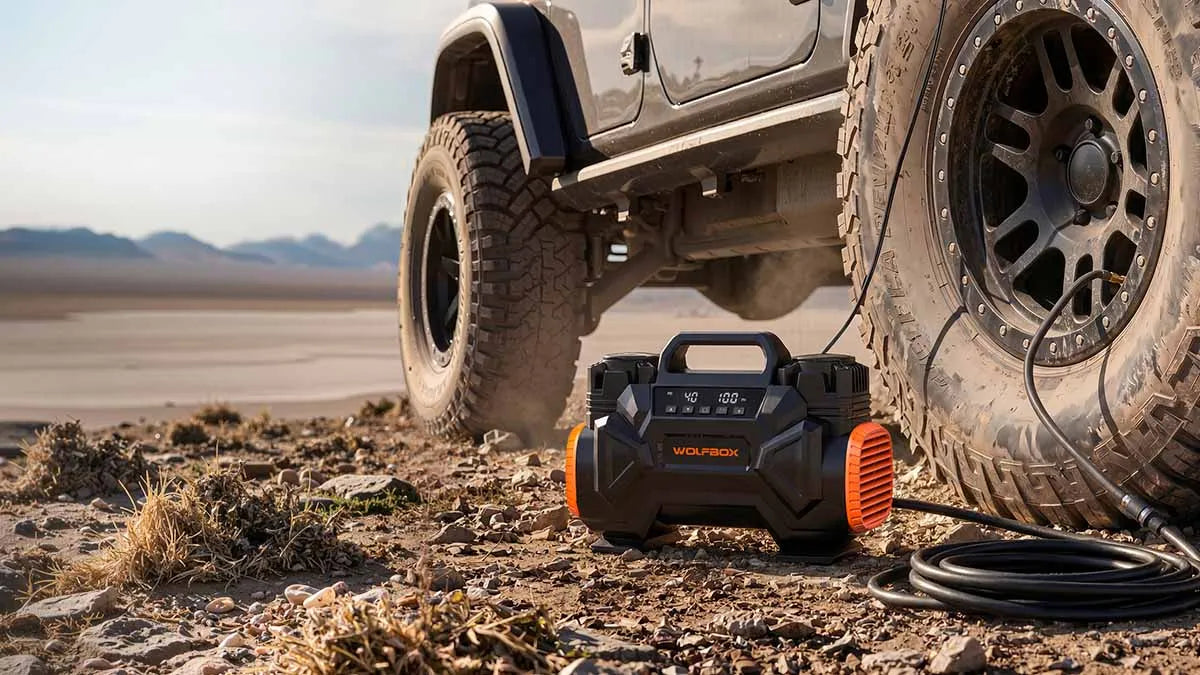
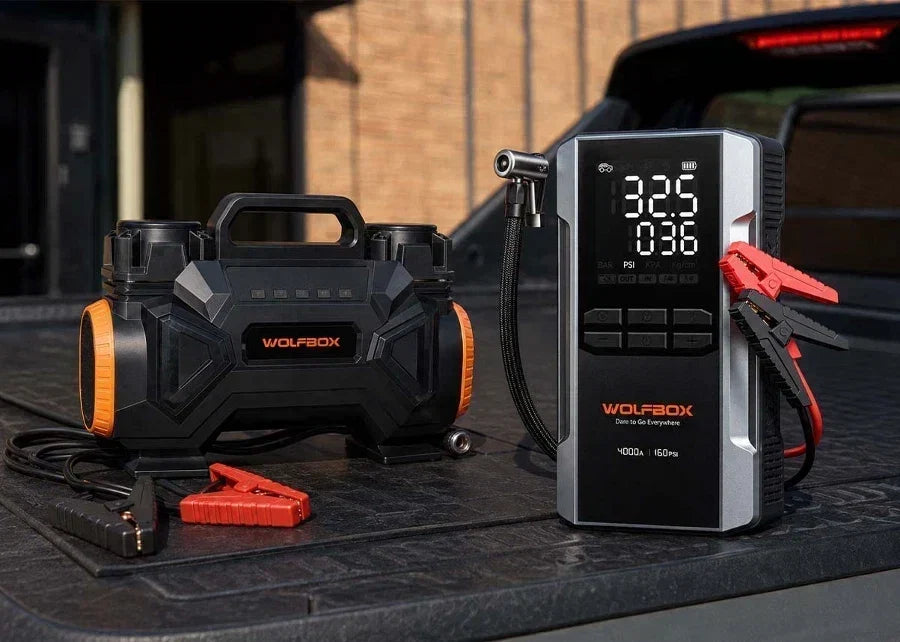
Airing down for the trail and back up for pavement, sometimes multiple times a day, is routine for off-road drivers. That repeated, high-volume workload is where a dual-cylinder compressor earns its cost. [6]
A dual-cylinder design runs two pumping chambers instead of one. That's how a compressor reaches a higher CFM without requiring from a larger, heavier single-cylinder motor. [7] Some also integrate an aluminum cooling manifold to help manage heat during extended air-ups.
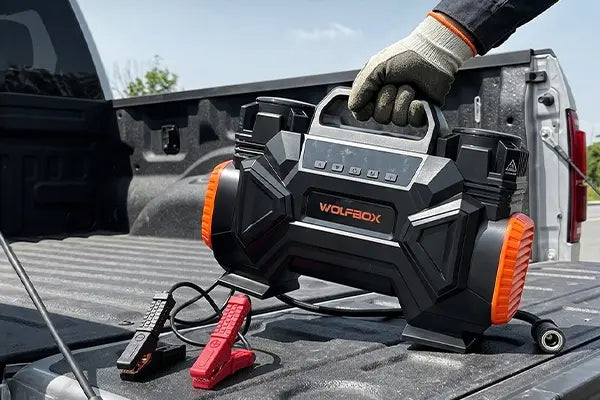
The WOLFBOX HyperFlow 60D is specifically built for this category. The dual-cylinder design delivers 5.1 CFM at 40 PSI. It even supports 100% duty cycle at 100 PSI for up to 60 minutes of continuous run time. [7]
The unit reaches a 150 PSI maximum output and is rated for tires up to 40 inches. Many air up four rigs and sixteen tires back-to-back without stopping, much less waiting for the compressor to cool. [7] [8]
That combination of sustained CFM and a full duty cycle makes the difference. You get to finish the intended job without frustrating cooldown waits, even after topping off every rig in the group. [6]
Choose by the Job, Not Just the "Size"
Come back to the five factors –
- PSI headroom above your target
- CFM rated near your actual pressure
- A duty cycle that matches how many tires you're filling in one sitting
- The right power source for where you'll use it
- Your specific tire size
A compact commuter sedan rarely needs more than a basic 12V unit. Meanwhile, oversized off-road tires and multi-vehicle trail groups want the sustained high CFM and full duty cycle that only a dual-cylinder design like the HyperFlow 60D can deliver without forced stop-and-wait cycles. [6] [7]
And you can't beat the WOLFBOX HyperFlow 60D for well-balanced mechanical performance. [7] Match the compressor to the job in front of you, not to the vague description on the box.

Conclusion
Skip vague answers to "what size air compressor do I need for car tires," as many drivers are lost in confusion. The real answer lies in matching specs to your vehicle. No single size fits all, but the right numbers always point to the right tool. [5] [6]
A compact compressor can outperform a bulkier one if its airflow and duty cycle are designed for sustained use. That's why the smartest next step is looking past the physical size. Compare CFM at 40 PSI, duty cycle, max PSI headroom, and power source against your own vehicle's placard. [1]
Match the right compressor to the job to avoid frustration, save time, and keep your tires ready. Explore the latest WOLFBOX compressor collection for models built around real data such as CFM, duty cycle, and PSI. [7]
Frequently Asked Questions (FAQs)
Is a 150 PSI air compressor good for car tires?
Yes. It gives you plenty of headroom. Most passenger car tires only need 30–35 PSI. So, a compressor rated to 150 PSI max, like the WOLFBOX HyperFlow 60D, works well within a comfortable range throughout your inflation. [7]
How many CFM do I need to inflate a car tire?
A passenger car tire generally inflates comfortably with 1.0–1.5 CFM. Meanwhile, larger SUV, truck, or off-road tires benefit from 2.5 CFM or higher for faster fill times and more capability. [1] [5]
Can a small air compressor fill a completely flat tire?
A small compressor can usually fill a completely flat tire eventually. Whether a small air compressor can fill car tires quickly and without overheating depends on its CFM and duty cycle relative to the tire's internal volume. [5]
What size air compressor do I need for 35-inch off-road tires?
Large off-road tires need higher CFM and a strong duty cycle to handle the extra air volume and repeated inflation and deflation. A dual-cylinder unit like the HyperFlow 60D, rated at 5.1 CFM at 40 PSI, delivers a fast fill time and has the duty cycle to inflate bigger tires without overheating. [6] [7]
Do I need a higher CFM or higher PSI for tires?
For most drivers, CFM matters more day-to-day. It controls fill speed once you're already within your compressor's PSI range. A higher PSI provides headroom, but higher CFM defines whether the compressor works fast or slow. [1] [5]
References
[1] Winston Engineering: "Understanding CFM PSI and Other Key Air Compressor Metrics" — https://winstonengineering.com/understanding-cfm-psi-and-other-key-air-compressor-metrics/
[2] NHTSA: "Tire Safety Ratings and Awareness" — https://www.nhtsa.gov/vehicle-safety/tires
[3] NHTSA: "Tire-Related Factors in the Pre-Crash Phase" — https://crashstats.nhtsa.dot.gov/Api/Public/ViewPublication/811617
[4] PIRELLI: "Recommended Tire Pressure" — https://www.pirelli.com/tires/en-us/car/driving-and-tire-tips/how-to-read/recommended-tire-pressure
[5] CAGI: "Resource Library – Glossary of Compressed Air Terms" — https://www.cagi.org/resources/glossary-of-compressed-air-terms
[6] WOLFBOX: "How to Choose the Best Air Compressor for Off-Roading" — https://wolfbox.com/blogs/news/how-to-choose-the-best-air-compressor-for-off-roading
[7] WOLFBOX: "Off-Road Air Compressor High-CFM Dual-Cylinder Tire Inflator – HyperFlow 60D" — https://wolfbox.com/products/off-road-air-compressor-high-cfm-dual-cylinder-tire-inflator-wolfbox-hyperflow-60d
[8] Car Buzz: "Wolfbox HyperFlow 60D: The Portable Air Pump That Runs Non-Stop" — https://carbuzz.com/wolfbox-hyperflow-60d-air-pump-review/

Leave a comment
This site is protected by hCaptcha and the hCaptcha Privacy Policy and Terms of Service apply.