








The peak amp figure printed on a jump starter's box is often the least useful number for deciding whether it can actually start your car. It measures a maximum current burst lasting a fraction of a second, not the sustained current a battery needs to crank an engine[1][2]. What actually determines whether a jump starter is sized correctly is closer to Cold Cranking Amps and the engine's displacement, not the biggest number on the packaging.
Peak Amps vs Cranking Amps vs CCA
Term |
Definition |
Duration |
Why it matters |
Peak amps |
Maximum current burst a jump starter can discharge |
A few milliseconds |
No standardized test method; often inflated for marketing[1][2] |
Cranking amps (CA) |
Current sustained at 32°F (0°C) |
30 seconds for lead-acid, about 3 seconds for lithium packs |
Reflects real starting capability better than peak amps[1][3] |
Cold cranking amps (CCA) |
Current sustained at 0°F (-18°C) without dropping below 7.2V |
30 seconds |
The rating standard used on vehicle batteries themselves[1][2] |
Lithium-ion jump starters typically list a short cranking-amp rating rather than a lead-acid-style CCA figure, since lithium packs deliver short, high-power bursts instead of sustained discharge[3]. Because there's no industry-wide test standard for peak amps specifically, two jump starters advertising very different peak amp numbers can perform almost identically in real starts[1][2].
Matching a Jump Starter to Your Vehicle
- Small car battery: as little as 150 CCA can be enough to get a boost[2]
- Most passenger vehicles: 400 to 500 CCA typically starts the engine reliably in cold weather[2]
- Large SUVs and trucks: also generally fall in the 400 to 500 CCA range, though diesel engines need more sustained current due to higher compression[2]
- Commercial trucks and large diesel engines: capacity requirements scale with both CCA and total engine displacement in liters, not peak amps alone
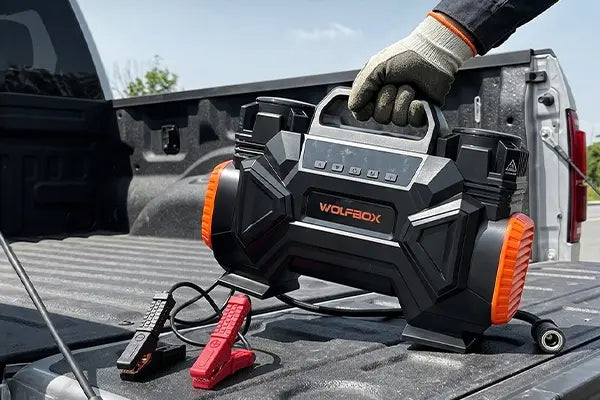
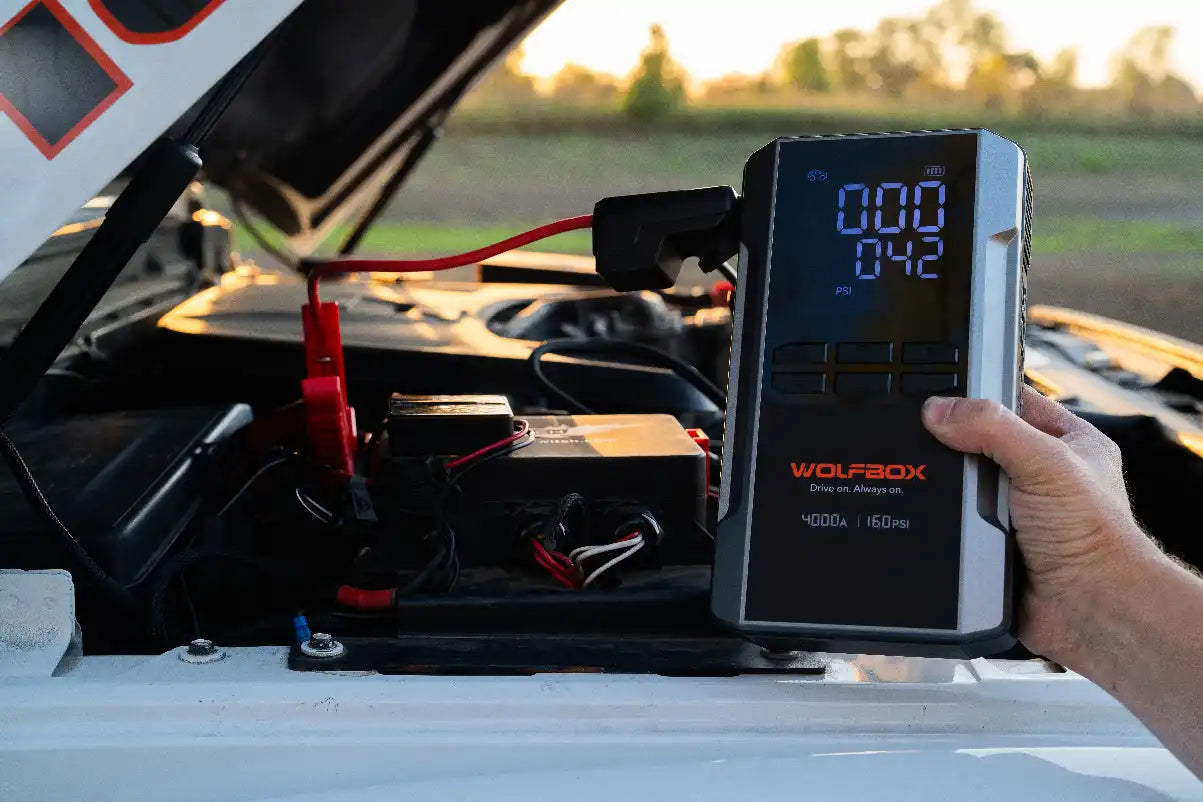
Engine displacement is the other half of sizing that peak amp claims don't communicate on their own. WOLFBOX's MegaVolt 24Air, for example, is rated at 4000A peak current and specified to start 12V gasoline or diesel engines up to 10 liters, which covers everything from sedans to pickups, and motorcycles[4][5]. That displacement ceiling is a more directly useful number for matching a device to a specific vehicle than the peak amp figure by itself.
Why Peak Amps Gets Inflated in Marketing
Without a standardized testing protocol, manufacturers can measure peak amps under different conditions and still print an impressive number on the packaging[1][2]. A jump starter advertising 4,000 peak amps isn't necessarily four times more capable than one advertising 1,000, since the two figures may not have been measured the same way. A more consistent way to compare devices across brands is rated engine displacement and total jump starts per charge, both of which tie back to actual battery capacity rather than a momentary burst spec[4][5].
A Practical Sizing Checklist
- Check your engine's displacement in liters, found in the owner's manual or on the engine cover, and confirm the jump starter's rated ceiling covers it
- For cold climates, prioritize devices with a published CCA or cranking-amp rating rather than peak amps alone
- For diesel engines specifically, confirm the jump starter lists diesel compatibility, since diesel engines need more sustained cranking power than an equivalent gasoline engine
- Check the battery capacity in mAh or Wh, since that determines how many total jump starts you get per charge, not just whether a single start will succeed
Spec Snapshot: WOLFBOX MegaVolt 24Air
Spec |
Value |
Battery capacity |
|
Peak current |
|
Rated vehicle coverage |
|
Jump starts per full charge |
Up to 40, depending on vehicle and battery condition[4][5][7] |
Air compressor |
|
Operating temperature range |
-4°F to 140°F[6] |
Frequently Asked Questions
Is a higher peak amp rating always better?
Not necessarily. Peak amps measures a very brief burst with no standardized testing method, so it's a less reliable indicator of real starting power than CCA or rated engine displacement.
What CCA rating do I need for a typical SUV or truck?
Most SUVs and trucks fall in the 400 to 500 CCA range, though diesel engines may require more sustained current due to higher compression.
Can one jump starter work for both my car and a diesel truck?
It depends on the unit's rated displacement ceiling. Check that the jump starter is specifically rated for diesel engines up to the displacement of the largest vehicle you plan to use it on.
How many jump starts can the WOLFBOX MegaVolt 24Air deliver on one charge?
Up to 40 jump starts per full charge, depending on the vehicle type and battery condition.
References
[1] Peak Amps vs Cranking Amps (CA) vs Cold Cranking Amps (CCA) — XenonPro, https://www.xenonpro.com/blogs/home/peak-amps-vs-cranking-amps-vs-cold-cranking-amps-jump-starters
[2] What's the difference in CCA and Peak Amps — NEBO/ACG Brands, https://nebo.acgbrands.com/en_US/blog/post/whats-the-difference-in-cca-and-peak-amps/
[3] The Truth About Cold Cranking and Cranking Amps — myweego, https://myweego.com/blogs/blog/cranking-amps
[4] 4-in-1 Jump Starter with Air Compressor Tire Inflator — WOLFBOX MegaVolt 24Air Official Product Page, https://wolfbox.com/products/jump-starter-with-air-compressor-tire-inflator-wolfbox-megavolt-24air
[5] Hybrid and EV Driver's Jump Starter Guide — WOLFBOX Official Guide, https://wolfbox.com/blogs/jump-starter-with-air-compressor/the-hybrid-and-ev-drivers-jump-starter-guide-your-12v-auxiliary-battery-will-die
[6] I tested the Wolfbox 4-in-1 Jump Starter with Air Compressor — PopSci, https://www.popsci.com/gear/wolfbox-4-in-1-jump-starter-with-air-compressor-review/
[7] Portable Car Jump Starter: Keep You Safe and Ready Anywhere — WOLFBOX Official Guide, https://wolfbox.com/blogs/news/portable-car-jump-starter

Leave a comment
All comments are moderated before being published.
This site is protected by hCaptcha and the hCaptcha Privacy Policy and Terms of Service apply.