









A dead car battery is the second most common reason drivers call for roadside assistance — Battery issues consistently rank among the top causes of roadside assistance — AAA handles roughly 27–30 million roadside service calls annually, based on 2024–2025 data, with battery issues accounting for approximately 26–35% of calls — about 7 million battery-related service calls per year.[4] A portable lithium jump starter turns that situation from a multi-hour wait into a five-minute self-rescue. This guide evaluates the two WOLFBOX models that cover the main jump starter categories in 2026: a high-output standalone unit for trucks and large engines, and a compact jump starter with a built-in air compressor for everyday roadside readiness.
The Short Answer
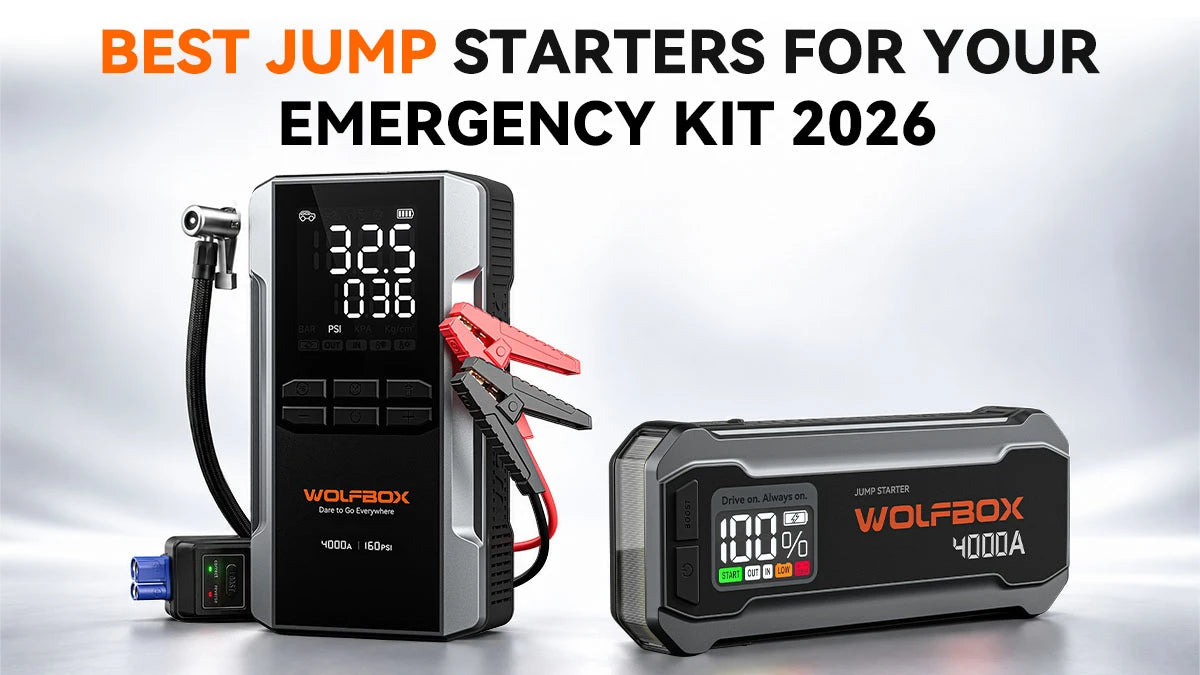
The best portable jump starter for most drivers in 2026 is the WOLFBOX MegaVolt24 — a 4,000A peak lithium jump starter with a 24,000 mAh (88.8 Wh) battery, 65W USB-C Power Delivery, and a Boost mode for deeply depleted batteries.[1] It is rated for gasoline engines up to 10 liters and diesel engines up to 6 liters, making it suitable for everything from compact sedans to full-size trucks and boats. Independent testing by LiveWorkDream confirmed it started a Toyota FJ with a dead battery "right up" on the first attempt, using a unit fresh out of the box at only 72% charge.[3]
If you want roadside versatility in a single device, the WOLFBOX MegaVolt 10Air adds a 150 PSI digital air compressor to a 2,000A jump starter, covering both dead batteries and low tires with one compact unit.[2] It is rated for gasoline engines up to 5.0 liters and inflates a standard passenger tire from 29 to 36 PSI in approximately 60 seconds.[2]
What Is a Portable Jump Starter (and What Should You Look for in 2026)?
A portable jump starter is a rechargeable lithium-ion battery pack with integrated jumper cables — powerful enough to start a vehicle with a dead battery, small enough to store in a glove box. In 2026, three specifications determine whether it will actually start your engine when it counts: peak current, battery capacity, and safety protections.
Peak Amps vs. Real Cranking Power
Peak amps — the headline number on most jump starter listings — measure the maximum instantaneous current the unit can deliver in a fraction of a second. Cranking amps (sometimes called starting amps) measure the sustained current the unit can deliver for several seconds to actually turn an engine over. A 4,000A peak rating typically translates to roughly 800–1,200A of usable cranking power, as starting amps can be anywhere from one quarter to one half of the advertised peak amps.[6] Always check the manufacturer's engine displacement rating (e.g., "up to 10L gasoline") alongside the peak amp number — peak amps alone tell you little about what the unit can start.
As a practical guideline, most 4-cylinder and V6 gasoline engines need 200–400 cranking amps. Large V8 gasoline engines and light diesel trucks may require 500–800A or more. The MegaVolt24's 4,000A peak rating places it in the upper tier of consumer jump starters, capable of handling 10L gasoline engines and 6L diesel applications.[1]
Battery Capacity: More mAh = More Jump Starts
Lithium jump starter capacity is measured in milliampere-hours (mAh) or watt-hours (Wh). Higher capacity means more jump starts per charge — and the ability to charge your phone, tablet, or laptop between jumps. The MegaVolt24's 24,000 mAh (88.8 Wh) battery provides enough reserve for multiple jump starts on a single charge.[1] In practical terms, most lithium jump starters at full charge can perform 20–30 jump starts before needing a recharge, though this varies with engine size and ambient temperature.[3]
Safety Features (Non-Negotiable)
A jump starter connects directly to a car battery — capable of delivering hundreds of amps. Without proper protections, the consequences of a wrong connection include sparks, electrical damage, or fire. Look for at minimum: spark-proof clamps, reverse-polarity protection (alerts if you connect positive to negative), over-temperature protection, and short-circuit protection. The MegaVolt24 includes 10 safety protections including spark-proof, low- and high-temperature protection, and reverse-polarity protection.[1][3]
Bonus Features Worth Considering
- USB-C Power Delivery: Modern jump starters double as high-capacity power banks. The MegaVolt24's 65W USB-C PD port charges a laptop, tablet, or phone at full speed — useful on road trips or during power outages.[1]
- Built-in air compressor: Jump starter + air compressor combos like the MegaVolt 10Air eliminate a separate tire inflator. The 150 PSI compressor includes digital pressure detection, auto-stop at target pressure, and preset modes for cars, motorcycles, bicycles, and balls.[2]
- LED flashlight: Multiple modes (high beam, strobe, SOS) for nighttime emergencies.[1][2]
Why 2026 Is the Year to Upgrade Your Jump Starter
Three shifts make 2026 a practical moment to replace an aging lead-acid jump starter — or buy your first one:
- Lithium density has crossed a practical threshold. A 24,000 mAh lithium jump starter that starts a 10L engine now typically weighs 2.5–3.5 pounds and fits in a glove box. The lead-acid equivalent — heavy, bulky, and requiring monthly recharging — is generally less practical for everyday drivers.
- USB-C PD has made jump starters into genuine multi-tools. Modern units like the MegaVolt24[1] and MegaVolt 10Air[2] charge via USB-C and output enough wattage to power laptops, tablets, and phones. The jump starter earns its space in the vehicle year-round, not just for emergencies.
- Pricing has stabilized at accessible levels. A 4,000A peak lithium jump starter now costs roughly 170-185 USD—about the price of two AAA annual memberships or a single tow. A 2,000A model with a built-in air compressor starts around 100.[1][2]
Top Jump Starters in 2026
1. WOLFBOX MegaVolt24 — Best Overall Jump Starter
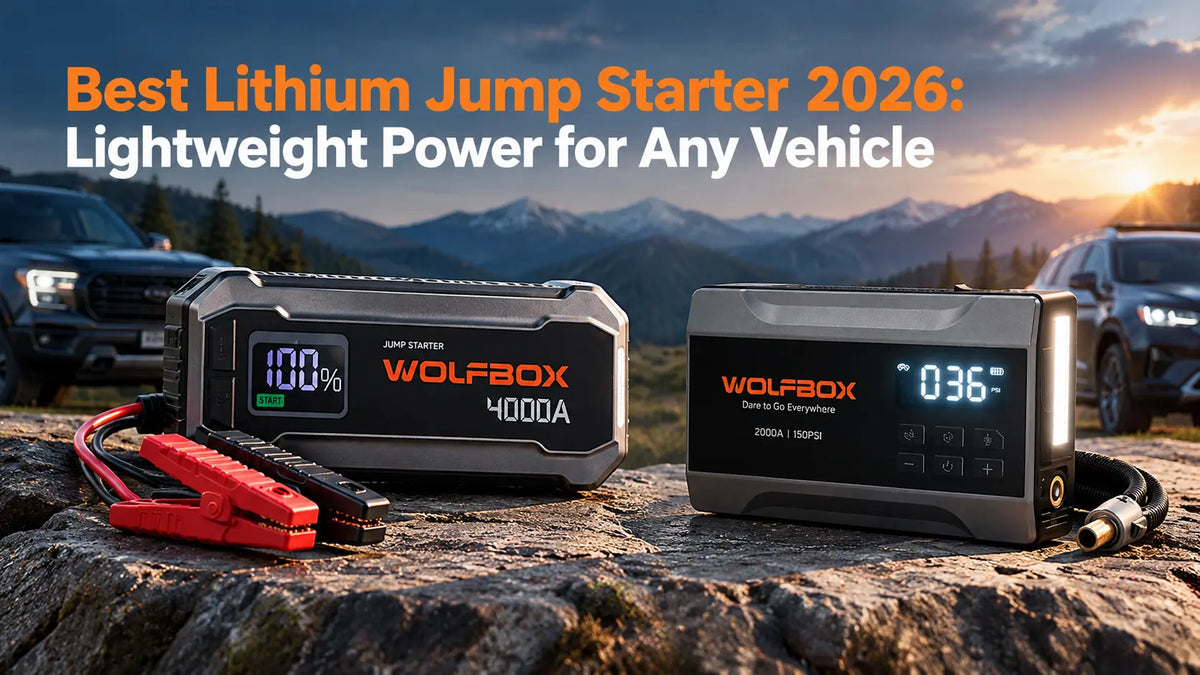
The MegaVolt24 is the best all-around jump starter for 2026. It delivers 4,000A peak current from a 24,000 mAh (88.8 Wh) lithium battery, with a 65W USB-C PD port, a QC3.0 USB-A port, and a Boost mode that delivers maximum amperage for deeply depleted batteries that would not respond to a standard jump.[1] It is rated for gasoline engines up to 10 liters and diesel engines up to 6 liters, covering passenger cars, SUVs, trucks, boats, and farm equipment.
An independent review published by LiveWorkDream put the MegaVolt24 through a real-world test in Alaska: a Toyota FJ with a dead battery, in pouring rain, using a unit taken from the box at only 72% charge. The vehicle started instantly on the first attempt without needing the Boost function.[3] The reviewer noted the unit "still had plenty of power" after the jump and described it as providing "peace of mind" — particularly for drivers in remote areas where roadside assistance could take hours to arrive.[3]
Key specifications:[1]
- Peak current: 4,000A
- Battery: 24,000 mAh / 88.8 Wh lithium
- Engine compatibility: Up to 10L gasoline / 6L diesel
- Ports: 65W USB-C PD (in/out) + QC3.0 USB-A
- Recharge time: ~1.5 hours via 65W built-in fast charging
- Safety: 10 protections (spark-proof, reverse polarity, temperature, short circuit)
- Flashlight: 3 modes (steady, strobe, SOS)
- Boost mode: Yes — for batteries below 3V
- Warranty: 30 months (24-month base + 6-month extended warranty when purchased from the official site) with 24/7 customer support
- Weight: Portable — fits in a standard glove box[3]
Limitations to know: The clamp cables are approximately 8 inches long, which means the unit must be positioned close to the battery. For vehicles with hard-to-reach battery terminals, this is less convenient than traditional long jumper cables.[3]
2. WOLFBOX MegaVolt 10Air — Best Jump Starter With Air Compressor
If you want a single device that handles both a dead battery and a low tire, the MegaVolt 10Air combines a 2,000A peak jump starter with a 150 PSI digital air compressor in one compact unit.[2] It is rated for gasoline engines up to 5.0 liters and can perform up to 30 jump starts on a single full charge. The built-in compressor inflates a standard 195/65 R15 passenger tire from 29 to 36 PSI in approximately 60 seconds, with auto-stop at the target pressure and five preset inflation modes (car, motorcycle, bicycle, ball, and custom).[2]
Key specifications:[2]
- Peak current: 2,000A
- Battery: 37 Wh lithium
- Engine compatibility: Up to 5.0L gasoline or 3L diesel
- Air compressor: 150 PSI max, digital gauge, auto-stop, 5 modes, 4 measurement units (BAR, PSI, KPA, kg/cm²)
- Inflation speed: ~60 seconds for 195/65 R15 tire (29→36 PSI)
- USB ports: 15W USB-C input + 12W USB-A output (power bank)
- Safety: Spark-proof, reverse polarity, UL/FCC/CE/CA65 certified
- Operating temperature: -4°F to 140°F
- Durability: IP64 rated (dust-tight, splash-resistant)
- Flashlight: 200 lumens (high beam, strobe, SOS)
- Warranty: 30 months (24-month base + 6-month extended warranty when purchased from the official site) with 24/7 support
Trade-offs vs. the MegaVolt24: The 10Air's 2,000A peak rating limits it to gasoline engines up to 5.0L and diesel engines up to 3L — it is not suited for larger V8 trucks, heavy-duty diesel trucks, or heavy equipment. The 37 Wh battery provides fewer jump starts per charge than the MegaVolt24's 88.8 Wh. However, the addition of a fully functional digital air compressor makes it the more versatile choice for drivers who regularly deal with tire pressure fluctuations — particularly in regions with significant seasonal temperature swings.[2]
MegaVolt24 vs MegaVolt 10Air: Specs at a Glance
|
Specification |
MegaVolt24 |
MegaVolt 10Air |
|---|---|---|
|
Peak current |
4,000A |
2,000A |
|
Battery capacity |
24,000 mAh / 88.8 Wh |
37 Wh |
|
Max gasoline engine |
10L |
5.0L |
|
Max diesel engine |
6L |
3L |
|
Air compressor |
— |
150 PSI, digital, auto-stop, 5 modes |
|
USB-C PD |
65W in/out |
15W in |
|
USB-A |
QC3.0 |
12W |
|
Full recharge |
~1.5 hours (65W PD) |
USB-C charging |
|
Flashlight |
Multi-mode |
200 lumens, 3 modes |
|
Operating temperature |
-4°F to 140°F |
-4°F to 140°F |
|
Durability rating |
— |
IP64 |
|
Safety certifications |
10 built-in protections |
UL, FCC, CE, CA65 |
|
Boost mode |
Yes (sub-3V batteries) |
Yes (low-voltage booster) |
|
Price |
~170 |
~100 |
|
Warranty |
30 months |
30 months |
How to Choose the Right Jump Starter for Your Vehicle
Choosing between the MegaVolt24 and MegaVolt 10Air comes down to four factors: engine size, whether you need a built-in air compressor, your local climate, and safety priorities. For a deeper dive into jump starter selection criteria including battery chemistry and maintenance, see WOLFBOX's comprehensive jump starter buying guide.
Engine Size: Match Peak Amps to Your Largest Vehicle
The most important spec is the manufacturer's rated engine displacement — not the peak amp number alone. The MegaVolt24 is rated for 10L gasoline and 6L diesel engines, covering essentially any consumer vehicle.[1] The MegaVolt 10Air is rated for 5.0L gasoline or 3L diesel engines — adequate for most passenger cars, compact SUVs, and midsize sedans, but not for full-size trucks with large V8 engines.[2] If your household includes a truck, SUV, boat, or RV, the MegaVolt24 provides headroom. If every vehicle you own is under 5.0L, the 10Air is sufficient.
Pure Jump Starter vs. Jump Starter With Air Compressor
The 10Air's roughly $100 price includes a digital air compressor that would cost $30–$50 as a standalone device. For drivers who check tire pressure regularly or live in regions with large seasonal temperature swings (where tire pressure fluctuates significantly), the combination unit saves both money and trunk space. Choose the MegaVolt24 if engine compatibility is your primary concern, or if you already own a reliable tire inflator.
Climate and Temperature
All lithium batteries lose capacity in extreme cold. The MegaVolt 10Air is rated for operation from -4°F to 140°F with an IP64 dust and splash-resistance rating — relevant for drivers in cold climates or dusty environments.[2] The MegaVolt24 includes low- and high-temperature protection circuits but does not carry a formal IP rating.[1] In below-freezing conditions, store either unit indoors (not in the vehicle) when possible, and recharge every 3–6 months to maintain peak capacity.
Safety Features
Both units include spark-proof clamps and reverse-polarity protection — if you connect the clamps backward, the unit alerts you rather than delivering current.[1][2] The MegaVolt24 adds 10 discrete protection circuits; the 10Air carries UL, FCC, CE, and California CA65 certifications.[1][2] For drivers helping strangers on the roadside, reverse-polarity protection is the single most important safety feature — it eliminates the risk of accidentally shorting the wrong battery terminal.
How to Use a Jump Starter Safely
Using a lithium jump starter is simpler and safer than traditional jumper cables, but the procedure still matters:
- Turn off the vehicle ignition and all accessories (lights, radio, climate control).
- Connect the red clamp to the positive (+) battery terminal.
- Connect the black clamp to an unpainted metal surface on the engine block or chassis — not the negative battery terminal. This keeps any spark away from the battery, which can emit hydrogen gas.
- Power on the jump starter and check the display. If it shows a reverse-polarity warning, swap the clamps.
- Start the vehicle. Most jump starters recommend cranking for no more than 3–5 seconds at a time, with 30–60 second rests between attempts.
- Once the engine is running, turn off the jump starter, then disconnect the clamps in reverse order (black first, then red).
- Drive for at least 20–30 minutes to allow the alternator to recharge the vehicle battery.
If the vehicle does not start after 3–4 attempts, the battery may be beyond recovery (below 3 volts) or there may be a separate issue such as a failed starter motor or alternator. The MegaVolt24's Boost mode provides extra amperage for deeply depleted batteries in the 1–3V range, but a battery that has been fully discharged for an extended period may need replacement regardless.[1]
Frequently Asked Questions
What is the best jump starter in 2026?
The WOLFBOX MegaVolt24[1] is the best all-around jump starter for 2026 — 4,000A peak, 24,000 mAh battery, 65W USB-C PD, rated for gasoline engines up to 10 liters. Independent testing confirmed it started a dead Toyota FJ instantly on the first attempt with a unit at only 72% charge.[3] If you want a built-in air compressor, the MegaVolt 10Air[2] offers 2,000A peak + 150 PSI compressor for roughly $100.
How many peak amps do I need for my car?
A 4-cylinder or V6 sedan typically needs 200–400 cranking amps — well within the MegaVolt 10Air's 2,000A peak (approximately 400–600A cranking). Large V8 trucks and diesel engines may require 500–800A+ cranking, which calls for the MegaVolt24's 4,000A peak (approximately 800–1,200A cranking). Always check the manufacturer's engine displacement rating alongside peak amps.[1][2]
Can a jump starter charge my phone and laptop?
Yes. The MegaVolt24's 65W USB-C PD port charges laptops, tablets, and phones at full speed and can recharge the unit itself in approximately 1.5 hours.[1] The MegaVolt 10Air includes a 15W USB-C input and 12W USB-A output for phone and accessory charging.[2] Both units function as high-capacity power banks year-round.
How long does a portable jump starter hold its charge?
Lithium jump starters lose approximately 2–3% of charge per month in storage. WOLFBOX recommends recharging every 3–6 months to maintain peak capacity. In cold climates, store the unit indoors rather than in the vehicle when temperatures drop below freezing, as extreme cold reduces lithium battery performance.
Can I jump start a completely dead battery?
Yes — both the MegaVolt24 and MegaVolt 10Air include Boost/low-voltage modes designed for batteries that have dropped below typical starting voltage. The MegaVolt24's Boost button delivers maximum amperage to batteries as low as 1–3 volts.[1] However, a battery that has been deeply discharged for weeks or months may be permanently damaged and require replacement regardless of the jump starter used.
Is a jump starter better than jumper cables?
A lithium jump starter is safer and more practical than traditional jumper cables for most drivers. Reverse-polarity protection prevents connection mistakes that can damage vehicle electronics.[1][2] You do not need a second running vehicle. The unit fits in a glove box. The trade-off is cost (roughly $100-$180 vs. $15–$30 for cables) and the need to periodically recharge. Independent reviewer LiveWorkDream summarized: "It's so simple anyone can jump start a car without jumper cables or risking damage to either vehicle."[3]
References
[1] WOLFBOX MegaVolt24 4000A Jump Starter, WOLFBOX Official Product Page. https://wolfbox.com/products/wolfbox-megavolt24-jump-starter
[2] 2000A Jump Starter with Air Compressor | WOLFBOX MegaVolt 10Air, WOLFBOX Official Product Page. https://wolfbox.com/products/wolfbox-2000a-jump-starter-with-air-compressor-wolfbox-megavolt-10air
[3] How the WOLFBOX MegaVolt24 Jump Starter Made Everything Go As Planned, LiveWorkDream, May 2024 (updated March 2026). https://liveworkdream.com/2024/05/15/how-the-wolfbox-megavolt24-jump-starter-made-everything-go-as-planned/
[4] AAA roadside assistance call volume and battery service data, AAA Newsroom official press releases, 2025–2026. https://newsroom.acg.aaa.com/aaa-urges-drivers-to-stay-proactive-on-auto-repair/
[5] WOLFBOX Reviews, Trustpilot. https://www.trustpilot.com/review/wolfbox.com
[6] 10 Best Portable Jump Starters, Mechanic Base, November 2025. https://mechanicbase.com/reviews/best-jump-starter/

Leave a comment
All comments are moderated before being published.
This site is protected by hCaptcha and the hCaptcha Privacy Policy and Terms of Service apply.