






Most comparison articles end with a winner. This one won't — because the honest answer depends on who you are, how you drive, and what your car looks like from behind.
Mirror dash cams and regular dash cams solve different problems. The fact that both record the road doesn't make them interchangeable. Here's what actually separates them once the honeymoon period is over.
What You're Actually Choosing Between
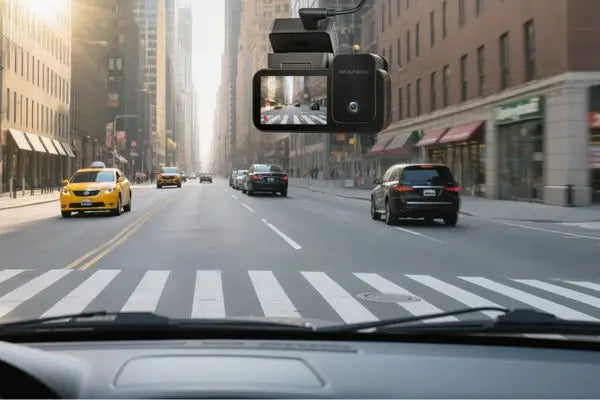
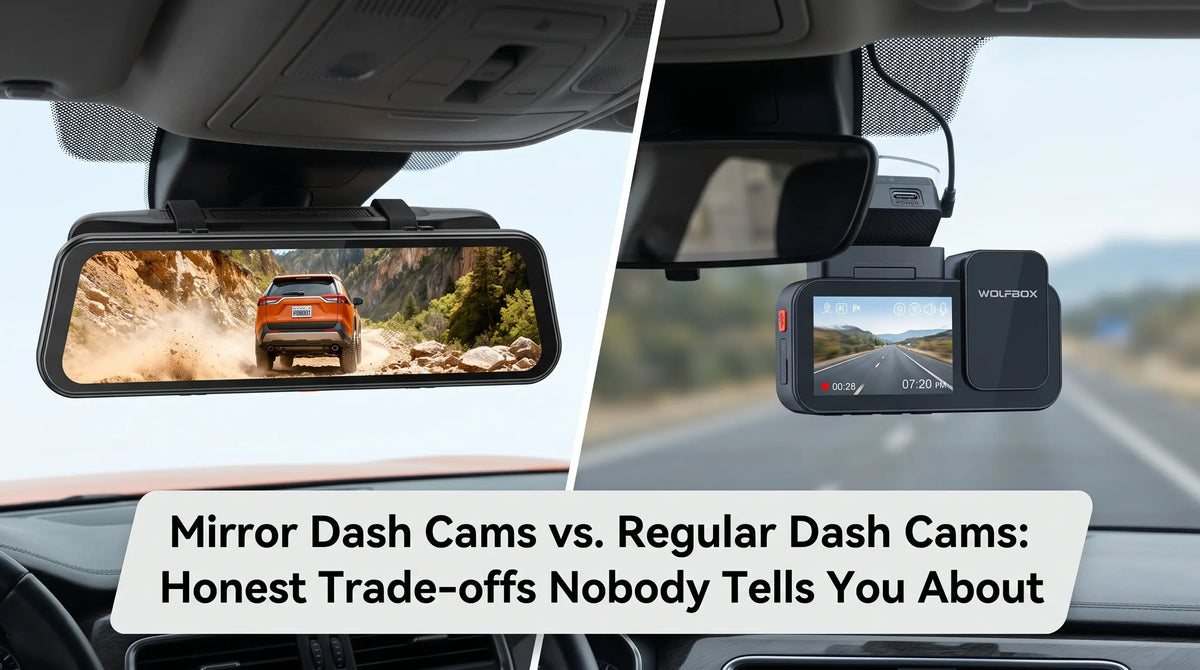
A regular dash cam is a compact unit — usually 2 to 4 inches — that mounts on your windshield via suction cup or adhesive bracket. It records through the glass, stores footage on a microSD card, and powers off when you leave. Many are single-channel (front only), though dual-channel options with a separate rear camera are common. The device is small and generally invisible to passengers.
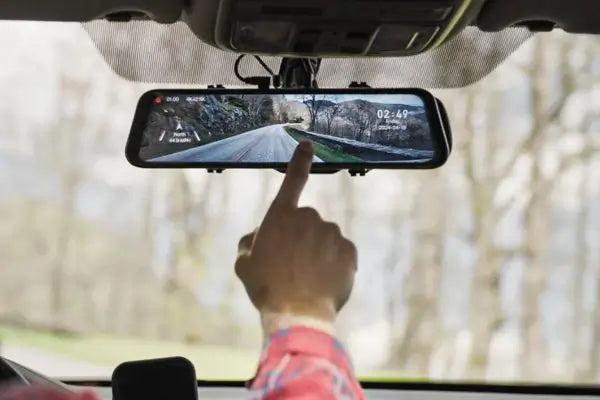
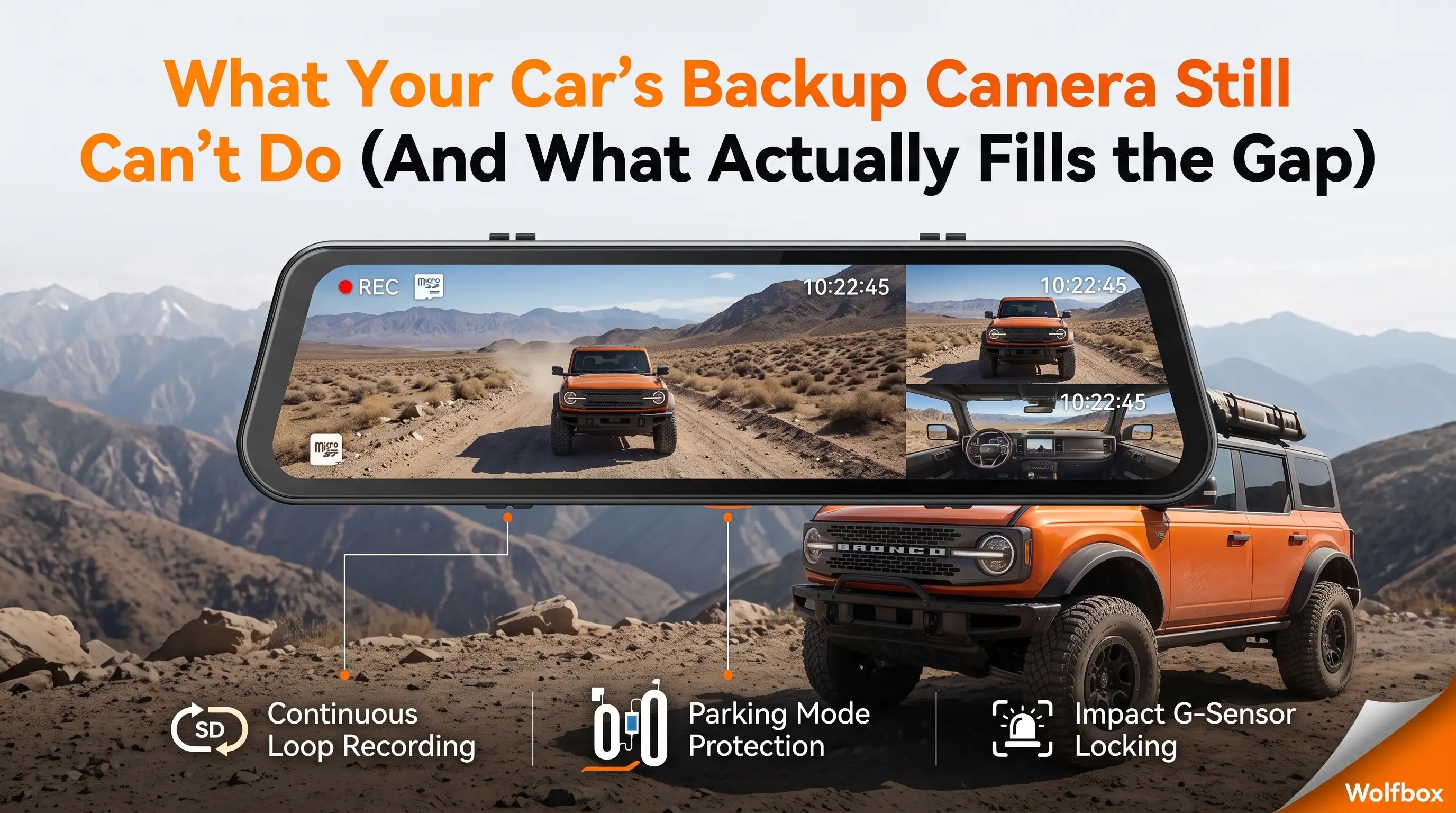
A mirror dash cam replaces your rearview mirror, or clips over it with rubber straps. The front camera is built into the unit; a separate rear camera cables back to the rear window or bumper. What you see in "the mirror" is a live digital feed from that rear camera, displayed on a full-width touchscreen — typically 10 to 12 inches. There is nothing reflective about it. The functional difference matters: a mirror dash cam is always visible to you and everyone in the car. A regular dash cam usually goes unnoticed.
The Depth Perception Adjustment (Most Reviews Skip This)
The trade-off most buyers don't discover until after installation: adjusting to a digital rear view takes time, and not everyone adapts easily.
A traditional mirror shows you a reflection with natural depth cues — you instinctively judge distance from objects by their apparent size and position. A camera feed is flat. The rear camera on a mirror dash cam typically captures at 140°–170° wide angle, which compresses perceived distance until your brain recalibrates. Research from the Electronic Imaging Symposium on Camera Monitor Systems found that drivers required a meaningful adaptation period when switching from optical mirrors to camera-based digital displays [1] — most users report this takes one to two weeks of regular driving.
This isn't a dealbreaker, but it's not mentioned in product listings. Buyers who don't expect it sometimes return the unit during that window.
Rear Camera Image Quality in Bright Sunlight
Both form factors rely on rear cameras, but not all mounting positions are equal. Mirror dash cam rear cameras often mount outside near the license plate or inside near the rear windshield at a wider outward angle. In direct sunlight, a camera aimed at the horizon will often blow out the sky, reducing license plate legibility in the frame — less a hardware limitation than a geometry one.
High-end models address this through sensor selection and dynamic range processing. The Wolfbox G900TriPro uses a Sony STARVIS 2 IMX678 sensor with wide dynamic range processing, which handles high-contrast lighting more gracefully than budget alternatives [2][5]. That said, this limitation exists across the category to some degree, and honest reviews should say so.

Truck, SUV, and Van Drivers: The Strongest Case for Mirror Cams
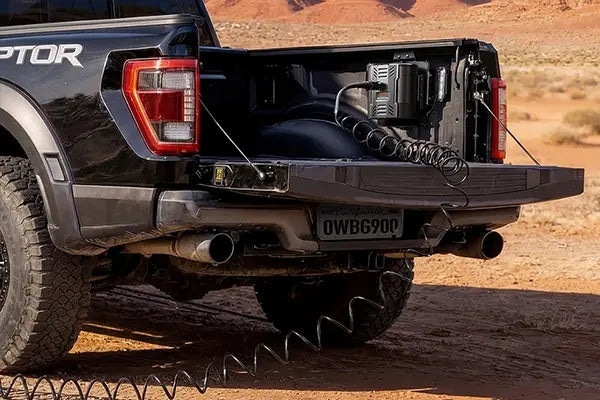
There's a reason mirror dash cams are disproportionately popular among truck and large SUV owners: factory mirrors are genuinely worse in these vehicles. A standard rearview mirror in a pickup truck reflects your rear cabin, headrests, and a narrow strip of the road behind. Add a truck bed, a full back seat, or cargo in an SUV, and your actual rear visibility is limited.
A mirror dash cam replaces that restricted view with a live camera feed from a rear-mounted unit — often at 140° wide angle — that shows the road behind regardless of what's in your cargo area. For a Ford F-150 driver towing a trailer or a Honda Odyssey driver with three car seats, this is a concrete, measurable improvement. The Wolfbox G840S installs via rubber straps with no drilling, and the rear camera cable extends 20 feet — long enough to reach the tailgate of a full-size pickup [3]. Compact sedan drivers, by contrast, often find that their factory mirror already delivers adequate rear visibility, and the trade-offs of a mirror cam start to matter more at that point.
The Screen-Always-On Question
Regular dash cams are designed to be invisible. The unit tucks behind the mirror, the recording indicator is small, and most passengers won't notice it.
A mirror dash cam is a 10–12 inch active display. The rear camera feed plays continuously. It is visible at night. Passengers notice it and often ask about it. For some drivers this is fine or even useful — the rear view is demonstrably helpful. For drivers who want discretion — rideshare drivers, for instance, who deal with passengers who may feel differently about visible recording equipment — the always-on display is a real consideration. Most mirror dash cams include a screen-off option, but turning off the screen means losing the live rear view. That's a genuine trade-off, not a minor caveat.
What a Mirror Cam Cannot Replace
A mirror dash cam replaces your rearview mirror with a digital display. It does not replace:
- Your side mirrors: the digital rear view covers the center rear, not the lateral blind spots your side mirrors address
- Your factory backup camera: if your car has a built-in backup camera, that system continues to function through the infotainment display; the mirror cam adds a parallel recording capability
- Your ADAS sensors: lane departure and forward collision systems built into the vehicle operate independently of any aftermarket dash cam
Some mirror dash cams, including the Wolfbox G850 Pro, add their own ADAS alerts — forward collision warning, lane departure warning, and blind spot detection — as software-analyzed features using the front camera feed [4][6]. These operate differently from factory sensor arrays, which are covered in a separate guide.

Installation Complexity: Suction Cup vs. 20-Foot Cable
Regular dash cam installation is typically a 15-minute task: suction cup on windshield, route cable to power, done. Some users add a hardwire kit, but basic installation requires no tools and no routing beyond the front cabin.
Mirror dash cam installation adds a step: routing the rear camera cable from the front unit along the headliner, down the A-pillar, along the door sill, and to the rear of the vehicle. In a standard sedan, this typically takes 30–45 minutes. In a full-size truck or SUV, cable length requirements increase accordingly. Wolfbox mirror cams include the rear camera cable (up to 20 feet standard), cable clips, and a routing tool [3]. The process doesn't require removing panels, but it requires patience and careful routing.
How to Decide
Use a mirror dash cam if:
- You drive a truck, SUV, van, or any vehicle with limited rear window visibility
- Your rear cargo area frequently blocks the traditional mirror view
- You want a large rear display that doubles as a documentation system
- You're replacing a factory mirror that already provides poor rear visibility
Use a regular dash cam if:
- You drive a compact or mid-size sedan with good rear window visibility
- You want minimal interior footprint or distraction
- Discretion matters — professional settings, rideshare, or personal preference
- You prefer faster, simpler installation without rear cable routing
Neither is universally superior. They serve different drivers. The drivers who know this before they buy are the ones who don't return their camera after two weeks.
Frequently Asked Questions
Q: Will a mirror dash cam fit over any factory rearview mirror?
Most mirror dash cams use a rubber strap mount that fits standard-size factory mirrors. Wide-format or unusually tall mirrors common in some trucks may need checking against the product's maximum mirror width specification before purchase.
Q: Does switching to a digital rear view affect night driving?
There is an adaptation period for most drivers — typically one to two weeks. Camera-based rear views differ from optical mirrors in depth perception. Low-light image quality varies significantly by sensor hardware.
Q: Can I still use my factory backup camera with a mirror dash cam installed?
Yes. A mirror dash cam is an independent aftermarket system. Your factory backup camera continues to function through the infotainment display separately.
Q: How long does the rear camera cable installation take?
Typical sedan: 30–45 minutes. Full-size truck or SUV: 45–75 minutes. No panel removal is required for strap-mount mirror cams that include a routing tool.
Q: Are mirror dash cams legal everywhere in the US?
Mirror dash cams are generally treated differently from windshield-mounted suction-cup cameras because they replace or strap over the mirror, but state obstruction and recording rules can vary. Check your local rules before installation; federal rear-visibility rules also explain why rear-view display requirements focus on visibility rather than recording [7].
References
[1] Electronic Imaging Symposium — Digital Rear View Mirrors With Augmented Reality in Comparison With Traditional Rear-View Mirrors: https://library.imaging.org/admin/apis/public/api/ist/website/downloadArticle/ei/36/11/HVEI-215
[2] Wolfbox G900TriPro Bumper Version Product Page — Sony STARVIS 2 IMX678, 4K front and 2.5K rear specs: https://wolfbox.com/products/wolfbox-g900-tripro-bumper-version-3-channel-rearview-mirror-camera
[3] Wolfbox G840S Official Product Page — mirror mount, 4K front, rear camera, GPS and installation details: https://wolfbox.com/products/wolfbox-g840s-12-4k-mirror-dash-cam-2160p-full-hd-smart-rear-view-camera-mirror-dash-cam
[4] Wolfbox G850 Pro Official Product Page — ADAS, BSD and 12-inch mirror form factor: https://wolfbox.com/products/wolfbox-g850pro-dash-cam-4k-wifi-car-dash-camera-front-and-rear-mirror-dashcam
[5] Wolfbox G840S vs G900 Pro vs G900TriPro Comparison Guide: https://wolfbox.com/blogs/dash-cams/wolfbox-g840s-vs-g900-pro-vs-g900-tripro-which-mirror-dash-cam-is-right-for-you
[6] IIHS — Advanced Driver Assistance Research Area: https://www.iihs.org/research-areas/advanced-driver-assistance
[7] Federal Register — FMVSS No. 111 Rear Visibility Rule: https://www.federalregister.gov/documents/2014/04/07/2014-07469/federal-motor-vehicle-safety-standards-rear-visibility

Leave a comment
All comments are moderated before being published.
This site is protected by hCaptcha and the hCaptcha Privacy Policy and Terms of Service apply.