







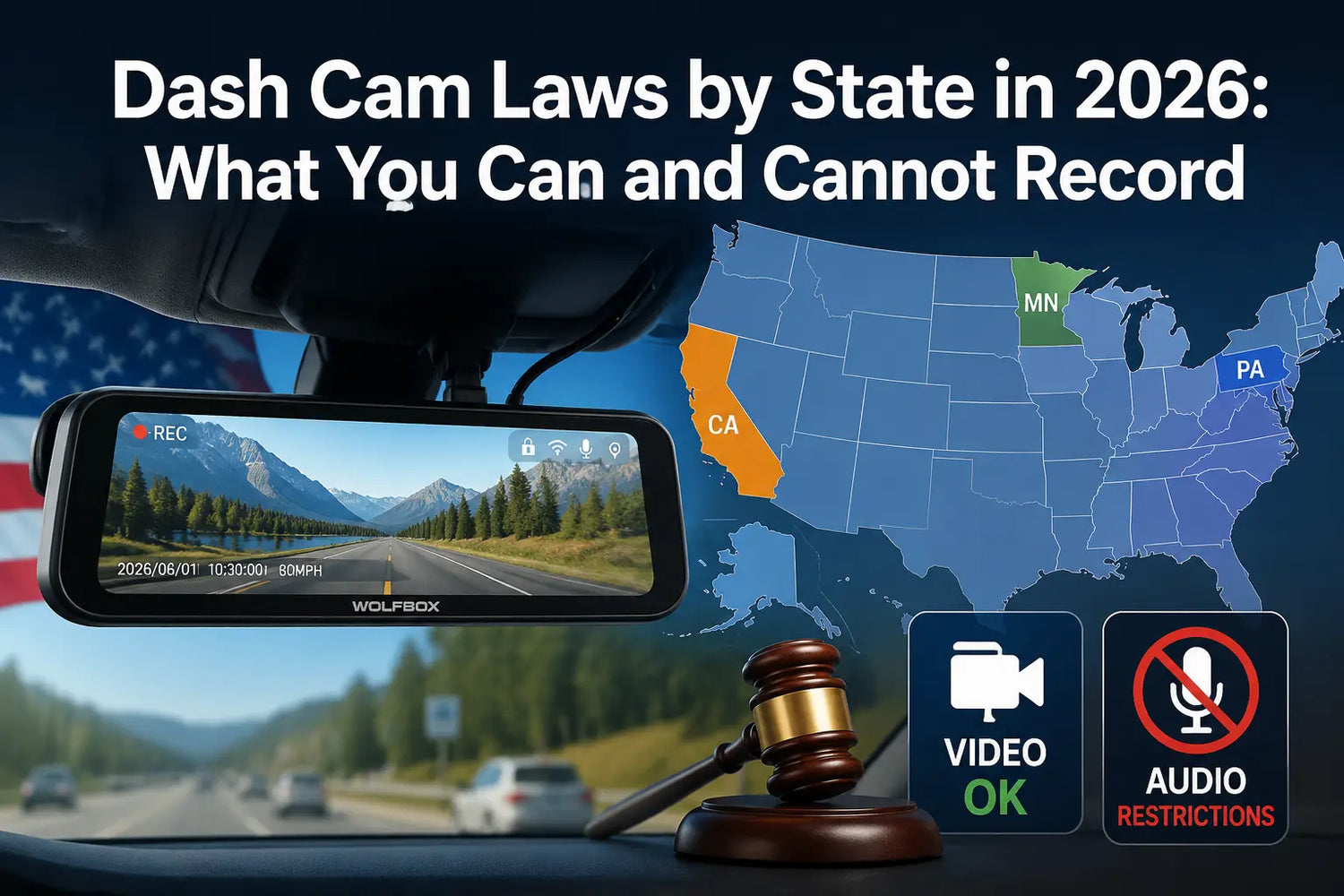
Dash cams are generally legal to use in the United States, but two details create most compliance problems: where the camera is mounted and whether the device records in-cabin audio. Video-only road recording is usually straightforward. Audio recording inside a vehicle becomes more sensitive when passengers, rideshare riders, employees, or customers are involved.
This article is informational only and is not legal advice. Laws and enforcement practices can change. For commercial use, rideshare work, or court evidence questions, check current state law or ask a qualified attorney.
The Two Rules Buyers Should Separate
Windshield rules are about driver visibility. California, Minnesota, and Pennsylvania are useful examples because their laws show how different the wording can be: California gives specific placement zones, Minnesota describes restrictions and exceptions around windshield obstruction, and Pennsylvania’s state road-safety guidance points drivers to 75 Pa. CS 4524 for windshield obstructions and wipers.[1][2][3]
Audio rules are different. Federal wiretap law allows recording when one party consents, but some states require all parties to consent to a private conversation.[4] That is why a dash cam can be fine for road video but risky for cabin audio.
Mounting Rules: Keep the View Clear
State example |
What to watch |
California |
Vehicle Code Section 26708 allows limited windshield placement zones; do not treat the full windshield as available space.[1] |
Minnesota |
Avoid placing objects where they obstruct the driver’s view; check the current exception language before mounting.[2] |
Pennsylvania |
The state guidance points drivers to 75 Pa. CS 4524 for windshield-obstruction issues.[3] |
Other states |
Most rely on general obstruction language rather than dash-cam-specific sizing. |
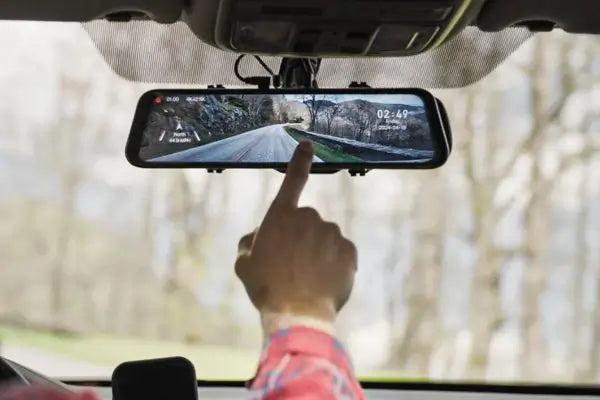
Mirror dash cams can reduce mounting issues because the screen attaches over or replaces the rearview mirror instead of adding a new device to the windshield. That does not remove every installation concern, but it keeps the driver’s forward view cleaner than many suction-cup windshield setups.
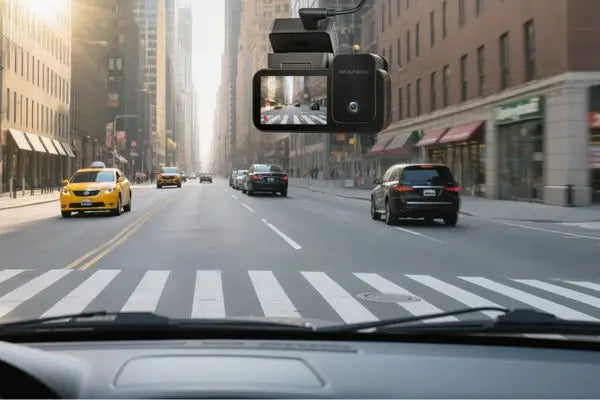
The practical test is simple: sit in the normal driving position and check whether the camera, cable, or screen blocks the road, traffic signals, pedestrians, or mirrors. If it does, the installation is not good even if the device technically fits.

Audio Recording: The Safer Default
If you drive in a state with all-party consent rules, or if passengers regularly enter your vehicle, the simplest default is to turn audio recording off unless you have a clear consent process. Washington’s RCW 9.73.030 and California Penal Code Section 632 are examples of laws that treat private conversations carefully.[5][6]
For rideshare, platform permission is not the same as state-law compliance. A visible notice helps, but disabling audio is usually the cleanest setup when consent is uncertain.
This is where many dash cam guides overstate the answer. A dash cam can be legal for road video and still create a problem if it records a private passenger conversation without proper consent. Treat video and audio as separate settings.
Practical Wolfbox Setup
Use a mirror-mounted position that keeps the windshield clear. Enable date, time, and GPS stamp if your model supports it. Set loop recording and G-sensor locking according to your driving environment. If you carry passengers, review the audio setting before the first trip rather than after a complaint.
For many owners, the cleanest everyday setting is road-facing video on and cabin audio off. Turn audio on only when you understand the consent rule for the state and situation.
For a family car, that may be enough. For rideshare or delivery work, add a visible notice and document your settings so you are not trying to explain them after a dispute. For fleet use, put the recording policy in writing before installing cameras across vehicles.

Legal-research checks
- Because state recording rules change and may interact with local court interpretation, Cornell’s federal wiretap statute is only a starting point; drivers should still check state law before enabling cabin audio.[7]
Additional source checks
- Florida’s interception statute is another example of why cabin audio should be treated as a state-law question, not a universal dash cam feature.[8]
- Illinois eavesdropping law is a further reminder that consent rules can differ sharply by state.[9]
Frequently Asked Questions
Are dash cams legal in all US states?
Video-only road recording is generally legal, but mounting restrictions and audio-consent rules vary by state.
Which dash cam setting creates the most legal risk?
In-cabin audio recording creates more risk than road-facing video because state consent laws differ.
Does a mirror dash cam avoid windshield rules?
It can reduce windshield obstruction concerns, but drivers still need to keep the view clear and follow state law.
Should rideshare drivers record audio?
Only with a clear consent process. When unsure, disable audio and keep road-facing video on.
Can dash cam footage help with insurance?
It can help document time, location, and road events, but admissibility and claim handling depend on the situation.
How often should I recheck the law?
Recheck before commercial use, before rideshare use, and whenever you move to or drive regularly in another state.
References
[1] California Vehicle Code Section 26708 — https://leginfo.legislature.ca.gov/faces/codes_displaySection.xhtml?lawCode=VEH§ionNum=26708
[2] Minnesota Statutes Section 169.71 — https://www.revisor.mn.gov/statutes/cite/169.71
[3] Pennsylvania State Police: Rules of the Road — https://www.pa.gov/agencies/psp/resources/safety-resources/rules-of-the-road
[4] 18 U.S.C. Section 2511 — https://www.law.cornell.edu/uscode/text/18/2511
[5] Washington RCW 9.73.030 — https://app.leg.wa.gov/rcw/default.aspx?cite=9.73.030
[6] California Penal Code Section 632 — https://leginfo.legislature.ca.gov/faces/codes_displaySection.xhtml?lawCode=PEN§ionNum=632
[7] 18 U.S.C. Section 2511 — https://www.law.cornell.edu/uscode/text/18/2511
[8] Florida Statutes Section 934.03 — https://www.flsenate.gov/Laws/Statutes/2025/934.03
[9] Illinois Compiled Statutes 720 ILCS 5/14-2 — https://www.ilga.gov/legislation/ilcs/fulltext.asp?DocName=072000050K14-2



Leave a comment
All comments are moderated before being published.
This site is protected by hCaptcha and the hCaptcha Privacy Policy and Terms of Service apply.