







People shop these two against each other, and they aren't really the same tool. The WOLFBOX MF200 is an air duster and nothing else, built to move air fast: 110,000 RPM, 196 MPH, 82 CFM([1][2]). The Verilux cordless air duster is a 2-in-1, a blower and a vacuum sharing one body, rated at 19,000 Pa of suction from a 120W motor at 35,500 RPM, with a reusable HEPA filter. One of them blows dust out of a machine. The other tries to do both jobs with a smaller motor. The real question is whether you want the dust gone or caught.
The Specs Aren't Measured the Same Way
Put the WOLFBOX MF200 spec sheet next to the Verilux one and you can't actually compare them. That's not a marketing trick. The numbers measure different physics.
Pa is pascals, a pressure unit. It tells you how hard a vacuum pulls at the nozzle. CFM, cubic feet per minute, is how much air is moving. MPH is how fast that air is going. RPM, the figure the WOLFBOX MF200 leads with, is how fast the impeller spins and nothing else.
The WOLFBOX MF200 publishes the airflow stuff: 82 CFM, 196 MPH, 110,000 RPM([1][2]). The Verilux listing opens with 19,000 Pa and 120 watts.
So a shopper sees 19,000 of something against 196 of something else and assumes bigger wins but Pa is a suction figure. A unit can pull hard through a nozzle and still move modest air out the blower end. Getting dust out from between fan fins is an airflow job, which is the column the WOLFBOX MF200 fills in.
Motor Speed: 110,000 RPM vs 35,500 RPM
Impeller speed is the one number here that compares cleanly, and it isn't close. The WOLFBOX MF200 spins to 110,000 RPM([1]). The Verilux unit does 35,500. What that difference buys is reach. A faster impeller throws a tighter, quicker column of air that gets down between fan blades and into a vent channel instead of just stirring the dust sitting on top. The WOLFBOX MF200 also has three speeds, so the same tool backs off for keycaps and winds up for a packed radiator([1]).
Battery: Swappable vs Sealed
Runtime is one question. What happens when the runtime runs out is a different one. The WOLFBOX MF200 takes a hot-swappable 3000mAh × 2 cartridge, so a dead pack comes out and a charged one goes in([1]). The Verilux listing specifies a 4,000mAh battery, up to 60 minutes of continuous use, and USB charging, with no mention of a swappable pack. WOLFBOX rates the MF200 at up to 100 minutes on the lowest speed([1][2]), and an independent reviewer measured about 23 minutes at medium before the pack quit, against 20 for the lighter WOLFBOX MF100 and 15 for a generic duster([3]). Nobody cleans on the lowest setting for 100 minutes straight. That's what the spare cartridge is for, and it's the real structural difference between these two.
Specs Side by Side
Spec |
WOLFBOX MF200 |
Verilux Cordless Air Duster |
|---|---|---|
Type |
Blower([1]) |
Blower and vacuum |
Impeller speed |
110,000 RPM([1]) |
35,500 RPM |
Air speed |
196 MPH([1]) |
Not published |
Airflow |
82 CFM([2]) |
Not published |
Suction |
Not applicable([1]) |
19,000 Pa |
Battery |
Swappable 3000mAh × 2([1]) |
4,000mAh, sealed |
Runtime |
Up to 100 min, lowest speed([1]) |
Up to 60 min continuous |
Filter |
None, blower only([4]) |
Reusable HEPA |
Attachments |
4 nozzles, 2 brushes([1]) |
Multi-nozzle set, count not listed |
Weight |
0.84 lb([1]) |
Not published |
What Each One Is Actually Good At
Pick by the mess you actually have, not by whichever box lists more features. A dedicated blower earns its money on anything with fins, vents, or gaps: desktop radiators, laptop intakes, mechanical keyboards, camera bodies and lens mounts, dashboard vents, sawdust in a shop. The WOLFBOX MF200 covers that whole span with three speeds, soft enough for keycaps and strong enough at 196 MPH for a packed heatsink([1]). Suction is better on flat surfaces and crumbs, where a nozzle has somewhere to sit and something to pick up. Worth remembering, though: most people already own a vacuum. Paying for a second one built into a duster is the part to think through.
The Filter Question Is the Real Decision
Here's the trade that actually decides this for most buyers: where does the dust go? The WOLFBOX MF200 is a blower, full stop, with no intake filter to clean or replace([4]). Dust leaves the machine and lands in the room. The Verilux unit's vacuum mode and reusable HEPA filter catch it instead. So if the goal is cleaning a desk without redistributing the dust across it, suction has a genuine case. If the goal is getting packed lint out of a GPU shroud or a laptop intake, a 110,000 RPM blower moves it and a vacuum nozzle can't even reach it.
Build and What Each One Is Shaped For
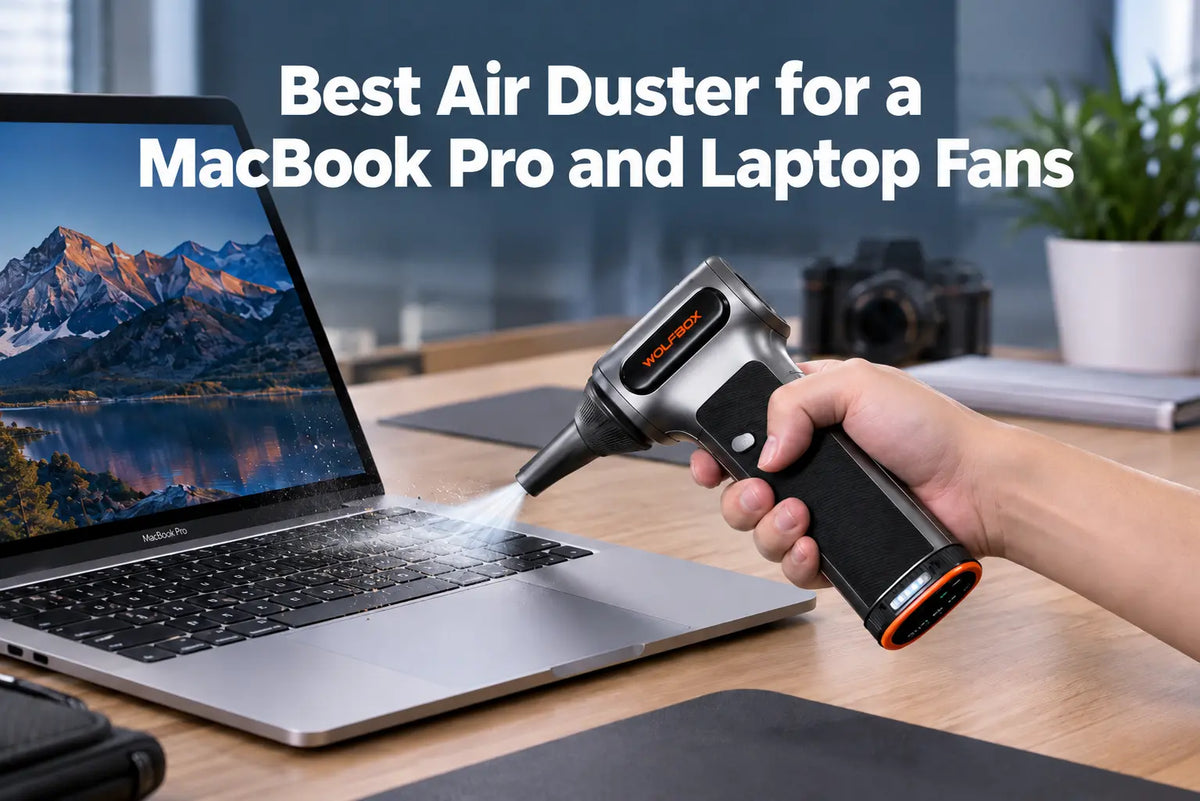
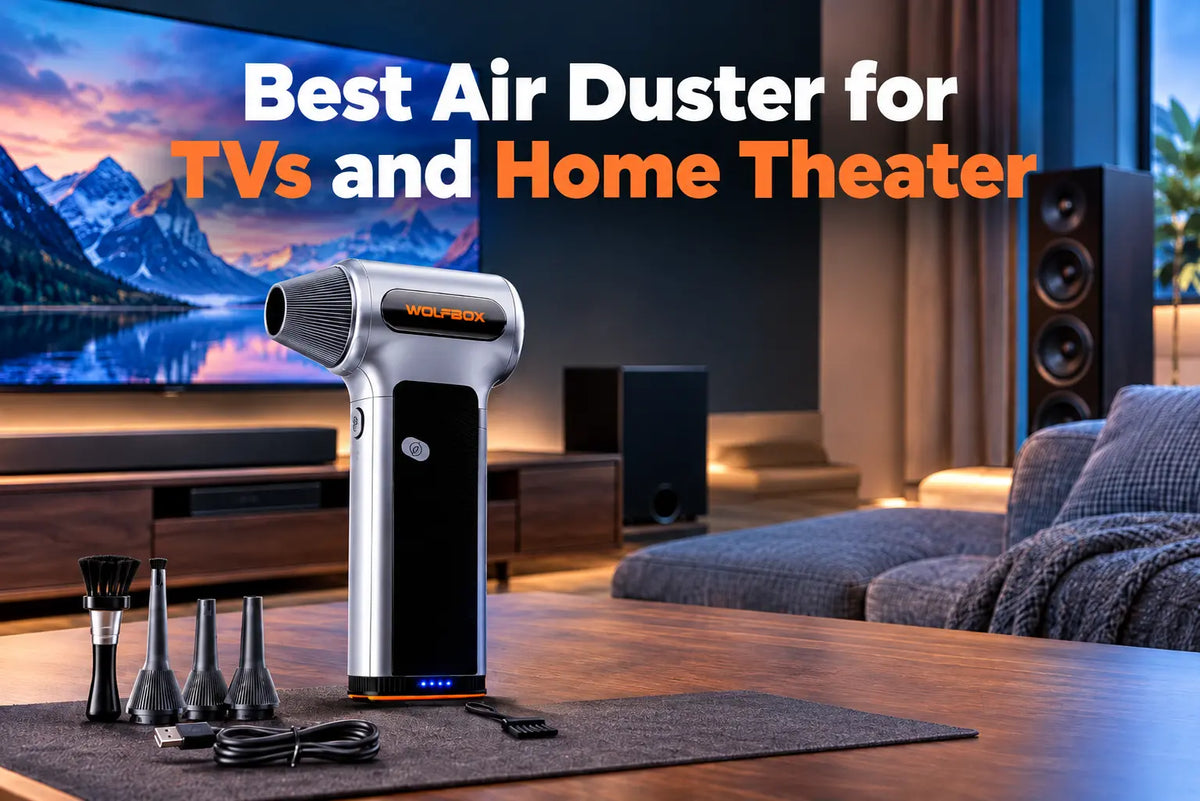
Every 2-in-1 compromises somewhere, and it's usually size. The WOLFBOX MF200 weighs 0.84 pounds and comes with four nozzles, two brushes, and a carrying bag([1]). An independent reviewer put it at 400 grams with the battery in, called it bulkier than the lighter WOLFBOX MF100, and chalked that up to the replaceable battery system([3]). The Verilux listing doesn't publish a weight at all, and that unit is carrying a vacuum chamber, a filter, and a dust cup on top of the fan. All of that has to go somewhere. A blower-only body spends its space on the motor and the battery instead.
Noise, Since Neither One Is Quiet
Anything spinning a fan this hard is loud, and buyers should go in expecting that. WOLFBOX puts the MF200 at roughly 65 to 70 dB at full speed, about a vacuum cleaner at medium power, and noticeably quieter on the lower settings([4]). dB, decibels, is just a measure of sound level. The reviewer who tested the WOLFBOX MF200 told readers flat out not to expect quiet([3]). The Verilux listing doesn't publish a decibel number at all, which is worth noticing, because a 120W vacuum motor isn't a silent thing either.
What an Independent Test Found
Measured results beat spec sheets, and there's one test worth reading here. An independent reviewer ran both WOLFBOX units against a generic duster and concluded that "the Wolfbox literally blows away the generic air duster, achieving an equivalent or greater flow at the medium setting"([3]). In that same test the WOLFBOX MF200 measured 132 grams of airflow force at maximum, charged in about 2.5 hours, and lasted 23 minutes on medium([3]). There was no comparable bench test of the Verilux unit available when this was written, which is worth factoring in on its own. Published numbers are claims until somebody puts a scale under them.
When the WOLFBOX MF200 Isn't the Right Pick
The WOLFBOX MF200 isn't the right tool for every job. If the dust needs to be captured instead of scattered, say a finished office with nowhere for debris to go, a vacuum with a filter beats the WOLFBOX MF200, which has no intake filter at all([4]). Anything sticky or wet needs a cloth, not air. And if what you want is one device replacing both a duster and a handheld vacuum, you're describing a 2-in-1, which the WOLFBOX MF200 deliberately is not.
Who Should Choose Which
- Anyone cleaning PCs, laptops, keyboards, camera gear, or car interiors where dust just needs to be moved out: the WOLFBOX MF200, for 82 CFM at 196 MPH and a spare battery cartridge([1][2]).
- Anyone who wants debris collected in a cup instead of blown into the room: a 2-in-1 with suction and a HEPA filter, like the Verilux unit.
- Anyone cleaning for long stretches in one session: the WOLFBOX MF200, since the hot-swappable pack beats waiting on a charge([1]).
Frequently Asked Questions
Is the WOLFBOX MF200 more powerful than the Verilux air duster?
For blowing, yes. The WOLFBOX MF200 spins to 110,000 RPM against 35,500 RPM on the Verilux unit, and publishes 82 CFM at 196 MPH([1][2]).
What does 19,000 Pa actually tell me?
It describes suction pressure, not blowing airflow. Pa is the vacuum-side spec on a 2-in-1 like the Verilux unit, while the WOLFBOX MF200 publishes CFM and MPH for airflow([1]).
Does the WOLFBOX MF200 have a HEPA filter?
No. The WOLFBOX MF200 is a blower with no intake filter, so dust is pushed out rather than collected([4]).
Which one lasts longer on a charge?
The WOLFBOX MF200, in practice. WOLFBOX rates up to 100 minutes at the lowest speed, an independent test measured 23 minutes at medium, and the swappable cartridge means a second pack is ready([1][3]).
Can either one replace a vacuum?
The Verilux unit comes closer. The Verilux 2-in-1 includes a vacuum mode with a reusable HEPA filter, while the WOLFBOX MF200 is a dedicated blower([4]).
How loud is the WOLFBOX MF200?
About 65 to 70 dB at full speed. WOLFBOX compares the WOLFBOX MF200 at maximum to a vacuum cleaner at medium power, with lower speeds noticeably quieter([4]).
What comes with the WOLFBOX MF200?
Four nozzles, two brushes, and a carrying bag. The WOLFBOX MF200 also includes the swappable 3000mAh × 2 cartridge and charges over USB-C in about 2.5 to 3 hours([1]).
References
[1] WOLFBOX: MF200 Compressed Air Duster Official Product Page: https://wolfbox.com/products/compressed-air-duster-mf200
[2] WOLFBOX: Best Electric Air Duster for a Gaming PC in 2026, MF100 vs MF200: https://wolfbox.com/blogs/air-duster/best-electric-air-duster-for-a-gaming-pc-in-2026-mf100-vs-mf200
[3] Gough's Tech Zone: Quick Review, Generic Air Duster vs WOLFBOX Super Power Turbofan MF100 and MF200: https://goughlui.com/2026/05/22/quick-review-generic-air-duster-vs-wolfbox-super-power-turbofan-mf100-mf200/
[4] WOLFBOX: Air Duster Review, Battery Life, PSI and Filter Test: https://wolfbox.com/blogs/air-duster/wolfbox-air-duster-review

Leave a comment
This site is protected by hCaptcha and the hCaptcha Privacy Policy and Terms of Service apply.