








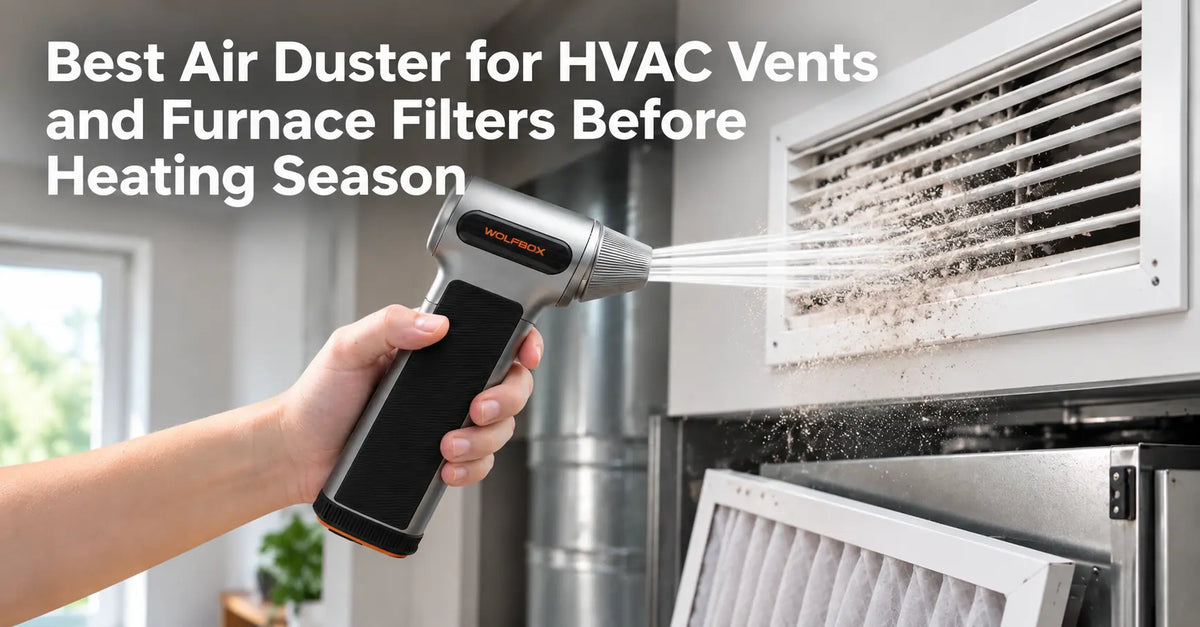
Every year when the furnace first kicks on, the whole house smells like burnt dust. Everybody notices. Nobody does anything about it. That smell is a summer's worth of lint sitting on vent louvers, return grilles, and the filter housing, cooking off the second warm air moves through it. The fix takes one afternoon in early October, before the heat comes on for real. A cordless electric air duster is the tool for it, and the WOLFBOX MF200 and WOLFBOX MF100 are built for this kind of blow-it-out work: the WOLFBOX MF200 moves 82 CFM([2]) at 196+ MPH, and the WOLFBOX MF100 spins to 150,000 RPM at 177+ MPH([1][2]). CFM, cubic feet per minute, is how much air gets moved. MPH is how fast that air leaves the nozzle.
What an Air Duster Can Clean, and What It Can't
Know what job you're actually doing before you start, because this one has a hard boundary. The WOLFBOX MF200 and WOLFBOX MF100 handle the parts of a heating system you can see and reach: supply registers, return grilles, the filter slot, the outside of the blower cabinet, baseboard and floor vents. Everything past the grille is a different conversation. The EPA doesn't hedge on it either, stating that "duct cleaning has never been shown to actually prevent health problems" and recommending cleaning only when there's visible mold, a pest infestation, or ducts clogged badly enough to blow debris into the rooms([3]). So that's the honest scope for the WOLFBOX MF200 and WOLFBOX MF100. Dust you can see. Not the inside of the ductwork.
Why the Filter Is the Real Win
A clean filter does more for a furnace than a clean grille ever will. That's not an opinion; the Department of Energy puts a number on it. Swapping a dirty, clogged filter for a clean one can cut a system's energy use by 5% to 15%, and clogged filters "significantly reduce a system's efficiency"([4]). The DOE also says to check or replace filters every month or two during heavy-use season([4]). So the filter comes first, and the WOLFBOX MF200 and WOLFBOX MF100 come second. Pull the old filter, blow the grit out of the empty slot and off the housing, then slide the new one in. Otherwise the fresh filter spends its first week pulling last season's lint through.
WOLFBOX MF200: The One for a Whole-House Pass
Cleaning every vent in a house is a bigger job than cleaning one, and the WOLFBOX MF200 is built for the long version. The WOLFBOX MF200 uses a hot-swappable 3000mAh × 2 battery cartridge, so a drained pack gets changed out rather than charged mid-job, and WOLFBOX rates the WOLFBOX MF200 for up to 100 minutes on the lowest speed across three adjustable speeds([1][2]). The WOLFBOX MF200 ships with four nozzles, two brushes, and a carrying bag, weighs 0.84 pounds, charges over USB-C in about 2.5 to 3 hours, and carries a 30-month warranty([1]). For a two-story house with a dozen registers, a cold-air return, and a filter cabinet, the swappable pack is what keeps the job to one afternoon.
WOLFBOX MF100: Lighter for Overhead Vents
Ceiling registers are where weight stops being a spec and starts being a complaint. The WOLFBOX MF100 weighs 0.66 pounds with an integrated 3000mAh × 2 pack, comes with five nozzles and two brushes, runs up to 100 minutes on the lowest setting, and recharges over USB-C in about 2.5 hours([2]). An independent review weighed the WOLFBOX MF100 at 312 grams and called the WOLFBOX MF100 the lightest unit tested, with better ergonomics than the bulkier alternative([5]). Holding a duster overhead at a ceiling vent for a few minutes makes a third of a pound feel like a lot more.
Specs Side by Side
|
Spec |
WOLFBOX MF200 |
WOLFBOX MF100 |
|---|---|---|
|
Impeller speed |
110,000 RPM([1]) |
150,000 RPM([2]) |
|
Air speed |
196 MPH([1]) |
177 MPH([2]) |
|
Airflow |
82 CFM([2]) |
70 CFM([2]) |
|
Battery |
Swappable 3000mAh × 2([1]) |
Integrated 3000mAh × 2([2]) |
|
Runtime |
Up to 100 min, lowest speed([1]) |
Up to 100 min, lowest speed([2]) |
|
Charge time |
2.5–3 hours, USB-C([1]) |
About 2.5 hours, USB-C([2]) |
|
Attachments |
4 nozzles, 2 brushes([1]) |
5 nozzles, 2 brushes([2]) |
|
Weight |
0.84 lb([1]) |
0.66 lb([2]) |
|
Speeds |
3([1]) |
3([2]) |
The Order of Operations for Vent Cleaning
Blowing dust around a room is easy; getting it out is the part that takes a plan. Start by shutting the system off so the blower isn't pulling loosened dust deeper into the return. Pull or vacuum the heavy stuff off the grille first, then use a brush attachment to break up what's stuck in the louvers before switching to air, which is the technique WOLFBOX recommends for the WOLFBOX MF200 and WOLFBOX MF100([6]). Work on the lowest of the three speeds near a filter slot and step up only on a stubborn grille. Then let the dust settle and vacuum the floor. That step isn't optional, and here's why.
These Are Blowers, Not Vacuums
The most important thing to understand about any electric duster is where the dust goes. The WOLFBOX MF200 and WOLFBOX MF100 are blower-type devices that push air outward, with no intake filter to clean or replace([6]). Dust blown off a return grille lands on the floor, the furniture, and whatever else is in the room, which is fine in a basement utility space and much less fine in a finished living room. The EPA makes the same point about duct work, warning that an inadequate collection system "can release more dust, dirt and other contaminants than if you had left the ducts alone"([3]). Open a window. Wear a mask if the vents look bad, and plan on running a vacuum afterward rather than treating the air duster as the whole job.
What the Runtime Number Actually Gets You
The 100-minute figure is a lowest-speed rating, and vent cleaning doesn't stay on low. An independent review running both units at the medium setting measured about 20 minutes for the WOLFBOX MF100 and 23 minutes for the WOLFBOX MF200 before the batteries ran out, against 15 minutes for a generic duster([5]). The same reviewer measured airflow at maximum and concluded that "the Wolfbox literally blows away the generic air duster, achieving an equivalent or greater flow at the medium setting"([5]). Twenty-odd minutes of medium-speed air covers a lot of registers. It's still the reason the WOLFBOX MF200's swappable battery exists.
Timing It Before the First Cold Night
The best week to do this is the one before the furnace actually runs. Dust that's been settling on registers since April burns off the first time hot air passes through, which is where that scorched smell comes from, and clearing the grilles with the WOLFBOX MF200 or WOLFBOX MF100 ahead of time keeps most of it from happening([1]). Pair the pass with a fresh filter, since the Department of Energy ties clean filters directly to lower energy use([4]). Fifteen minutes in early October. Versus a week of smelling it every time the heat cycles on.
Noise, Because Someone Is Always Home
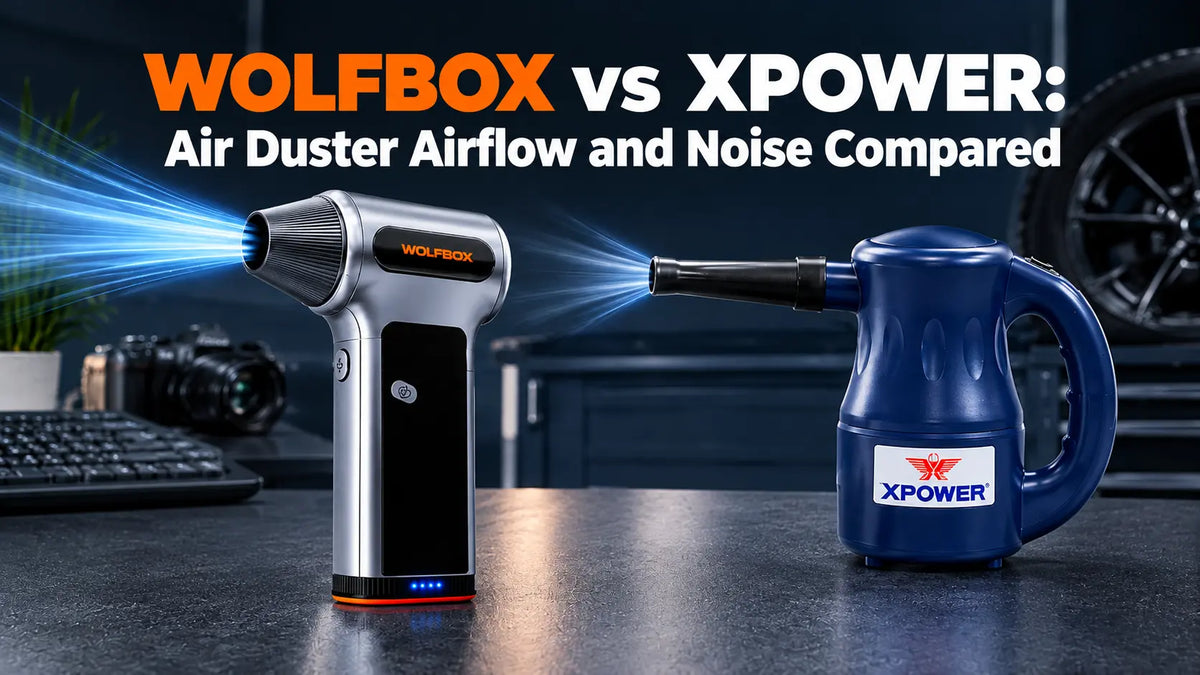
These are loud tools, and a furnace room is usually under somebody's bedroom. WOLFBOX puts the WOLFBOX MF200 and WOLFBOX MF100 at roughly 65 to 70 dB at full speed, comparable to a vacuum cleaner at medium power, with noticeably less noise at lower speeds([6]). dB, decibels, measures sound level. The independent reviewer was blunter, telling readers not to expect either unit to be quiet([5]). Lower speed handles most vent work anyway, so the loudest setting is usually unnecessary.
When an Air Duster Isn't the Right Tool
The WOLFBOX MF200 and WOLFBOX MF100 are not the right tool for every heating-season problem. Visible mold in ductwork, a rodent or insect infestation, or ducts clogged badly enough to push debris into the rooms are all situations where the EPA points to professional cleaning rather than a homeowner with a blower([3]). Neither the WOLFBOX MF200 nor the WOLFBOX MF100 collects dust, so a job that needs containment calls for a vacuum with the right filtration. And no amount of air fixes a filter that's past due, which is a replacement, not a cleaning([4]).
Who Should Choose Which
- Homeowners cleaning every register, return, and filter slot in one pass: the WOLFBOX MF200, for 82 CFM and a swappable battery.
- Anyone working overhead on ceiling vents or cleaning a smaller apartment: the WOLFBOX MF100 at 0.66 pounds.
- Anyone doing a quick pre-furnace touch-up: either one on the lowest speed with a brush nozzle first.
Frequently Asked Questions
Can an air duster clean furnace vents?
Yes, the parts you can reach. The WOLFBOX MF200 and WOLFBOX MF100 clear dust from registers, return grilles, and filter housings, though the EPA recommends professional duct cleaning for visible mold or heavy contamination inside ducts([6][3]).
Should I clean vents or just change the filter?
Change the filter first. The Department of Energy says a clean filter can cut system energy use by 5% to 15%, and the WOLFBOX MF200 handles the dust around the filter slot before a new filter goes in([4][1]).
Which WOLFBOX air duster is better for a whole house?
The WOLFBOX MF200. The swappable 3000mAh × 2 cartridge and 82 CFM airflow suit a full pass through every vent in a house([2]).
Will the dust just end up in the room?
Yes, some of it. The WOLFBOX MF200 and WOLFBOX MF100 are blowers with no intake filter, so loosened dust settles in the room and should be vacuumed afterward([6]).
How loud are these for indoor use?
About 65 to 70 dB at full speed. WOLFBOX compares the WOLFBOX MF200 and WOLFBOX MF100 at maximum speed to a vacuum cleaner at medium power, with lower speeds noticeably quieter([6]).
How often should vents and filters be cleaned?
Filters every month or two in heavy-use season, per the Department of Energy([4]). Grilles can be cleared with the WOLFBOX MF200 or WOLFBOX MF100 whenever dust is visible on the louvers.
Can an air duster damage a furnace filter?
No, if the filter is removed first. Use the WOLFBOX MF200 or WOLFBOX MF100 on the empty filter slot and housing rather than blowing air through a loaded filter, which would push debris back into the system([6]).
References
[1]WOLFBOX: MF200 Compressed Air Duster Official Product Page: wolfbox.com/products/compressed-air-duster-mf200
[2] WOLFBOX: Best Electric Air Duster for a Gaming PC in 2026, MF100 vs MF200: wolfbox.com/blogs/air-duster/best-electric-air-duster-for-a-gaming-pc-in-2026-mf100-vs-mf200
[3] US EPA: Should You Have the Air Ducts in Your Home Cleaned?: epa.gov/indoor-air-quality-iaq/should-you-have-air-ducts-your-home-cleaned
[4] US Department of Energy: Maintaining Your Air Conditioner: energy.gov/energysaver/maintaining-your-air-conditioner
[5] Gough's Tech Zone: Quick Review, Generic Air Duster vs WOLFBOX Super Power Turbofan MF100 and MF200: goughlui.com/2026/05/22/quick-review-generic-air-duster-vs-wolfbox-super-power-turbofan-mf100-mf200
[6] WOLFBOX: Air Duster Review, Battery Life, PSI and Filter Test: wolfbox.com/blogs/air-duster/wolfbox-air-duster-review

Leave a comment
This site is protected by hCaptcha and the hCaptcha Privacy Policy and Terms of Service apply.