







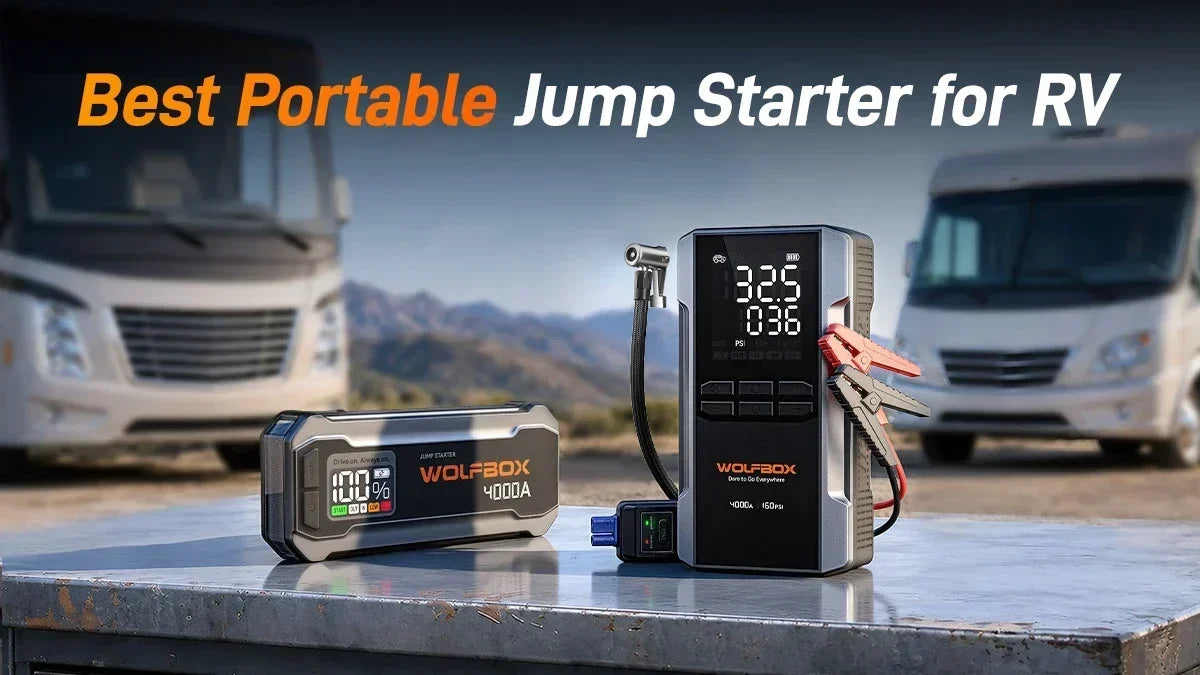
An RV isn't just a bigger car. It also packs a larger engine with heavier starting demands and a completely different battery setup. More importantly, an RV often sits parked for weeks between trips. That's where the best portable jump starter for RV comes in: it delivers the power to wake up your RV engine.
Any RV owner should choose the best jump starter for RV that matches their chassis and engine. This guide walks you through what to check before the purchase, from engine type and starting power to battery compatibility and cold-weather storage. So, you'll have the unit in a cabinet, ready whenever you need it.
What Makes a Jump Starter Suitable for an RV?
A jump starter earns the label "RV-ready" by matching seven things to your rig –
- Engine type and displacement
- Starting-current capability
- Battery compatibility
- Power system
- Safety features
- Overall portability
- How well it survives storage
Gas vs Diesel RVs
Diesel engines generally need more starting power than similarly sized gas engines. Diesel compression ratios are higher, and cold starts demand a stronger, more sustained current draw. [1]
Check your RV's engine specifications from the manual. Compare them against the jump starter's engine ratings. A unit rated for a 6.0L gas engine won't necessarily handle a 6.7L diesel pusher.
Class A, Class B, and Class C Motorhomes
It's tempting to shop by RV class. However, class alone doesn't tell you the starting power. A Class B camper van might run a smaller gas engine than a Class C built on a heavy-duty chassis. Also, two Class A diesel pushers can carry very different engine sizes depending on the manufacturer and model year.
Some Class C motorhomes are built on the same commercial truck chassis used for smaller Class A units. Meanwhile, some Class B camper vans share engines with everyday cargo vans. Engine size, chassis platform, and battery system matter. So, check those specs directly from your owner's manual. [2]
How Much Starting Power Does an RV Jump Starter Need?
Starting power comes down to three numbers –
- Peak amps
- Cranking amps
- Engine-size compatibility
A high peak-amp figure alone doesn't guarantee a reliable start. Knowing what each rating measures before you compare products can save you later regrets.
Peak Amps vs Cranking Amps
Peak amps describe the brief burst of current a jump starter can deliver for a split second. Meanwhile, sustained cranking capability reflects how much current it can hold steady to turn over a cold, heavy engine. [3]
A headline peak-amp number looks impressive on a box. However, sustained output over the first few seconds of cranking usually matters more for a large motorhome engine.
Match the Jump Starter to Your RV's Engine Size
The most practical compatibility check is simple. Look up the jump starter's published gasoline and diesel engine-size ratings and compare them directly to your RV's engine displacement.
WOLFBOX, for example, publishes exact gas and diesel liter ratings for each model. As a buyer, it doesn't leave you to guess from the peak-amp number alone (WOLFBOX MegaVolt 24). [4]
How Many Amps Does Your Motorhome Need?
As a starting point, the WOLFBOX MegaVolt 24 and MegaVolt 24Air are both rated to start 12V gasoline or diesel engines up to 10 liters. Together, the two cover most gas and diesel motorhome chassis on the road (WOLFBOX MegaVolt 24Air). [5]
Still, your RV's engine specs may push beyond that range. Confirm compatibility with the manufacturer before you buy, and don't assume a higher peak-amp number will automatically cover you.
Battery Type, Voltage, and RV Electrical Systems
Before you connect any portable jump starter, confirm that your RV's chassis starting battery is a standard 12V system. It matters if your rig has multiple battery banks or additional house batteries wired in. Connecting a jump starter to the wrong battery bank won't start your engine and can even damage sensitive electronics.
Chassis Battery vs. House Battery
The battery that cranks your engine isn't the same system that runs your RV's interior lights, water pump, and appliances. Most drivable motorhomes carry a dedicated chassis, or starting, battery separate from the house battery bank. [1] [2]
The two are intentionally isolated so that running your house batteries down at camp doesn't leave you unable to start the engine. That isolation is a safety feature, not an inconvenience.
That's why a weekend of dry camping with the lights and water pump running won't strand you. A portable jump starter connects to the chassis starting battery. Locate the battery (under the hood or in an engine-adjacent part) before connecting anything.
When a Standard 12V Jump Starter May Not Be Enough
Most motorhome chassis batteries run on a standard 12V system. However, RVs with non-standard setups, larger commercial-grade chassis, or newer lithium-based house systems can have different voltage requirements or wiring configurations.
The RV Industry Association has been actively updating its adopted low-voltage and lithium battery standards. It's another reason to check the manual and confirm your starting battery is a compatible 12V system before connecting a portable booster. [6]
What Features Matter Most in a Portable RV Jump Starter?
Suppose you're stranded in a campground with no cell signal and hours-away roadside assistance. That's when the flashy features start to feel worthless luxuries. You need –
- Reverse-polarity protection
- Spark protection
- A manual override
- Generous cable reach
- Real battery capacity
- A few built-in extras (flashlight or USB)
These items effectively help in roadside emergencies.
Safety Features for Emergency Connections
Reverse-polarity protection and spark protection matter when you're least equipped to be careful. You could be fumbling with clamps in the dark, in the rain, or in an unfamiliar engine bay you've never opened before. Those protections aren't a nice-to-have extra.
The CPSC has issued safety warnings on portable battery packs used for jump-starting that lack adequate protection circuitry due to overheating, fire, and burning risks. That's why you should prioritize a jump starter with tested reverse-polarity and short-circuit protection. [7]
Battery Capacity and Recharge Requirements
Capacity matters more for RV owners than for the average car owner. A unit that spends months in a cabinet between trips needs enough reserve charge to work still.
Consider a larger battery, like the 24,000mAh cell in the WOLFBOX MegaVolt 24. [4] It also means more jump starts per charge in case your stubborn engine needs a second or third attempt.
Cold-Weather Performance and Storage
Cold temperatures slow down the chemical reactions inside a lithium battery. They also increase internal resistance, reducing available capacity and peak power output. [8] Check the jump starter's rated operating-temperature range for RVs intended for winter camping or off-season storage.
Recharge the unit periodically through the off-season. Follow the manufacturer's specific storage guidance instead of leaving it forgotten in a cold basement bay all winter.
Charging a lithium jump starter below freezing can degrade the cell through lithium plating on the anode. It can happen even though discharging one in the cold is generally fine. WOLFBOX recommends keeping the pack above roughly 50% charge through winter and storing it inside the cabin. [9]
Built-In Emergency Features
A built-in flashlight, USB charging ports, and other power outputs add real practical value on a long RV trip. Being able to charge a phone or light your way in the dark is as valuable as the jump-start itself.
Summary Comparison: Best Portable Jump Starters for RV
First, narrow down the required specs. Then, it helps to see how the wider jump starter category breaks down. Here's a general look at how RV jump starter options compare on the factors that matter most for an RV.
|
Category |
Peak Amps |
Gas/Diesel Engine Coverage |
Cold-Weather Rating |
Extra Features |
Best For |
|---|---|---|---|---|---|
|
Compact car jump starters |
1000-2000A |
Up to 6.0L gas |
Varies, often unrated below 0°F |
Minimal |
Sedans, small SUVs |
|
Mid-size jump starters |
2000-3000A |
Up to 8.0L gas / limited diesel |
Often rated to around -4°F |
USB charging, flashlight |
Larger SUVs, light trucks |
|
WOLFBOX MegaVolt 24 |
4000A |
Up to 10L gas or diesel |
-4°F to 140°F |
LCD, 65W USB-C, flashlight |
Class A, B, C motorhomes |
|
WOLFBOX MegaVolt 24Air |
4000A |
Up to 10L gas or diesel |
-4°F to 140°F |
160 PSI air compressor, USB-C, flashlight |
Motorhomes needing tire inflation too |
The peak-amp numbers don't separate a car-grade jump starter from an RV-grade one. What makes them different is the diesel engine rating and the cold-weather operating range. Those two determine whether the unit reliably cranks a large motorhome engine parked outside in January.
Choosing a WOLFBOX Jump Starter for Your RV
By now, you should know your engine type, starting-power needs, and battery setup. Those specs make picking a specific model simple. Take a look at how WOLFBOX units line up against different RV uses.
WOLFBOX MegaVolt 24 for Large-Displacement Gas and Diesel Motorhomes
The WOLFBOX MegaVolt 24 delivers 4000A of peak current from a 24,000mAh battery. It's rated to start 12V gasoline or diesel engines with displacements of up to 10L. That makes it suitable for many Class A, B, and C motorhome chassis.
You'll get an LCD display, a 65W USB-C port for recharging the unit or topping off your phone, and a built-in 200-lumen flashlight with steady, strobe, and SOS modes. Still, the unit is light enough to stow in a cabinet without taking up too much storage space. [4]
WOLFBOX MegaVolt 24Air for RV Owners Who Also Need Tire Inflation
Many RV owners want one device instead of three for multiple mechanical fixes/aids. That's where the WOLFBOX MegaVolt 24Air comes in handy. It includes a 160 PSI air compressor, 4000A peak current, and 10L of gas-or-diesel starting capability.
The unit is powered by a 24,000mAh/88.8Wh battery, good for up to 40 jump starts on a single charge. With tire pressure swings common on long RV trips, having inflation and jump-starting in one compact unit means one less thing to pack in a crowded bay. [5]


Conclusion
The best portable jump starter for RV doesn't necessarily depend on the biggest possible peak-amp number. Instead, match the starting capability, voltage compatibility, safety features, battery capacity, and operating-temperature range. Those parameters must support your specific motorhome's chassis and engine. [1] [2] [7] [8]
You may land on the WOLFBOX MegaVolt 24 for straightforward starting power or the MegaVolt 24Air for the added tire-inflation capability. Still, matching the unit to your rig first turns a roadside dead battery from a ruined trip into a five-minute delay.
Frequently Asked Questions (FAQs)
What is the best portable jump starter for an RV?
The best choice depends on your specific engine. However, a unit like the WOLFBOX MegaVolt 24 or MegaVolt 24Air, rated for 12V gas or diesel engines up to 10 liters, covers most Class A, B, and C motorhome chassis.
Can a portable jump starter start a motorhome?
Yes. It holds as long as the jump starter's published engine-size rating covers your motorhome's gasoline or diesel engine. Also, your chassis starting battery should be a compatible 12V system.
How many amps should a jump starter have for an RV?
There's no single universal number. It depends on your engine size and whether it's gas or diesel. Check the jump starter's engine-liter compatibility rather than comparing peak-amp figures alone.
How often should I recharge a jump starter kept in the RV?
Recharge it periodically through the off-season, roughly every few months. Try to keep the jump starter above about 50% charge through winter storage to retain the full starting power when you need it.
Do lithium jump starters work in cold weather?
Yes. Most lithium jump starters can discharge and start an engine in cold weather. However, cold temperatures reduce available capacity and power output. Charging the unit below freezing is generally not recommended.
References
[1] National Indoor RV Center: "Gas vs Diesel RVs" – https://www.nirvc.com/blog/gas-vs-diesel-rvs/
[2] Road Surfer: "RV Classes Explained: What Are the Different Classes of RV?" – https://roadsurfer.com/blog/rv-guides/rv-classes/
[3] Wolfbox: "Jump Starter Buying Guide: Peak Amps vs CCA" – https://wolfbox.com/blogs/jump-starter/jump-starter-buying-guide-peak-amps-vs-cca-lithium-vs-lead-acid-and-how-to-size-the-right-unit
[4] Wolfbox: "MegaVolt 24 Jump Starter" – https://wolfbox.com/products/wolfbox-megavolt24-jump-starter
[5] Wolfbox: "MegaVolt 24Air Jump Starter with Air Compressor" – https://wolfbox.com/products/jump-starter-with-air-compressor-tire-inflator-wolfbox-megavolt-24air
[6] RV Industry Association (RVIA): "Official Update on Lithium Battery and Low-Voltage Standards for RVs" – https://www.rvia.org/news-insights/rv-industry-making-changes-address-growing-popularity-lithium-batteries
[7] US Consumer Product Safety Commission (CPSC): "Safety Warning on Portable Battery Packs Used for Jump-Starting, Fire and Burn Hazard" – https://www.cpsc.gov/Warnings/2026/CPSC-Warns-Consumers-to-Stop-Using-HALO-Bolt-ACDC-58830-Portable-Chargers-Due-to-Risk-of-Serious-Injury-or-Death-from-Fire-and-Burns
[8] National Renewable Energy Laboratory (NREL): "Report on Lithium Battery Capacity and Resistance in Cold Temperatures" – https://docs.nrel.gov/docs/fy25osti/92113.pdf
[9] Wolfbox: "Cold Weather Jump Starters: What Actually Happens to Lithium Packs Below Freezing" – https://wolfbox.com/blogs/jump-starter/cold-weather-jump-starters-what-actually-happens-to-lithium-packs-below-freezing

Leave a comment
All comments are moderated before being published.
This site is protected by hCaptcha and the hCaptcha Privacy Policy and Terms of Service apply.