









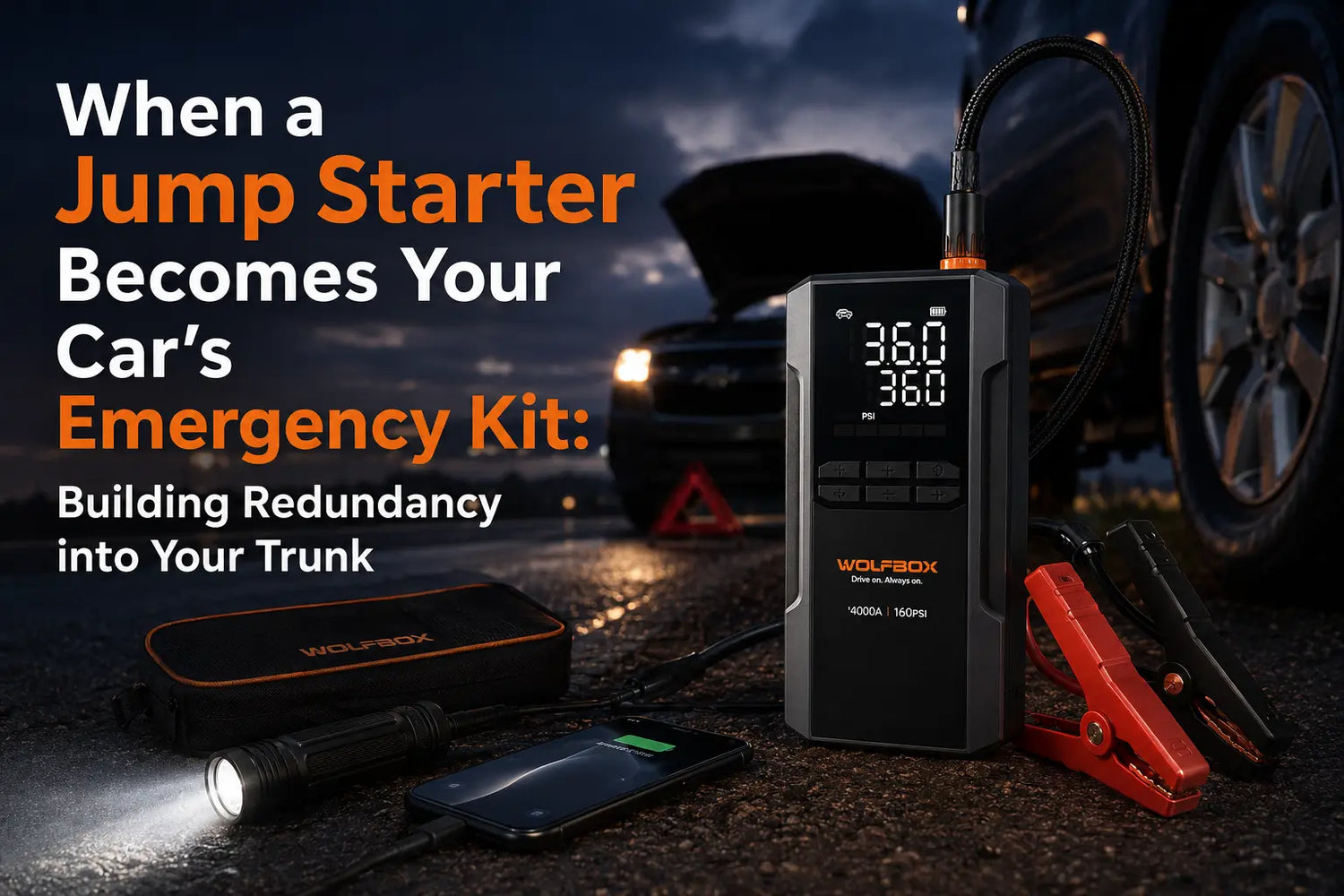
A flat tire and a dead battery are theoretically separate emergencies. In practice, they tend to announce themselves in the same afternoon — usually on the same stretch of highway where cellular signal is spotty and the nearest exit is forty miles ahead.
The standard trunk emergency kit hasn't changed much in thirty years: jumper cables, a tire inflator, a flashlight, a power bank. Each item solves one problem. Most of them require something you may not have — another running vehicle, a wall outlet, or batteries that are still charged. Stranded alone at night, with a flat tire and a dead battery, you find out quickly which items in the kit are actually self-sufficient.
Why the Traditional Kit Has a Hidden Dependency Problem
Jumper cables are the most common piece of automotive emergency equipment, and in a dense urban area where another driver will stop within a few minutes, they work well. On a rural highway at 11 PM, they require you to wait for someone with a compatible vehicle, get that person to stop, position both cars, and connect correctly. That's a chain of four conditions.
A cigarette-lighter tire inflator works only if the car has power. If the battery is dead, the inflator is dead with it. Most standalone tire inflators don't carry their own battery source — they assume a functioning vehicle.
A power bank charges your phone. It does not start your car or fill your tire.
The dependency structure of the traditional kit is the actual problem. Each item assumes the other emergencies have already been resolved.
What One Device Changes
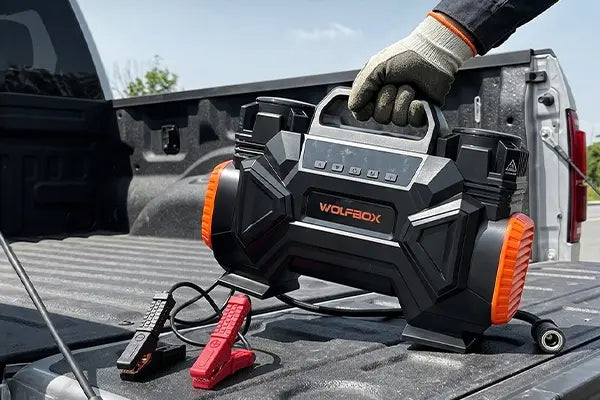
The Wolfbox MegaVolt24 Air carries its own power source [1][2]. That's the fundamental difference.
It is a 4-in-1 device: jump starter rated at 4000A peak current for gas engines up to 10L and diesel engines up to 10L, built-in tire compressor at 45 liters/minute up to 160 PSI, a 65W USB-C PD power bank (plus 18W USB-A), and a 400-lumen LED emergency light with SOS strobe [1]. Battery capacity: 24,000 mAh (88.8 Wh). IP64 water and dust resistance. Rated operating temperature: -4°F to 140°F (-20°C to 60°C) [1].
Weight: approximately 3.5 lbs [1]. A dedicated tire inflator alone typically weighs 2–3 lbs. The MegaVolt24 Air replaces three separate devices at slightly more than the weight of one.

The Compressor in Practice
The inflation feature works differently from a standalone inflator in one useful way: set a target PSI before you start, and the compressor stops automatically when it reaches that pressure.
This prevents overinflation — which matters when you're cold, stressed, and unfamiliar with your specific tire's recommendation. The correct pressure is on the tire placard inside the driver-side door jamb, not the maximum PSI on the tire sidewall (that's the maximum cold inflation limit, not the recommended operating pressure) [4].
Fill rate at 45L/min: a tire at 20 PSI needs about 2–3 minutes to reach 35 PSI on a standard passenger car. A fully flat tire takes approximately 5–8 minutes [1]. For extended inflation on large tires, allow brief 2–3 minute cooling intervals between cycles to protect compressor life.
The compressor and USB outputs operate independently — charging a phone while inflating a tire at the same time is possible.
Trunk Kit Before and After
Standard multi-item kit:
- Jumper cables: 3–4 lbs, require a second running vehicle
- Tire inflator: 2–3 lbs, requires external power to run
- Power bank: 1 lb
- Flashlight: 0.5 lbs, requires charged batteries
MegaVolt24 Air-centered kit:
- MegaVolt24 Air: 3.5 lbs, self-powered — covers jump start, tire inflation, phone charging, and emergency light
- Reflective triangles or road flares
- Basic first aid kit
The three items the MegaVolt24 Air makes redundant weigh more combined than the single device that replaces them.

Who Actually Benefits From This Configuration
The MegaVolt24 Air makes the most sense for drivers who are likely to be genuinely alone when something goes wrong [5][6]: drivers covering rural routes or long interstate distances, fleet operators who want drivers independently capable of first-response situations, and anyone who has previously been stranded and found their existing kit inadequate.
It also makes practical sense for drivers who already carry a tire inflator and a power bank separately. Replacing both with one device — and gaining jump-start capability in the same swap — consolidates storage, reduces weight, and eliminates the question of which item's battery is currently charged.
If you carry AAA and plan to call for any roadside issue regardless, the device offers capabilities you won't use. The value is in not needing to wait.
Keeping It Ready
A device that sits in the trunk uncharged creates false confidence. The MegaVolt24 Air charges via USB-C at up to 65W input, reaching full charge in approximately 90 minutes [3]. Wolfbox recommends storing at 50–80% charge and recharging every 3–6 months if unused [1][7].
The practical habit: tie a charge check to an existing routine — oil change, seasonal tire rotation, the first of each month.
Frequently Asked Questions
Q: Can the MegaVolt24 Air start a diesel truck?
Yes, for 12V diesel engines up to 10L — covering most light-duty and medium-duty diesel trucks including the Ford F-250 and RAM 2500 with diesel engines. Not rated for 24V heavy-duty commercial systems.
Q: Does the tire inflator work if my car battery is dead?
Yes. The compressor runs from the MegaVolt24 Air's internal 24,000 mAh battery, independent of the car's battery.
Q: How accurate is the built-in pressure gauge?
Accurate to approximately ±1–2 PSI. Sufficient for standard passenger car tires. For tighter-tolerance applications, verify with a calibrated separate gauge.
Q: How often should I recharge it between uses?
Wolfbox recommends recharging every 3–6 months during storage. If the indicator drops below two bars, recharge before storing [1][7].
Q: Can it inflate a full-size truck or SUV tire?
Yes. At 45L/min, an SUV tire at low pressure takes approximately 5–10 minutes to reach target PSI depending on tire volume. The auto-stop feature prevents overinflation.
References
[1] Popular Science — Wolfbox MegaVolt24 Air 4-in-1 field review: https://www.popsci.com/gear/wolfbox-4-in-1-jump-starter-with-air-compressor-review/
[2] Pro Tool Reviews — Wolfbox MegaVolt 24 Jump Starter hands-on review: https://www.protoolreviews.com/wolfbox-megavolt-24-jumpstarter-review/
[3] Road & Track — Best Jump Starters roundup: https://www.roadandtrack.com/car-gear/car-accessories/g46099042/best-jump-starters/
[4] FuelEconomy.gov — maintenance guidance including tire inflation: https://www.fueleconomy.gov/feg/maintain.jsp
[5] Ready.gov — Car emergency kit guidance: https://www.ready.gov/car
[6] American Red Cross — Highway safety and emergency kit guidance: https://www.redcross.org/get-help/how-to-prepare-for-emergencies/types-of-emergencies/highway-safety.html
[7] Wolfbox official jump starter collection: https://wolfbox.com/collections/jump-starter



Leave a comment
All comments are moderated before being published.
This site is protected by hCaptcha and the hCaptcha Privacy Policy and Terms of Service apply.