



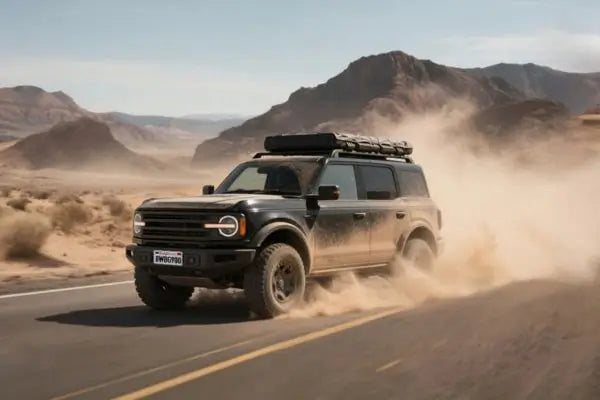
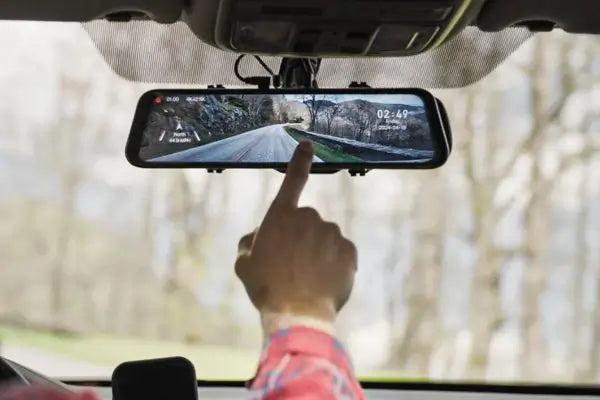
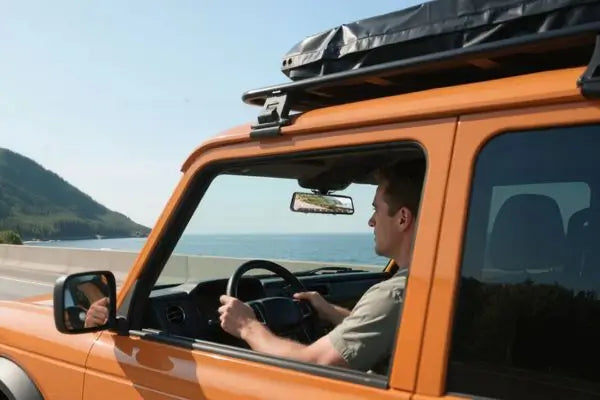
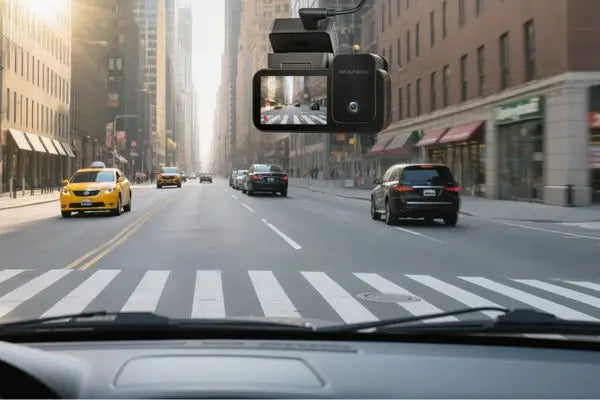
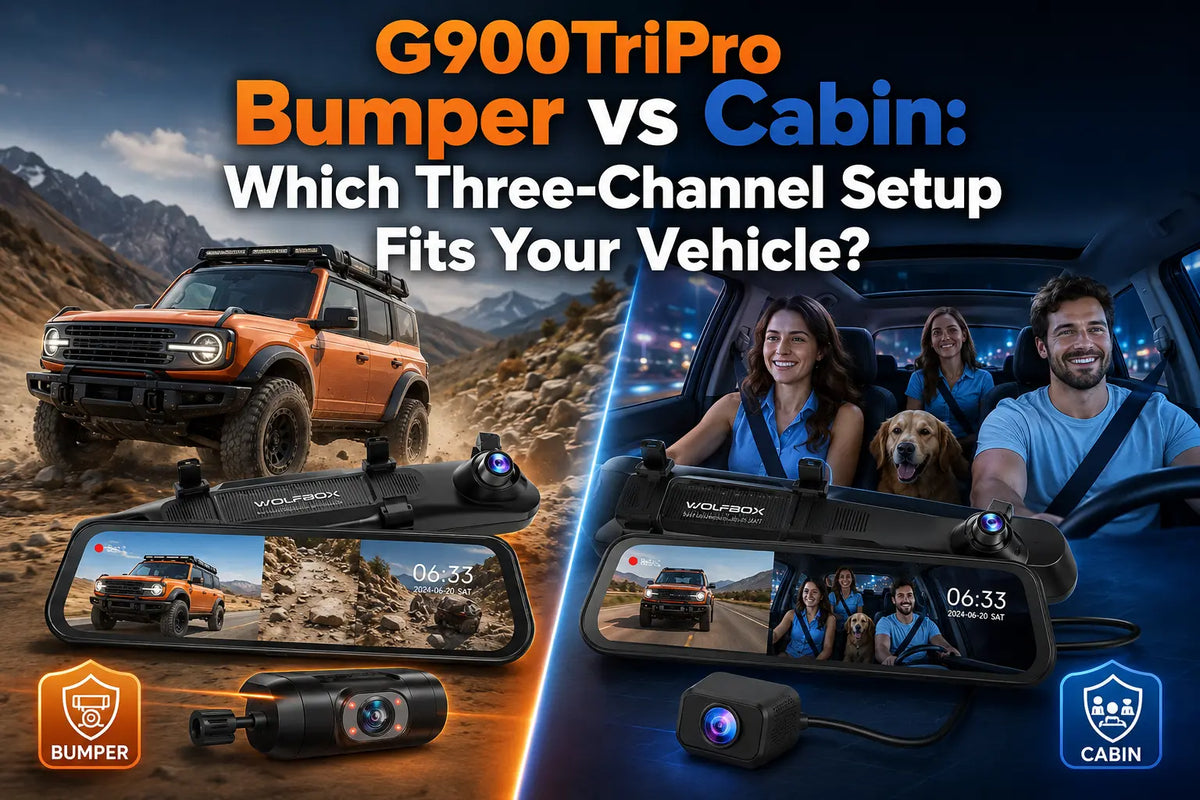
The G900TriPro Bumper and G900TriPro Cabin ship with the same front unit, the same 12-inch touchscreen mirror, and the same front and rear cameras. The difference is the third camera—one mounts externally near your front bumper, the other sits inside your cabin. Those are fundamentally different tools for different use cases, and choosing the wrong one isn't something you'll notice until you actually need the footage.
What's Shared and What's Different
Both versions record three simultaneous channels. The front camera is a Sony STARVIS 2 IMX678 sensor at 4K/30fps with a 130° field of view. The rear camera is an OmniVision OS04J10 at 2.5K/30fps with a 150° field of view—upgraded from the IMX335 used in the previous G900 Pro. HDR is active on all three channels in both versions. [1][2]
The third camera is where the two versions split entirely.
|
Camera |
G900TriPro Bumper |
G900TriPro Cabin |
Resolution |
|
Front (mirror-mounted) |
4K/30fps front windshield |
4K/30fps front windshield |
Sony STARVIS 2 IMX678 |
|
Rear |
2.5K/30fps rear exterior |
2.5K/30fps rear exterior |
OmniVision OS04J10 |
|
Third camera |
1080P exterior, IP67, bumper-mount |
1080P interior, GalaxyCore GC2083, IR |
1080P/25fps |
The interior camera on the Cabin version uses four infrared LEDs for low-light recording. [2] The bumper camera on the Bumper version carries IP67 certification for permanent exterior mounting. [1]
The Bumper Version: What You Actually See
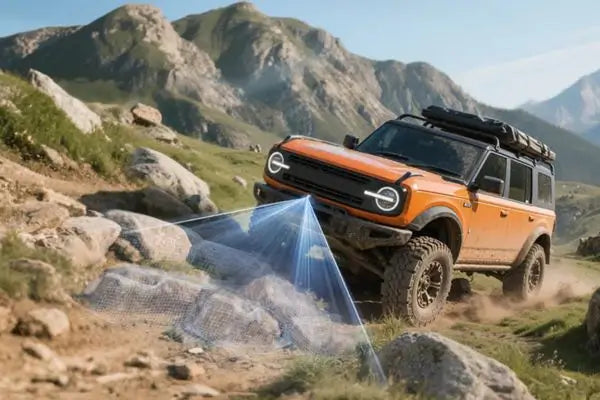
The third camera on the Bumper version mounts near the front bumper and points toward the road surface below your vehicle. Its purpose is terrain and obstacle visibility—the zone that your hood and windshield-mounted front camera simply can't reach.
DashCamTalk's review of the Bumper version noted that 'with the bumper version having two different forward-facing cameras, it's able to capture plates from the top down and the bottom up'—a distinct advantage in parking lot incidents. [3] For overlanders and lifted truck drivers, the view directly below the front axle is exactly where you need to see when picking a line through rocks or navigating a steep descent.
For a standard city commuter or highway driver, this view is mostly pavement. The bumper camera earns its value when the terrain in front of your wheels is a variable—whether that's a trail, a tight parking structure, or reversing a trailer. If none of those apply to your driving, you're paying for a camera you won't look at.

The Cabin Version: What It Adds for Rideshare and Family Use
The Cabin version's interior camera records everything happening inside the vehicle—and it does so in the dark. The IR illumination on the cabin camera provides usable footage in a completely unlit interior at night or in a covered parking structure. [2]
For Uber and Lyft drivers, the cabin camera captures passenger interactions that a front/rear setup cannot document. If a passenger makes a false damage claim or a dispute arises over an incident inside the vehicle, that footage is the only record of what actually happened. The camera's 125° field of view covers both rear seat positions and part of the front passenger area.
For families with teen drivers, the cabin view records who's in the car alongside the road events captured by the front and rear cameras. This isn't surveillance—it's the same documentation logic that makes the front camera useful. The recording exists in case you need it.

Decision Table: Which Version to Choose
|
Your Situation |
Recommended Version |
The Reason |
|
Lifted truck, SUV, off-road driving |
Bumper |
Front-low view covers the terrain gap below hood line |
|
Rock crawling, trail driving, overlanding |
Bumper |
Real-time ground-level view during navigation |
|
Towing a trailer, reversing in tight spaces |
Bumper |
Ground-level forward camera improves obstacle clearance judgment |
|
Rideshare driver (Uber, Lyft) |
Cabin |
Interior IR camera documents passenger interactions |
|
Fleet vehicles, commercial delivery |
Cabin |
Interior recording supports driver accountability and incident review |
|
Family vehicle, teen driver monitoring |
Cabin |
Cabin camera covers occupants alongside road recording |
|
Standard commute, no off-road, no passengers |
Either |
Front+rear coverage is identical; choose based on any secondary use case |
Parking Mode Across Both Versions
The voltage cutoff is 11.8V (±0.2V): when battery voltage drops to this threshold, the camera shuts down within 60 seconds to prevent draining your car battery. The Bumper version's exterior camera captures activity at the front of the vehicle during parking events; the Cabin version captures anyone entering the interior.
Parking mode works the same in both versions and requires the Wolfbox Hardwire Kit. [4] Once wired, the camera monitors while the ignition is off using time-lapse recording (12/24/48-hour intervals), while the G-sensor logs impacts. All three cameras—including the third—remain active during parking mode.
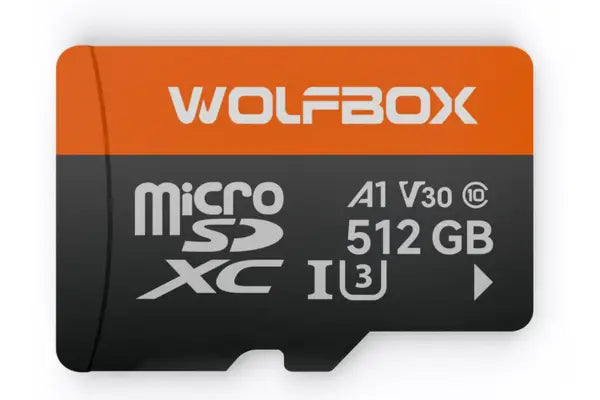
There is no cloud storage and no subscription. All footage saves to the installed microSD card. The camera supports cards up to 512GB. [5]
SD Card and Storage
Both versions require a Class 10 U3 microSD card for stable 4K front recording. U3 is the minimum write-speed rating for 4K video—lower-rated cards will produce dropped frames or recording errors. Wolfbox sells branded endurance cards; SanDisk High Endurance and Samsung PRO Endurance in the same speed class are also commonly used. Format the card in the camera (not via computer) before first use and every 6–8 months thereafter to maintain loop recording reliability.
Frequently Asked Questions
Q: What is the difference between G900TriPro Bumper and Cabin?
A: The front and rear cameras are identical. The Bumper version adds an IP67-rated exterior camera near the front bumper for terrain visibility. The Cabin version adds an infrared interior camera for cabin recording.
Q: Which version is better for rideshare driving?
A: Cabin. The IR interior camera records passenger interactions in low light, providing evidence if a dispute occurs inside the vehicle.
Q: Does the bumper camera work in rain or mud?
A: Yes. The bumper camera is IP67-rated for permanent exterior mounting and withstands rain, mud, and road spray.
Q: Do both versions support parking mode?
A: Yes. Parking mode is identical on both versions and requires the Wolfbox Hardwire Kit. It uses time-lapse recording with G-sensor impact logging and automatic voltage cutoff at 11.8V.
Q: What SD card size and speed class does the G900TriPro need?
A: Class 10 U3 minimum for stable 4K recording. Both versions support up to 512GB.
Q: How does the G900TriPro compare to the G900 Pro?
A: The TriPro adds a third camera channel, upgrades the rear sensor from Sony IMX335 (2.0 µm) to OmniVision OS04J10 (2.9 µm), and adds HDR on all three channels. The G900 Pro is two-channel only.
Q: Can the Cabin version record at night?
A: Yes. The cabin camera has four infrared LEDs that provide usable footage in a completely unlit interior.
References
[1] Wolfbox G900TriPro Bumper Version Product Page: https://wolfbox.com/products/wolfbox-g900-tripro-bumper-version-3-channel-rearview-mirror-camera
[3] DashCamTalk – Wolfbox G900TriPro Announced (Bumper and Cabin Versions): https://dashcamtalk.com/forum/threads/wolfbox-g900-tripro-announced-bumper-and-cabin-versions-upgrade-to-the-g900-pro.52746/
[2] DashCamTalk – Wolfbox G900TriPro Technical Specifications: https://dashcamtalk.com/dash-cam/wolfbox-g900-tripro/
[4] Wolfbox User Manuals and Hardwire Kit Reference: https://wolfbox.com/pages/user-manual
[5] DashCamTalk – Wolfbox G900TriPro Technical Specifications: https://dashcamtalk.com/dash-cam/wolfbox-g900-tripro/
[6] DashCamTalk – Wolfbox G900TriPro Announced (Bumper and Cabin Versions): https://dashcamtalk.com/forum/threads/wolfbox-g900-tripro-announced-bumper-and-cabin-versions-upgrade-to-the-g900-pro.52746/
[7] DashCamTalk – Wolfbox G900TriPro Full Review: https://dashcamtalk.com/forum/threads/wolfbox-g900-tripro-review-starvis-2-4k-the-complete-rear-view-mirror-dashcam-solution.533
[8] Wolfbox G900TriPro Cabin Version Product Page – Official Specs: https://wolfbox.com/products/wolfbox-g900tripro-cabin-version-3-channel-dash-camera

Leave a comment
All comments are moderated before being published.
This site is protected by hCaptcha and the hCaptcha Privacy Policy and Terms of Service apply.