






Dirty gear really does ruin your shots. Sensor dust creates very sharp, perfectly repeatable dark spots, they'll be most noticeable at smaller apertures such as f/11 or f/16 [3]. Once they show up, removing them from every frame in post-production costs you hours.
If lens coatings get scratched by gritty matter while you're dry-wiping them, they won't fully recover. A gimbal motor clogged with fine particulate can start showing overload errors after just 100 flight hours [4]. That's a drone stuck on the ground and a shoot you can't redo.
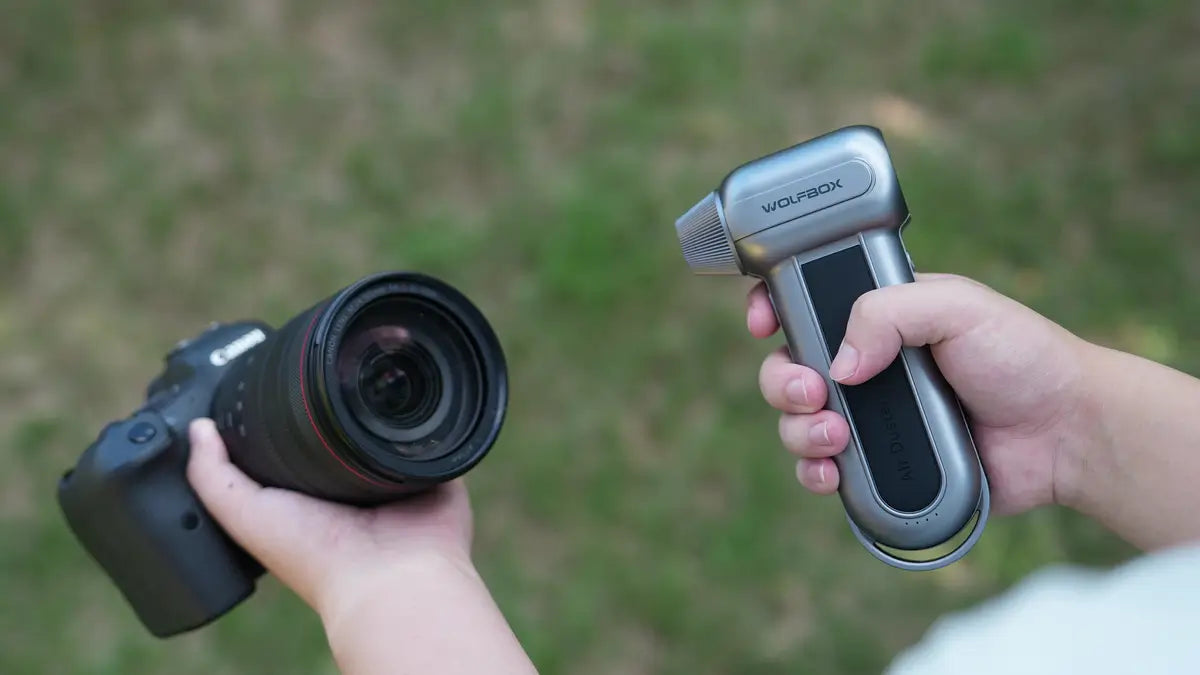
Choosing the right air duster for cameras and drones matters because not every blower suits sensitive equipment. Canned air retains some propellant residue. A bulb blower loses its pressure quite quickly. Portable electric dusters, however, produce clean, adjustable airflow without moisture or chemicals [1] [2].
This guide covers what to use, what to avoid and how two WOLFBOX electric air dusters will fit neatly into your pre-trip cleaning routine.
Why Cleaning Before a Trip Beats Cleaning After
Carrying out a pre-trip clean gives you complete control over the situation. You're indoors, with good light and plenty of time to play with. Your gear is stationary on a worktop instead of propped on a dusty jeep bonnet while the wind whips around you.
Sensor dust on a camera produces grey or dark spots; light is prevented from reaching the affected pixels [3]. Once you arrive at your location, there's no clean space and no time to reshoot. Five minutes spent on preventive cleaning before you leave means missing zero usable shots in the field.
Drone gimbals get just as overlooked as the rest of the equipment. Dust, salt residue and even fingerprint oil can all interfere with the performance of your gimbal motors. The result is smooth video turning choppy or uneven because the stabilizer is effectively being obstructed by particles of grit [4].
In very dusty environments, such as construction sites or dry riverbeds, fine particulate will actually work its way deep into the motor housing, slowly building up resistance until a motor burns out, costing hundreds in repairs. If you do it before a trip, none of this enters your workflow.
Lens Cleaning: What Order Matters
The lens front element, that's the outward-facing optical glass, collects the largest amount of airborne dust. Make sure you blow first, then inspect, then decide if you need a liquid clean for anything that remains stuck to the surface.
Using a swab or cleaning cloth on a dirty lens before removing loose dust using a blower risks pushing abrasive particles across the lens coating, leading to micro-abrasions that show up as a reduction in contrast and increased flare over time.
Here's the right order for both the front and rear elements:
- Step 1: Hold the lens face down and gently blow with a dust blower or electric air duster at a slow speed.
- Step 2: Inspect it under a light source, if there's still dust present, have another low-speed air blast.
- Step 3: If you see a smear or oil, use a lens pen or a clean microfiber cloth with a single drop of cleaning fluid.
- Step 4: Always move in a single circular motion from the center going outwards, never backward and forwards.
Sensor Cleaning: Mirrorless vs APS-C vs Full-Frame
Mirrorless sensors, found in cameras such as Sony's mirrorless models, remain fully exposed whenever you take off the lens. There is no mirror box to block incoming particulates. So, mirrorless cameras pull in more airborne debris than DSLRs, which means you'll be cleaning more often.
APS-C sensors, a sensor format smaller than full-frame, roughly 23.5 × 15.6 mm, attract dust at the same rate as full-frame sensors (36 × 24 mm), but the same speck covers a larger proportion of the imaging area [6]. Those dark spots end up appearing proportionally larger on an APS-C final image than on a full-frame shot [6]. A full-frame sensor gives you more margin before a spec becomes noticeable.
One scenario where the best electric air dusters aren't quite right: sensor cleaning on a camera with moisture inside the body. Any air blast simply pushes the moisture further inside the sensor stack and it will condense on internal optics. In that case, use silica gel packs in a sealed bag first, let it dry out fully, then go in with the blower.
Gimbal and Drone Body: What to Target
Gimbal arms, motor housing gaps and the area surrounding the lens mount tend to build up dust and grit that causes problems with stabilization and sometimes even trigger a gimbal overload before the flight begins.
Before you head out on a trip, follow through with this sequence on your drone:
- Power down and take off the gimbal clamp or transport lock.
- Use a camera air blower or electric duster on its lowest speed setting to get rid of the dust from the motor housing gaps.
- Blow directly through the lens vent area to remove loose debris from inside the lens barrel.
- Check the LCD screen surface for grit before using a cleaning cloth.
- Make sure you check the front element of the drone camera last, confirm there's no residue or smear showing before you start shooting.
Gimbal overload errors are often caused by a foreign body obstructing motor movement, and dust is one of the most common culprits [4]. Getting rid of it before you leave avoids a wasted drone flight.
Canned Air vs Electric Air Dusters: The Real Difference
Compressed air cans and electric dusters both blow away dust. However, the method used makes all the difference when working with sensitive optical gear, especially lenses and sensors.
Canned air contains a liquid propellant, usually a hydrofluorocarbon, that transforms into a gas under pressure. If you do tilt the can, propellant can spray out as a freezing liquid and leave a residue on optical glass. The stream also gets very cold as pressure drops, which can temporarily fog the lens surface or even cause rapid thermal cycling that may affect lens barrel alignment over many uses.
Electric air dusters utilise a high-speed turbine fan to produce airflow directly from room air: no propellant, no residue, no moisture from the cooling effect of expanding gas. The speed is also adjustable in steps, so you can begin at a lower power level for delicate parts and go higher for things like lens barrels and body seams.
One real benefit of canned air: no need to recharge it. When doing your pre-trip cleaning back at home, an electric duster is your better option. It's precise, rechargeable and uses no consumables.
WOLFBOX MF100 and MF200: Which One Suits Camera and Drone Cleaning
For camera gear, the very best electric air dusters require a precise output. The actual blast power matters less than the level of precision you get over all that air. Meanwhile, the very best drone cleaning tool needs enough speed to clear particles from motor housing gaps and tight spaces around the lens mount without forcing dust deeper into the optics.
Both the WOLFBOX MF100 and WOLFBOX MF200 Compressed Air Dusters come with three different adjustable speed settings, the main feature that sets them apart from non-variable-speed dusters. However, there are some differences that matter for photographers and drone pilots.
WOLFBOX MF100 Compressed Air Duster
The WOLFBOX MF100 Compressed Air Duster achieves 150,000 RPM, rotations per minute, a measure of fan speed, with the highest airflow of 45 m/s. It weighs only 1.01 pounds, making it a great lightweight choice for travel [1].
The WOLFBOX MF100 Compressed Air Duster comes with five nozzles and two brushes, a thin nozzle for getting into the gaps of gimbal motors, a brush attachment for dislodging caked-on dust from body crevices and a wide nozzle for large body panels [1]. Its internal battery gives you around 30 to 40 minutes of continuous use on a single charge [1].
Speed setting one on the WOLFBOX MF100 Compressed Air Duster gives you enough airflow to get rid of loose dust from a sensor, but won't do anything to affect the delicate sensor surface or motor mechanisms. This airflow is a good match for a sensor clean whether you're using a mirrorless, APS-C or full-frame camera. [1]
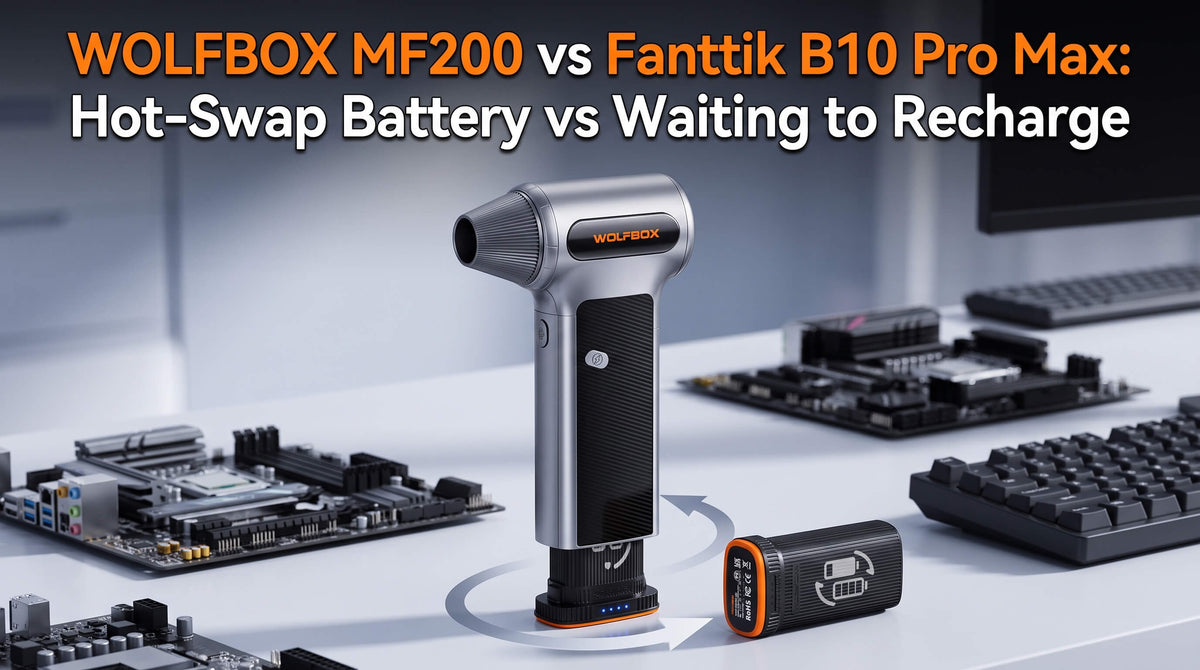
WOLFBOX MF200 Compressed Air Duster, Swappable Battery Cartridge
The WOLFBOX MF200 Compressed Air Duster gives you airflow of over 210 miles per hour from a motor spinning at 110,000 rpm [2]. Swapping out the battery cartridge means your runtime isn't limited by an internal cell. That feature is quite useful for people who clean multiple devices back-to-back or do a lens maintenance session involving several dusty lenses.
At speed 1, the WOLFBOX MF200 produces a gentle flow of air, perfect for working with lenses and sensors. At speed three, the WOLFBOX MF200 is designed for heavy-duty applications such as cleaning drone motor housings, vans or workstations [2]. It combines the precision needed for optical glass with the power needed for deeper maintenance jobs.
The WOLFBOX MF200 Compressed Air Duster comes with four nozzles and two brushes and weighs 0.84 pounds [2]. If you are a photographer or drone operator juggling multiple pieces of kit and shooting in dusty locations frequently, the MF200's unlimited runtime can save you time.
The best electric air dusters for cleaning cameras need a consistent speed and performance level. The most effective air duster for drones needs more raw expulsion capability. The MF100 and MF200 each satisfy one of those requirements, but for all-day professional cleaning jobs, the MF200 has the clear edge.
What Else Belongs in a Camera Cleaning Kit Before a Trip
The best air duster for cameras and drones really does handle that light dust. Your complete pre-trip kit, however, will cover everything else: smears, stubborn grit and the occasional wet clean before a critical shoot.
Your standard sensor cleaning kit should include some swabs, a cleaning solution and a blower. It's crucially important that the swab size is matched to your sensor width. Using a swab that's too small will leave streaks on the edges because it cannot cover the entire sensor surface in a single pass.
If you have a car and travel with it as well as your camera equipment, you might want to consider the very best jump starter that has a built-in air compressor, useful for inflating a tire on the way to your shoot location.
Core items:
- An electric air duster (use the WOLFBOX MF100 in your camera-focused kits or the MF200 if you want something for multiple tasks).
- Sensor swabs sized for your particular sensor format (either APS-C or full-frame).
- Sensor cleaning fluid, just one drop per swab will do.
- Lens pen for the front element and rear element of each lens.
- Microfiber cloth (microfibre cloth) for the LCD screen and body, but never use it on optical glass without fluid.
- Rocket blower or bulb blower, a second option for lens barrels, one-way valve, no battery, lower pressure than an electric duster [5].
Camera owners planning long journeys to distant places might also want the best jump starter with air compressor for their daily commute in a remote location.
Frequently Asked Questions
Can I use the WOLFBOX MF100 directly on a camera sensor?
Yes indeed, at its lowest speed setting the WOLFBOX MF100 Compressed Air Duster is quite suitable for camera sensor cleaning, producing enough airflow to shift loose dust without touching the sensor surface. It's a controlled output ideal for mirrorless, APS-C sensor and full-frame sensor cleaning alike [1].
Is the WOLFBOX MF200 too powerful for lens cleaning?
No, not at speed 1. The WOLFBOX MF200 Compressed Air Duster on its lowest speed setting produces a controlled output perfect for lens and sensor cleaning. The key is staying at the lowest of its three variable speeds for delicate surfaces. Reserve higher settings for drone motors and crevices [2].
What is the difference between a rocket blower and an electric air duster?
A rocket blower, also referred to as a puffer or bulb blower, uses a squeezable silicone bulb and produces a variable, lower-pressure air flow that entirely depends on how hard you squeeze it. An electric air duster produces a constant airspeed at each speed setting, which makes it a more repeatable tool for sensitive tasks [5].
Does canned air leave residue on a lens?
Yes indeed, if it's tilted. Aerosol cans used for compressed air contain propellants that will sometimes turn into liquid when the can is at an angle. That liquid can spray onto the lens and leave behind a film that takes multiple passes of fluid cleaning to remove. Electric dusters remove this risk entirely.
How often should I clean a drone gimbal before a trip?
Before each trip, following outdoor flights in dusty, sandy, or even coastal conditions, dust particles can get stuck inside gimbal motor housing gaps and degrade performance over time. An electric duster can help clean these areas quickly as part of a pre-flight routine [4].
References
[1] WOLFBOX MF100 Compressed Air Duster — https://wolfbox.com/products/compressed-air-duster-mf100
[2] WOLFBOX MF200 Compressed Air Duster Swappable Battery Cartridge — https://wolfbox.com/products/compressed-air-duster-mf200
[3] Iceland Photo Tours: "How to Minimize and Clean Camera Sensor Dust" — https://iceland-photo-tours.com/articles/photography-tutorials/how-to-minimize-and-clean-camera-sensor-dust
[4] FlyingMachineArena.org: "Drone Lifespan and Environmental Factors: Dust and Particulate Ingress on Motors and Gimbals" — https://flyingmachinearena.org/drone-lifespan-environmental-factors-dust-ingress/
[5] Alan Ranger Photography: "Camera Sensor Cleaning: The Ultimate Step-by-Step Guide" — https://www.alanranger.com/blog-on-photography/camera-sensor-cleaning-guide
[6] USPTO: "Camera Module with a Dust Trap" — https://patents.google.com/patent/US20210364725A1/en


Leave a comment
This site is protected by hCaptcha and the hCaptcha Privacy Policy and Terms of Service apply.