







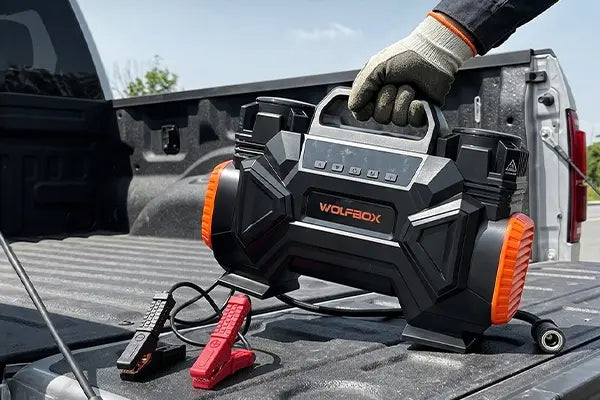
A jump starter that won't crank an engine usually isn't dead. It's one of four things: low charge, poor clamp contact, corroded battery terminals, or a car battery too far gone for any jump starter to revive, and those causes have to be ruled out in that order to actually find the real problem [1][2]. Lithium-battery longevity varies with charge depth, temperature, storage, and use frequency, so a calendar-life estimate should not be treated as a manufacturer standard. A unit that suddenly will not respond may still have a fixable charging, connection, or vehicle-battery issue before its internal battery is assumed to be worn out.
Work Through This Before Assuming It's Broken
Step |
What to check |
Why it matters |
1. Charge level |
Power on the unit and confirm at least 50% charge on the display or LED |
Below roughly 50%, some units can't deliver enough sustained current even though they power on |
2. Terminal condition |
Look at the car battery's terminals for corrosion, dirt, or built-up grease |
Corrosion breaks the electrical connection no matter how good the jump starter or clamps are |
3. Clamp contact |
Wiggle the clamps after attaching them; they should bite into bare metal |
Loose contact is one of the most common reasons a jump attempt fails silently |
4. Polarity |
Confirm red to positive (+), black to negative (-) or a proper ground point |
Reverse-polarity protection blocks power delivery when this is wrong, which can look identical to a dead unit |
5. Car battery condition |
Consider how long it's been dead and how old it is |
A battery dead for weeks, or older than about five years, may be beyond what any jump starter can recover |
This order matters because it's diagnostic, not arbitrary. Checking charge first rules out the most common cause quickly, and checking the car battery's own condition last makes sense because it's the hardest to fix on the roadside and the least likely explanation if the battery is relatively new [1][3].
Situations That Look Like a Dead Jump Starter but Aren't
A unit that shows absolutely no response — no lights and no display — is usually fully discharged. Charge it first, then recheck the clamps, polarity, and terminal condition before assuming the unit itself has failed [3]. If the display turns on and shows charge but the jump attempt still fails, the terminal and clamp issues above are far more likely culprits than the internal cell itself.
Cold weather is a separate case worth calling out specifically. Lithium batteries deliver less power when cold, so a jump starter left in a freezing vehicle can seem weak even when it is functional. Warming the unit in the cabin before trying again can help, while the product's stated operating-temperature limits should still be followed [4].
When the Jump Starter Itself Is the Real Problem
- If it won't hold a charge at all after a full charging cycle, and it's several years old, the internal battery has likely reached the end of its usable life.
- If it powers on, shows a full charge, and still can't crank an engine that starts fine with standard jumper cables from another vehicle, it may simply be undersized for that engine's cranking demand. Check the manufacturer's stated engine-size rating before the next attempt [7].
- If a persistent error or warning light stays on even after a full charge and clean, correct connections, that's worth contacting the manufacturer about rather than continuing to troubleshoot alone.
- A unit stored fully depleted for months at a time can lose usable capacity over time; charging it every few months during periods of light use is routine upkeep, not a workaround for a defect [5].
WOLFBOX lists two-year coverage for the MegaVolt 24Air, with six additional months if purchased on the official site. If the basic checks fail, use the model's current warranty terms rather than continuing repeated jump attempts [6].
Frequently Asked Questions
Why won't my jump starter turn on at all?
The most common cause is a fully discharged internal battery. Charge it and try again; if it still won't power on, it may have tripped an internal thermal or overcurrent protection that resets after a few minutes.
My jump starter powers on but won't start my car. What should I check first?
Check the clamp contact and terminal condition before assuming the unit is faulty. Corroded terminals or clamps that aren't gripping bare metal are the most common reason a jump attempt fails even with a fully charged unit.
Does cold weather make a working jump starter seem broken?
Yes. Lithium batteries output less power in cold temperatures, which can make a fully functional unit seem weak. Warming it up for a few minutes before use usually resolves this.
References
[1] Jump Starter Failure: Why Some Units Won't Start Your Car, My Garage Hero: https://mygaragehero.com/blogs/news/jump-starter-failure
[2] Common Issues with Jump Starters and How to Fix Them: https://www.jfegwo.com/blogs/news/common-issues-with-jump-starters-and-how-to-fix-them
[3] Portable Jump Starter: Troubleshooting Guide, Scosche: https://www.scosche.com/blog/post/portable-jump-starter-troubleshooting-guide
[4] WOLFBOX MegaVolt 24Air official product page: https://wolfbox.com/products/jump-starter-with-air-compressor-tire-inflator-wolfbox-megavolt-24air
[5] 5 Tips for Long-lasting Jump Starter Performance, Clore Automotive: https://cloreautomotive.com/top-5-things-to-remember-for-long-jump-starter-life/
[6] WOLFBOX Warranty Policy, official coverage terms: https://wolfbox.com/pages/warranty-policy
[7] WOLFBOX Portable Car Jump Starter Guide: https://wolfbox.com/blogs/news/portable-car-jump-starter

Leave a comment
All comments are moderated before being published.
This site is protected by hCaptcha and the hCaptcha Privacy Policy and Terms of Service apply.