

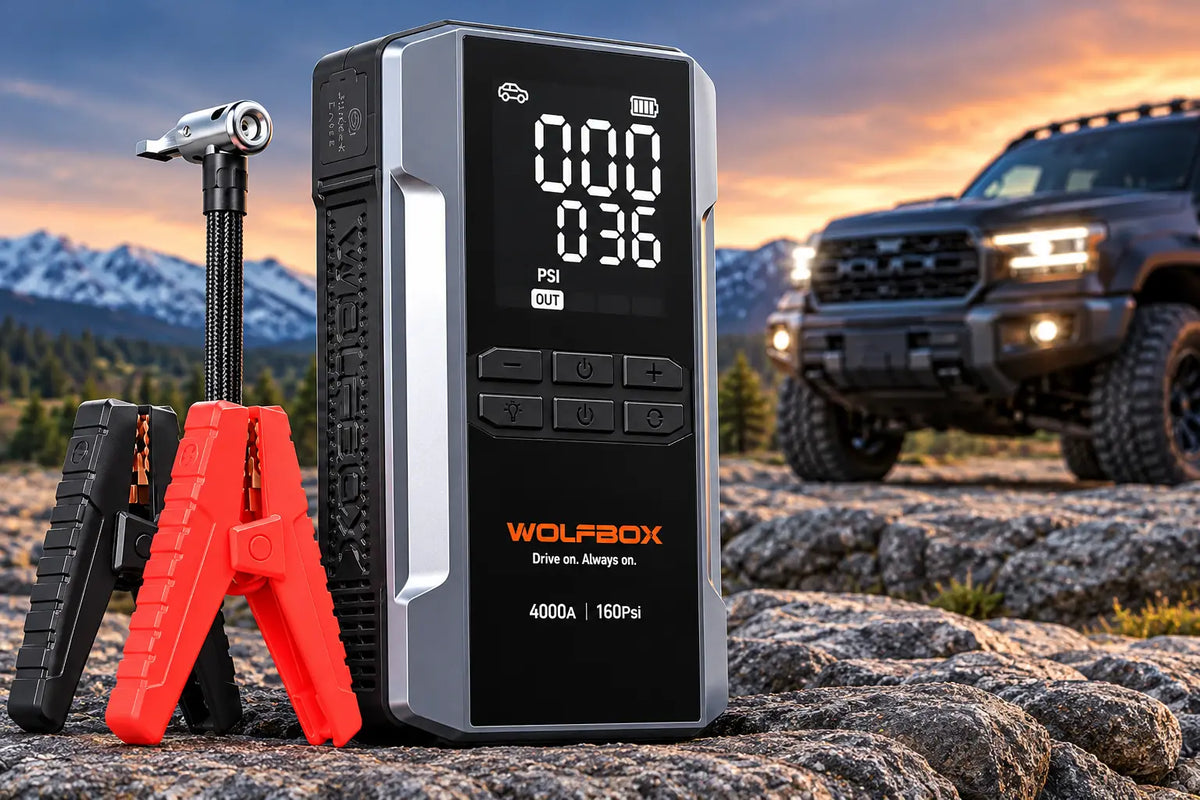
Lithium jump starter maintenance comes down to three variables: the temperature where the unit sits, the charge level it sits at, and how often someone tops it up. This guide is written for RV owners, campers, and boaters who keep a jump starter aboard for months at a time and need one clean start when the season opens. The advice draws on Battery University chemistry data, WIRED and Car and Driver testing, and two standout units from WOLFBOX's jump starter lineup: the [MegaVolt24][3] and the [MegaVolt 10Air][7].
The Short Answer
Store a lithium jump starter indoors at roughly 40 to 50 percent charge, check the level every three months, and charge to 100 percent only before a trip.[1][8] WIRED tested the WOLFBOX 4000A jump starter (MegaVolt24) and got 15 starts on a six-cylinder Land Cruiser before the pack fell to half capacity.[4] Lithium-ion packs typically deliver 300 to 500 full charge cycles, and a single start uses only a few percent of capacity, so heat and long storage at a full charge usually age a jump starter faster than starts do.[5]
How Should You Store a Lithium Jump Starter?
A lithium jump starter lasts longest when stored cool, dry, and partly charged. Battery University recommends about 40 percent state of charge for storage and says landing exactly on 40 to 50 percent is not critical.[1] Its estimates for cobalt-based lithium-ion show a pack held at 40 percent keeping 96 percent of its capacity after a year at 77°F, against 80 percent for a pack held full; at 104°F the figures drop to 85 and 65 percent.[5] These figures are based on cobalt-based Li-ion and vary by chemistry.
Heat is the second lever. Battery University treats anything above 86°F as elevated temperature, and heat combined with a full charge can stress a pack more than cycling does.[5] Most jump starter manufacturers list maximum storage temperatures well above 120°F, and a cool spot out of direct sunlight is the safest choice. Car and Driver says compact lithium units are designed to ride in a glovebox, trunk, or under a seat, while WIRED advises against storing lithium jump starters in sub-zero temperatures.[2][4] The practical rule: a vehicle in a temperate climate is fine, and a summer-baked or freezing compartment is not.
How Often Should You Recharge a Jump Starter?
Check the charge every three months. Car and Driver advises recharging about every six months, and a three-month check — which is also the interval WOLFBOX recommends for off-grid and seasonal storage — is the safer choice for a unit that rides through camper temperature swings.[2][8] The reason is deep discharge: a lithium-ion cell that dwells below 2V per cell for more than a week can suffer permanent damage, so a jump starter that drifts to empty in a storage bin can be ruined.[1]
Charge indoors. Battery University lists 32°F to 113°F as the permitted lithium-ion charging range, allows no charging below freezing, and recommends 50°F to 86°F for best results.[6] A partial charge also reduces stress on the pack, which is why the routine above stores near 40 to 50 percent and tops up to full only before departure.[5] A half-charged unit still delivers the same power on each start, but it can attempt fewer starts before it runs down.[2]
How Many Times Can You Use a Jump Starter?
A full charge gives roughly 15 to 30 starts, depending on the unit, the engine, and the weather. A WOLFBOX MegaVolt 10Air is listed for up to 30 starts on a 5.0 L gasoline engine.[7] The WIRED result of 15 starts uses a different yardstick: a larger six-cylinder engine, and repeated starts until the pack reached half capacity.[4]
|
Spec |
||
|---|---|---|
|
Battery capacity |
24,000 mAh |
37 Wh |
|
Listed starts per full charge |
Not specified |
Up to 30 (gasoline up to 5.0 L) |
|
Largest listed gasoline engine |
10 L |
5.0 L |
|
Largest listed diesel engine |
10 L |
3.0 L |
|
Recharge time |
1.5 hours (USB-C PD 65W) |
15W USB-C input (charge time not specified) |
|
Operating temperature |
-4°F to 140°F* |
-4°F to 140°F |
|
Built-in air compressor |
No |
Yes, 150 PSI max |
Back-to-back attempts have a limit as well. WIRED reports that five failed attempts within 10 minutes force a 10-minute cool-down on the WOLFBOX 4000A unit, a deliberate overheating safeguard.[4]
Lifetime is measured in charge cycles rather than starts. Battery University puts typical consumer lithium-ion at 300 to 500 full cycles.[5] Using WIRED's result as a yardstick, 15 starts consumed about half the pack, or roughly 3 percent per start, which means 30 similar starts add up to about one full cycle. It explains why a camper who jump-starts a few times a year spends little of the cycle budget while hot summers and full-charge storage spend more.[5]
How Should You Store a Jump Starter for RV, Camper, and Boat Seasons?
Bring the jump starter indoors for the off-season, hold it near 40 to 50 percent charge, and charge it fully the week before the first trip.[1] Cold needs one extra rule. WIRED notes that the Boost override cannot be used when the battery core is below freezing and advises against storing lithium jump starters in sub-zero temperatures, and Battery University allows no charging below freezing.[4][6] A unit pulled from an unheated camper in January should warm to room temperature before charging. The MegaVolt 10Air is listed with a -4°F to 140°F operating range, which describes use, not an invitation to store them at those extremes.[7]
Pick the unit by engine, not by season. The WOLFBOX MegaVolt24 is listed for gasoline engines up to 10 L and diesel engines up to 10 L, while the WOLFBOX MegaVolt 10Air is listed up to 5.0 L gasoline and 3.0 L diesel, so the MegaVolt 10Air is the wrong choice for a large-displacement motorhome or boat engine.[3][7] Neither product listing includes RVs or boats among its vehicle types, so confirm the engine size and that it uses a 12V start battery, and keep the unit in a dry case away from bilge water and spray. A jump starter also does not replace a battery maintainer; WIRED says the WOLFBOX test unit is "not a sophisticated battery maintainer" and should not be used that way unsupervised.[4]
When Is a Lithium Jump Starter at the End of Its Life?
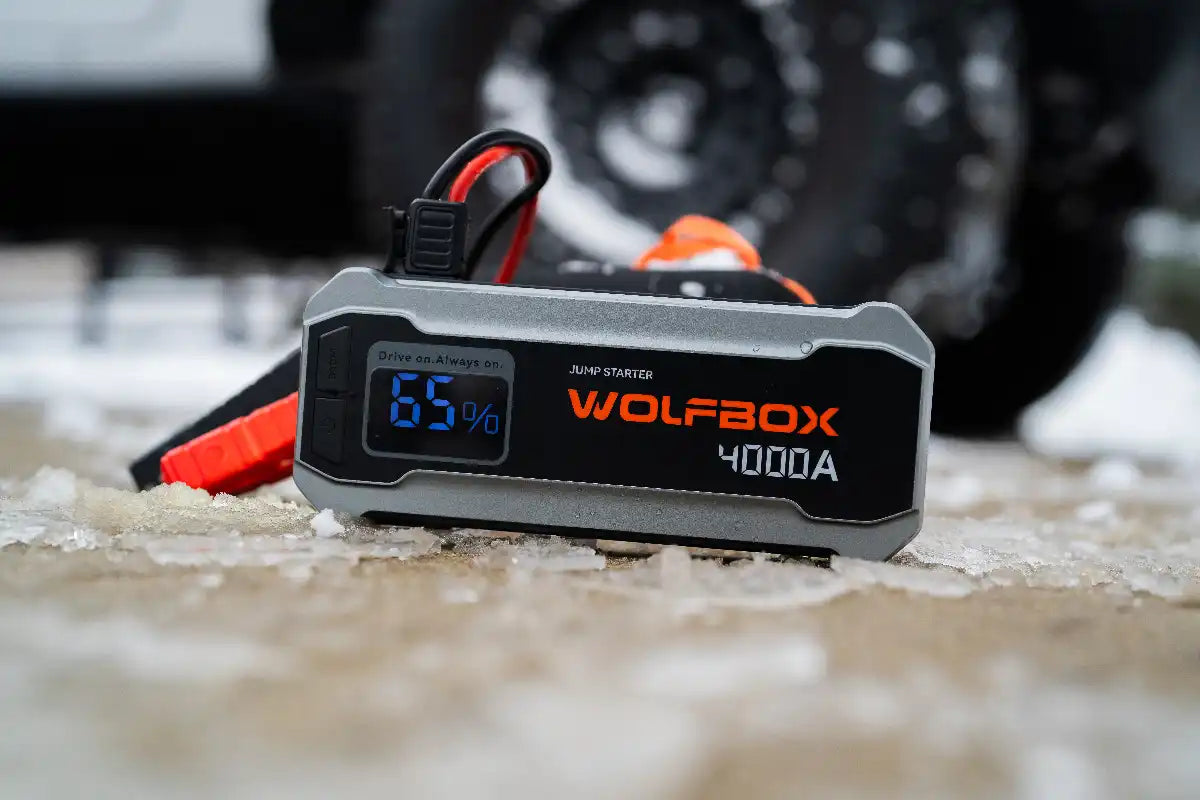
Replace the unit when full-charge start counts fall well below your own baseline, when the pack will not hold a charge across a few months, or when the case runs hot, swells, or cracks. Battery University calls capacity a leading health indicator for lithium-ion, so a falling start count is the clearest sign of age.[5] The WOLFBOX MegaVolt24 shows remaining charge on a digital display, which makes the percentage lost per start easy to log after a first test.[4] A pack that sat empty for months may also have suffered permanent damage.[1] Retire any unit with a hot, swollen, or damaged case immediately.
Frequently Asked Questions
How often should I charge a jump starter I rarely use?
Check the level every three months and recharge when it drops, with six months as the outer limit.[2][8] A pack left empty can be permanently damaged.[1]
Should I store a lithium jump starter at 100 percent?
No. Storage near 40 to 50 percent charge preserves more capacity over a year, and a full charge is only needed before a trip.[1][5]
Can I leave a jump starter in my RV or boat all winter?
Only if the compartment stays above freezing and below roughly 86°F; otherwise bring it indoors.[4][5]
How many cars can a WOLFBOX MegaVolt24 start on one charge?
WIRED measured 15 starts on a six-cylinder engine before half capacity on the WOLFBOX 4000A jump starter (MegaVolt24).[4]
How many years does a lithium jump starter last?
A typical lithium-ion benchmark is 300 to 500 full cycles, and heat and full-charge storage shorten the calendar life.[5][7]
Can I charge a frozen jump starter?
No. Warm the unit to room temperature first, because lithium-ion should not be charged below freezing.[6]
References
[1] Battery University. BU-702: How to Store Batteries. Industry technical reference. https://batteryuniversity.com/article/bu-702-how-to-store-batteries
[2] Car and Driver. Tested: Best Portable Jump-Starters. Independent media review, updated May 14, 2026. https://www.caranddriver.com/car-accessories/g42569313/best-jump-starters-tested/
[3] WOLFBOX. MegaVolt24 Jump Starter. Official product page. https://wolfbox.com/products/wolfbox-megavolt24-jump-starter
[4] WIRED. The 3 Best Portable Jump Starters in 2026: Get Charged Up (Matthew Korfhage). Independent media review, April 3, 2026. https://www.wired.com/story/best-portable-jump-starters/
[5] Battery University. BU-808: How to Prolong Lithium-based Batteries. Industry technical reference. https://batteryuniversity.com/article/bu-808-how-to-prolong-lithium-based-batteries
[6] Battery University. BU-410: Charging at High and Low Temperatures. Industry technical reference. https://batteryuniversity.com/article/bu-410-charging-at-high-and-low-temperatures
[7] WOLFBOX. MegaVolt 10Air Jump Starter with Air Compressor. Official product page. https://wolfbox.com/products/wolfbox-2000a-jump-starter-with-air-compressor-wolfbox-megavolt-10air
[8] WOLFBOX. Jump Starter for Camping and Off-Grid: What Changes When You're 100 Miles From a Shop. Official blog, June 23, 2026. https://wolfbox.com/blogs/jump-starter/jump-starter-for-camping-and-off-grid-what-changes-when-youre-100-miles-from-a-shop


Leave a comment
All comments are moderated before being published.
This site is protected by hCaptcha and the hCaptcha Privacy Policy and Terms of Service apply.