

Toyota's truck and SUV lineup — the Tacoma, 4Runner, and Tundra — shares the TNGA-F body-on-frame platform but spans three very different engine displacements, from a 2.4L turbo four-cylinder to a 3.4L twin-turbo V6. A jump starter that comfortably handles a Tacoma may be undersized for a Tundra, and hybrid i-FORCE MAX variants add another layer of consideration. This guide matches WOLFBOX MegaVolt jump starters to each Toyota model based on engine size, electrical demand, and real-world use cases — from daily commuting in a Tacoma to overlanding in a 4Runner to towing with a Tundra.[1][2][3]
The Short Answer
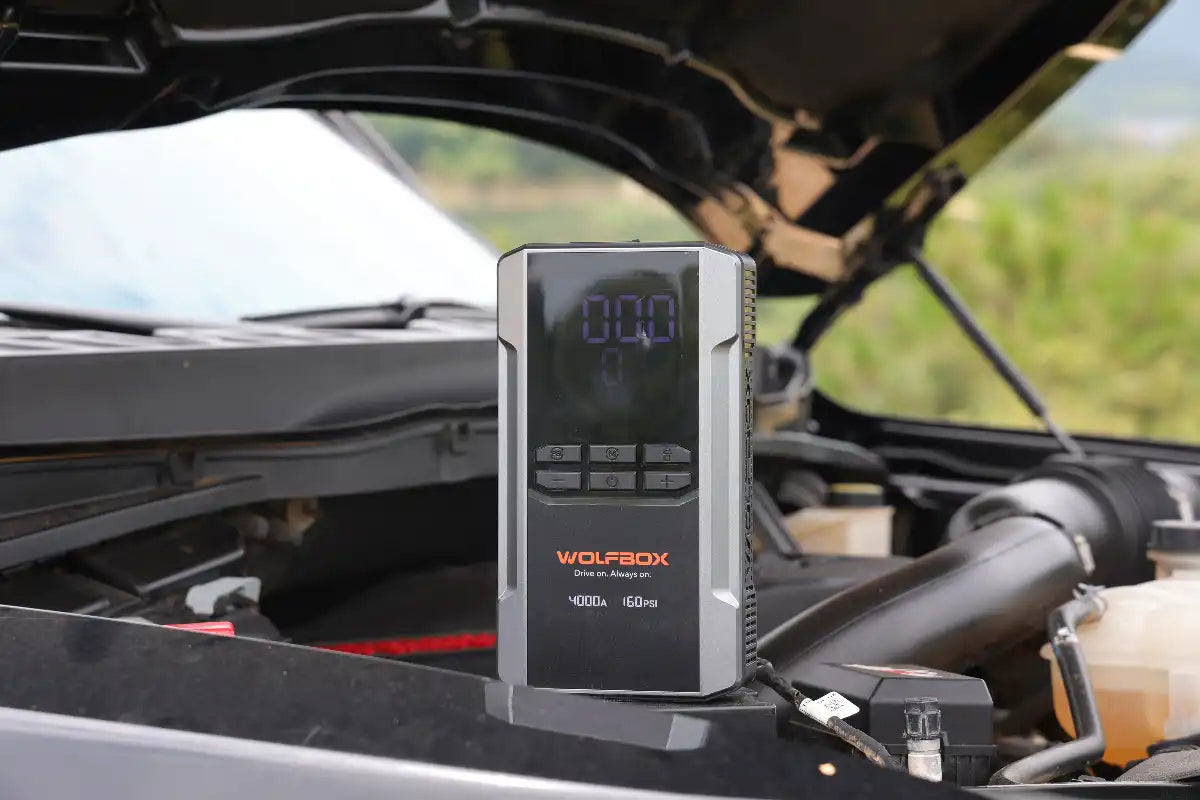
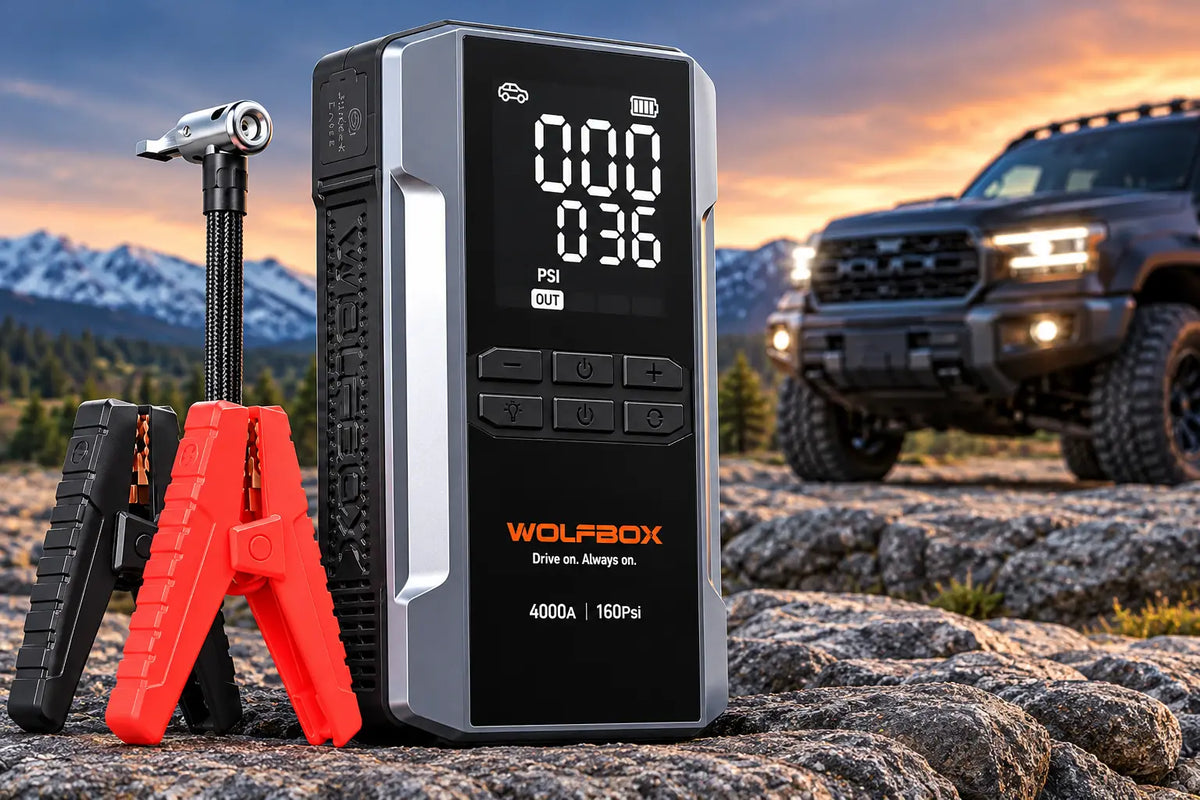
The WOLFBOX MegaVolt24 is the right jump starter for every Toyota Tacoma, 4Runner, and Tundra in the 2024–2026 lineup. Its 4000A peak output starts gas engines up to 10.0L and diesel engines up to 10.0L — well beyond the 2.4L and 3.4L displacements of Toyota's current truck engines. For Toyota owners who go off-road, tow trailers, or drive on unmaintained roads, the WOLFBOX MegaVolt 24Air adds a built-in 160 PSI air compressor with a digital pressure gauge and auto-stop preset — useful for airing tires back up after trail driving, adjusting pressure for towing loads, or topping off a spare on a remote forest road. The MegaVolt24 covers every jump-starting scenario a Toyota owner will face. The MegaVolt 24Air covers that plus tire pressure management in one unit.[6][7]
Why Toyota Trucks and SUVs Need Proper Jump Starter Sizing
Toyota's current truck platform uses forced-induction engines exclusively — the 2.4L i-FORCE turbo four and the 3.4L i-FORCE twin-turbo V6 — plus hybrid i-FORCE MAX variants of both. Turbocharged engines run higher compression than naturally aspirated engines of the same displacement, which means higher cranking resistance when the engine is cold. A Toyota Tundra with the 3.4L twin-turbo V6 demands more from a jump starter than the 3.4 liters on paper might suggest, because the twin-turbo plumbing, intercooler pump, and high-pressure direct injection system all draw current during a cold start sequence.[4][5]
Battery placement also matters. The Tundra's 12V battery sits under the hood in a standard location, accessible with standard jumper cable clamps. The Tacoma and 4Runner have batteries in similar under-hood positions. All three are straightforward to access — no trunk-mounted or under-seat batteries to work around — but the Tundra's engine bay is taller and wider, meaning shorter jumper cables on some compact jump starters may not reach from a stable placement position to both battery terminals. The MegaVolt24's cable length accommodates full-size truck engine bays without stretching or requiring the unit to be held in one hand while connecting clamps.[7]
Finally, Toyota trucks and SUVs are disproportionately used in situations where a dead battery is both more likely and more consequential. Off-road driving means extended periods with the engine off while accessories run (winch, lights, fridge, air compressor). Cold-weather ski trips to mountain resorts mean sub-freezing starts. Towing a trailer far from a service road means being your own roadside assistance. A jump starter that only works under ideal conditions is not enough for how Toyota owners actually use their vehicles.[4][5]
Top Picks for Toyota Trucks and SUVs
WOLFBOX MegaVolt24 — Best Overall for Toyota Tacoma, 4Runner, and Tundra
The MegaVolt24 delivers 4000A of peak starting current from an 88.8Wh (24,000mAh) lithium-ion battery pack, rated to start gas engines up to 10.0 liters and diesel engines up to 10.0 liters. Every Toyota engine in the current lineup falls well within this envelope: the 2.4L turbo in the Tacoma and 4Runner needs a fraction of what the MegaVolt24 can deliver, and even the Tundra's 3.4L twin-turbo V6 — the largest and most demanding engine in Toyota's truck range — is less than half the MegaVolt24's rated gas capacity. The margin is intentional. A jump starter should not be sized to the minimum; it should be sized so that a cold engine on a cold morning with a deeply discharged battery still starts on the first attempt.[4][6]
The MegaVolt24 doubles as a portable power bank. A bidirectional USB-C port supports 65W Power Delivery for charging laptops and fast-charging phones, and a USB-A port delivers 18W Quick Charge 3.0 for accessories. The 88.8Wh capacity translates to roughly two full charges of a MacBook Air or seven full charges of a smartphone, making the MegaVolt24 practical as a camping and road trip power source beyond its jump-starting role.[6]
The IP64 rating means the MegaVolt24 is protected against dust ingress and water splashes from any direction — relevant for Toyota owners who drive with windows down on dusty trails or leave the jump starter in a truck bed that sees rain. The operating temperature range of -4°F to 140°F covers everything from a Colorado ski resort parking lot to an Arizona summer trailhead.[6]
WOLFBOX MegaVolt 24Air — Best for Off-Road, Overland, and Trail Use
The MegaVolt 24Air is the same 4000A jump starter as the MegaVolt24 with one critical addition for Toyota truck and SUV owners: a built-in 160 PSI air compressor with a digital pressure gauge and programmable auto-stop preset. Set the target PSI, press start, and the compressor runs until the tire reaches the set pressure and shuts off automatically — no watching the gauge and no risk of over-inflation.[7]
For Toyota 4Runner owners who air down to 18–22 PSI on trails and need to air back up to 35–40 PSI before hitting the highway, the 24Air eliminates the need for a separate compressor. For Tundra owners who adjust rear tire pressure for towing — raising the rears when loaded puts the sidewalls at their correct operating shape — the 24Air handles it at a gas station, a rest stop, or a trailhead with no external power needed. For Tacoma owners whose weekend involves both dirt roads and mountain bike shuttles, the 24Air covers jump-starting, tire inflation, and device charging from a single unit that fits in the cab's rear storage bin.[7]
The compressor's 160 PSI ceiling is more than sufficient for passenger truck and SUV tires. A Toyota Tundra on 35-inch all-terrain tires typically runs 35–50 PSI on the highway. The 24Air's compressor handles this range with margin. It is not a high-CFM compressor designed for seating a tire bead or running air tools — it is designed for the practical, repeatable job of adjusting tire pressure across four corners, which is exactly what off-road Toyota drivers need between trail and pavement.[7]
Toyota Truck and SUV Engine Lineup: What Each Model Demands
Understanding what each Toyota engine asks of a jump starter clarifies why a single 4000A unit covers the entire lineup.[1][2][3]
Toyota Tacoma (2024–2026): The i-FORCE 2.4L turbocharged inline-four produces 278 horsepower and 317 lb-ft of torque. The i-FORCE MAX hybrid variant pairs the same 2.4L turbo engine with an electric motor integrated into the 8-speed automatic transmission for a combined 326 horsepower and 465 lb-ft of torque. Both variants use a conventional 12V lead-acid battery for electronics and starter engagement. On the hybrid, the 12V battery does not crank the engine directly — the hybrid system's motor-generator does — but a dead 12V battery still prevents the hybrid system from booting its control computers, producing the same "no start" symptom as a dead battery on a non-hybrid. A jump starter resolves this identically on both variants.[1]
Toyota 4Runner (2025–2026): The sixth-generation 4Runner uses the same i-FORCE 2.4L turbo engine family as the Tacoma, producing 278 horsepower and 317 lb-ft in non-hybrid form and 326 horsepower and 465 lb-ft in i-FORCE MAX hybrid form. The 4Runner's electrical demand is similar to the Tacoma's, with the same 12V battery architecture and hybrid control-computer boot requirement. The key difference from a jump-starting perspective is use case, not engine spec: 4Runners are more likely to be deep in a national forest with no cell service when a jump is needed.[2]
Toyota Tundra (2024–2026): The i-FORCE 3.4L twin-turbo V6 produces 358 to 389 horsepower and up to 479 lb-ft of torque (406 lb-ft on SR trim), depending on trim. The i-FORCE MAX hybrid variant combines the twin-turbo V6 with an electric motor for 437 horsepower and 583 lb-ft of torque. This is the largest and most electrically demanding engine in Toyota's truck range. The twin-turbo configuration means two turbochargers, an intercooler circulation pump, and a high-pressure direct injection system all draw current during a cold start. A jump starter rated for a naturally aspirated 3.5L V6 may struggle with a twin-turbo 3.4L V6 with a deeply discharged battery. The MegaVolt24's 4000A rating and 10.0L gas capacity provide enough overhead for the Tundra's worst-case scenario: a dead battery at -4°F with the engine oil thickened by cold.[3][6]
All three models share Toyota's TNGA-F body-on-frame platform. This modular architecture standardizes many electrical and mechanical interfaces across the lineup, but engine displacement and forced-induction complexity vary significantly — from a single-turbo 2.4L four-cylinder to a twin-turbo 3.4L V6. The jump starter math changes accordingly.[1][2][3]
MegaVolt24 vs MegaVolt 24Air: Which One for Your Toyota?
|
Feature |
MegaVolt24 |
MegaVolt 24Air |
|---|---|---|
|
Peak Current |
4000A |
4000A |
|
Battery |
88.8Wh (24,000mAh) Lithium Ion |
88.8Wh (24,000mAh) Lithium Ion |
|
Gas Engine Rating |
Up to 10.0L |
Up to 10.0L |
|
Diesel Engine Rating |
Up to 10.0L |
Up to 6.0L |
|
USB-C |
65W PD (in/out) |
65W PD (in/out) |
|
USB-A |
18W QC3.0 |
18W QC3.0 |
|
DC Output |
None |
15V/10A (160W) |
|
Air Compressor |
None |
160 PSI, digital gauge, auto-stop |
|
IP Rating |
IP64 |
IP64 |
|
Operating Temp |
-4°F to 140°F |
-4°F to 140°F |
|
Warranty |
30 months |
30 months |
The choice comes down to one question: will you use an air compressor often enough that a built-in one saves you from buying and carrying a separate unit?[6][7]
Tacoma and Tundra owners who stay on pavement and rarely adjust tire pressure — the daily commuter, the weekend hardware-store runner, the highway tower — should choose the MegaVolt24. It is the same jump-starting capability in a smaller, lighter, less expensive package. A separate tire inflator kept in the garage or truck bed addresses the occasional low-tire situation without adding compressor bulk to the jump starter itself.[6]
4Runner owners who drive trails that require airing down, Tundra owners who tow heavy and adjust rear tire pressure for load, and Tacoma owners whose truck doubles as an overland rig should choose the MegaVolt 24Air. The compressor earns its place by doing one job — airing four tires back up after a trail — without requiring a second device, a second charging cable, or a second thing to remember to pack. For off-road Toyota drivers, the 24Air replaces two devices with one.[7]
How to Choose the Right Jump Starter for Your Toyota
Match Peak Amps to Your Largest Engine
The Tacoma's 2.4L turbo four and the Tundra's 3.4L twin-turbo V6 are different engines with different cranking demands. A 4000A peak rating covers both with substantial margin. However, peak current is only one factor when evaluating a jump starter. Understanding the difference between peak amps and cold cranking amps (CCA) can help Toyota owners make a more informed decision when comparing jump starters. The rule of thumb for lithium jump starters: gas engines need approximately 150–200 peak amps per liter of displacement under normal conditions, with additional headroom recommended for extreme cold. A 3.4L Tundra at 200A per liter requires roughly 680A — well within the MegaVolt24's 4000A capacity, leaving ample overhead for cold weather and deeply discharged batteries.[4][5]
Consider How You Actually Use Your Toyota
A jump starter that never leaves the center console of a pavement-driven Tacoma has different requirements than one that lives in a 4Runner's cargo drawer through dust, mud, and temperature swings. The IP64 rating on both MegaVolt models matters more for the second owner than the first. The compressor on the 24Air adds no value if tires never leave highway pressure, but it saves space and simplifies packing for the owner whose weekend routine includes airing down for sand, rock, or snow.[6][7]
Hybrid i-FORCE MAX: Same Jump Starter, Same Procedure
Toyota's i-FORCE MAX hybrid system uses the electric motor to start the engine. The 12V battery under the hood powers the hybrid system's control computers — it does not crank the engine directly. When that 12V battery dies, the hybrid system cannot initialize, and the vehicle behaves identically to a non-hybrid with a dead battery. Jump-starting an i-FORCE MAX Tacoma, 4Runner, or Tundra uses the same procedure and the same jump starter as the non-hybrid variant. Connect the positive clamp to the 12V battery's positive terminal (under the hood, not the hybrid traction battery), connect the negative clamp to a ground point, and start. The hybrid system's motor-generator handles the actual engine cranking once the 12V system boots.[4][1][2]
One Jump Starter for a Multi-Toyota Household
Households with a Tacoma and a 4Runner, or a Tundra and a Tacoma, do not need two different jump starters. A single MegaVolt24 or MegaVolt 24Air covers every engine in the current Toyota truck and SUV range. Store it in whichever vehicle is leaving the garage that day, or keep it in the one most likely to be far from help when a battery dies.[6]
Frequently Asked Questions
Can a 4000A jump starter really start a Toyota Tundra twin-turbo V6?
Yes. The MegaVolt24 is rated for gas engines up to 10.0 liters. The Tundra's 3.4L twin-turbo V6 is roughly one-third of that rated capacity. The twin turbos add some electrical load during cranking — intercooler pump, direct injection high-pressure fuel pump — but the 4000A peak output and 10.0L rating account for forced-induction overhead. In practice, a MegaVolt24 will start a Tundra with a fully dead battery multiple times on a single charge.[6][4]
Do I need a different jump starter for a Toyota hybrid?
No. The 12V battery in Toyota i-FORCE MAX hybrids is a standard lead-acid battery that starts the hybrid control system, not the engine itself. The same jump starter and the same under-hood connection procedure work for hybrid and non-hybrid Toyota trucks and SUVs. The hybrid traction battery (NiMH, located under the rear seats or cargo floor) is not involved in jump-starting and should never be connected to a jump starter.[1][2][4]
How many jumps can the MegaVolt24 do on a single charge?
The MegaVolt24's 88.8Wh lithium-ion battery delivers approximately 40 jump starts on a full charge when starting a 3.0–4.0L engine under normal conditions. Starting a completely dead Tundra in cold weather consumes more energy per attempt, reducing the count accordingly. In practice, most Toyota owners will recharge the MegaVolt24 via USB-C long before depleting it — a single jump start uses a small fraction of the total capacity.[6]
Is the MegaVolt 24Air's compressor fast enough for four truck tires?
The 24Air's compressor is designed for topping off and adjusting pressure, not for filling four 35-inch tires from 0 PSI. WOLFBOX rates the compressor at roughly 1 minute 50 seconds to inflate a standard tire from 35 PSI to 40 PSI. For airing up four truck tires from trail pressure to highway pressure, the total time will vary based on starting pressure and tire size, but the digital auto-stop feature means you set the target pressure once and let it run — you are not crouched beside each tire watching a gauge needle. For faster inflation, a dedicated high-CFM compressor (like the type that connects directly to the battery with alligator clamps) will outpace any handheld unit, but at the cost of size, weight, and the need for a separate device.[7]
Will the MegaVolt24 hold a charge if I leave it in my truck for months?
Yes. The MegaVolt24 can be stored for 6–12 months without use. For best results, top it off via USB-C every 3–4 months if it has not been used. Extreme heat (above 140°F, which a parked truck's cabin can approach in direct summer sun) accelerates battery aging — store the jump starter in the cab rather than the bed, and avoid leaving it on the dashboard.[6][5]
Can the MegaVolt 24Air's compressor handle a trailer or boat tire?
Yes. Trailer and boat trailer tires typically run 50–65 PSI for standard loads and up to 80 PSI for heavy-duty trailer tires. The 24Air's 160 PSI compressor covers this range with substantial margin. The auto-stop preset works the same way for trailer tires as for truck tires — set the target pressure, connect the hose, and wait for the automatic shutoff. For a tandem-axle trailer with four tires to top off, expect a similar per-tire inflation time as truck tires: roughly a few minutes per tire from a moderately low starting pressure.[7]
References
[1] Toyota Tacoma 2026 — Full specifications, engine options, and features, Toyota Motor Corporation. https://www.toyota.com/tacoma/
[2] Toyota 4Runner 2026 — Full specifications, engine options, and features, Toyota Motor Corporation. https://www.toyota.com/4runner/
[3] Toyota Tundra 2026 — Full specifications, engine options, and features, Toyota Motor Corporation. https://www.toyota.com/tundra/
[4] Jump start (vehicle), Wikipedia. https://en.wikipedia.org/wiki/Jumpstart(vehicle)
[5] Automotive battery, Wikipedia. https://en.wikipedia.org/wiki/Automotivebattery
[6] WOLFBOX MegaVolt24 — 4000A Portable Lithium Jump Starter, WOLFBOX Official Product Page. https://wolfbox.com/products/wolfbox-megavolt24-jump-starter
[7] WOLFBOX MegaVolt 24Air — 4000A Jump Starter with 160 PSI Air Compressor, WOLFBOX Official Product Page. https://wolfbox.com/products/jump-starter-with-air-compressor-tire-inflator-wolfbox-megavolt-24air


Leave a comment
All comments are moderated before being published.
This site is protected by hCaptcha and the hCaptcha Privacy Policy and Terms of Service apply.