








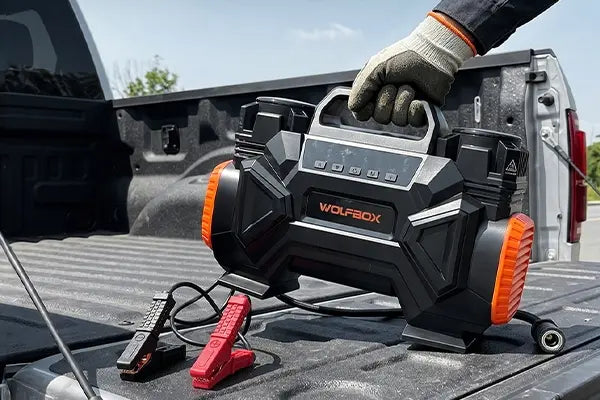
A jump starter with a built-in compressor can either become permanent emergency gear or spend most of its life waiting for trouble. The WOLFBOX MegaVolt 24Air and Stanley FATMAX J20CF cover many of the same jobs, including jump starting, tire inflation, device charging, and roadside lighting, but the two products take very different approaches to getting there.[1][2]
The two jump starters look surprisingly competitive on paper. The WOLFBOX MegaVolt 24Air uses a lithium-ion battery and combines a published 4000-amp peak rating, meaning the manufacturer's advertised maximum-current figure, with a 24,000 milliamp-hour (mAh) / 88.8 watt-hour (Wh) battery, 160 pounds-per-square-inch (PSI) compressor, 45 liters-per-minute (L/min) airflow, and 65-watt USB-C charging.[1] Stanley's J20CF uses a sealed lead-acid internal battery with a published 2000-amp peak rating, 120 PSI compressor, and USB-C Power Delivery (PD) output up to 60W.[2] Power Delivery is the fast-charging standard commonly used by modern phones, tablets, and many laptops.
The Short Answer
The WOLFBOX MegaVolt 24Air is the stronger fit for drivers who want one compact emergency tool to leave in the vehicle. The lithium design, high-output USB-C charging, higher published compressor output, and strong independent testing make the WOLFBOX MegaVolt 24Air particularly useful for road trips, commuting, towing, and other situations where the tool needs to travel with the vehicle.[1][3][4] Popular Science also selected the WOLFBOX MegaVolt 24Air for an emergency-roadside-kit guide, reinforcing that multipurpose role.[5]
Stanley still makes a credible case as an all-in-one power station. The WOLFBOX MegaVolt 24Air has the advantage in portability and independent test support, while Stanley counters with a 120 PSI digital compressor, 60W USB-C output, work light, and included charging hardware.[1][2]
WOLFBOX MegaVolt 24Air vs Stanley FATMAX J20CF Specifications
The specifications show two products built around different priorities. The WOLFBOX MegaVolt 24Air emphasizes compact lithium power, high-output USB-C charging, and stronger published compressor performance, while Stanley keeps the traditional sealed lead-acid power-station format without giving up modern USB-C charging.[1][2]
|
Specification |
WOLFBOX MegaVolt 24Air |
Stanley FATMAX J20CF |
|---|---|---|
|
Internal battery |
Lithium-ion [1] |
Sealed lead-acid [2] |
|
Published peak rating |
4000A [1] |
2000A [2] |
|
Battery capacity |
24,000mAh / 88.8Wh [1] |
Not published in the same format in cited specifications |
|
Compressor |
160 PSI / 45 L/min [1] |
120 PSI digital compressor [2] |
|
USB-C output |
Up to 65W PD [1][3] |
Up to 60W PD [2] |
|
USB-A output |
18W [1][3] |
15W [2] |
|
Lighting |
400-lumen light, three modes [1] |
Integrated work light [2] |
|
Charging/storage |
About 1.5–2 hours with suitable USB-C charger [1] |
Recharge at least every 30 days when stored [2] |
Two Different Ways to Build the Same Roadside Tool
Battery design creates one of the clearest differences between the two jump starters. The WOLFBOX MegaVolt 24Air uses lithium-ion, while Stanley uses a sealed lead-acid battery, the rechargeable lead-based design traditionally found in many booster packs and portable power stations.[1][2]
Storage maintenance makes that design difference more noticeable over time. The WOLFBOX MegaVolt 24Air supports 65W USB-C charging and lists a recharge time of roughly 1.5 to 2 hours with a suitable charger, while Stanley recommends recharging the jump starter at least every 30 days during periods of infrequent use.[1][2] That does not make Stanley difficult to own, but a jump starter that might sit untouched for months benefits from being quick and easy to top up.
4000A vs 2000A Does Not Tell the Whole Story
Peak-current ratings should not be treated like horsepower figures on a comparison chart. The WOLFBOX MegaVolt 24Air carries a published 4000A peak rating, while Stanley is marketed at 2000A peak, but cross-brand peak-current figures are not reliable enough to assume that one jump starter simply produces twice the usable starting performance of the other.[1][2][3]
Real-world testing gives the WOLFBOX MegaVolt 24Air more useful evidence than the headline number alone. Popular Science used the WOLFBOX MegaVolt 24Air to start three different vehicles during winter testing, including a crossover, a six-cylinder pickup, and a diesel Ford F-350.[3] The review also cautioned against treating peak-current figures from different brands as directly comparable performance measurements.[3]
Stanley does not have the same level of model-specific independent starting evidence in the sources used here. The WOLFBOX MegaVolt 24Air therefore has stronger third-party support behind its starting claims, while Stanley relies more heavily on published specifications.[2][3] That is a difference in available evidence rather than proof that Stanley cannot perform as advertised.
The Compressor Creates a More Useful Difference
Tire inflation separates the two products more clearly than their peak-amp figures. The WOLFBOX MegaVolt 24Air is rated at up to 160 PSI and 45 L/min, while Stanley uses a 120 PSI digital compressor with automatic shutoff at the selected pressure.[1][2]
Independent testing shows that the WOLFBOX MegaVolt 24Air compressor is more than an extra feature added to the specification sheet. Popular Science took an SUV tire from 25 to 35 PSI in about a minute, while Car and Driver found the unit to be one of the faster inflators in its 2026 testing and named it Best Inflator/Jumper Combo.[3][4]
The WOLFBOX MegaVolt 24Air still has limits as an air source. The 20-inch inflation hose was one of the drawbacks noted during Car and Driver testing, particularly around larger wheels.[4] Drivers who routinely air up several large off-road tires may still be better served by a dedicated compressor designed specifically for repeated use.
USB-C Makes the Charging Comparison Surprisingly Close
USB-C keeps Stanley from feeling like an outdated garage booster. The WOLFBOX MegaVolt 24Air provides up to 65W USB-C PD output and 18W USB-A output, while Stanley reaches 60W through USB-C PD and 15W through USB-A.[1][2][3]
The practical gap between 60W and 65W is fairly small for device charging. The WOLFBOX MegaVolt 24Air has the higher published USB-C output, but both units can provide useful charging power for compatible phones, tablets, and many USB-C laptops.[1][2][3]
The included charging hardware gives Stanley a practical convenience advantage. The WOLFBOX MegaVolt 24Air supports 65W USB-C PD charging but does not include a wall adapter, although a USB-C charging cable is provided. Stanley, by contrast, includes a 45W AC/USB-C adapter and a USB-C cable.[1][2] Buyers who do not already own a compatible charger may find the Stanley package more convenient to use straight out of the box.
Portability Changes Which One You Actually Carry
Compactness becomes important when emergency equipment has to remain in the vehicle every day. WOLFBOX lists the WOLFBOX MegaVolt 24Air at 3.42 pounds.[1][3] Stanley uses a larger sealed lead-acid power-station format.[2]
The WOLFBOX MegaVolt 24Air is easier to fit into everyday vehicle storage. The compact lithium design suits an SUV cargo organizer, pickup storage compartment, or trunk where emergency equipment has to share space with luggage, tools, groceries, and everything else drivers eventually throw in there. Stanley's larger format is less of a concern when the unit usually stays in one convenient location.
Where the WOLFBOX Stops Making Sense
The WOLFBOX MegaVolt 24Air is not the best tool for every tire-inflation job. The WOLFBOX MegaVolt 24Air works well for roadside top-ups and emergency inflation, but drivers who routinely air up several large off-road tires are better served by a dedicated compressor designed for longer continuous operation.[4]
The WOLFBOX MegaVolt 24Air also provides more capability than every driver needs. Someone who wants little more than occasional jump-starting and tire pressure correction around the house may not benefit much from the WOLFBOX MegaVolt 24Air's stronger USB-C output, lithium portability, or higher published compressor figures.[1]
Final Verdict
The WOLFBOX MegaVolt 24Air offers the stronger all-around package for drivers who want one emergency tool to remain with the vehicle. The WOLFBOX MegaVolt 24Air combines lithium battery architecture, 65W USB-C, a 160 PSI/45 L/min compressor, and credible independent starting and inflation tests in a compact package.[1][3][4]
Stanley makes the comparison much closer than a basic traditional booster would. The WOLFBOX MegaVolt 24Air gives up Stanley's included charging hardware and the appeal of a substantial power-station format, but gains easier portability, high-output USB-C charging, and stronger independent evidence for both starting and inflation performance.[1][2][3][4] Stanley remains a credible choice when a larger garage-style unit fits the owner's routine better, while the WOLFBOX makes more sense when the jump starter is expected to travel with the vehicle.
Frequently Asked Questions
Is the WOLFBOX MegaVolt 24Air more powerful than the Stanley J20CF?
No direct numerical winner can be established from the published peak-current figures alone. The WOLFBOX MegaVolt 24Air lists 4000A peak while Stanley lists 2000A peak, but cross-brand peak ratings should not be treated as directly equivalent performance measurements.[1][2][3]
Can the WOLFBOX MegaVolt 24Air and Stanley J20CF both inflate tires?
Yes. The WOLFBOX MegaVolt 24Air includes a compressor rated at up to 160 PSI and 45 L/min, while Stanley includes a 120 PSI digital compressor with automatic shutoff.[1][2]
Which jump starter is easier to keep in a vehicle?
The WOLFBOX MegaVolt 24Air is the more practical design for permanent in-vehicle storage. The WOLFBOX MegaVolt 24Air uses a compact lithium-ion architecture, while Stanley uses a larger sealed lead-acid power-station design.[1][2]
Can the WOLFBOX MegaVolt 24Air and Stanley J20CF charge a laptop?
Yes, when the laptop supports charging within the available USB-C output. The WOLFBOX MegaVolt 24Air provides up to 65W USB-C Power Delivery, while Stanley provides up to 60W.[1][2][3]
Is the Stanley J20CF better for a garage or workshop?
Yes, in some situations. The WOLFBOX MegaVolt 24Air is easier to move and store in a vehicle, while Stanley's larger power-station format and included charging hardware can make sense when the unit normally stays in one place.[1][2]
References
[1] WOLFBOX, “4-in-1 Jump Starter with Air Compressor Tire Inflator | MegaVolt 24Air” https://wolfbox.com/products/jump-starter-with-air-compressor-tire-inflator-wolfbox-megavolt-24air
[2] ManualsLib, “Stanley FATMAX J20CF Instruction Manual” https://www.manualslib.com/manual/4519848/Stanley-Fatmax-J20cf.html
[3] Popular Science, “I Tested the Wolfbox 4-in-1 Jump Starter With Air Compressor During a Real-World Emergency” https://www.popsci.com/gear/wolfbox-4-in-1-jump-starter-with-air-compressor-review/
[4] Car and Driver, “Best Portable Tire Inflators of 2026, Tested” https://www.caranddriver.com/car-accessories/g42589683/best-portable-tire-inflators-tested/
[5] Popular Science, “How to Build the Best Emergency Roadside Kit” https://www.popsci.com/gear/how-to-build-an-emergency-roadside-kit/


Leave a comment
All comments are moderated before being published.
This site is protected by hCaptcha and the hCaptcha Privacy Policy and Terms of Service apply.