







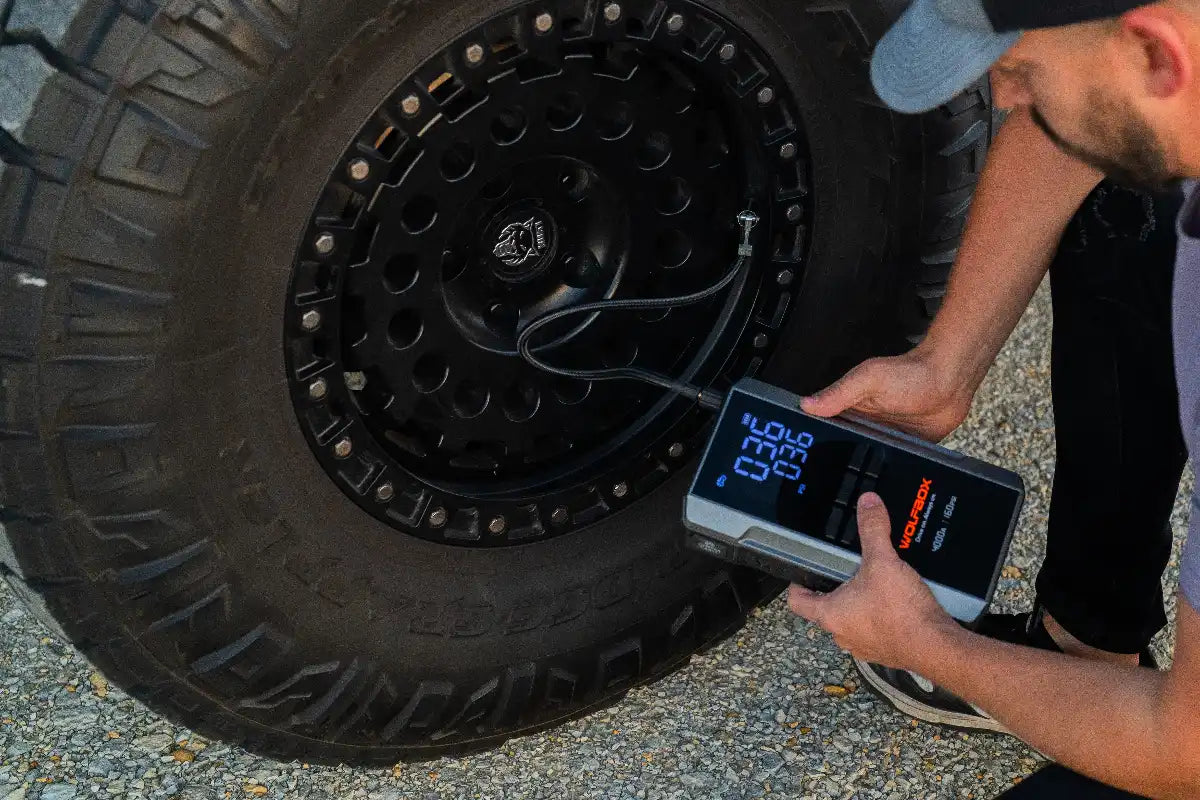
Airing down is one of the easiest ways to improve traction off-road. Lower tire pressure increases the contact patch and helps the vehicle move more comfortably over rocks, sand and uneven terrain. The less enjoyable part comes when the trail ends and it is time to get back on the highway.
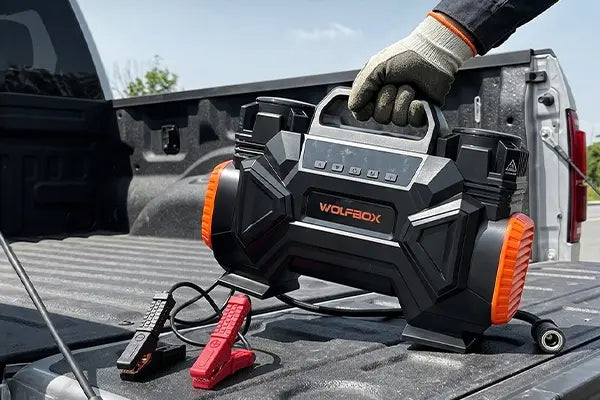
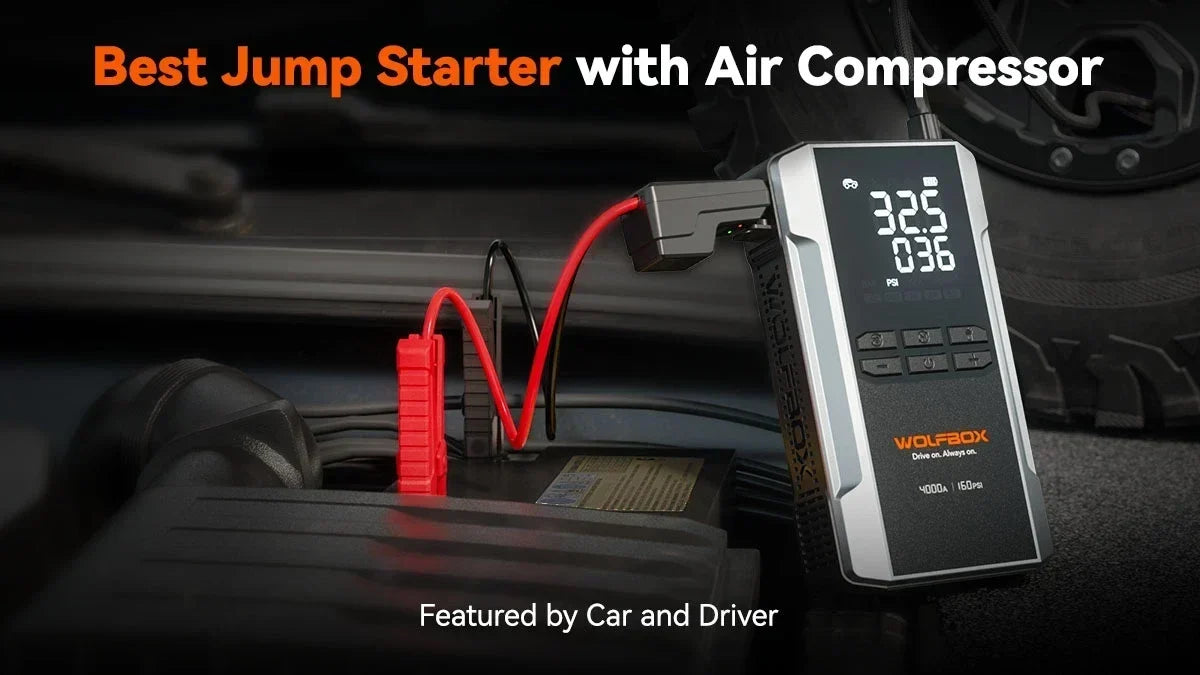
Reinflating four tires can easily add extra time to the end of the day, especially when using a small compressor that heats up quickly. A combined jump starter and air compressor such as the MegaVolt 24Air brings tire inflation and emergency battery starting together in a single 3.42 lb unit [1].
Why Airing Down Helps and What Happens After the Trail
Airing down improves off-road grip by increasing the amount of tread in contact with the ground. Lowering the pressure also lets the tire flex around rocks and ruts, taking some of the harshness out of rough sections. The downside shows up when the trail ends: before getting back on pavement, the tires have to return to their normal road pressure.
As a starting point, we use around 15 - 18 PSI on rocky trails and 12 - 15 PSI in deep sand or mud. Gravel and washboard roads usually sit closer to 20 - 25 PSI [2]. PSI stands for pounds per square inch, the unit used to measure tire pressure. If your normal road pressure is around 35 PSI, restoring all four tires from those levels means moving a considerable volume of air [1][2].
This is where compressor performance starts to matter. Inflating a 33-inch tire from 15 PSI back to road pressure keeps the compressor working for much longer than a simple 2 or 3 PSI top-up. Moreover, small inflators can begin to slow down when they are asked to run continuously.
The MegaVolt 24Air delivers up to 45 L/min and can reach 160 PSI [1]. That gives it enough output for larger tires and longer inflation sessions, rather than restricting its use to occasional top-ups.

What to Look for When Airing Tires Back Up
Airing four tires back up after a trail run can keep a compressor working for several minutes, especially when the tires are large or have been dropped to very low pressures.
Two specifications are particularly useful here: airflow and duty cycle. Airflow affects how quickly air moves into the tire, while duty cycle indicates how long the compressor can keep running before it needs to cool down. Some dedicated off-road compressors are designed for continuous operation of 30 to 40 minutes [3].
Tire size and starting pressure also affect inflation time. For the MegaVolt 24Air, our published figures include about 1 minute 50 seconds for a 37×12.5R17 tire going from 35 to 40 PSI. A 275/75R17 tire takes around 1 minute 40 seconds, while a 195/65R15 tire goes from 30 to 36 PSI in 39 seconds [1].
These figures describe relatively small pressure increases, so they should not be treated as full trail reinflation times. A tire starting at 15 or 20 PSI will keep the compressor running longer on the way back to road pressure, particularly when several large tires need to be inflated one after another.
The MegaVolt 24Air also lets you select the target pressure before starting. Once that pressure is reached, the compressor shuts off automatically [1][5]. The display supports PSI, BAR, KPA and kg/cm². For an additional check, we recommend confirming the final pressure with a separate tire gauge, particularly during your first few uses [5].
Jump-Starting After a Long Day on the Trail
After a long day on the trail, the vehicle battery may have had to support lights, accessories, a winch and repeated engine starts. If the vehicle battery is too weak to start the engine, the MegaVolt 24Air can step in as a jump starter. Its peak output is 4000A, and it can be used with gasoline and diesel engines up to 10L. Depending on the vehicle and conditions, one full charge can cover up to 40 jump starts [1].
Peak amps are the short burst of current available when the engine needs to turn over. CCA, or cold cranking amps, is measured differently: it looks at battery performance at 0°F over a 30-second test [4]. That distinction becomes especially useful when considering cold-weather starts.
Inside the unit is a 24,000 mAh, 88.8 Wh lithium battery. It is also available for charging other gear, with a 65W USB-C port and a 160W DC output at 15V/10A [1]. A 65W or higher PD charger can fully recharge the MegaVolt 24Air in about 1.5 to 2 hours [1].
The unit is rated to work between -4°F and 140°F [1]. At temperatures below 0°F, however, the lithium battery may not deliver its full capacity [4]. So, if you are camping in very cold weather, it is better to keep the jump starter somewhere warmer overnight instead of leaving it inside a freezing vehicle.
The casing is rated IP64, providing protection against dust and splashing water. There are also 10 safety functions built into the unit, covering issues such as sparks and temperatures that move outside the normal operating range [1].
How the MegaVolt 24Air Performed in Real-World Testing
Specs tell you what a product is designed to do. Real-world use gives a better idea of what that looks like in practice.
Popular Science tested the MegaVolt 24Air during an actual roadside emergency in Upstate New York, with temperatures around 0°F [6]. It successfully jump-started three vehicles one after another, including a crossover SUV, a six-cylinder pickup and a diesel Ford F-350, without needing a recharge between starts [6].
In the same Popular Science test, the compressor took an SUV tire from 25 to 35 PSI in about a minute [6]. The review did point out two drawbacks. The MegaVolt 24Air is fairly heavy for a portable jump starter, and the hose may feel short when you are working with larger wheels [6].
The inflator completed the test without issue and the 65W USB-C port was another part of the unit the reviewer used positively [6]. A 400-lumen LED light is built in as well, with high-beam, strobe and SOS modes [1]. That can be useful at night when checking tire pressure, connecting the jump-start clamps or working around the vehicle in low light.
MegaVolt 24Air Specs and Performance
| Spec | WOLFBOX MegaVolt 24Air |
|---|---|
| Peak current | 4000A |
| Battery | 24,000 mAh / 88.8 Wh lithium |
| Engine compatibility | Gas up to 10L, diesel up to 10L |
| Jump starts per charge | Up to 40 |
| Max compressor pressure | 160 PSI |
| Airflow | 45 L/min |
| Inflation (37×12.5R17, 35→40 PSI) | 1 min 50 sec |
| Inflation (195/65R15, 30→36 PSI) | 39 sec |
| USB-C output | 65W |
| DC output | 160W (15V / 10A) |
| LED light | 400 lumens, SOS / strobe / high beam |
| Ingress rating | IP64 |
| Operating temperature | -4°F to 140°F |
| Recharge time | 1.5 - 2 hours (65W+ PD) |
| Weight | 3.42 lb |
| Warranty | 30 months |
Source: WOLFBOX official MegaVolt 24Air product page [1].

When the WOLFBOX MegaVolt 24Air Is Not the Right Tool
The WOLFBOX MegaVolt 24Air works well for top-offs, moderate reinflation and emergency use. It is less suitable, however, if you regularly need to bring several large off-road tires back from very low trail pressures.
Inflating four 35-to-40-inch tires from around 12 PSI to road pressure requires a long, continuous run. That kind of workload is better handled by a dedicated compressor built for sustained use.
For heavier-duty inflation, we offer the HyperFlow 60D. This dual-cylinder compressor delivers 5 CFM at 40 PSI and has a 100% duty cycle [7]. It can take a 37-inch tire from 10 to 40 PSI in about three minutes [7].
The HyperFlow 60D is therefore a better match for drivers with very large tires or for groups airing up several vehicles at the end of a trail. The MegaVolt 24Air makes more sense as an all-in-one tool for a single vehicle, combining tire inflation, jump-starting and portable power in one unit [1][7].
Who the MegaVolt 24Air Is Best For
- Solo overlanders and weekend trail drivers with 31 - 35 inch tires: the WOLFBOX MegaVolt 24Air is a practical all-in-one option for topping up tire pressure, dealing with a dead battery and charging devices without carrying several separate tools [1].
- Drivers short on cargo space: the MegaVolt 24Air weighs 3.42 lb and combines an inflator, a jump starter and a power bank in one unit [1][8].
- Drivers who spend time in cold weather: the operating range runs from -4°F to 140°F, and the unit carries an IP64 rating [1]. At very low temperatures, the lithium battery may have less usable power available [4].
- Heavy-duty users may need a different setup: regularly reinflating several vehicles or large off-road tires from low pressures puts a much longer load on the compressor. For that kind of routine, a dedicated high-duty-cycle model is the stronger option [7].
Frequently Asked Questions
Can the WOLFBOX MegaVolt 24Air air up all four tires after a trail run?
Yes, especially when the tires only need a moderate increase in pressure. As a reference, the MegaVolt 24Air can take a 37×12.5R17 tire from 35 to 40 PSI in about 1 minute 50 seconds [1]. If you regularly need to inflate oversized tires from very low trail pressures, a dedicated high-duty-cycle compressor will be a better choice [7].
What tire pressure should I air down to off-road?
It depends on the terrain, vehicle and tire setup. As a general guide, 15 - 18 PSI can work for rocky trails, 12 - 15 PSI for deep sand and mud, and 20 - 25 PSI for gravel and washboard roads [2]. Always check the recommendations for your specific tires before airing down. Once you are back at the trailhead, the MegaVolt 24Air can be used to restore the pressure needed for road driving [1].
How many jump starts can the WOLFBOX MegaVolt 24Air provide on one charge?
The MegaVolt 24Air is rated for up to 40 jump starts per charge [1]. Peak output is 4000A, with support for gasoline and diesel engines up to 10L.
Does the WOLFBOX MegaVolt 24Air stop inflating automatically?
It does. Choose the pressure you want on the display, start the compressor and the unit will stop when that PSI is reached [1][5]. It is still a good idea to check the tire with a separate gauge, especially the first few times you use it [5].
Does the WOLFBOX MegaVolt 24Air work in freezing temperatures?
The MegaVolt 24Air can be used at temperatures down to -4°F and up to 140°F [1]. Below 0°F, the cold can reduce lithium battery capacity [4]. During a particularly cold night, bringing the unit indoors or storing it somewhere protected from freezing temperatures can help.
How long does the WOLFBOX MegaVolt 24Air take to recharge?
A full charge takes about 1.5 to 2 hours when the MegaVolt 24Air is connected to a 65W or higher PD charger [1].
References
[1] WOLFBOX MegaVolt 24Air 4-in-1 Jump Starter with Air Compressor & Tire Inflator - Official Product Page: https://wolfbox.com/products/jump-starter-with-air-compressor-tire-inflator-wolfbox-megavolt-24air
[2] WOLFBOX - Unleash Your Off-Road Potential: The Ultimate Air Compressor for Overlanding and Off-Roading: https://wolfbox.com/blogs/news/unleash-your-off-road-potential-the-ultimate-air-compressor-for-overlanding-and-off-roading
[3] WOLFBOX - How to Choose the Best Air Compressor for Off-Roading: https://wolfbox.com/blogs/news/how-to-choose-the-best-air-compressor-for-off-roading-wolfbox-portable-tire-inflator
[4] WOLFBOX - Jump Starter Buying Guide: Peak Amps vs CCA, Lithium vs Lead-Acid, and How to Size the Right Unit: https://wolfbox.com/blogs/jump-starter/jump-starter-buying-guide-peak-amps-vs-cca-lithium-vs-lead-acid-and-how-to-size-the-right-unit
[5] WOLFBOX - How to Use a Jump Starter with Air Compressor: Step-by-Step Guide: https://wolfbox.com/blogs/jump-starter-with-air-compressor/how-to-use-a-jump-starter-with-air-compressor
[6] Popular Science - I tested the Wolfbox 4-in-1 Jump Starter with Air Compressor during a real-world emergency: https://www.popsci.com/gear/wolfbox-4-in-1-jump-starter-with-air-compressor-review/
[7] PR Newswire - Wolfbox Launches HyperFlow 60D Tire Inflator, Built to Deliver 60 Minutes of Continuous Inflation: https://www.prnewswire.com/news-releases/wolfbox-launches-hyperflow-60d-tire-inflator-built-to-deliver-60-minutes-of-continuous-inflation-302800368.html
[8] WOLFBOX - Jump Starter with Air Compressor Collection: https://wolfbox.com/collections/jump-starter-with-air-compressor


Leave a comment
All comments are moderated before being published.
This site is protected by hCaptcha and the hCaptcha Privacy Policy and Terms of Service apply.