







SUVs typically sit between sedans and heavy-duty trucks in starting demand. Start with the vehicle’s stated engine compatibility and battery requirements rather than treating a battery-group label or a peak-amp headline as a complete sizing rule 12.
BCI group numbers describe battery case dimensions and terminal layout, not a fixed CCA value. An SUV may use Group 65, 34, or 48, but the actual CCA requirement still depends on the vehicle and battery specification 34. A 2020 Toyota RAV4 XLE, for instance, has a manufacturer-specified minimum CCA of 605, noticeably higher than the 350-500 CCA range typical of a compact sedan 3.
Battery Group Size and CCA by Vehicle Class
Vehicle class |
Common BCI group size |
Typical CCA range |
Jump starter peak amps to look for |
Compact sedan |
24, 35 |
350-500 CCA |
1,000-1,500A |
Midsize SUV / crossover |
35, 48, 65 |
500-650 CCA |
1,500-2,000A |
Full-size SUV / light truck |
65, 78, 34/78 |
650-800 CCA |
1,500-2,000A |
Heavy-duty diesel truck |
31, group 4D/8D |
750-1,000+ CCA |
3,000-4,000A |
These ranges are consistent across battery retailers and jump starter guides, though actual requirements shift with trim level, engine size, and climate, so treat them as a starting point rather than an exact match 156.
Why 'SUV-Rated' Should Mean More Than Just Clearing the Minimum
A jump starter aimed at SUV owners should ideally sit above the minimum threshold with real margin, not just barely clear it. SUV batteries are physically larger, and the vehicles often carry more accessory load, all-wheel-drive electronics and bigger infotainment systems draw more standby power, which leaves less headroom if the jump starter itself isn't fully charged or the morning is cold.
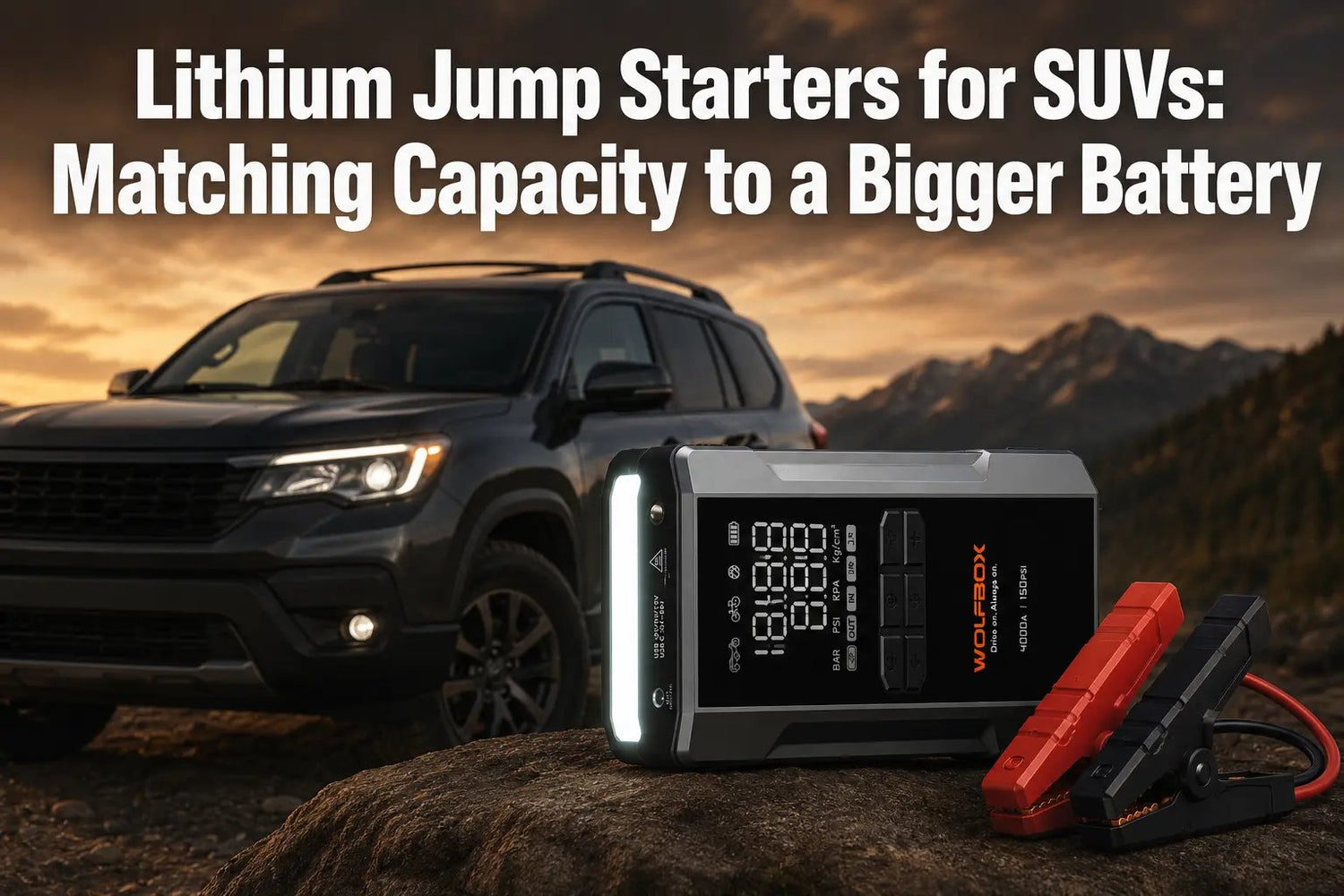
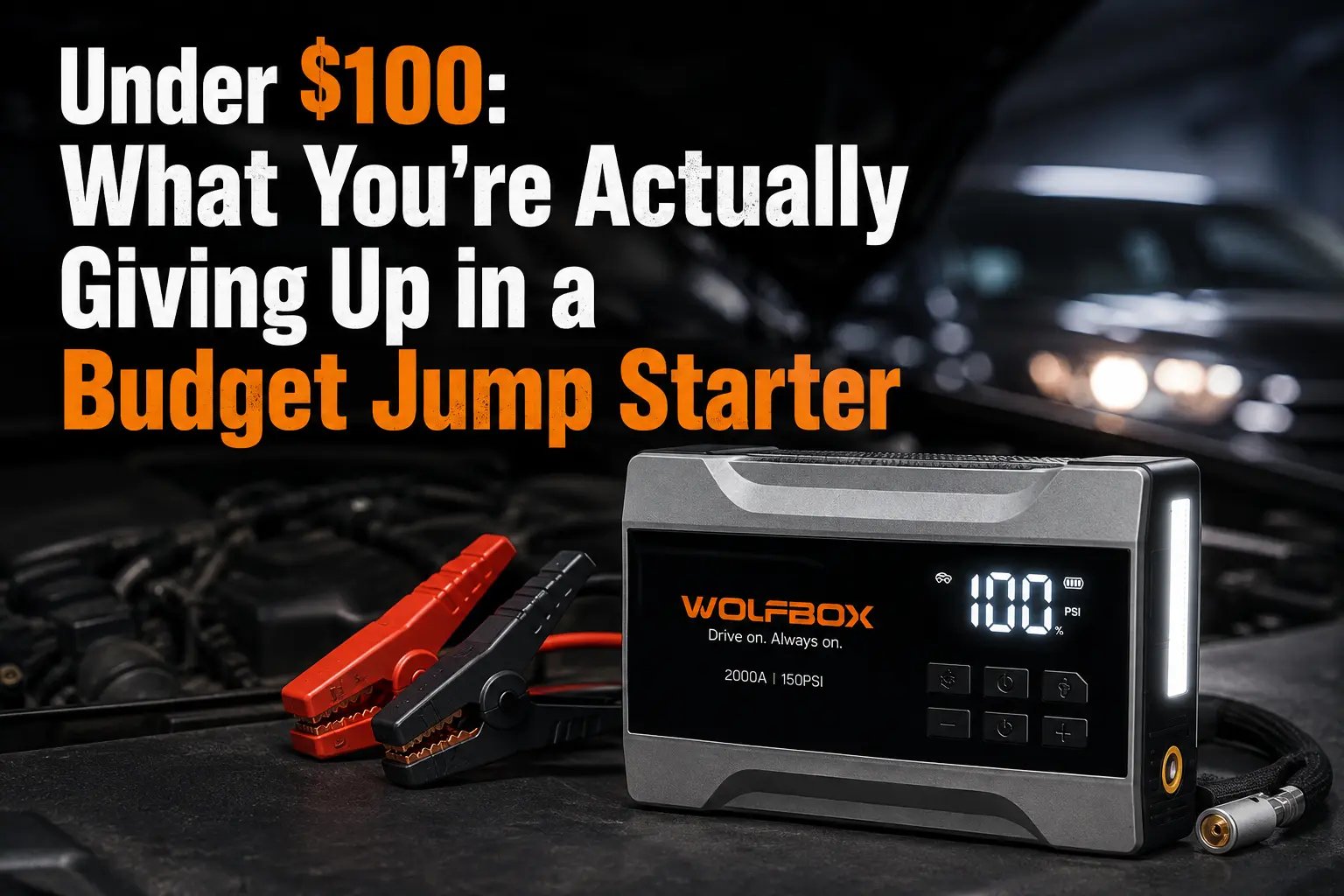
The WOLFBOX MegaVolt 24Air illustrates this margin directly: its 4,000A peak rating and coverage up to 10.0L for both gas and diesel engines sits comfortably above the 1,500-2,000A range recommended for SUVs 7, leaving room for a repeat attempt if the first jump doesn't take. A forum post from an off-road SUV owner describes using the MegaVolt 24Air on a 4Runner with a Group 34R battery and a V8 engine, noting it started the vehicle without issue on a charge that had already been partly used for tire inflation earlier that day 8.
A Quick Sizing Checklist for SUV Owners
- Check your SUV's factory battery group size and CCA rating, usually printed on the battery or listed in the owner's manual.
- For a midsize or full-size SUV, confirm that the jump starter’s stated gasoline-liter coverage meets or exceeds your engine size; treat peak amps as a comparison detail, not a direct conversion from battery CCA.
- If your SUV has an auxiliary battery, common in some hybrid and mild-hybrid models, confirm the clamps and cable length can actually reach the correct terminal.
- A documented jumps-per-charge figure is a better comparison point than peak amps alone, since a deeply discharged SUV battery may need more than one attempt.
Sizing this way avoids the two common mistakes: buying a sedan-tier jump starter and hoping it stretches to cover an SUV, or paying for diesel-truck-level capacity a typical SUV doesn't actually need.
Frequently Asked Questions
How many peak amps does a jump starter need for an SUV?
Use the jump starter’s stated gasoline-liter coverage for your engine as the primary fit check. Peak-amp figures can help compare models, but they are not directly interchangeable with a vehicle battery’s CCA rating.
Why do SUVs need a bigger jump starter than sedans?
SUVs may use larger battery groups, such as Group 65 or Group 34/78, but group numbers define physical fit rather than a fixed CCA value. Check the vehicle’s battery specification and the jump starter’s stated engine coverage together.
Can one jump starter cover both an SUV and a smaller sedan in the same household?
Yes. A jump starter sized for SUV-level demand, such as a 4,000A-rated unit, will comfortably cover a smaller sedan too, since the extra capacity is simply unused margin for the smaller vehicle.
References
1 What Amp Jump Starter Do I Need, GOOLOO buying guide: https://us.gooloo.com/blogs/basics/what-amp-jump-starter-do-i-need
2 Peak Amps vs Cranking Amps vs Cold Cranking Amps, XenonPro: https://www.xenonpro.com/blogs/home/peak-amps-vs-cranking-amps-vs-cold-cranking-amps-jump-starters
3 What Size Battery to Get for My Car, Batteries Plus: https://www.batteriesplus.com/blog/power/which-car-battery-fits
4 Battery Size Chart Guide, AutoZone: https://www.autozone.com/diy/battery/battery-size-chart-guide
5 A Complete Guide To BCI Battery Group Sizes And Their Applications: https://bslbatt.com/blogs/bci-battery-group-sizes-guide-chart-selection-applications/
6 8 Best Car Batteries of 2026, Lab-Tested and Reviewed, Consumer Reports: https://www.consumerreports.org/cars/car-batteries/best-car-batteries-of-the-year-a2280775847/
7 WOLFBOX MegaVolt 24Air 4-in-1 Jump Starter with Air Compressor, official product page: https://wolfbox.com/products/jump-starter-with-air-compressor-tire-inflator-wolfbox-megavolt-24air
8 Wolfbox MegaVolt 24 Air Compressor/Jump Starter Review, Expedition Portal forum: https://forum.expeditionportal.com/threads/wolfbox-megavolt-24-air-compressor-jump-starter-review.251435/

Leave a comment
All comments are moderated before being published.
This site is protected by hCaptcha and the hCaptcha Privacy Policy and Terms of Service apply.