







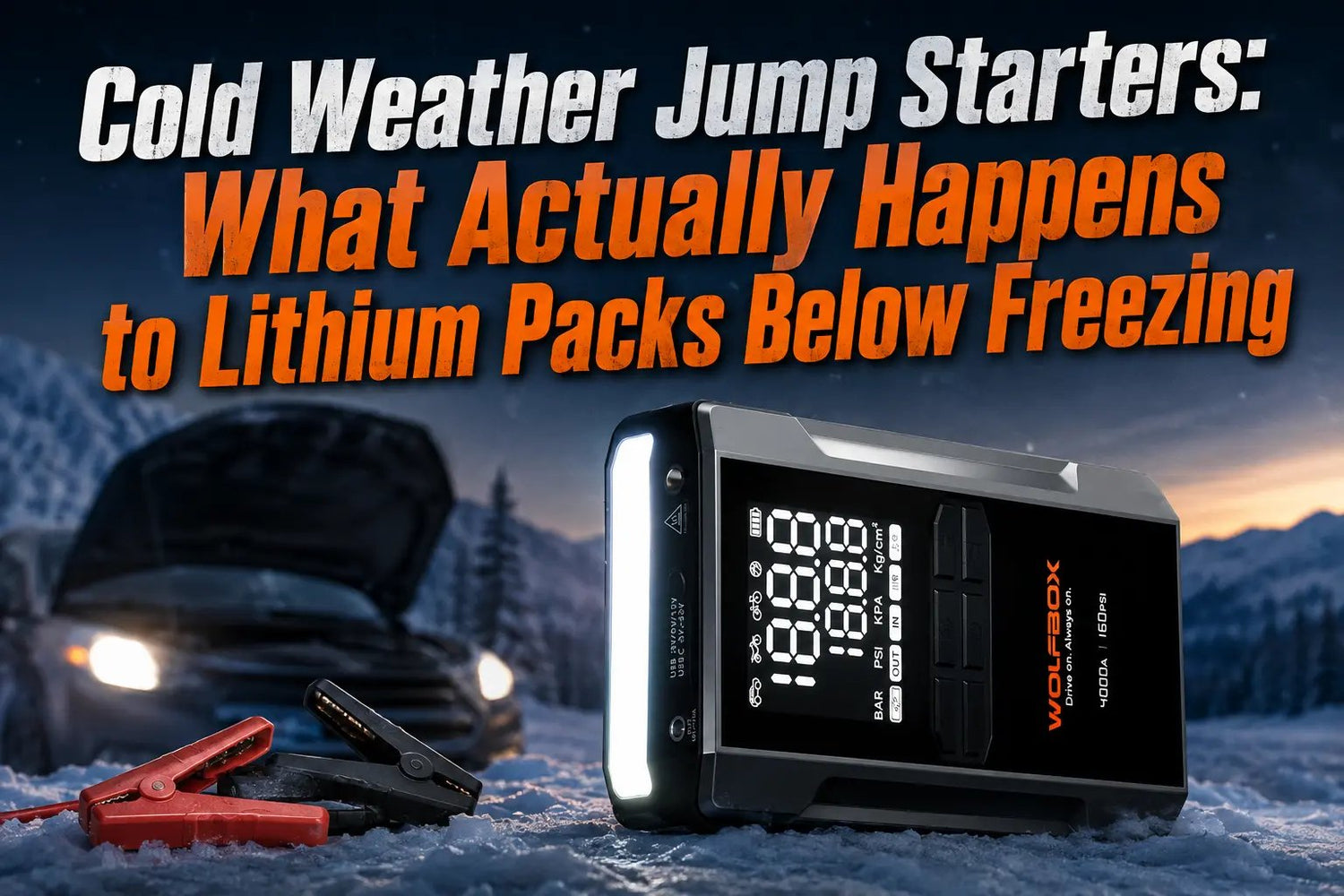
A lithium jump starter that worked perfectly in October can feel noticeably weaker in January, and that's not a defect. Internal resistance inside a lithium-ion cell rises as temperature drops, which physically limits how much current the pack can push out in a short burst 12. The question worth answering isn't whether cold weather affects these packs (it does), but by how much, and whether that drop still leaves enough power to start a car.
There's also a distinction that gets lost in most buying guides: discharging a lithium jump starter in the cold is generally fine, but charging one below freezing is not. Below roughly 32°F, lithium plating can form on the anode during charging, which degrades the cell and creates a long-term safety risk 34. A jump starter with a competent battery management system will detect this and pause or restrict charging until the pack warms up. That's a safeguard, not a flaw.
How Much Power Actually Disappears in the Cold
The honest answer is: it depends on the pack, and most brands don't publish the number. Two figures matter more than a generic 'cold-weather ready' label: the rated operating temperature range, and how much capacity the battery retains at a specific sub-zero temperature.
Spec to check |
What it tells you |
Why it matters for winter |
Rated operating temperature |
The range the unit is tested to function in, not just survive |
A pack rated only to 14°F may shut down where one rated to -4°F won't |
Capacity retention at -20°C |
Percentage of rated capacity still available at that temperature |
Tells you roughly how many jump attempts you'll realistically get |
Charge-cutoff behavior |
Whether the BMS blocks charging below freezing |
Protects the cell from plating damage during winter charging |
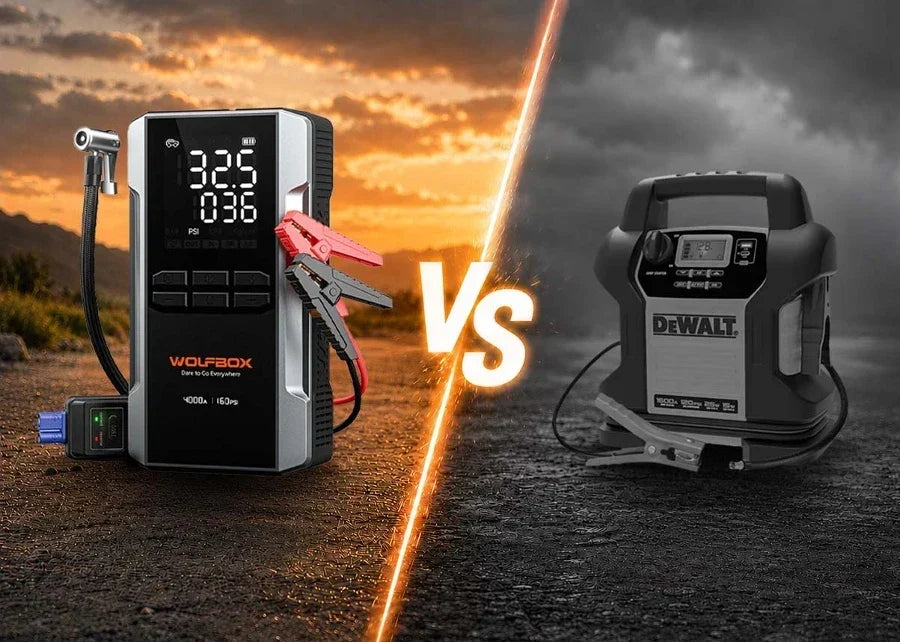
The WOLFBOX MegaVolt 24Air is rated for operation from -4°F to 140°F, with high- and low-temperature protection built into the unit 56. That published operating range is more useful than a generic “cold-weather ready” label when preparing an emergency kit for winter driving.
Why Peak-Amp Numbers Can Be Misleading in Winter
Peak amps are usually measured at room temperature, and that number says nothing about cold-weather output. A pack that boasts an impressive peak-amp rating on the box but has no published cold-temperature data could underperform in January in ways the spec sheet never warns you about. Popular Science's hands-on testing of the WOLFBOX MegaVolt 24Air noted it functioned at 0°F during their review period 7. On a full charge, WOLFBOX MegaVolt 24Air can remain on standby for 6 to 12 months before needing a recharge, so periodically topping off any lithium emergency device is sound practice regardless of brand.
Consumer Reports has similarly found real variation in jump-starter performance across brands under testing, which reinforces that a single peak-amp figure isn't a reliable stand-in for how a unit behaves outside ideal conditions 8. If a manufacturer only advertises peak amps and skips the cold-weather number entirely, that's worth treating as a gap in the spec sheet, not an oversight to shrug off.
What to Actually Do With a Jump Starter in Winter
- Keep it in the cabin, not the trunk, on nights when temperatures drop near or below freezing.
- Charge it at room temperature. If it's been sitting in a cold car, let it warm up before plugging it in.
- Look for a published capacity-retention figure at a specific sub-zero temperature, not just a wide operating range.
- Keep the pack above roughly 50% charge through winter; a fuller charge gives more usable output in the cold.
- If a first jump attempt fails, wait about a minute before trying again. The pack can warm slightly during use, which helps.
None of this makes a lithium jump starter immune to cold weather, but it explains why two packs with identical peak-amp claims can behave very differently once the temperature actually drops.
Frequently Asked Questions
Do lithium jump starters stop working in freezing temperatures?
Not usually, but their output drops. A unit with a documented capacity-retention figure at sub-zero temperatures, rather than just a wide operating range, is a better predictor of cold-weather performance.
Is it safe to charge a jump starter when it's cold outside?
No, not below about freezing. Charging lithium cells below 32°F risks lithium plating, so bring the unit to room temperature first. A jump starter with a proper battery management system will usually restrict charging automatically in these conditions.
What operating temperature range should a winter jump starter cover?
Check the model’s published operating range rather than assuming every lithium pack behaves the same. The WOLFBOX MegaVolt 24Air is rated to operate from -4°F to 140°F and includes high- and low-temperature protection.
References
1 Assessing the Feasibility of a Cold Start Procedure for Solid State Batteries, MDPI Batteries: https://www.mdpi.com/2313-0105/8/2/13
2 All-temperature area battery application mechanism and strategies, PMC: https://pmc.ncbi.nlm.nih.gov/articles/PMC10336268/
3 Lithium Jump Packs Vs. Cold Weather, technical forum discussion: https://www.ar15.com/forums/t_1_5/2824319_Lithium-Jump-Packs-Vs--Cold-Weather.html
4 Battery warm-up methodologies at subzero temperatures, Journal of Power Sources: https://linkinghub.elsevier.com/retrieve/pii/S0360128519301169
5 WOLFBOX MegaVolt 24Air 4-in-1 Jump Starter with Air Compressor, official product page: https://wolfbox.com/products/jump-starter-with-air-compressor-tire-inflator-wolfbox-megavolt-24air
6 Lithium vs Lead Acid Jump Starter: Which Technology Wins, WOLFBOX: https://wolfbox.com/blogs/jump-starter/lithium-vs-lead-acid-jump-starter
7 I tested the Wolfbox 4-in-1 Jump Starter with Air Compressor, Popular Science: https://www.popsci.com/gear/wolfbox-4-in-1-jump-starter-with-air-compressor-review/
8 Best Jump Starter Buying Guide, Consumer Reports: https://www.consumerreports.org/cars/jump-starters/buying-guide/


Leave a comment
All comments are moderated before being published.
This site is protected by hCaptcha and the hCaptcha Privacy Policy and Terms of Service apply.