
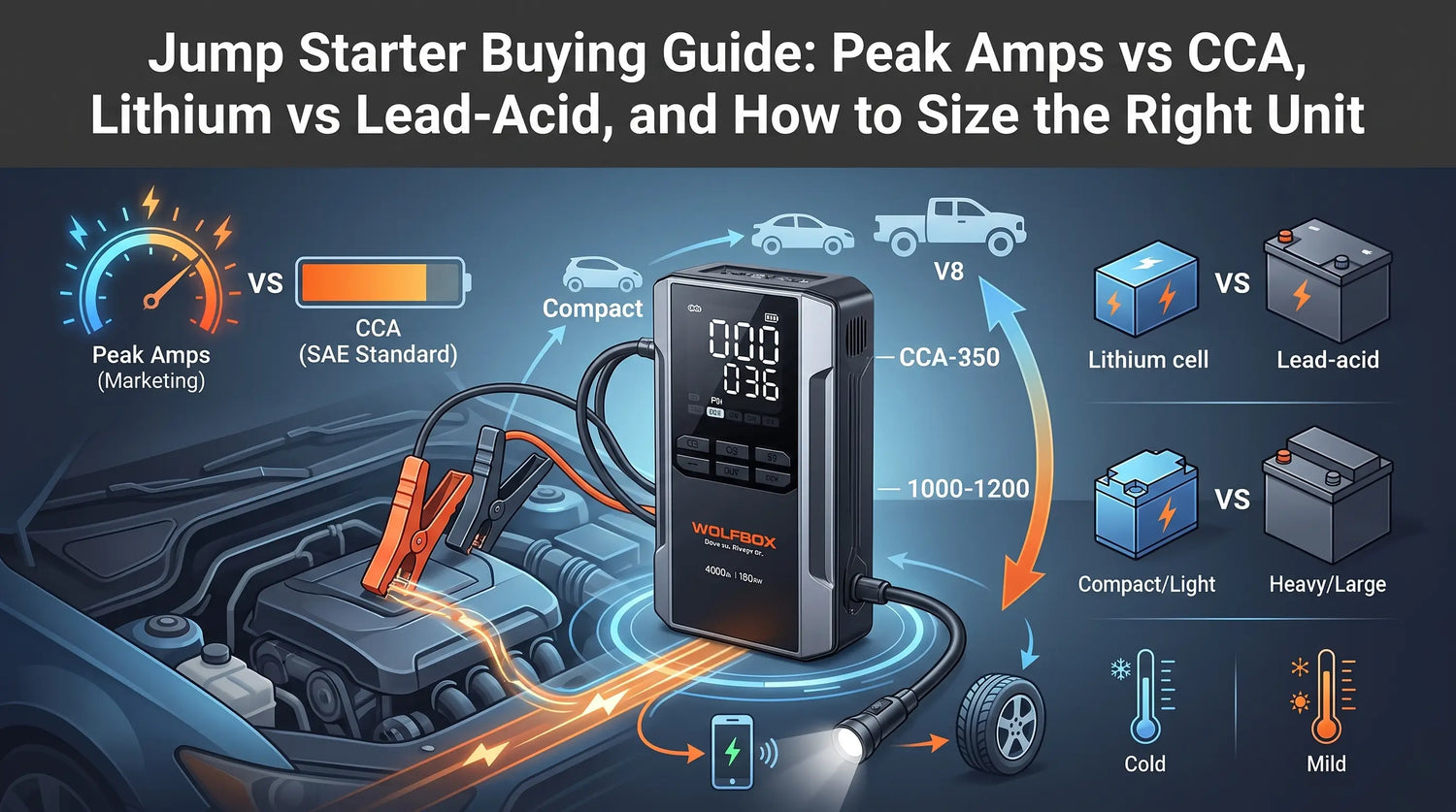
The most common complaint about portable jump starters comes from buyers who purchased a unit advertised at 2,000 peak amps — and watched it fail to start a V8 truck. The problem is not the jump starter. Peak amps is an unregulated marketing number with no industry standard definition. It measures nothing that directly correlates to vehicle starting ability. Cold Cranking Amps (CCA) is the metric that does, and understanding the difference will tell you more about any jump starter than any headline spec on the packaging.
Peak Amps vs Cold Cranking Amps: What Each Number Means
Cold Cranking Amps (CCA) is defined by SAE standard J537. It specifies the amps a 12-volt battery delivers at 0°F (−18°C) for 30 seconds while maintaining at least 7.2 volts.1 This test simulates the worst-case cold-weather starting scenario a vehicle battery faces. It's a standardized, reproducible measurement that OEMs and battery manufacturers use consistently.
Peak amps have no standard definition. Manufacturers measure them at different temperatures, under different load conditions, and sometimes as a momentary pulse that lasts fractions of a second. A jump starter labeled "2,000 peak amps" may deliver far less sustained current than one labeled "1,000 CCA." Peak amps is a marketing number; CCA is an engineering number.
CCA Requirements by Engine Type
The ranges below come from SAE J537 standard data and OEM vehicle specifications.1 3 These apply to healthy batteries in moderate weather. Cold climates and older batteries push requirements toward the upper end.
Engine Type / Displacement |
Recommended CCA Range |
Notes |
4-cylinder gas, 1.5–2.5L |
350–450 CCA |
Most compact cars and hybrids |
6-cylinder gas, 3.0–3.5L |
550–650 CCA |
Midsize sedans, crossovers, minivans |
8-cylinder gas, 4.0–6.2L |
650–800 CCA |
Trucks, SUVs, full-size cars |
Diesel, under 4.0L |
700–850 CCA |
Higher cranking demand than equivalent gas |
Diesel, 6.0–10L |
900–1,200+ CCA |
Heavy trucks, fleet vehicles |
Any engine, below 0°F |
Add 20–30% to above |
Cold significantly increases cranking resistance |
Lithium vs Lead-Acid Jump Starters
Lithium jump starters (lithium iron phosphate / LiFePO4) are lighter, charge faster, and hold a charge longer when stored. A lithium unit charged three months ago will still have most of its capacity available. A lead-acid unit in the same scenario may have self-discharged significantly.2 A lithium unit small enough to fit in a glove compartment can deliver enough current to start most gasoline vehicles up to 8–10L.
The limitation that matters is cold weather. Below 0°F (−18°C), lithium cells lose effective capacity — and storing the unit overnight in a vehicle at those temperatures compounds the problem. For drivers in climates where −10°F to −20°F is a winter regular, a lead-acid booster pack is worth considering. For temperate climates, lithium is the better day-to-day choice in every other dimension.
Dimension |
Lithium (LiFePO4) |
Lead-Acid |
Weight |
Typically 1–3 lbs |
Typically 10–20+ lbs |
Size |
Fits in glove compartment |
Requires trunk or cargo space |
Self-discharge rate |
Low — retains charge for months |
Higher — needs periodic recharge |
Cold weather performance |
Reduced below 0°F |
Less cold-sensitive |
Cost at equivalent CCA |
Higher |
Lower |
The WOLFBOX MegaVolt 24Air: Four Functions in One Unit
The WOLFBOX MegaVolt 24Air is rated at 4,000A with stated compatibility for gasoline engines up to 10L, delivering up to 40 jump starts on a full charge.2 It also includes a built-in air compressor (45L/min, 160 PSI) for tire inflation, a 65W USB-C PD power bank for charging laptops and phones, and a 400-lumen LED emergency light with multiple flash modes.2 The unit charges to full in approximately 1.5–2 hours using a PD 65W or higher charger and comes with a two-year warranty.2
This four-function design changes the value equation. The air compressor and power bank are useful on an average day — not just in emergencies. For drivers who want a single compact tool to handle jump starting, tire inflation, device charging, and emergency lighting without carrying multiple devices, the MegaVolt 24Air consolidates all four into one unit.
TechGearLab included the WOLFBOX MegaVolt 24 in their 13-unit jump starter roundup, naming it Best Overall Jump Starter. The MegaVolt 24Air is the upgraded model in the same line, adding an integrated air compressor, higher peak output, and diesel engine compatibility for drivers who need more capability than jump-starting alone.5
Safe Jump-Starting Procedure
- Connect red clamp to dead battery positive (+) terminal first
- Connect second red clamp to jump starter positive (+)
- Connect black clamp to jump starter negative (−)
- Connect final black clamp to unpainted metal on the dead vehicle chassis — not to the dead battery negative terminal
- Wait 60 seconds before attempting to start the engine
- Remove clamps in reverse order after the engine starts
- Run the engine for 20–30 minutes to recharge the battery before shutting off
Connecting the final ground clamp to chassis metal (rather than battery negative) reduces the risk of igniting hydrogen gas near the battery. The MegaVolt 24Air includes spark-proof clamps and reverse-polarity protection that alerts you before current flows if the clamps are connected incorrectly.2
Frequently Asked Questions
Q: What is the difference between peak amps and CCA in a jump starter?
A: CCA (Cold Cranking Amps) is a standardized SAE J537 measurement — the amps delivered at 0°F for 30 seconds at or above 7.2 volts. It directly reflects starting ability. Peak amps have no standard definition and vary between manufacturers. When comparing jump starters, CCA or stated engine displacement compatibility is more meaningful than peak amps.
Q: How many CCA do I need for my engine?
A: A 4-cylinder gas engine typically needs 350–450 CCA. A V6 needs 550–650 CCA. A V8 gas engine needs 650–800 CCA. Diesel engines need 700–1,200 CCA depending on displacement. Add 20–30% to these estimates in climates below 0°F.
Q: Can the WOLFBOX MegaVolt 24Air jump start a diesel truck?
A: The MegaVolt 24Air is rated for gasoline engines up to 10L at 4,000A. For diesel compatibility within its range, check the product page. For very large diesel trucks above 10L, or for use in climates regularly below 0°F, verify the unit's cold weather rating and consider a lead-acid booster as a backup.
Q: What does the WOLFBOX MegaVolt 24Air include besides the jump starter?
A: A built-in air compressor (45L/min, 160 PSI) for tire inflation, a 65W USB-C PD power bank for laptops and phones, and a 400-lumen LED emergency light with multiple flash modes. It delivers up to 40 jump starts per charge, recharges in approximately 1.5–2 hours with a PD 65W charger, and includes a two-year warranty.
Q: Why does my lithium jump starter perform worse in winter?
A: Lithium cells lose effective capacity below 0°F (−18°C). Storing the unit in a vehicle at sub-zero temperatures overnight compounds this. For deep-cold climates, warm the jump starter above 32°F before use if possible, or use a lead-acid booster for extreme cold conditions.
Q: Is it safe to jump start a car with a lithium jump starter?
A: Yes, with correct clamp placement. Use a unit with reverse-polarity protection to prevent voltage issues if clamps are connected incorrectly. Connect clamps in the right order, use chassis metal for the final ground connection rather than the dead battery negative terminal, and wait 60 seconds before cranking.
Q: What warranty does the WOLFBOX MegaVolt 24Air include?
A: The WOLFBOX MegaVolt 24Air comes with a 30-month warranty from WOLFBOX.
References
1. Battery University – CCA and Battery Standards: https://batteryuniversity.com/article/bu-902-what-is-capacity
2. WOLFBOX MegaVolt 24Air Official Product Page: https://wolfbox.com/products/jump-starter-with-air-compressor-tire-inflator-wolfbox-megavolt-24air
3. Battery University – Discharge Basics and SAE J537: https://batteryuniversity.com/article/bu-501-basics-about-discharging
4. Argonne National Laboratory – Cold Weather and Battery Performance: https://www.anl.gov/article/cold-weather-significantly-reduces-electric-vehicle-range
5. Wired – Best Jump Starters: https://www.wired.com/story/best-jump-starters/
6. ProToolReviews – Best Jump Starters Tested and Reviewed: https://www.protoolreviews.com/best-jump-starter/
7. Consumer Reports – Portable Jump Starters Buying Guide: https://www.consumerreports.org/car-maintenance-repairs/portable-jump-starters-buying-guide/
8. WOLFBOX MegaVolt 24: https://wolfbox.com/products/wolfbox-megavolt24-jump-starter
9. WOLFBOX About Us: https://wolfbox.com/pages/about-us


Leave a comment
All comments are moderated before being published.
This site is protected by hCaptcha and the hCaptcha Privacy Policy and Terms of Service apply.