
Key Takeaways
- Side steps for trucks cover eight distinct types, each built for a different job, budget, and driving style
- Running boards, nerf bars, hoop steps, and truck steps all address cab entry but with different clearance and style tradeoffs
- Power running boards are the most versatile option for owners who split time between pavement and the trail
- Rock sliders prioritize protection over comfort and are built specifically for serious off-road use
- Retractable bed steps solve a problem that all other side steps ignore, getting into the truck bed safely
- The right choice comes down to your truck, your use case, and how much ground clearance you can afford to lose
- Wide, flat step surface gives confident footing for passengers of all sizes
- Full-length design supports entry at every door
- Available for nearly every truck and SUV on the market
- Come in multiple finishes, from polished aluminum to textured black
- Generally straightforward bolt-on installation
- Reduce ground clearance permanently
- Vulnerable to scraping on curbs, speed bumps, and trail terrain
- Fixed in place, no retraction when you don't need them
- Can collect mud, snow, and road grime over time
- Retract fully when not in use, no permanent clearance loss
- Automatic deployment with door open, retraction when door closes
- Clean, flush look against the rocker panel
- Wide step surface when deployed, comparable to a fixed running board
- Works well on both stock and lifted trucks
- Higher upfront cost, typically $900 to $1,500 or more
- Requires electrical hookup during installation
- More components than fixed boards, more to maintain over time
- If the motor or sensor fails, the step won't deploy automatically
- Improved safety and visibility when boarding at night or in low-light conditions
- Distinctive visual appeal that sets the truck apart
- LEDs are low-draw and long-lasting
- Often available with color customization options
- More expensive than standard fixed running boards
- Adds electrical complexity to installation
- Light strips can accumulate dirt and road grime over time
- Not a priority upgrade for most truck owners who don't frequently board at night
- More budget-friendly than running boards or power boards, often $100 to $400
- Sportier, more aggressive visual profile
- Offer some side protection from road debris and trail brush
- Available in cab-length and wheel-to-wheel configurations
- Relatively simple bolt-on installation
- Narrower step pads mean less stable footing than a running board
- Do reduce ground clearance, similar to fixed boards
- Step pads can become slippery in wet, icy, or muddy conditions
- Less ideal for families with young kids or passengers who need a wider foothold
- High-clearance main tube reduces exposure on the trail
- Drop steps positioned close to the ground for easier entry
- Rugged, off-road aesthetic fits lifted and modified builds
- Good compromise between clearance and accessibility
- Less step surface area than a full running board
- Drop step design can catch on rocks or debris if not mounted high enough
- Not ideal for passengers who need a wide, stable platform
- Generally more expensive than standard nerf bars
- Clean, low-profile look that doesn't change the truck's visual silhouette much
- Lighter and simpler than full running boards or nerf bars
- Mounts directly to the rocker panel, typically straightforward installation
- Good option for stock-height trucks where a full running board would be overkill
- Less step surface area than running boards or even most nerf bars
- No lateral rocker panel protection
- Not suitable for lifted trucks where a deeper drop is needed
- Doesn't look as rugged or aggressive as hoop steps or nerf bars on modified builds
- Genuine frame-mounted protection for rocker panels on the trail
- Can double as a recovery point on some designs
- Frame-level strength that no bolt-on running board can match
- Aggressive, purpose-built aesthetic for serious off-road trucks
- Often compatible with Hi-Lift jack positioning
- Comfort and accessibility are secondary, not as easy to step on as a running board
- Generally more expensive than other side step types
- Installation requires more effort and may need frame attachment points
- Overkill for trucks that stay on pavement or mild terrain
- Directly solves tailgate height access problems that other steps don't address
- Tucks away when not in use, no clearance impact, no exposed hardware
- Quick to deploy and solid underfoot
- Compatible with most tonneau covers and bed setups
- Available for a wide range of popular truck models
- Won't help with cab door entry, that's a different category
- Requires a truck-specific fit, confirm compatibility before buying
- Some installations may need minor drilling or bracket work
- Can interfere with certain towing setups depending on placement
Why Truck Owners Need to Know the Difference
Modern full-size pickups sit high. A stock F-150 or Silverado can put the cab entry point 20 inches or more off the ground, and tailgate heights on most half-tons land between 30 and 35 inches. That's a real climb every time you're loading gear, helping a kid into the back seat, or hopping in after a long shift.
Side steps solve the access problem. But "side steps" isn't one product. It's a broad category with eight distinct types, each designed around a specific need. Buy the wrong one and you're either scraping it on a trail, or spending more than you need to on features your truck doesn't require.
Here's the breakdown.
1. Running Boards
What They Are
Running boards are the classic truck step. They're wide, flat platforms that mount horizontally along the rocker panels beneath the cab doors. Most run the full length of the cab, from the front door to the rear, giving passengers one continuous surface to step onto.
They've been around since the early days of automobiles, and for good reason. They work.
Who They're For
Running boards are the go-to for daily drivers, families, and work trucks that stay on pavement or mild terrain. If you've got kids, elderly passengers, or shorter riders climbing in and out regularly, a full-length running board is the most stable and accessible option available. They're especially popular in the South and Midwest where off-road clearance isn't a primary concern.
Pros
Cons
2. Power Running Boards
What They Are
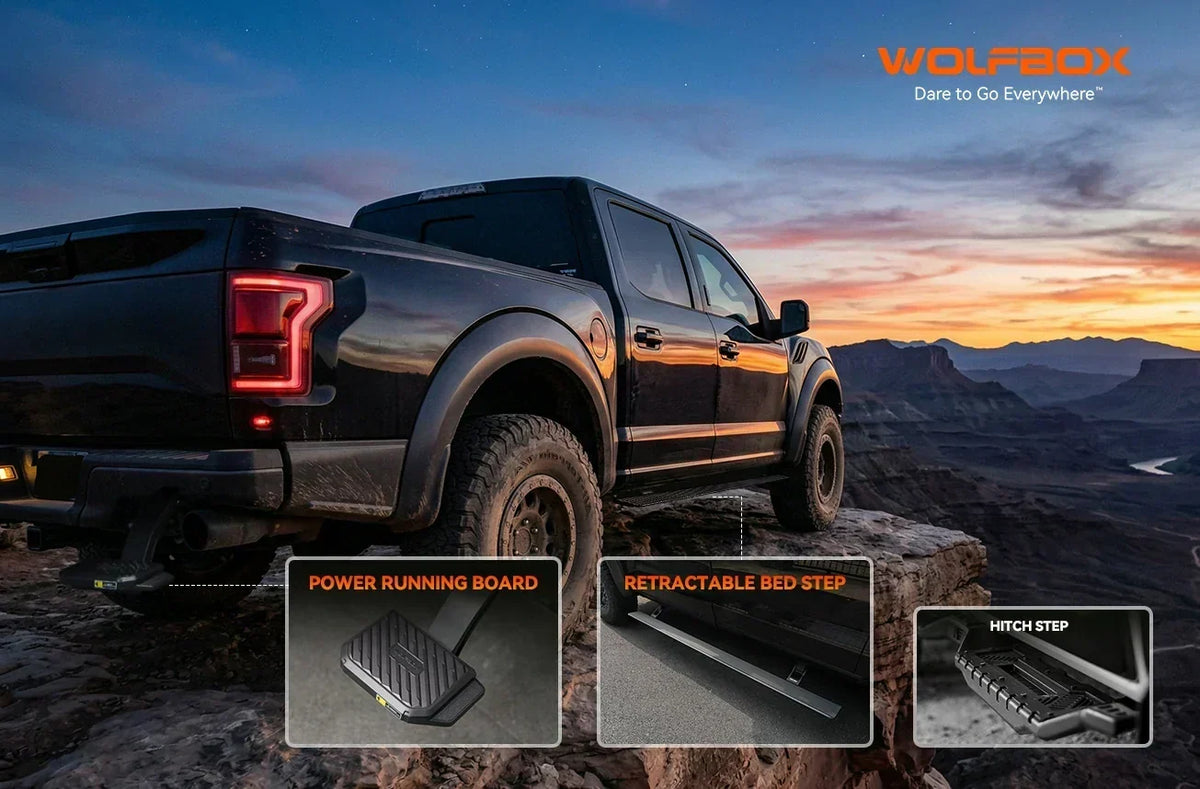
Power running boards are motorized versions of the traditional running board. They extend automatically when a door opens and retract flush to the truck body when the door closes. When tucked away, they sit completely out of the picture, no ground clearance loss, no exposed hardware catching trail debris.
They're the most technologically advanced side step in the category and the most versatile for mixed-use ownership.
Our WOLFBOX Power Running Boards are built for exactly this kind of dual-use life. Heavy-duty construction for the trail, smooth automatic deployment for every day. Whether you're running a shelf road in the Southwest desert or dropping the kids off at school in Minnesota, they adapt to both without you thinking twice about it.
Who They're For
Power boards are the right call for truck owners who genuinely split time between off-road use and daily driving. They're also a strong choice for lifted trucks, where fixed steps would hang too low or make entry awkward. If ground clearance matters to your build but you still want real step-up access, this is the answer.
Pros
Cons
3. Lighted Running Boards
What They Are
Lighted running boards are fixed or power running boards with integrated LED lighting built into the step surface or along the underside. They illuminate when a door opens, lighting up the step and the ground below it.
Who They're For
Useful for truck owners who frequently get in and out at night, whether that's on a job site, a campsite in the Rockies, or a dark parking lot. They add a layer of visibility without requiring a flashlight, and the LED strips also give the truck a more distinctive look at night.
Pros
Cons
4. Nerf Bars
What They Are
Nerf bars, also called step bars or side bars, are tubular steps that mount under the cab doors. They're typically round or oval in cross-section, made from steel, stainless steel, or aluminum, and feature small step pads positioned at each door opening rather than a continuous flat surface.
The name actually comes from motorsports. Nerf bars were originally used on race cars to prevent tires from touching during close-quarters racing. The tubular design was adopted by the truck aftermarket and has been a staple ever since.
Who They're For
Nerf bars are popular with truck owners who want some cab access improvement without the visual bulk of a full running board. They suit sport-oriented builds, single-cab and extended-cab trucks, and owners who prioritize a cleaner, more aggressive look over a wide step platform. They work fine on stock-height trucks but can get complicated on lifted builds depending on how low they hang.
Pros
Cons
5. Hoop Steps
What They Are
Hoop steps share the tubular look of nerf bars but with a key structural difference. They feature a main tube that runs tightly against the rocker panel, with individual drop steps positioned at each door that hang lower, closer to the ground, giving a deeper step down than a standard nerf bar. The result is a high-clearance mounting position for the main tube with accessible step placement where it counts.
They feature a high-clearance design that perfectly complements off-road builds, and that's exactly where they tend to show up most.
Who They're For
Hoop steps are aimed at off-road and overland builds that want trail-capable clearance without giving up a functional step. You'll see them on lifted Tacomas, Silverados, and Broncos running moderate to aggressive terrain. They sit higher than standard nerf bars but still give you a solid point to step from.
Pros
Cons
6. Truck Steps
What They Are
Truck steps, sometimes called drop steps or individual steps, skip the main tube entirely. Instead of a bar running the length of the cab, individual step brackets mount directly to the rocker panel at each door opening. The result is a minimalist, compact step that's barely visible from a distance.
Truck steps mount directly to your vehicle's rocker panels for a sleek, minimalist design.
Who They're For
Truck steps work well for owners who want a functional step without any visual bulk. They're popular on work trucks and daily drivers where aesthetics lean toward clean and understated. They're also a practical choice when the goal is simple cab entry improvement with minimal installation complexity.
Pros
Cons
7. Rock Sliders
What They Are
Rock sliders are a different beast. They're heavy-duty steel tubes that mount directly to the truck's frame, sitting tight against the rocker panels. Their primary job is protection, not access. On technical terrain, they take the hit from rocks, ledges, and obstacles that would otherwise dent or tear the sheet metal on the truck's underbody.
Many rock sliders double as a step point, and some include integrated step pads, but that's secondary to their structural role.
Who They're For
Rock sliders are built for serious off-road use. If you're running technical trails in Utah, crawling through the Pacific Northwest backcountry, or doing anything that puts your rocker panels in danger, sliders are the upgrade that matters. They're common on Wrangler JL builds, Tacoma trail rigs, and Broncos running anything more than light gravel.
Pros
Cons
8. Retractable Bed Steps
What They Are
Retractable bed steps solve a problem the other seven types don't touch. Getting into the truck bed. Running boards and nerf bars are all about cab door entry. But truck bed tailgates on most full-size pickups sit 30 to 35 inches off the ground, and reaching in and out repeatedly while hauling gear gets old fast, especially in colder states where you're bundled up or on trails where you've got boots and layers on.
A retractable bed step mounts near the rear wheel well and deploys with a kick or simple push, giving you a solid foothold to step up into the bed. When you're done, it tucks back in cleanly so it doesn't affect clearance or catch on debris.
Our retractable truck bed steps are built with durable hardware, quick deployment, and compatibility with most tonneau cover setups. If you're hauling regularly or loading heavy gear, this is the step that actually solves the problem.
Who They're For
Retractable bed steps are a practical upgrade for anyone who loads and unloads the truck bed often. That includes weekend overlanders packing gear for a trip in the Sierra Nevada, contractors pulling heavy tools in and out of a work truck, or farmers in the Plains states stacking feed bags in a Silverado. They're also a smart pairing with a tonneau cover since they tuck away and don't interfere with cover operation on most setups.
Pros
Cons
Side Steps for Trucks: Full Comparison
|
Feature
|
Running Boards
|
Power Boards
|
Lighted Boards
|
Nerf Bars
|
Hoop Steps
|
Truck Steps
|
Rock Sliders
|
Bed Steps
|
|
Cab Entry
|
Yes
|
Yes
|
Yes
|
Yes
|
Yes
|
Yes
|
Limited
|
No
|
|
Bed Access
|
No
|
No
|
No
|
No
|
No
|
No
|
No
|
Yes
|
|
Ground Clearance Impact
|
Moderate
|
None (retracted)
|
Moderate
|
Low to Moderate
|
Low
|
Minimal
|
None
|
None
|
|
Trail Protection
|
No
|
No
|
No
|
No
|
Partial
|
No
|
Yes
|
No
|
|
Install Complexity
|
Low
|
Moderate
|
Moderate
|
Low
|
Low
|
Low
|
High
|
Low
|
|
Price Range
|
$150-$600
|
$900-$1,500+
|
$300-$800
|
$100-$400
|
$200-$600
|
$100-$350
|
$400-$1,000+
|
$150-$250
|
|
Best For
|
Daily drivers, families
|
Mixed use, lifted trucks
|
Night-use, style
|
Budget builds, sport look
|
Off-road, lifted builds
|
Minimalist builds
|
Trail rigs
|
Haulers, overlanders
|
According to SAE International, vehicle dimensional standards including step heights are governed by SAE J1100, which helps aftermarket manufacturers design steps to consistent geometry across vehicle platforms. That matters when you're buying steps and need proper fitment on your exact truck.
Which Type Is Right for Your Truck?
Here's the short version. If you've got a family truck that stays on pavement, fixed running boards or lighted boards cover you well. If you split time between daily driving and the trail, power running boards are worth the investment. If you want a budget-friendly step with a sportier look, nerf bars are the practical pick. Hoop steps and truck steps suit lifted and modified builds where clearance and clean aesthetics both matter. Rock sliders are for serious off-road rigs where protection comes before comfort. And if you load the bed regularly, a retractable bed step fills a gap that none of the other options address.
We carry truck steps and running boards across the categories that matter most for truck owners at WOLFBOX. Every product comes with our Guaranteed Fit promise, and our installation guides walk you through the process from start to finish. If it doesn't fit your rig, it's on us. Check out our full steps and running boards collection to find what fits your truck and your build.
FAQs
What are the different types of side steps for trucks?
The eight main types are running boards, power running boards, lighted running boards, nerf bars, hoop steps, truck steps, rock sliders, and retractable bed steps. Each serves a different purpose depending on whether you need cab entry, bed access, trail protection, or a combination.
What's the difference between nerf bars and running boards?
Running boards are wide, flat platforms that run the full length of the cab and provide a continuous step surface. Nerf bars are tubular and feature smaller step pads at each door opening rather than a full-length platform. Running boards give more stable footing; nerf bars have a more aggressive, sport-oriented look and are generally more affordable.
What are hoop steps and how are they different from nerf bars?
Hoop steps feature a main tube that sits high against the rocker panel with individual drop steps hanging lower at each door. Nerf bars typically run at a consistent height with step pads built in. The hoop design gives better trail clearance for the main tube while still providing accessible footing at the entry points.
Do power running boards affect ground clearance?
No. When retracted, power running boards sit flush against the rocker panels. Ground clearance is only affected when the boards are extended, which happens automatically when a cab door opens. That's what makes them ideal for trucks that see both pavement and off-road use.
What is a retractable bed step and who needs one?
A retractable bed step mounts near the rear wheel well and deploys when you kick or press it, giving you a solid foothold to climb into the truck bed. It tucks away when not in use. It's built for truck owners who load and unload the bed frequently and need a safe, reliable way to reach a tailgate that sits 30 or more inches off the ground.
Will installing side steps void my truck warranty?
In most cases, no. Under the Magnuson-Moss Warranty Act, as outlined by the Federal Trade Commission, a manufacturer generally can't void your warranty simply because you added an aftermarket accessory. However, if a specific part causes damage, that damage may not be covered. Check your owner's manual or talk to your dealer if you have concerns about your specific setup.
What type of side step is best for an off-road truck?
It depends on what you need. Rock sliders offer the most trail protection for serious technical driving. Hoop steps provide better clearance than standard nerf bars with usable step access. Power running boards retract fully so they don't sacrifice clearance during driving. For bed access on the trail, a retractable bed step is the practical addition.


Leave a comment
All comments are moderated before being published.
This site is protected by hCaptcha and the hCaptcha Privacy Policy and Terms of Service apply.