
Key Takeaways
- Placement matters as much as brightness. A great light in the wrong spot throws glare back at you or lights up the wrong thing.
- Bumper and grille mounts are the go-to for long-range spot beams, and they keep light off your hood.
- A-pillar ditch lights cover the sides of the trail, and they work best with wide flood or amber beams.
- Roof lights reach farthest, but they cause the most hood glare, dust backscatter, and wind noise.
- Check your state's rules on auxiliary lamps before you wire anything to run on the highway.
You bolted on a pair of bright pods, flipped the switch on a dark two-track, and something felt off. Maybe the hood lit up like a mirror. Maybe the dust turned into a white wall.
That's not a brightness problem. It's a placement problem.
Good off-road lighting starts with a simple question: what job does each light need to do? Once you answer that, the right mounting spot usually becomes obvious. Below, we break down each common position, the beam that fits it, and the mistakes we see most often.
Start With the Job, Then Pick the Spot
Every beam pattern has a natural home.
- Spot beams throw a narrow, long beam far down the trail. They're for speed and distance.
- Flood beams spread light wide and short. They fill in the sides, corners, and the ground near your tires.
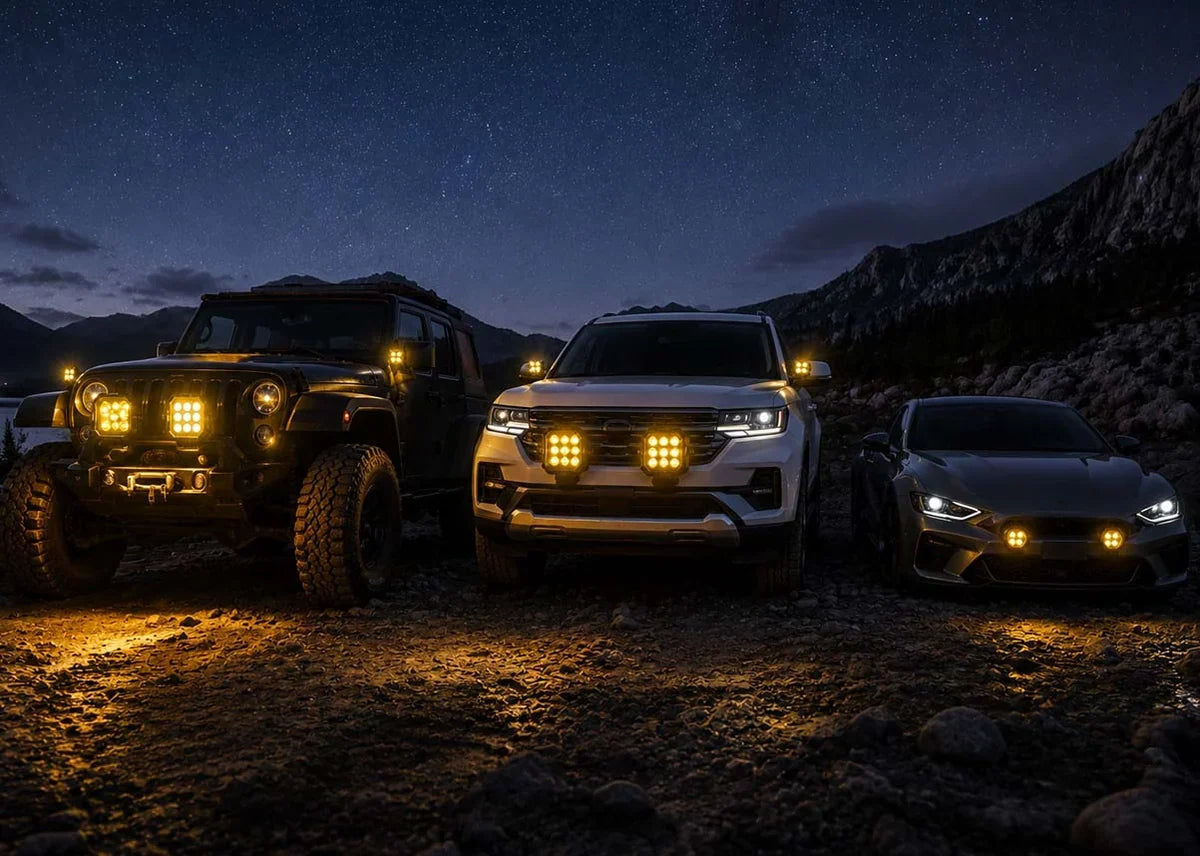
- Amber light is easier on the eyes in rain, snow, and dust, since it tends to reflect back less than bright white light.
So a spot pod belongs where it can see straight ahead without anything in the way. A flood pod belongs where it can wash light across a wide area. If you want a deeper look at beam types, our guide to LED off-road light types and beam patterns covers each one side by side.
The Main Off-Road Lighting Mounting Locations
Front Bumper and Grille
For most rigs, this is where the heavy hitters go.
A bumper or grille mount puts your lights low and forward, close to headlight height. That means no hood glare, a clean line of sight down the trail, and short wiring runs to the battery. Lights mounted low also tend to sit under dust and fog instead of shining into the thick of it at eye level.
The WOLFBOX NomadRover 7" Off-Road LED Pod Lights put out 15,500 raw lumens per pod and a rated beam distance of 575 meters at 1 lux behind a 304 stainless steel U-bracket. That U-bracket is the industry-standard off-road mounting interface, and it fits more than 99% of modified front bumpers, roof racks, and universal mounting bases that come with pre-drilled holes, so the same lamp can live on the bumper, on a roof rack, in the grille, on the hood, or on an A-pillar.
WOLFBOX does not ship vehicle-specific brackets in the box because the right base depends on your truck and your mounting position; vehicle-specific A-pillar brackets are sold separately for Tacoma (16-23), 4Runner (14-24), Tundra (14-21), F-150 (2021+), Ram 1500 (19+), Silverado HD (20+), F-150 Raptor (15-20), Bronco (2021+) and Wrangler JL/JT (18+).
Mounting is easier than most people expect. The WOLFBOX A-Pillar Ditch Light Brackets for the 2021-2026 Ford F-150 bolt to the factory hood hinge mounting points - a 100% reversible bolt-on install with zero drilling or cutting. Want two pods per side? The WOLFBOX Dual LED Pod Mounting Bracket bolts onto a vehicle-specific A-pillar base and carries a dual setup: two 3" pods side by side, or a 5" pod paired with a 3" pod. It is laser-cut from 304 stainless steel and works with most aftermarket pods, as long as the center-to-center distance between the two mounting holes stays under 120 mm (4.72 in).
For a midsize truck or a Jeep, the WOLFBOX NomadRover 5" LED pods are a common bumper pick, with a white spot beam rated to 432 meters at 1 lux.
Watch for two things up front. Don't block airflow to your radiator with a wall of lights. And keep pods away from the very edges of the bumper, where brush and rocks hit first.
A-Pillar (Ditch Lights)
Ditch lights mount near the base of the windshield, just above the fender line. Their job isn't distance. It's the edges of the trail: the washout on your right, the switchback coming up on the left, the deer standing in the brush.
Aim them slightly outward and down. Flood or amber beams work best here.
Compact pods are the natural fit. The WOLFBOX NomadRover 3" Off-Road LED Pod Lights come with a yellow-tinted spotlight lens, a white-tinted floodlight lens, a yellow-tinted floodlight lens, and a solid black protective cover.
Mounting is easier than most people expect. The WOLFBOX A-Pillar Ditch Light Brackets for the Ford F-150 bolt to the factory hood hinge mounting points, with no drilling or cutting. Want two pods per side? A WOLFBOX Dual LED Pod Mounting Bracket bolts onto a vehicle-specific A-pillar base and holds two 3" pods, two 5" pods, or one of each.
Roof and Windshield Header
The roof gives you the most height, which means the most reach over hills and crests. That's why you see roof bars on desert trucks running washes in Arizona and Nevada.
But height comes with tradeoffs:
- Hood glare. Light hits the hood and bounces into your eyes. Matte hood decals help, but they don't solve it.
- Backscatter. In dust, fog, or snow, high-mounted lights reflect right back at the driver.
- Wind noise and drag. A roof bar sits right in the airflow, so it can whistle on the highway and cost you some fuel economy.
If you go up top, aim the beams a bit higher than you think and pair them with low-mounted lights you can switch on in bad weather. We cover these tradeoffs in more detail in our LED light bar vs. off-road pods comparison.
Rear Bumper, Bed, and Rack
Rear lights don't get enough credit. They light up camp, help you back a trailer down a dark boat ramp, and show you what's behind you on a tight trail where reversing is the only way out.
A pair of flood pods on the rear bumper or a bed rack does the job, and overlanders often mount them high on a rack so the light spreads across the whole campsite.
Just remember: rear work lights stay off on public roads. More on that below.
Rock Lights and Underbody
Rock lights mount in the wheel wells or along the rocker panels. They shine straight down at the ground. They're a niche pick, but if you crawl slow technical lines at night in Moab or the Ozarks, seeing your tire placement is a big deal.
Off Road Lighting Placement Cheat Sheet
|
Position |
Best Beam |
Typical Pod Size |
Best For |
Watch Out For |
|
Front bumper / grille |
Spot or driving |
5" to 7" |
Fast runs, long distance |
Radiator airflow, trail damage |
|
A-pillar |
Flood or amber |
3" to 5" |
Trail edges, corners, wildlife |
Aim too high blinds you |
|
Roof / header |
Spot |
Light bar or 5" pods |
Max reach over crests |
Hood glare, backscatter, wind noise |
|
Rear bumper / rack |
Flood |
3" to 5" |
Camp, reversing, trailer work |
Must stay off on the road |
|
Wheel wells / rockers |
Wide flood |
Small rock lights |
Slow crawling, tire placement |
Mud packing, wiring exposure |
Glare, Dust, and Fog: Placement Mistakes to Avoid
Most lighting complaints come back to one of these.
Lights that see the hood. If any part of the beam touches your hood, it'll reflect into the cab. Raise the pod, move it forward, or tilt it up a degree or two.
High white lights in bad weather. Bright white light from above your line of sight bounces off every dust particle and raindrop. In those conditions, switch to low lights or amber. So what about the roof bar? Save it for clear nights.
Lopsided setups. Pods should be mirrored side to side at the same height and angle. An uneven pair pulls your eye toward the brighter side, and that's tiring over a long night drive.
Flimsy brackets. A light that shakes is a light that's out of aim. Use solid mounts and check bolts after your first few rough trails. Every NomadRover pod carries a 6G vibration rating, but that only helps if the bracket holding it is just as stiff.
How to Aim and Wire Your Lights
Aim on level ground, with the truck loaded the way you normally drive it. Park about 25 feet from a wall and mark the center of each light. Then, generally speaking, you'll aim spot beams slightly below that mark, and aim flood beams lower and outward. Your light's install manual has the final word.
For wiring, keep it short and clean:
- Run power through a fused relay and a switch you can reach without looking.
- Route harnesses away from the exhaust and anything that moves, like steering parts or suspension arms.
- Seal every connection. The 5-inch and 7-inch NomadRover pods use 3-pin DT connectors, while the 3-inch NomadRover pods use 2-pin DT connectors.
If you're running several circuits (bumper, ditch, rear, rocks), the WOLFBOX SSB-8 Smart Switch Panel gives you eight switched outputs with Bluetooth app control in one panel.
Low-mounted lights take the worst beating from water and mud. That's where an IP69K rating earns its keep. IP69K comes from ISO 20653, the international standard for ingress protection on road vehicle electrical equipment, and it covers dust-tight sealing plus protection against high-pressure, high-temperature water jets. In plain English, you can pressure wash the mud off your bumper lights without worrying about them.
Want lights that do more than shine? The WOLFBOX NomadPixel 5" Off-Road LED Pod Lights pair 17,700 lumens per pair and a 389-meter beam (1 lux) with an 84-pixel matrix you control from an app. They work in any of the front positions above.
Is Off-Road Lighting Legal Where You Mount It?
Short answer: it depends on your state and where the lights sit.
Federal rules under FMVSS No. 108 (49 CFR 571.108) cover the lamps a vehicle needs to be road legal, like headlamps, taillamps, and turn signals. Auxiliary lights for off-road use are mostly regulated by each state, and the rules vary a lot.
Here's one real example. Minnesota Statutes section 169.56 allows no more than two auxiliary driving lamps on the front, mounted between 16 and 42 inches above the road. Fog lamps are limited to two, mounted between 12 and 30 inches. A roof bar sits well outside those heights.
So, in most states:
- Keep off-road lights switched off on public roads.
- Cover them when your state requires it.
- Never run white work lights to the rear while driving.
Not sure about your state? Check your DMV or state patrol website before your first night run.
Find the Right Lights for Each Position
The best setups we see aren't built around one giant light. They're built around a few lights placed with purpose. Think long-range pods low on the bumper, compact flood or amber pods on the A-pillars, and floods out back for camp.
WOLFBOX lights are designed for off-road use and work with a wide range of vehicles, including trucks, Jeeps, and SUVs. Browse the full lineup of WOLFBOX off-road LED lights and pod lights to match the right size and beam to each spot on your rig. Every order comes with Guaranteed Fit and 30-day returns. Questions about brackets or wiring? Call our specialists at +1 888 296 8399, Monday–Friday, 9:00 AM–7:00 PM (Eastern Time), or email service@wolfbox.com.
Step up. Light up. Gear up.
FAQs
Where is the best place to mount off-road lights?
For most rigs, the front bumper or grille is the best spot for long-range lights because it avoids hood glare, while A-pillar mounts are best for wide side lighting.
Should off-road lights go on the roof or the bumper?
The bumper is the better all-around choice. Roof lights reach farther over crests, but they cause hood glare, more backscatter in dust and fog, and extra wind noise.
What are ditch lights used for?
Ditch lights mount at the A-pillars and light up the sides of the trail, so you can spot washouts, tight turns, and wildlife your headlights miss.
What color light is best for fog and dust?
Amber is usually the better choice in fog, dust, rain, and snow. It tends to reflect back less than bright white light, so it's easier on your eyes.
How high should auxiliary lights be mounted?
It depends on your state. Minnesota, for example, allows auxiliary driving lamps between 16 and 42 inches above the road. Check your state's vehicle code before you drive with lights on.
Can I use off-road lights on the highway?
In most states, no. Off-road lights should stay off on public roads, and some states also require them to be covered.


Leave a comment
All comments are moderated before being published.
This site is protected by hCaptcha and the hCaptcha Privacy Policy and Terms of Service apply.